Tell The Boys I Am Waiting For Them In Heaven

“Tell the boys I am waiting for them in Heaven,” was one of the last thoughts Don Bosco spoke.

This weekend the relics of Saint John Bosco will be among us in Miami. More specifically, his remains will come to the church which bears his name and that I have attended [off and on, now on] since the mid-1960’s. It is a time of great joy and anticipation. Last night, a meeting led by Father Juan Carlos Paguaga, the pastor at St. John Bosco Catholic Church, was attended by over 100 people. Each person there had committed to serving in some way. If you get a chance to see the relics, please notice those whose guests you are for that brief time. They will not soon forget the experience.

Pivotal moment in Don Bosco’s life

When he was nine years old, he had a dream that was prophetic.

He seemed to be in the middle of a crowd of children at play, some of whom were cursing. Suddenly, the young John threw himself at them, hitting and kicking them to make them be quiet. But a man appeared before him who said: “Don’t hit them, with kindness and love you must win over these your friends. I shall give you a Teacher under whose guidance you will be able to become wise, and without whom, all wisdom becomes nonsense”. That person was Jesus, and the Teacher would be the Virgin Mary, under whose guidance he placed his whole life.

Who dies for a lie?

In one of my favorite book of apologetic’s, Lee Strobel’s The Case for Christ presents the following arguments about the validity of the Resurrection:

J. P. Moreland’s circumstantial evidence added final documentation for the Resurrection. First, the disciples were in a unique position to know whether the resurrection happened, and they went to their graves confirming it was true. Nobody knowingly and willingly dies for a lie. Second, apart from the Resurrection, there’s no good reason why Paul and James would have been converted and would have died for their faith. Third, within weeks of the Crucifixion, thousands of Jews began abandoning key social practices that had critical sociological and religious importance for centuries. They believed they risked damnation if they were wrong. Fourth, the early sacraments of communion and baptism affirmed Jesus’ resurrection and deity. And fifth, the miraculous emergence of the church in the face of brutal Roman persecution “rips a hole in history, a hole the size and shape of Resurrection,” as C. F. D. Moule put it.

So to those with doubts [so this is self-directed part of the time], the question is;

Who dedicates their life over just a dream at the age of nine?

Posted in Catholic Faith & Inspiration | Tagged , , , | Leave a comment

Mike González – In The Game

Mike González died about when I was graduating from the great Miami Senior High. His name was familiar to me growing up because my father would mention his accomplishments as a Cuban in MLB with pride, along with his namesake, Adolfo Luque. One of the best pieces of advise I have heard and learned in life is about the need to ‘get in the game.’ Meaning, whatever it is you want to do, get involved in any capacity and then work your way up [or out, not all our initial ideas are good ones]. So while I have no idea how much González earned from baseball along the way, I am sure he was a success.

On September 24, 1890, Miguel Angel González (Cordero) was born in Havana, Cuba. He would die there 87 years later. Here are some of the things he accomplished in baseball along the way:

  • 1910 – Began playing winter baseball in the Cuban League
  • 1911 – Played “Negro baseball” with integrated teams from Cuba
  • 1912 – MLB debut for Boston Braves
  • 1929 – World Series appearance with the Chicago Cubs
  • 1932 – Appeared in last MLB game
  • 1934 – Joined the St. Louis Cardinals coaching staff under manager Frankie Frisch
  • 1938 – Became the first Cuban-born (and Latino) manager in Major League Baseball history
  • 1946 – Was the 3rd base coach when Enos “Country” Slaughter made his “Mad Dash” to win the World Series for the St. Louis Cardinals
  • 1950’s – Barnstormed through Cuba with fellow Cardinal, Stan Musial.
  • 1950’s – González is credited with contributing a lasting piece of baseball terminology. Asked by the Cardinals to scout a winter league player, González judged that the player was outstanding defensively but a liability as a batter. He wired back a four-word scouting report: “Good field, no hit.” That phrase is still in use today.
  • 1955 – Elected to Cuban Baseball Hall of Fame

Please also see the Encyclopedia of Baseball entry for Gonzalez.

Posted in RIP | 2 Comments

Miami Herald Editorial Board vs Sarah Stephens

The Miami Herald is no apologist for the Castro regime, Sarah Stephens is.

For a while now, I find myself in complete agreement with the Miami Herald editorials about Cuba. Here is what they wrote today about the recent pronouncements coming out of Cuba:

Now the Cuban people, having been told that their ration cards are losing value and their free meals at work will no longer be served, have to look toward private employment without having the materials necessary to start up their own businesses. Where does a seamstress buy fabrics in Cuba that aren’t price-prohibitive? Where would a furniture maker get the wood to craft a table and chairs?

For decades, Cubans have been resolviendo, taking care of things, buying goods on the black market pilfered from government warehouses. That won’t change under this new plan until the Castros are gone.

Contrast that with Castro apologist Sarah Stephens writing in the Huffington Post:

As recently as Friday, Cuba’s Catholic Church revealed the names of four more political prisoners to be released, under the agreement it made with the government this spring, which will bring to 36 the number of dissidents freed. The agreement calls for all 52 of the remaining prisoners from Cuba’s 2003 round up to be let go. This agreement is not uncontroversial among hardliners in the government or the Cuban communist party, but it is being honored nonetheless.

This past week, Cuba’s government also announced that it would lay off 500,000 Cuban citizens on state payrolls, and take steps to help the private sector economy absorb them, which sounds an awful lot like they will be less dependent on the government.

These changes, along with others already made, are redefining, as many analysts have written, Cuba’s social contract with its own people, and represent extraordinarily difficult decisions taken even in the context of a one-party state.

Defending tyrants is not a job for the feint of heart. If you’re keeping score at home; Stephens not only seeks credit for a regime which releases 70% of prisoners illegally detained for 7 years, she implies that the Castro brothers also deserve credit for acting against the wishes of a secret, albeit powerful, new opposition, the much-feared non-Castro hardliners.

Stephens last sentence I underline is a sycophantic tour de force. You see the very reason for “one-party” regimes is that decisions become much less “extraordinarily difficult,” since the regimes do whatever they want to whoever they want whenever they want [with apologies to M&M].

Want to hear it from someone outside Miami? OK, how about a Washington Post editorial from Sept 20, 2010:

Predictably, apologists for the Castros and for U.S. corporate agriculture greeted the half step with renewed calls for the lifting of what remains of the embargo on trade with Cuba, or at least the end of all restrictions on travel. This, too, is part of the Castros’ strategy. The regime has begun slowly releasing political prisoners into exile — another limited concession that it has made before — in the expectation that the Obama administration will respond and that a wave of American tourists will arrive with desperately needed dollars. In fact, the administration reportedly is planning a liberalization of travel restrictions, though not a lifting of the tourism ban.

Castro apologists have one thing in common, they object to being referred to as Castro apologists. But how else to describe people who write what Ms Stephens is writing at this stage of the regime. Shame on her and shame on those of us who forget how those like her have acted and what they have defended during the next chapter of Cuba’s history. On the flip side, I am thankful for the views of my hometown newspaper, who gets it and does not allow domestic ideological differences to alter its view of an evil regime.

The Miami Herald editorial referenced is copied in full at end of post.

—————————————————-
Miami Herald Editorial 09/21/10
Cuba’s tailspin into the `free’ market – Castro’s latest desperation move won’t work

As Cuba’s failed economy struggles after a half century of quashing individual creativity and entrepreneurship, the regime has come up with a plan to lay off a half-million workers — 10 percent of its workforce. They are being encouraged to open small businesses, instead.

Sounds like “capitalism-lite” to us.

Not so, says Fidel Castro, who has been making speeches to university students. The octogenarian says he was misunderstood when he told a reporter for The Atlantic magazine recently that the Fidelista economic model no longer works. It’s capitalism that doesn’t work, he corrected. Whatever.

It’s no secret that Cuba is broke and has been for years, even before the Soviet Union’s subsidies ended two decades ago.

Raúl Castro has been hinting about changes since his brother Fidel became sick, and Raúl was put in charge. “We have to erase forever the notion that Cuba is the only country in the world where one can live without working,” Raúl told Cuba’s National Assembly recently.

And no wonder many Cubans don’t seem to want to work. They long ago lost hope that a college education or specialized training would reward them with better earnings, much less let them move to a better home or buy a used car. Cuban youth have grown weary of a dictatorship that seeks to monitor their music, limit their use of the Internet and keep them focused on their next meal by standing in line with their ration cards for steadily declining goods.

Truth is, most Cubans work hard. They just don’t work that hard for the government jobs that pay on average $20 a month. To survive they have had to turn to the black market for work or depend on family remittances from abroad if they’re so lucky.

Over the years, doctors, lawyers and military officials, among others with “revolutionary” clout in Cuba, have been allowed to open paladares (home restaurants), to try to offset their lousy earnings.

But the Cuban government imposed so many rules on those restaurants — from the number of chairs allowed to the types of meals that can be served (no lobster!) — and hit them with burdensome taxes of 50 percent or more that the wannabe entrepreneurs had no choice but to close or do their business in hiding. This has meant paying off government overseers so they can sell “illegal” lobster meals to European tourists with a wink and a nod.

Farmers markets were another attempt for Havana to survive after the Soviet Union’s collapse, but there, too, the regime came down hard so that profits were cut to the bone.

Now the Cuban people, having been told that their ration cards are losing value and their free meals at work will no longer be served, have to look toward private employment without having the materials necessary to start up their own businesses. Where does a seamstress buy fabrics in Cuba that aren’t price-prohibitive? Where would a furniture maker get the wood to craft a table and chairs?

For decades, Cubans have been resolviendo, taking care of things, buying goods on the black market pilfered from government warehouses. That won’t change under this new plan until the Castros are gone.
———————————————-

Posted in Cuba | Tagged , | Leave a comment

Ideological Post for Christine O’Donnell

If I had ever heard of Christine O’Donnell before three days ago, I couldn’t remember. But now the type of people I intensely dislike are attacking her, so it is time to head back to my the typically-dormant ideological post and be ready to do politics with the next O’Donnell-bashing lefty whom I may encounter between now and November.

I truly look forward to any such encounters since they have proven to be a source of great pleasure in the past. Here’s why; Typically, lefty-attackers are just regurgitating who-could-possibly-disagree-with-this Katie Couric-ish pablum. They’re not really looking or prepared for an argument, they’re just trying to let others know that they get it, they are part of secular mainstream thought.

Aside from financial difficulties [she’ll be fine if elected as we know], O’Donnell’s main sin to date is a video taped program where she discusses with other young adults why masturbation is not healthy. From a tactical view, the video tells me that Christine O’Donnell is no Elena Kagan. Kagan’s confirmation process revealed that she spent her life avoiding doing or saying anything which would cause discomfort in confirmation hearings or as described by man-card-penalized-into-the-next-century George Stephanopoulos [I am sure that testosterone-testing is part of his ABC contract. I just can’t figure out if they want him above or below the line].

Turns out that libertarian David Friedman, at best an agnostic, while not necessarily a fan of Ms O’Donnell, is much less of a fan of the type of weak logic exhibited by those who are currently ripping Ms O’Donnell. How lucky can I get. It’s like I had a scheduled fight after-school and an MMA fighter begged me to let him take my place.

The great David Friedman on what qualifies as nutty:

Getting curious, I followed up on some of the other evidence offered that she was a nut. One repeated claim was that she was, in Moynihan’s words, “opposed to the sinister habit of masturbation,” which makes it sound as though she had been campaigning against it. Another story describes her as the “masturbation hating candidate” and links to another informing us that “One of the most notable things on her political résumé is her well-publicized position against masturbation.”

All of this seems, as far as I can tell, to be based on a single comment made in the course of an MTV program on sex in the nineties. O’Donnell asserted that the bible says that lust in your heart is to commit adultery, and that you cannot masturbate without lust—both, I think, correct statements. As best I can tell, that is the sole basis for the claims of “well publicized position” and “masturbation hating candidate.”

I don’t take the bible as a source of truth, but quite a lot of people do, and the fact that O’Donnell does, or at least did at one time, isn’t evidence that she is a nut.


Running through much of the criticism of O’Donnell is the implications that she is committed to fundamentalist Christianity. It is surely at least worth mentioning that a large part of the reason she sued her employer was, by her own account, the fact that they were.

Finally, it’s worth noting that a good deal of the material used to make O’Donnell look nutty is coming from her activities in the nineties, when she was a twenty-something crusading for sexual purity. It would be interesting to see a similar selection for left of center candidates.

Finally, in a later post, Friedman provides a link to an O’Donnell talk on the women in The Lord of the Rings – see C-SPAN 2003 video – a decidedly un-nutty performance. Odds that talk will come up on the networks? Zero. A fight over Christine O’Donnell? I’m in with the blog and a few nutty bucks. Here’s the O’Donnell campaign web site.

Please check out a fellow local blogger — Robert Molleda’s Searching for Signs — who also reacts to the attacks on O’Donnell. Robert spells out in more detail some of O’Donnell’s flaws as a candidate, but ultimately believes that the attacks on her are rooted in her social and religious conservative views as opposed to those flaws.

Tagged | 2 Comments

Luca Brasi’s Twitter account

1. Brasiscode

Great, everybody’s gonna think it was me “@DEATHbyGUIDO: See the thing about masculine children is sometimes you gotta let them grow up. Though I guess you don’t have to … or at least I have 1 friend who didn’t.”
2 minutes ago via Twitter from pay phone on Bleeker Street near the bakery with the thing out front.
* Reply

* Retweet

2. Brasiscode

@Backtothewall: Thanks for the heads up. Just saw the promo. Hey me watching Boardwalk Empire is like Beldar Conehead reading the bible.
4 days ago via Twitter
* Reply
* Retweet

3. Brasiscode

Like I’se told Lenny when he got into the method thing — man did Francis hate that and me btw — ‘a verbis ad verbera.’ Words to live by, the latter, not the former.
14 days ago via Twitter
* Reply
* Retweet

My bad, I thought you were giving the points.

Posted in Random Observations | Tagged , | Leave a comment

Hubris on display

This blog post has two purposes. One is to document the continuing attempts — see Jeff Passan’s and Sarah Talalay’s columns — by the Florida Marlins president David Samson to mislead the public about the Florida Marlins profitability and how Jeffrey Loria has benefited from that profitability. The other purpose is to give future auditors a good example of how someone can attempt to mislead by using pretentious language. This latest example came on Samson’s radio show with Dan Le Batard on 9/1/10.

The exchange came with 18 minutes left in the program. My clarifications will be in [brackets] and my comments will be [bolded in brackets]. See the text below:

Le Batard: Given your claim that “not a dollar has gone to Loria,” what’s the explanation for the payments which went to Double Play, a company run by you and Jeffrey Loria?

Samson: Yeah you have to look a little deeper though into the statements and understand they are … Double Play is the Managing General Partner of a partnership [Marlins] and … God we’re getting so technical it’s such bad radio, I’d rather talk about other things [JC: No doubt.] but I will always answer your questions … Daniel.

Samson: Ugh … it is a … it’s [Double Play] the Managing General Partner of a partnership [Marlins]. Any limited partnership [type of partnership the Marlins are] has a [Managing] General Partner … and what Double Play is … in the books … is that Managing General Partner … and the Partnership [Marlins] gives money to the [Managing] General Partner, in the form … we call it a … it’s a management fee, for its expenses in running the Partnership [Marlins].
[JC: Important to note that Samson has said nothing yet to answer the actual question. He merely stated that Double Play is the Managing General Partner of the Florida Marlins, but he did so in a very confusing manner. For example he never mentions the Marlins, always calls them the partnership, and Double Play is alternately referred to as the ‘Managing General Partner’ and the abbreviated ‘General Partner.’ They are one and the same in Samson’s explanations.

The question was; Why did the Marlins pay Double Play? Double Play’s role in relation to the Marlins is clearly spelled out in the released financial statements. So he has merely reiterated facts which were not asked or in dispute, and done so in an attempt to create confusion.]

Le Batard: [clearly baffled] What?
[JC: So it worked, for now.  Where’s Jo-Ellan Dimitrius when you need her.]

Samson: What you don’t understand or what you want a different answer?

Le Batard: Is that how owners get paid?

Samson: [cough] I, I, … In terms of getting paid, I don’t know what that means.
[JC: He does.]

Samson: In terms of W-2 income … [cough] …
[JC: W-2’s reflect salaries paid to employees. There is no reason to refer to a ‘W-2’ when discussing the fees paid by the Marlins to Double Play. Clearly an attempt to confuse in the hopes non-business people associate getting paid with an employee salary, as opposed to a management fee from one company to another.]

Samson: … it’s [Management Fees] expenses that are paid [to Double Play] in the running of the partnership [Marlins].
[JC: So he raised the issue of W-2’s and then just ignored it. The question was not whether the monies paid to Double Play were expenses to the Marlins, the question was whether that is how Loria gets paid. Since it is how Loria gets paid, we get his nonsensical answer.]

Le Batard: Like?

Samson: Travel
[JC: Remember, Double Play was paid $5.4 million over two years and is scheduled to earn $3.2 million this year. Samson has tried to imply that Loria does not benefit from those monies because the company which he controls, Double Play, had expenses which would have eaten up the $5.4 million received from the Marlins.

Here, he can’t even think of anything significant which would be an expense to Double Play, which strongly suggests that the monies paid were exactly what the question implied, fees paid to the owner. Fees which obviously put a lie to the claim that “not a dollar has gone to Loria.”]

Le Batard: Like?

Samson: I could go on and on.
[JC: If he could have, he would have.]

Samson: It’s a complicated thing to run a partnership.
[JC: Misleading people about numbers on audited financial statements is even more complicated.]

LeBatard: And it [costs] millions of dollars right?
[JC: Key question. Without putting a dollar amount on Double Play’s expenses, Samson could continue to allude to different expense line items — for example the “travel” he noted earlier in the interview or the “architects and engineers” he had told the Miami Herald last week — which don’t alter the main point here.

Whatever expenses Double Play may have, they would never approach the $5.4 million paid to them by the Marlins. Because the main reason for setting up a [related party] company like Double Play — an arrangement which involves two companies with the same owner — is to pay the owner [Loria] in an indirect manner.]

Samson: Ugh … it is millions …
[JC: Careful David, this lie would be really hard to walk back.]

Samson: … it is millions of dollars [the $5.4 million management fee] that is awarded to the Managing General Partner [Double Play] …
[JC: No David, we know $5.4 million was paid [awarded?] to Double Play. But what were Double Play’s expenses? That’s the question now being asked.]

Samson: … that they [Double Play] then use, it [DP] then uses, it’s not a they [JC: kinda funny that Samson interrupts himself to ensure that Double Play is thought of as an “it” as opposed to a “they” – it’s the only thing he is interested in being clear about], which it [DP] then uses to do it’s job.
[JC: But David, the question was how much of the $5.4 million it uses to do that job. Because even if travel amounted to $400,000, that means that Loria personally benefited by $5 million from the team in fees alone over the two exposed years.

To be clear, if Double Play’s expenses were millions of dollars, the answer could have been a simple yes. It does not cost millions of dollars to run Double Play. It is how Loria gets his money from the Florida Marlins and simultaneously reduces the Marlins net income. Samson ends the interview how he began it, reiterating facts which were not being asked in such a way as to confuse non-business people.]

LeBatard: We come back with your questions for David Samson….

Some people would argue that this attempt at obfuscation is just part of Samson’s job. I believe that if he can’t be truthful, Samson should just avoid these type of public comments. Far from revealing any type of financial acumen — the things I pointed out could spotted by most 1st year accounting students — they reveal a contempt for the listeners; Marlins fans, people concerned about public monies committed to private projects and the actual hosts of the radio show.

Of the hosts, only Dan Le Batard would claim any type of journalist role, but not necessarily, or perhaps explicitly, not on the radio. But at what point does someone who earns a living at least part of the time as a journalist, have a responsibility not to appear to be complicit in the public dissembling of the Florida Marlins?

To me the complicity comes not in the actual interview, during which it would have been difficult for someone unfamiliar with financial language to spot — I had the luxury of replaying the broadcast — but in the lack of a serious follow up, even if it means bringing up the topic on the next show. The irony is that the Le Batard questions I noted in this interview was one of the few times [I’m a regular listener] that there was a follow up to something Samson had said on a previous show.

But what’s the point if the follow up is met meet with yet more of the same unchallenged nonsense? Samson has been making these type of misleading comments for years on his shows. It’s just too convenient for Le Batard to write that the truth is a matter of perspective when most of Samson’s lies have been spoken on his radio program.

This latest radio interview was just another example of the hubris of Jeffrey Loria and David Samson.

Posted in 2TG Favorites, Marlins Ballpark & Finances | Tagged , , | Leave a comment

Griese: Miami Legend Honored

I have written before about how much I admire Bob Griese. As a kid, he was almost a default hero as the Miami Dolphins quarterback. But as the years passed, when things beyond sports matter more in how you think about people, Griese, a fellow Catholic, remained admirable.

His alma mater, Purdue University, also finds much to admire about the man:

The Davey O’Brien Foundation announced Boilermaker icon Bob Griese as the recipient of the 2010 Davey O’Brien Legends Award, which recognizes a college or professional quarterback who has made a significant contribution to the game of football, distinguished himself as an extraordinary leader and demonstrated exemplary conduct on and off the football field.

The legendary broadcaster is also very committed to giving back to the community. He serves as Chairman of the Board of Advisors of the Moffitt Cancer Center, is a Board member of the Don Shula Foundation, and is a senior member of the Orange Bowl Committee. He is a devoted supporter of Judi’s House, and he has endowed a football scholarship at his alma mater, Purdue University.

Article referenced is copied in full at end of post.

———————————————-
Bob Griese To Receive Davey O’Brien Legends Award

Boilermaker icon recognized as a quarterback who has made a significant contribution to the game of football, distinguished himself as an extraordinary leader and demonstrated exemplary conduct on and off the football field.

Sept. 2, 2010

FORT WORTH, Texas – The Davey O’Brien Foundation announced Boilermaker icon Bob Griese as the recipient of the 2010 Davey O’Brien Legends Award, which recognizes a college or professional quarterback who has made a significant contribution to the game of football, distinguished himself as an extraordinary leader and demonstrated exemplary conduct on and off the football field.

“We are extremely proud to add Bob Griese to the esteemed list of Legends Award recipients,” said Scott Murray, Chair of the Legends Committee for the Davey O’Brien Foundation. “It is only appropriate that he is honored for his dedication, leadership and commitment to the game of football.”

The award will be presented at the 34th Annual Davey O’Brien Awards Dinner on Feb. 21, 2011 at The Fort Worth Club in Fort Worth, Texas. Griese joins a prestigious list of recipients which includes Dan Fouts (2009), Joe Theismann (2008), Steve Spurrier (2007), Paul Hornung (2006), Len Dawson (2005), Archie Manning (2004), Terry Bradshaw (2003), Bart Starr (2002) and Roger Staubach (2001).

“I am honored to receive the Legends Award and to be mentioned with some of football’s greatest quarterbacks,” said Griese.

The standout quarterback from Evansville, Ind. earned All-American honors at Purdue where he threw for 4,541 yards and 28 touchdowns. Griese led the Boilermakers to three consecutive winning seasons from 1964 to 1966, including the 1966 Big Ten championship and the school’s first appearance in the Rose Bowl, where they defeated USC 14-13.

Griese, known as the “Thinking Man’s Quarterback,” was drafted by the American Football League’s (AFL) Miami Dolphins in 1967. He went on to help lead them to three consecutive Super Bowl appearances, including back-to-back championships in 1972 and 1973.

An AFL All-Star during his first two years, Griese was named consensus All-Pro quarterback in 1971 and 1977, made six appearances in the Pro Bowl and was voted the Dolphin’s Most Valuable Player six times by South Florida media.

During his 14 pro seasons with the Dolphins, he threw for 25,092 yards and 192 touchdowns. He also rushed for 994 yards and seven scores. Griese’s accomplishments were celebrated with his induction into the College Football Hall of Fame and Indiana Football Hall of Fame in 1984 and into the Pro Football Hall of Fame in 1990. His No. 12 jersey became the first in Dolphins’ history to be retired.

After retiring from the NFL, Griese began his career in broadcasting in 1982 as a NFL analyst for NBC Sports. In 1987, he was hired as a television commentator for college football on ABC and ESPN.

The legendary broadcaster is also very committed to giving back to the community. He serves as Chairman of the Board of Advisors of the Moffitt Cancer Center, is a Board member of the Don Shula Foundation, and is a senior member of the Orange Bowl Committee. He is a devoted supporter of Judi’s House, and he has endowed a football scholarship at his alma mater, Purdue University.

Griese has three sons, and he and his wife, Shay, live in Jupiter, Florida.

About The Davey O’Brien Foundation The Davey O’Brien Foundation (the Foundation) was founded in 1977 to honor and remember the strong character and leadership of football great, Davey O’Brien. Widely known for its Davey O’Brien National Quarterback Award®, the Foundation recognizes champions on and off the field through national awards programs encouraging academic and career success. The Foundation has given away more than $800,000 in scholarships and university grants to help high school and college athletes transform leadership on the field to leadership in life. More information about the Foundation can be found at http://www.DaveyOBrien.org.
———————————————-

Posted in Catholic Faith & Inspiration | Tagged , , | Leave a comment

How Loria Took Money For Personal Use

The Miami Herald on Sunday, in an article by Charles Rabin and Adam Beasley, did a good job of summarizing the issues surrounding the web site Deadspin’srelease of the financial statements for various MLB teams. In addition, they got the Florida Marlins team president David Samson to admit the following:

  • “Some” of the money [5.4 million over 2 years] reported as a ‘Management Fee – Related Party’ to the company Double Play, covered expenses for architects and engineers. This also then means that “some” of the monies represented actual management fees paid to Loria. This is in direct contrast to Samson’s assertion earlier in the week – see Jeff Passan’s column – ‘that not $1 had gone into Loria’s pocket.’ What are the odds that if the portion of the $5.4 million which had gone to expenses represented all or most of the $5.4 million, that Samson would have failed to note that?
  • That Loria collected $16 million from the team in the past 2 years in repayment of loans [interest was not noted, but probably should have been]. My own attempt to quantify the monies which Loria had collected from the Marlins through Double Play came to $14.2 million — see my earlier blog post.
  • Samson refined his ‘not $1 in Loria’s pocket’ defense to “Loria has never taken money from the team for personal use.”

Given Samson’s track record, it would not be unreasonable to try and analyze that assertion. Other than having enough money to donate $20 million to Yale in March 2007, not much is know of Loria’s wealth as far as I can tell.

Why Management Fees = Taking Money For Personal Use

We don’t need any special insight to know that any monies paid to a company Loria controls, like Double Play, should be considered funds that are at his disposal, net of any expenses. As such, almost by definition, whatever amount “some” of the $5.4 million in management fees paid to Double Play which were not being used to cover expenses [architects and engineers] amounted to, those funds would end up at Loria’s disposal, or for his personal use.

Left unexplored is why any necessary stadium related expenditures would be handled through an owner controlled company instead of the Florida Marlins themselves. Lack of transparency is not some unfortunate by-product here, it is likely the main purpose of involving Double Play.

Here is how the Marlins will respond. When Samson said “taken” he did not mean to include Loria’s management fees [payments to an owner], which likely is most of the $5.4 million. Neither did he mean to include the $16 million of loan repayments and interest earned on those loans. He only meant the net earnings [or surplus in the case of a partnership] from the Marlins themselves.

Then let Samson and the Marlins say that — with all the caveats which that entails — rather than making cynical statements which imply that their owner has not benefited [income and cash flow well into eight figures] personally from the team’s finances during the two years exposed. The truth is that one of the purposes of a company like Double Play is that it allows owners to take monies from the main business, without appearing to be taking the money directly.

More left unexplored is how many owners of franchises preparing to build stadiums can use that time to pull monies out of their team instead of having to invest in a project which will substantially increase the value of their investment. Loria’s behavior is especially egregious when you factor in that the franchise increased in value by about $70 million during the two years covered, as per Forbes valuations, which have an excellent track record. No wonder respected MLB writer Buster Olney has called for a government investigation of the Marlins.

One of Miami’s best know journalists remains neutral on this issue. Elsewhere in the Sunday Miami Herald, it took Dan LeBatard about 1,300 words to conclude that this issue is really complicated. As evidence, he noted that he received unsolicited input from CPA’s which defended Samson. One was quoted as writing:

Few people understood then, and understand now, how poorly capitalized Loria is.

Unless that CPA was privy to Loria’s personal financial statements and or those of his company Double Play, the released Florida Marlins financials would not tell you how well or poorly capitalized Loria was or is. They tell us how leveraged the Florida Marlins were, not Jeffrey Loria, an important distinction. The fact that Double Play lends the Florida Marlins money, is evidence that Loria keeps his money elsewhere. The one concrete observation about Jeffrey Loria’s personal finances which can be made after reading the Florida Marlins financials [and the Rabin and Beasley article], is that his cash flow increased by at least $16 million [plus “some” management fees] during the two exposed years.

Maybe it’s time for some solicited opinions?

Even more left unexplored. How does a team with operating income of $134 million [according to Forbes – hey, we’re done with the whole Forbes just makes it up spin no?] since Loria purchased the team in 2002, end up in debt with a partners’ deficit? Just think of it this way, if 2008 and 2009 resulted in a total of $52 million in operating income, what would make 2006 and 2007 any different in terms of profitability? What makes 2010 that much different [in terms of baseball operations]? Same bottom of the league payroll and same revenue sharing agreements in place since 2006. Where did all the operating income go? The amount of management fees paid to Loria during that time is probably a good place to start. At least we know the profits are not in the bullpen.

This whole issue reminds me of Malcom Gladwell’s observation on the need for journalists to be smarter [about accounting and statistics]. I would add that a willingness to go outside comfort zones could easily compensate for any industry specific or technical issues.

The Rabin and Beasley article referenced is copied in full at end of post.

—————————————————-
Marlins saved millions in revenue-sharing deal
BY CHARLES RABIN AND ADAM H. BEASLEY
crabin@MiamiHerald.com

The Florida Marlins reaped more from Major League Baseball’s revenue sharing than the team paid for player salaries the last two years — a disparity fueling the $52 million in operating income the franchise pocketed in that time, previously secret financial records show.

The team secured its profit — which exceeded that of five other franchises whose books have also been leaked — as it won hundreds of millions of dollars in public money for its new stadium, the records show.

Critics chide the team for lobbying for $487 million in public money for its $642 million stadium as its own financial health was robust. The Marlins tell a different story: That the bottom line represents sound financial footing allowing the team to contribute $155 million to the structure rising in Little Havana.

Either way, there’s no disputing the bottom line:

“The Marlins are running a shoestring budget so they can turn a profit,” said Neil deMause, a Brooklyn-based journalist who co-authored the 1999 book Field of Schemes: How the Great Stadium Swindle Turns Public Money into Private Profit.

The previously confidential information came to light last week when the sports website Deadspin.com released the private financial statements of the Marlins and five other teams: the Tampa Bay Rays, Pittsburgh Pirates, Seattle Mariners, Los Angeles Angels of Anaheim and the Texas Rangers.

The documents covered the 2007 and 2008 seasons for the Pirates, Rays and Mariners, and 2008 and 2009 for the Marlins, Rangers and Angels.

While that makes it impossible for an apples to apples comparison, the records provide the first comprehensive look at MLB’s financial doings.

And, they show how the Marlins separated from the pack in the amount of money it collected from revenue sharing and income it earned:

• The Marlins reported the largest operating income over a two-year period, at $52 million. Next came the Pirates at $38 million, the Rays at $36 million, the Angels at $23 million and Mariners at $6 million. The Rangers were the only team to record a net operating loss, of $8 million.

• The Marlins also collected the most net income, at $33 million, followed by the Pirates at $29 million, Angels at $18 million, Rays at $15 million and Mariners at $13 million. The Rangers, meanwhile, were $23 million in the red.

• The team secured its largest financial advantage in revenue sharing, in which big-market teams share their wealth with smaller franchises.

In the two years, the Marlins received $92 million in revenue sharing, enough to cover the team payroll in that time with close to $20 million left over to go toward ballpark construction or other costs. Earlier this year, MLB called into question the team’s payroll practices.

The Rays collected $75 million from revenue sharing, the Pirates $69 million, and the Rangers $29 million. The other two franchises paid more than they pocketed, with the Mariners reporting a loss of $24 million and Angels $31 million.

The numbers also show the Marlins were last in concession sales and next to the bottom in television and radio revenue, ahead of Tampa.

On the flip side, the Marlins — who have remained competitive on the field despite being at or near the bottom of payroll in baseball — devoted the largest share for player development, at $60 million, according to the sports business website BizOfBaseball.com. The Pirates were next closest at $44 million.

Ultimately, the records reveal a franchise turning a healthy profit.

“It should come as no surprise — and, in fact, a great comfort — that the team’s balance sheet reflects the wherewithal to honor its commitments,” County Manager George Burgess wrote Friday.

Of the Marlins’ share of stadium costs, $120 million will be a direct contribution and $35 million a loan the team will repay the county through yearly rent. Bond deals are bankrolling the public end of financing, and interest costs could ultimately send the tab above $2 billion.

“The deal is so one-sided, it’s really sad to see this community obligated for 30 years,” said art collector Marty Margulies, who campaigned against the use of public money for a stadium set to open in 2012. “At the end of the day, the people who voted for this . . . are to blame.”

In March 2009 the Marlins won a decades-long battle to secure financing for the stadium now reaching skyward and visible miles away.

Team owner Jeffrey Loria landed the deal through commission votes in Miami and Miami-Dade, beating back a lawsuit from billionaire auto magnate Norman Braman and a legal effort to show the public its books.

Loria and Marlins President David Samson said the information was proprietary, convincing a judge local government didn’t need to see the records to award the money.

Though the team never released its financial records, Samson said it allowed elected leaders to speak with the Marlins’ bankers.

Some county and city commissioners are trying to reopen negotiations over the stadium and parking contracts, citing the franchise’s bottom line.

“Now, Mr. Samson on the record says that at the time, city officials in Miami knew everything about their finances — and yet on the record before the city commission they refused to disclose their records,” said Miami Mayor Tomás Regalado, who voted against the stadium as a commissioner and is trying to get the parking deal restructured.

Whether that will happen is yet to be seen, but Samson said city and county leaders were aware of the team’s financial shape. “You may disagree on how we run the team. But I didn’t lie. The documents are right there,” he said.

The president also said Loria has never taken money from the team for personal use.

That may be so, but in 2008 and 2009, the Marlins paid $5.4 million to Double Play Company, whose partners are Loria and Samson. Samson said some of that money covered expenses like the hiring of architects and engineers.

Also, the documents show Loria collected $16 million from the team the past two years. Samson said that represented repayment of a loan Loria provided the team to help with stadium costs.

“The team needed money,” Samson said. “Jeffrey lent the team money and the team has to pay him back.”

Samson said the ballclub used revenue sharing to shore up its bottom line so lenders would feel more comfortable that the franchise could cover its end of the stadium cost.

When the revenue-sharing system was adopted in 1996, broad language was written into the collective bargaining agreement between the union and baseball owners that allowed a team to use the proceeds “to improve its performance on the field.”

The Marlins received a public slap on the wrist earlier this year from Major League Baseball and the players’ union. Though the league never said why, it’s been reported the team wasn’t spending enough on payroll. The team later signed All-Star pitcher Josh Johnson to a multi-year contract.

Still, the position of MLB Commissioner Bud Selig is that, over time, the franchise has been in compliance with the use of revenue-sharing.

“It is always possible to take a club’s financial statements in a given year and make an argument that they spent less on payroll than they could have,” said MLB executive vice president for labor relations Rob Manfred.

“But with a lower-revenue club, you have to look at it over a number of years.

“When you think about the revenue sharing system, you have to focus on the system as a whole, and it has been very successful in improving the level of competitive balance.”

The Marlins have won two World Series, most recently in 2003 when the club toppled the big budget Yankees — ironically, a team contributing a share of Miami’s payroll.

Since then, the ballclub has jettisoned accomplished players, including Miguel Cabrera, Dontrelle Willis and, this year,Jorge Cantu and Cody Ross.

Opening the 37,000-seat, retractable-roof stadium will strengthen the Marlins’ long-term financial health, said MLB’s Manfred. The roof is sure to draw fans wary of rain or scorching heat.

And, the Marlins will reap more from concessions as the contracts stipulate the team collects almost all the revenue from a new ballpark.

Read more: http://www.miamiherald.com/2010/08/28/v-print/1797179/marlins-saved-millions-in-revenue.html#ixzz0y1J5HAsl
———————————————-

Posted in Marlins Ballpark & Finances | Tagged , , , , | Leave a comment

Marlins Ownership: Doublespeak Through Double Play

The first line from Jeff Passan’s column reads, ‘Florida Marlins president David Samson has perfected the art of doublespeak.’ That actually might be an understatement. Passan, of Yahoo Sports, points out how the recently released Florida Marlins financial statements has disclosures which make David Samson’s assertion on The Dan Lebatard Show this Wednesday that “Jeffrey Loria did not put a dollar in his pocket” a lie. This is a blog and I’m not a journalist, but I’ll highlight that Passan credits my blog as a good source of information about the Marlins finances.


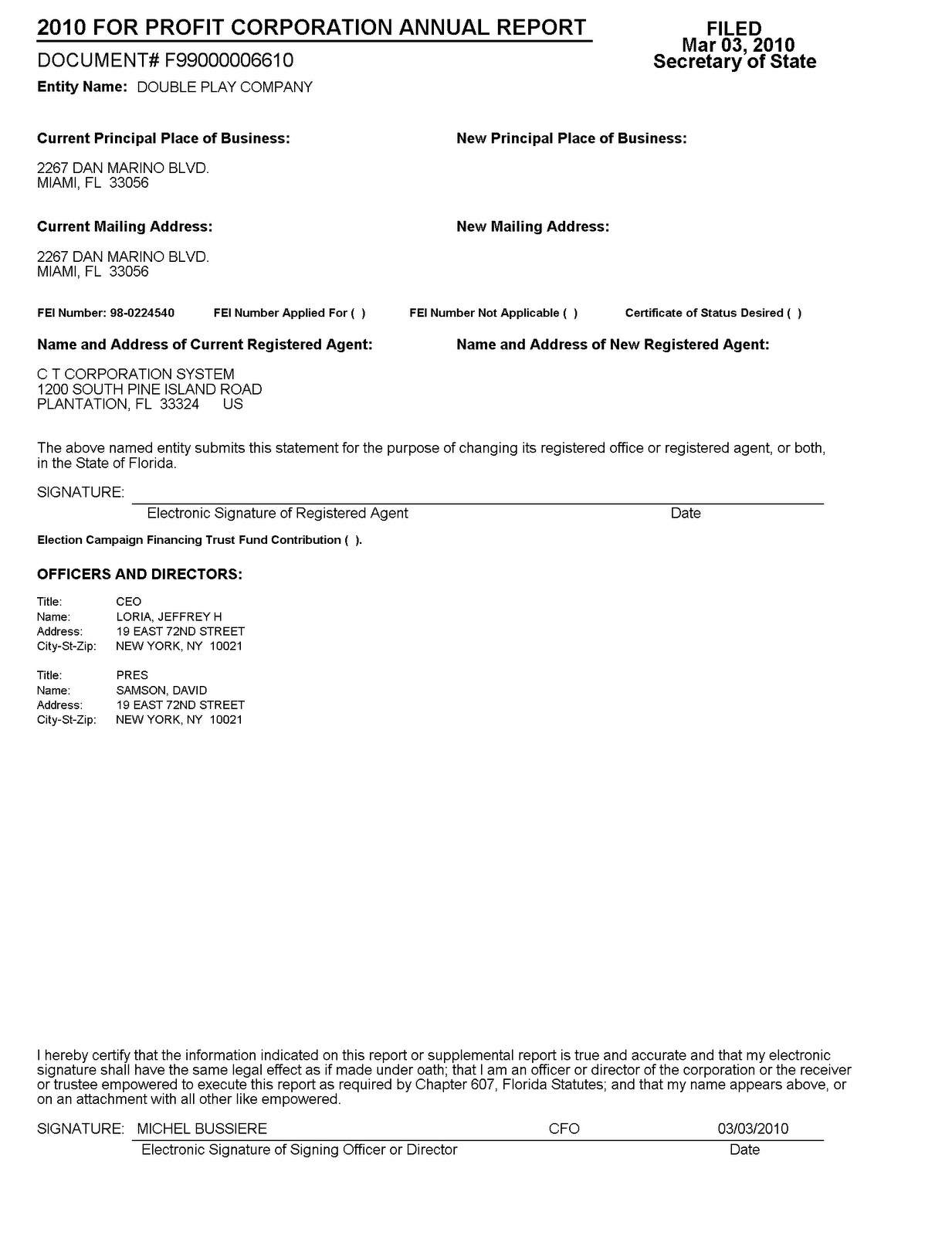
I’ll be writing more specifically about what’s in the financial statements — for example, what could possibly be the source of debts for a team that since Loria purchased the franchise in 2002, has had, according to Forbes, net operating incomeof $134 million through 2009 — but the key revelation in the Passan column is that the Managing General Partner of the Florida Marlins partnership is a Florida Corporation named Double Play [clever no?]. On the annual report filed with the State of Florida, a public document, Double Play’s officers and directors are listed as Jeffrey Loria [CEO] and David Samson [President]. The main disclosures in the Marlins financial statements which make David Samson’s statement untrue are:

  • As the Passan article notes, the Marlins are the only one of the six teams whose financials were leaked to have taken a Management Fee in their operating expenses. The fees paid in the two years to DP/Loria came to $5.4 million.
  • Related Party Promissory Note to DP/Loria was reduced from $19.9 to $14.1 million. So DP/Loria received $5.8 from the Marlins in repayment of loans.
  • The DP/Loria Promissory Note also earned $3 million [$1.2 & 1.8] in interest for the two years.

If you are keeping score, that’s $14.2 million that went from the Florida Marlins to DP/Loria. Management fees to companies you control, interest payments on related party loans and repayments of those loans are not illegal or even unusual, given certain tax implications. But they are unequivocally payments from the Florida Marlins to DP/Loria.

Now pretend you are Loria and Samson. Earlier in the week you had been exposed with the release of the documents. Samson is now going to be on a radio program taking questions. There may be times in the career of people who speak publicly, when they might make unintended comments. I don’t think this could reasonably be considered one of those times. What David Samson said on Wednesday has to be considered the firm position of the Florida Marlins and Jeffrey Loria. What the experienced MLB executive decided to say was that “Jeffrey Loria did not put a dollar in his pocket.”

The reaction of the people on LeBatard’s radio show after their interview with Passan last night was revealing. They reminded me of a David Letterman joke about defending Pete Rose from charges of gambling: “Recordings, fingerprints on betting slips, bank statements, and corroborating affidavits? Hey Commissioner, let’s see some real evidence!”

Passan had noted the management fees and interest received, but did not get into the repayment of the loans. The hosts reaction — mind you, these were the same people who Samson had told one day earlier that “Jeffrey Loria did not put a dollar in his pocket ” — was to speculate whether the $5.4 million in management fees could not have been considered a salary, … and “who would begrudge them a salary,” … it was a “small amount of money, all things considered.”

The point is not whether the $5.4 million was salary [we don’t know], or if that salary was fair, the point is that the president of the Florida Marlins did not go on the air the previous day and say; ‘Aside from a fair salary, interest income and repayments of principal on a loan, the total of which is well into eight figures, Jeffrey Loria did not put any other dollars in his pocket.’

He did not say that for the same reason that he has been intentionally lying prior to the release of the financials. The reason is that owner of the Florida Marlins does not consider telling the truth a viable option given his objectives, a largely taxpayer-funded stadium and pocketing revenue sharing monies, instead of spending them as intended by MLB. What we’ve learned this week is that their willingness to lie remains unchanged.

Unless of course, we’ve all misconstrued the meaning of ‘pocket.’

The Jeff Passan column referenced is copied in full at end of post.

—————————————————-
Marlins execs funneled cash to themselves
By Jeff Passan, Yahoo! Sports – Aug 27, 2010

Florida Marlins president David Samson has perfected the art of doublespeak. Even after the mushroom cloud settled over the disclosure of financial statements that showed he and Marlins owner Jeffrey Loria are indeed duplicitous, Samson couldn’t help himself. Lies are simply part of how the Marlins do business.

The latest came during Samson’s weekly radio appearance on The Dan LeBatard Show in Miami, during which he addressed Deadspin’s publication of the Marlins’ balance sheet. What Samson said was so provably false that it was akin to a 3-year-old trying to hide his peas under a pile of mashed potatoes.

“Jeffrey Loria did not put a dollar in his pocket,” Samson said.

So programmed is that statement in Samson’s head, he keeps repeating it, like a robot with a shorted circuit. He’s right. Jeffrey Loria did not put a dollar in his pocket.

He put millions.

On Page 34 of the documents, under the heading Note Y, is a transaction called “Management Fee.” A corporation named Double Play Company is listed as the Marlins’ managing general partner. The partner is paid a yearly sum. For the two years the documents cover, the fees were $2.6 million and $2.8 million. In 2009, the documents say, the fee was raised to $3.2 million.

Records from the Florida Division of Corporations show Double Play’s CEO is Jeffrey Loria. Its president is David Samson.

Of the six teams whose documents were leaked, only the Marlins have a management fee listed in their operating expenses.

Earlier in the balance sheet, under Note L, is a one-paragraph section called “Related Party Promissory Note.” It explains that the managing general partner made a number of loans to the team at 1.5 percent to 1.75 percent above the London Interbank Offered Rate – a particularly high interest rate for the current lending climate, according to two accountants who reviewed the Marlins’ financials. Over the past two years, the loans have paid Double Play $1.83 million and $1.19 million, respectively.

While the financial records of Double Play are unavailable because it is a private company, at least $8.42 million went to the managing general partner in the past two years. Though the documents do not show that Loria has taken a direct distribution of money as owner, it is undeniable that he plundered the team’s coffers as it received nearly $500 million in public funding for a new stadium and more than $75 million in revenue sharing from MLB.

Samson did not reply to a request for comment.

The ugliness of the ballpark debt was apparent long before the documents surfaced. To help fund the $634 million stadium complex, Miami-Dade County commissioners voted to secure more than $400 million in loans, most of which are loaded with balloon payments. The worst is a $91 million loan that will take $1.2 billion to pay off. By 2049, the county will have spent $2.4 billion to cover its portion of the stadium.

The anti-Marlins groundswell in South Florida continued Thursday when Miami mayor Tomas Regalado asked the city attorney to look into renegotiating a $100 million parking-facility contract for the stadium complex. Political backlash was a given after the Marlins’ refusal to release their financial records during the push for the new stadium.

For years, the Marlins cried poverty. Loria threatened to move the team from Florida. Despite several sources claiming the Marlins raked in money — Forbes’ annual valuations for the Marlins have proven extremely close to reality, and Miami-area accountant Jorge Costales has written incisively about Marlins finances — the county commissioners voted in December 2007 to pay for more than three-quarters of the stadium due open in 2012.

Samson claimed on LeBatard’s show that the tax dollars will come from tourism money devoted to sports and convention complexes. That is only half-true. To free the tourism-tax dollars, the county shifted general-use monies from property taxes to pay other debt. Take from one hand, give to the other and buy an owner worth hundreds of millions of dollars a new toy from which he reaps damn near every cent, all with the money of hardworking citizens.

This was avoidable, of course, had the county commissioners refused to approve a deal until they saw the Marlins’ financial statements. The management fee was an obvious red flag. How could Loria and Samson say they didn’t have enough money for a stadium when they were paying themselves? The loan was another red flag. Such revelations almost certainly would have given the commissioners pause about offering the breadth of public financing they did.

Loria refused transparency. He is an excellent businessman, and he knew the repercussions. In the end, the Marlins hoodwinked local politicians so caught up in the excitement of keeping the team in Miami, they forgot with whom they were dealing. When hundreds of millions of dollars are involved in anything, people are going to lie, and Loria and Samson made statement after misleading statement and got away with it.

“I never go back to regret what I do because I make decisions based on the information provided to me, my conscience and what is best for those I represent,” said Rebeca Sosa, one of the nine county commissioners who voted for the stadium funding against four opponents — including Regalado, now the mayor. “The situation and information I have today in my hand is different than the one I had before.

“I still support the Marlins stadium.”

How Sosa, or any commissioner who voted yes, could stand by a potential $2.4 billion of debt with a clear conscience is difficult to fathom. The Marlins are up to their old tricks, still pussyfooting their way around the facts. All those years the team had the lowest payroll in baseball, Samson claimed money went to hidden costs in running a ballclub. One of them, he told Sun-Sentinel columnist Dave Hyde, was marketing.

“Eight figures,” Samson said. He told The Miami Herald it was among the most in baseball.

In 2008, the Marlins spent $9.8 million on marketing, according to their balance sheet. The Tampa Bay Rays spent $23 million, the Pittsburgh Pirates $17.1 million, the Texas Rangers $16 million and the Los Angeles Angels $10 million. The only team to budget less among the six whose financials were leaked was the Seattle Mariners, whom the Marlins outspent by $11,000.

This isn’t a white lie here, a fib there. It is systemic. Marlins mislead, public follows. The balance sheet was a gift to Miami-Dade County taxpayers who deserve – and have deserved since the “yes” vote – to know how the team they were endowing is run.

The poor, poor Marlins had an operating profit of $48.9 million in 2008 and 2009, including $11.1 million last year, when they increased payroll and started paying off their stadium debt. Loria has already doubled his money on the Marlins – he bought the team for $158.5 million, including a $38.5 million interest-free loan, and it’s now worth $317 million, according to Forbes’ valuations – and the revenue streams from the new stadium should only increase that figure. A county hemorrhaging jobs funneled tax money to fund a stadium for a team with a reckless disregard for its community’s welfare.

The politicians can pursue recourse, and the fans can bellow, and it doesn’t change the reality that a $91 million loan to the county will take 39 years and $1.2 billion to pay off, and that Jeffrey Loria still owns the Florida Marlins with David Samson as his president, and that the retractable-roof stadium, the one that’s 40 percent done, was built on lies that never seem to end.
———————————————-

Posted in Marlins Ballpark & Finances | Tagged , , | Leave a comment

Cash Rich and Honor Poor

In business, there are times when bad news is released and there is no apparent reaction because the information had been anticipated and already discounted. So it was yesterday in Miami, when Jeffrey Loria admitted lying and no one was surprised.

The Sun-Sentinel’s Sarah Talalay documents how Jeffrey Loria [through David Samson] reacted to the public release of the Marlins financial statements:

However, with their contents revealed, Samson changed his long-held contention the team wasn’t making a profit and instead said the documents prove the team has been saving its dollars to pay for its new baseball-only ballpark under construction in Little Havana.

Changing ‘long-held contentions’ could come as a result of soul searching. When it comes after financial documents prove you have been lying, the proper analogy involves rats instead of souls.

The article will ultimately be remembered for a particularly incisive quote towards the end:

“Local government’s in business with a very profitable baseball team,” said Jorge Costales, a Miami CPA, who blogs about Marlins finances. “To me, there’s no doubt the Marlins’ strategy since 2006 has been ‘Let’s budget as if we’re not getting a cent from revenue sharing.’ When it comes time to make payments on stadium, there should be no concerns about defaulting. The irony is to get the stadium, they’ve misinformed people about the profitability of the team.”

For the record, I believe this story will have a good ending. A Major League Baseball franchise firmly established in Miami, a new stadium on the site of the great former Orange Bowl and at some point, the team of Loria and Samson voluntarily exiled from the City of Miami. They will leave financially enriched and little respected. Solovalla, ….

The Talalay article referenced is copied in full at end of post.

—————————————————-
Marlins more than profitable, records show
By Sarah Talalay, Sun Sentinel

August 23, 2010

The Marlins, who for years have said they weren’t making a profit, generated nearly $50 million in operating income the past two years, documents show.

Financial records for a handful Major League Baseball teams obtained by Deadspin.com, show the Marlins had a net operating income of $37.84 million in 2008, when the team’s on-field payroll was a league-low $24.8 million, and a more modest $11.1 million in 2009, when the payroll was up to $35.1 million.

Marlins President David Samson called the release of the information “disappointing” and a “crime” and said MLB and its clubs will launch an investigation.

However, with their contents revealed, Samson changed his long-held contention the team wasn’t making a profit and instead said the documents prove the team has been saving its dollars to pay for its new baseball-only ballpark under construction in Little Havana.

“It basically confirms everything we have said over the years of how we’ve operated the team,” Samson said Monday. “It’s about making sure baseball would be secure in South Florida.”

Samson said to ensure the team could meet its $155 million obligation to the $515 million ballpark, which is also being funded by $347 million from Miami-Dade County and $13 million from the city of Miami, it needed to show it had paid down debt and had assets to borrow against.

The team has been profitable in part because of its low payrolls – which ranked last among the 30 clubs in three of the last four years and second to last in 2007. Over the years, Samson has repeatedly denied the team made a profit and said payroll would reflect revenue.

“Very often the mistake that’s made is they look at revenue sharing numbers and the team’s payroll and take the difference and see profit without looking at our expenses,” Samson said in 2007 in reference to a Forbes report the team had the league’s highest operating income.

In 2008, he said, “We’re always going to do what we can with revenues and match payroll to revenue in a current year.”

But that contention clearly ruffled MLB and its Player Association enough to reach agreement with the team earlier this year that requires the club’s 2010-12 payrolls better reflect the revenue sharing dollars it receives.

The Deadspin documents show the team benefited handsomely from the Major League Baseball’s revenue sharing program — the system by which the richest teams share revenue with the lowest revenue ones to even competition.

Revenue sharing plus the dollars from MLB’s central fund — the pot that includes items such as national TV contracts and to which all teams contribute and then receive an even distribution — brought the team more than $75 million each of the past two years. That’s before factoring in ticket sales, sponsorships and the $16 million annually the team gets from local television and radio broadcast contracts.

Total revenues in 2009 were $135.5 million with expenses of $122.8 million, including dollars spent on the ballpark, the records show.

“Local government’s in business with a very profitable baseball team,” said Jorge Costales, a Miami CPA, who blogs about Marlins finances. “To me, there’s no doubt the Marlins’ strategy since 2006 has been ‘Let’s budget as if we’re not getting a cent from revenue sharing.’ When it comes time to make payments on stadium, there should be no concerns about defaulting. The irony is to get the stadium, they’ve misinformed people about the profitability of the team.”

Miami politicians, who approved the ballpark deal, never saw the Marlins’ finances.

“The Marlins’ net worth was never a concern of ours,” said Victoria Mallette, a spokeswoman for Miami-Dade County Mayor Carlos Alvarez. “The mayor and the [county] manager thought it would be an asset to the community. It’s always been about a community asset and keeping professional sports in Miami-Dade County.”

Staff Writer Juan C. Rodriguez contributed to this report. Sarah Talalay can be reached at stalalay@SunSentinel.com.
———————————————-

Posted in Marlins Ballpark & Finances | Tagged , , | 4 Comments