Multi-Cinema Civil Disobedience [MCCD]

Multi-Cinema Civil Disobedience [MCCD] = Watching one movie, while having purchased a ticket for another.

I have conservative political views and love movies. This used to mean that I would end up voting with my entertainment dollars for people whose views I disagreed with. The rise of multi-cinemas solved this problem a while ago.

For example, as a political junkie, I was curious about Oliver Stone’s Bush movie, but naturally didn’t want to reward a political opponent. In addition to his leftist politics, I consider him a good, but dishonest [JFK], filmmaker. If Stone had made ‘Do the Right Thing,’ Mookie would have resembled the Rev Martin Luther King.

Spike Lee is a more complicated case. I dislike his politics, but respect him as a filmmaker. Tipping the scales against him are his sporting allegiances [NY Knicks]. Although I do compromise when a film of his is not overtly political, like Inside Man. Most actors are on the left politically, so to boycott each offender would leave you with a limited selection of martial arts and indie films about diseases.

During presidential elections, the need to practice MCCD, is heightened. The inevitable interviews with the earnest leftist actors who condescendingly communicate, ‘I know my fans may not like this, but my powerful intellect and empathetic soul demands that I speak out’ [see any Matt Damon interview].

Alas, given the uniformity of their views in a profession for which success is not correlated with intellectual prowess, suggests that other factors are at work. Richard Posner dissects those factors:

The nature of their work, which combines irregular employment with high variance in income, an engagement with imaginative rather than realistic concepts, noninvolvement in the production of “useful” goods or service, and, traditionally, a bohemian style of living (a consequence of the other factors I have mentioned), distances them from the ordinary, everyday world of work and family in a basically rather conservative, philistine, and emphatically commercial society, which is the society of the United States today.

I picture Posner, preparing that analysis, working with a petri-dish full of actors. Holding the Alec Baldwin specimen up to the light, inspecting him like a Broward County hanging chad examiner would, chuckling, and depositing him back with the other ‘cultures.’

Thankfully, through the magic of MCCD, I can now watch any movie I am curious about and still direct my entertainment dollars towards a less odious recipient. Below are my upcoming list of movies to watch and whom I plan to reward with my discounted matinee dollars:

  • [Watch] Frost/Nixon – [Pay for] Madagascar
  • The Curious Case of Benjamin Button – Marley & Me
  • Nothing Like the Holidays – same

All articles referenced are copied in full at end of post.

————————————————————————————
Why Is Hollywood Dominated by Liberals? — Richard Posner

A recent article in the Washington Times by Amy Fagan, entitled “Hollywood’s Conservative Underground,
http://www.washingtontimes.com/news/2008/jul/23/hollywoods-conservative-underground/ (visited Aug. 23, 2008), is a reminder of the curious domination of the American film industry by left liberals. The industry’s left-wing slant drives the Right crazy (if you Google “Hollywood Liberals,” you’ll encounter an endless number of fierce, often paranoid, denunciations by conservative bloggers and journalists of Hollywood’s control by the Left). Fagan’s article depicts Hollywood conservatives as an embattled minority, forced to meet in secret lest the revelation of their political views lead to their being blacklisted by the industry. The conservatives’ complaint is an ironic echo of the 1950s, when communists and fellow travelers in Hollywood–who were numerous–were blacklisted by the movie studios.

We need to distinguish between actors, actresses, set designers, scriptwriters, directors, and other “creative” (that is, artistic) film personnel, on the one hand, and the business executives and shareholders of the film studios, on the other hand. (Producers are closer to the second, the business, echelon than to the creative echelon.) The creative workers, I think, are not so much magnetized by left-wing politics as drawn to political extremes–for there have been a number of extremely conservative Hollywood actors, such as Ronald Reagan, John Wayne, Charlton Heston, Mel Gibson, and Jon Voight–Voight recently wrote a fiercely conservative op-ed in the Washington Times, where Fagan’s article was published. The left end of the political spectrum in this country is still somewhat more respectable than the right end, and so if one finds a class of persons who are drawn to political polarization, more will end up at the far liberal end of the political spectrum than at the far conservative end, yet it will be polarization rather than leftism as such that explains the imbalance. No one has a good word for Stalin and Mao nowadays, but socialism is not a dirty word, as fascism is.

But why should actors and other creative workers in the Hollywood film industry, and indeed “cultural workers” more generally, be drawn to political extremes? The nature of their work, which combines irregular employment with high variance in income, an engagement with imaginative rather than realistic concepts, noninvolvement in the production of “useful” goods or service, and, traditionally, a bohemian style of living (a consequence of the other factors I have mentioned), distances them from the ordinary, everyday world of work and family in a basically rather conservative, philistine, and emphatically commercial society, which is the society of the United States today.

The choice of a political ideology, which is to say of a general orientation that guides a person’s response to a variety of specific political and ethical issues, is less a matter of conscious choice or weighing of evidence than of a feeling of comfort with the advocates and adherents of the ideology. An ideology attractive to solid bourgeois types is unlikely to be attractive to cultural workers as I have described them. So we should not expect those workers to subscribe to the conventional political values, and apparently a disproportionate number of them do not. Moreover, though most actors and other creative film workers are not particularly intellectual, as cultural producers much in the public eye they have a natural affinity with public intellectuals, who I found in my book Public Intellectuals: A Study of Decline (2001) split about 2/3 liberal 1/3 conservative.

The situation of Hollywood’s business executives, including investors in the film business, is different. They are not cultural workers, and one expects their focus to be firmly on the bottom line. It is true that the Hollywood film industry was founded largely by Jews and has always been very heavily Jewish, and that Jews of all income levels are disproportionately liberal. But if Hollywood based its selection of movies to produce and sell on the political views of the studios’ owners and managers, that would be commercial suicide, as competitors would rush in to cater to audiences’ desires. The idea that Hollywood is a propaganda machine for the Left is not only improbable as theory but empirically unsupported. Hollywood produces antiwar movies during unpopular wars and pro-war movies during popular ones (as during World War II), movies that ridicule minorities when minorities are unpopular and movies that flatter them when discrimination becomes unfashionable, movies that steer away from frank presentation of sex when society is strait-laced and movies that revel in sex when the society, or at least the part of the society that consumes films avidly, society turns libertine. The Hollywood film industry follows taste rather than creating taste, as one expects business firms to do.

What troubles conservatives about Hollywood is less the promotion in movies of left-liberal policies than the breakdown of the old taboos. Those taboos were codified in the Hays Code, which was in force between 1934 and 1968 with the backing of the Catholic Church. The code forbade disrespect of religion and marriage, obscene and scatological language, sexual innuendo, and nudity. The code was abandoned because of changing mores in society rather than because leftwingers suddenly took over Hollywood. If conservatives bought the studios and reinstituted the Hays Code they would soon be out of business. But what is true is that when movie audiences demand vulgar fare, then given that conservatives are more disturbed by vulgarity than liberals are, the film industry becomes less attractive to conservatives as a place to work in. This may be an additional reason for the left-liberal slant of the industry. But as long as the industry is an unregulated competitive industry, market forces will prevent studio heads and owners from trying to impose their own values on audiences, rather than trying to create movies that are in sync with those values.
————————————————————————————
Hollywood and Liberals-Becker

For every Ronald Reagan Arnold Schwarzenegger, Jon Voight, Charlton Heston, and a few other prominent conservative Hollywood stars, there are probably more than 50 strongly liberal actors, directors, producers, and other “above the line” categories of filmmakers. The top “below the line” categories of cinematographers and production designers are also heavily liberal.Less creative crew members, such as grips, have political views that are closer to those of the general American voting population.

Posner gives several explanations of the liberality of filmmakers, including their engagement in fantasy projects, their irregular employment, and the prominence of Jews, who are mainly liberal, in the industry. There is an additional consideration of great importance. Whereas most actors and other filmmakers have little interest in tax policy, approaches to Medicare and social security, other domestic economic and political questions, and even in many foreign policy issues (except wars), they are very much concerned about policies regarding personal morals. I believe the single most important reason why so many of these Hollywood creative personnel are opposed to the Republican party, especially to the more conservative members of this party, is that the personal morals of many filmmakers deviate greatly from general norms of the American population.

Creative contributors to films divorce in large numbers, often several times. Many have frequent affairs, often while married, they have children without marriage, they have significant numbers of abortions, have a higher than average presence of gays, especially in certain of the creative categories, who are open about their sexual preferences, they take cocaine and other drugs, and generally they lead a life style that differs greatly from what is more representative of the American public. By contrast, an important base of the Republican Party is against out of wedlock births, strongly pro life and against abortions, against gays, especially those who adopt an publicly gay lifestyle, against affairs while married, and very much oppose the legalization of drugs like cocaine and even marijuana.

It becomes impossible for Hollywood types who adopt these different lifestyles to support a political party that is so openly and prominently critical of important aspects of their way of living. That the majority of the relatively few conservative filmmakers lead more ordinary lifestyles confirms this hypothesis: they tend to be heterosexual, married, have children while married, are less into drugs, and in other ways too have more conventional lifestyles. True, some of the most prominent conservative member of Hollywood, such as Reagan and Voight, have been divorced, but divorce is now more accepted even by most conservative Republicans. After all, Ronald Reagan was a darling of conservative Republicans, and John McCain also has been divorced. Note that below the line members of crews lead more conventional life styles, and so they are less likely to be anti conservatives and against Republicans.

When other issues affect filmmakers more than attacks on their morals, their views often become very different. So while many of the more creative filmmakers consider themselves to be socialists, filmmakers, writers, and other creative types in communist countries were typically very strongly opposed to their governments. The obvious reason is that these governments imposed substantial censorship on the type of films that could be made, and so directly interfered with what filmmakers and writers wanted to do.

Another important factor stressed to me by Guity Nashat Becker is that members of the print and visual media who generally have strongly liberal political views surround actors and other creative contributors to films. Since it is well established that political views are greatly affected by the attitudes of people one interacts with closely, it is not surprising that some of the liberality of the media rub off on actors and others in the filmmaking industry. In addition to their concern about political approaches to personal morality, their association with the media helps make filmmakers anti-business, especially big business, and strongly pro-union.

Do the liberal views of Hollywood stars and leaders have a big affect on the opinions of others? I do not know of any evidence on this, but I suspect they only have a small indirect effect. This is not the result of speeches or other statements of their views-since they usually are not articulate in their extemporaneous comments- but their entertainment at various political functions can help generate enthusiastic audiences. More important probably is that whereas audiences do not go to films unless they enjoy them, anti-business and other liberal views will often be an underlying message of popular films. I doubt of these messages have a large permanent effect on the opinions of the audiences, but some affect is surely possible. So all in all, I believe Hollywood is a very minor contributor to general political views, but I do not think their influence can be fully dismissed
———————————————————————–


Posted in 2TG Favorites, Entertainment | Tagged , | Leave a comment

What if They Don’t Know How to Fix This?

The ‘they’ in the post title are economists. While there always many schools of thought, the amazing thing about this current financial crisis is that we are truly in uncharted territory. Two of the most influential economist bloggers are admitting as much about the stimulus plans being discussed:

Tyler Cowen in the Marginal Revolution:

My point is simple: it is very hard to find examples of successful fiscal stimulus driving an economic recovery. Ever. This should be a sobering fact. The New Deal doesn’t count because fiscal policy wasn’t very expansionary then. American participation in World War II doesn’t count. Nazi Germany during the 1930s doesn’t count. I’ll cover Japan in the 1990s and other examples soon.

The bottom line is this: we are being asked to believe that a big, trillion or even multi-trillion fiscal stimulus can boost the current macroeconomy. If you look at history, there isn’t good reason to believe that. Any single example, such as the Nazis, can be knocked down for lack of relevance or lack of correspondence to current conditions. Fair enough. But the burden of proof isn’t on the skeptics. It’s up to the advocates of the trillion dollar expenditure to come up with the convincing examples of a fiscal-led recovery. Right now we’re mostly at “It wasn’t really tried.” And then a mental retreat back into the notion that surely good public sector project opportunities are out there.

So what you have is the possibility of faith — or lack thereof — that our government will spend this money well.

And that is under “emergency” conditions, with great haste (“use it or lose it”), with a Congress eager to flex its muscle, and with more or less one-party rule.

For me, that’s not enough.

Greg Mankiw:

Skepticism, rather than unequivocal opposition, is the right word. When contacted, I said the same things I have been saying on this blog: that monetary policy is not out of ammunition, and that tax cuts are potentially more potent than spending increases. I might have added that I feared a spending-based stimulus to address the current short-term crisis might lead to a long-term increase in the size of government, but I doubted that concern would sway Team Obama. In general, I think economists need a large dose of humility when evaluating alternative proposals to deal with the current downturn, as there is still a lot we do not understand.

All blog posts referenced are copied in full at end of post.

————————————————————————————-
Tyler Cowan’s Blog
Fiscal policy and the burden of proof

I’d like to drive home the point that the case for fiscal policy has not yet been made by its advocates (the rest is under the fold)…

I believe that most current advocates of a huge fiscal stimulus have two major arguments in mind. The first is that “when resources are unemployed, in principle government spending can put them back to work, times are dire so we need this.” The second is the Galbraithian point that public sector expenditure has been starved for a long time so in principle there are plenty of good ways to spend money through government. In the predominant mental model on this topic, it is believed either of these arguments suffices to justify a large fiscal stimulus. In the debates I sometimes find that when one claim is criticized there is a mental switch back to the other.

Don’t let those switches distract you. My point is simple: it is very hard to find examples of successful fiscal stimulus driving an economic recovery. Ever. This should be a sobering fact. The New Deal doesn’t count because fiscal policy wasn’t very expansionary then. American participation in World War II doesn’t count. Nazi Germany during the 1930s doesn’t count. (Read Matt Yglesias’s response; the point however is that maybe Hitler couldn’t have easily spent the money on something else in a rapid and effective fashion; if he could have they why can’t we find more examples of a fiscal-policy lead recovery elsewhere?). I’ll cover Japan in the 1990s and other examples soon.

Don’t be mesmerized by a static, aggregated AD-AS diagram into thinking surely it must be easy. Whether the government can target unemployed resources effectively, and deliver the right stimulus in time, is a major question and so far the evidence isn’t so convincing. Keep in mind there are good reasons why truly major fiscal stimulus hasn’t been tried very often.

Here’s Free Exchange on the research behind fiscal policy. They write:

Today, Mr Cowen links to a(nother) piece of macro research on stimulus multipliers that finds in favour of tax cuts before declaring that “the science isn’t there”, to support deficit spending as stimulus.

The point is not that I think tax cuts are much better than government spending as stimulus; I don’t. The NBER piece I cited considers the possibility that tax cuts bring a multiplier of as large as five. I say no way. The point is not to argue for tax cuts. The point is to note that this is the best research that the highly reputable NBER can come up with on the topic. What does that say about prevailing standards of evidence and proof in the area as a whole? It means they are very weak and that we know very little. This is not “the evil and corrupt WSJ Op-Ed page,” this is the NBER and the researchers have done as good a job as others on this topic or maybe better. And what they have produced still isn’t very believable.

The bottom line is this: we are being asked to believe that a big, trillion or even multi-trillion fiscal stimulus can boost the current macroeconomy. If you look at history, there isn’t good reason to believe that. Any single example, such as the Nazis, can be knocked down for lack of relevance or lack of correspondence to current conditions. Fair enough. But the burden of proof isn’t on the skeptics. It’s up to the advocates of the trillion dollar expenditure to come up with the convincing examples of a fiscal-led recovery. Right now we’re mostly at “It wasn’t really tried.” And then a mental retreat back into the notion that surely good public sector project opportunities are out there.

So what you have is the possibility of faith — or lack thereof — that our government will spend this money well.

And that is under “emergency” conditions, with great haste (“use it or lose it”), with a Congress eager to flex its muscle, and with more or less one-party rule.

For me, that’s not enough.

Posted by Tyler Cowen on December 18, 2008 at 12:52 PM in Economics
————————————————————————————-
Gre Mankiw’s Blog
Thursday, December 18, 2008
Stimulus Spending Skeptics
An AP story reports:

Obama advisers, including Christina Romer and Lawrence Summers, have been contacting economists from across the political spectrum in search of advice as they assemble a spending plan that would meet Obama’s goal of preserving or creating 2.5 million jobs over two years….Only one outside economist contacted by Obama aides, Harvard’s Greg Mankiw, who served on President Bush’s Council of Economic Advisers, voiced skepticism about the need for an economic stimulus, transition officials said.

Skepticism, rather than unequivocal opposition, is the right word. When contacted, I said the same things I have been saying on this blog: that monetary policy is not out of ammunition, and that tax cuts are potentially more potent than spending increases. I might have added that I feared a spending-based stimulus to address the current short-term crisis might lead to a long-term increase in the size of government, but I doubted that concern would sway Team Obama. In general, I think economists need a large dose of humility when evaluating alternative proposals to deal with the current downturn, as there is still a lot we do not understand.

I am sure I am not the only person in the economics profession skeptical of spending increases to stimulate the economy. See, for example, GMU economist Tyler Cowen. If the new administration wanted to find more skeptics of stimulus spending among professional economists, I could come up with some possible candidates for them, but the Obama economists probably already know who those likely skeptics would be.

By the way, House Republican leader John Boehner is compiling “a list of credentialed American economists who would like to add their voices to the list of stimulus spending skeptics.”
——————————————————————————-

Posted in Business & Economics | Tagged , , | Leave a comment

Marlins New Ballpark Website

The Marlins have setup a website dedicated to news about the new Ballpark. They set one up in Spanish as well.

See the FAQ’s copied at end of post.
————————————————————————————–
Frequently Asked Questions

A new 37,000-seat ballpark is being planned for the Marlins and is expected to open for the 2012 season. Below are answers to
frequently asked questions about the ballpark.

Q.

Where do the Marlins play now?
A.

Since the team’s inception, the Marlins have played on a temporary baseball diamond on the football field of Dolphin Stadium located in Miami Gardens.

Q.

Why do the Marlins need a new home?
A.

A modern, destination-class ballpark is a crucial component in building and maintaining a world-class Major League Baseball team. Marlins fans have never enjoyed a home game in a facility built for their sport and surrounded by the emerging traditions of Marlins baseball. The ballpark will combine the timeless elements of ballparks beloved by fans across the country with the design and amenities essential to sports facilities of the 21st Century.

The new stadium will be designed and built for baseball – from the size, to seat locations, to sight lines and even the proximity of the field. Its playing surface will be cutting-edge and feature natural grass. In addition, the new ballpark will have a roof to protect players from rain and heat, putting an end to rain delays and unpredictable playing conditions.

Q.

How will the fans benefit from a new ballpark?
A.

Locating the ballpark in Miami will bring games closer to the fan base, making it easier for fans to attend games. It will be a true baseball ballpark, meaning fans will be able to enjoy the atmosphere and experience of a baseball game like other MLB fans throughout the nation. In addition, the ballpark will have a retractable roof to screen fans against the rain and heat.

Q.

Why is a roof so important for the fans?
A.

The frequency of rain in the south Florida summer season and the heat in the afternoons affect attendance at Dolphin Stadium. The uncertainty of weather conditions discourages South Florida’s millions of residents and visitors from building a baseball game into their plans. This potential market of visitors from other Major League cities, who would come to see their own team, combined with visitors from the Latin American nations that produce so many MLB players, strongly suggests the potential for the Marlins’ economic success if the threat of weather delays or rainouts can be eliminated. A roof means games won’t have to be cancelled due to inclement weather. When weather conditions are favorable, the roof can be retracted.

Q.

Where will the new ballpark be located?
A.

The Marlins ballpark will be built on the site of the former Orange Bowl. The use of the region’s oldest and most famous sports venue for the ballpark provides the opportunity to continue an unmatched sports legacy. The ballpark, which will occupy less than half of the 42-acre site, is less than two miles from downtown Miami.

Q.

How may seats will the new ballpark have?
A.

Plans call for a seating capacity of 37,000 that includes 3,000 club seats and 60 private suites.

Q.

How long will the Marlins lease the new ballpark?
A.

The Marlins will enter into a Non-Relocation Agreement that requires the team to operate and maintain an MLB franchise in Miami for a minimum of 35 years.

Q.

Will the new ballpark provide any major benefits to the local neighborhood?
A.

Yes, redevelopment of the Orange Bowl will create thousands of jobs, tens of millions of dollars in tax revenue, and will change the way people view and experience Miami. Major sports facilities have long been major economic drivers for the areas in which they are located, and the Marlins new ballpark will be no exception.

Q.

How has Major League Baseball supported the Marlins’ efforts to build a ballpark in Miami?
A.

The MLB named the Florida Marlins as host of a second round of the World Baseball Classic, a jewel event scheduled for March 2009 in Miami. It also pledged $3 million to build a Youth Baseball Academy for local youth to develop the sport in the region. To assist with efforts to build a “green” stadium, MLB has committed for the first time a $1 million matching grant to help the parties achieve LEED certification.

Q.

Who will pay for the new $515 million stadium?
A.

The Marlins will provide $155 million and fund any and all construction cost overruns except those that are governmentally caused. Additionally, the team will purchase from the city $100 million worth of parking spaces in the newly constructed garage and pay for all maintenance, repairs, operations and insurance on the facility.

Miami-Dade County will provide $50 million of Building Better Communities General Obligation Bond funds that were specifically allocated for the Orange Bowl site and $297 million of County tourist-tax revenues. Under Florida law, these funds are set aside exclusively for tourism-related projects. No new taxes will be levied for the project.

The city of Miami, which owns the land at the Orange Bowl site, will provide $13 million, the land and the cost of the recent demolition of the Orange Bowl.

Q.

Will parking be provided on site?
A.

The site will have parking spaces available in a parking structure to be built in conjunction with the ballpark.

Q.

What is the timeline for the stadium?
A.

The target completion date for the ballpark is the 2012 baseball season.
——————————————————————————–

Posted in Marlins Ballpark & Finances | 1 Comment

The Local Boxing Scene is Non-antiseptic

Definition of an·ti·sep·tic:

a: coldly impersonal

b: of, relating to, or being warfare conducted with cold precision from a safe distance with few or no casualties on one’s side

That is exactly what the local boxing scene is not. Its participants don’t come with guaranteed contracts. They don’t perform in arenas with big screens, canned music and programmed chants to keep its fans awake. Talk about an incentive driven profession. Boxers must perform on each occasion or risk injury, not just defeat.

Tired of spoiled athletes who don’t seem to care? Local boxing is a sport where a boxer who was knocked out in one of the early matches, comes back out to be with family and friends and sit among all the other fans. Talk about having nowhere to hide. I walked past that boxer on my way out of the arena on a recent Friday night. He looked like someone who had lost much that evening, perhaps even the hopes of remaining a professional boxer. I got home, turned on ESPN and heard — actually was bombarded by the 4-letter network — about Stephon Marbury’s latest dogging-it incident. I wish the boxer and Marbury could have traded places that evening.

A few weeks ago I got to sit in on a local boxing press conference and attend the Friday night [12/05] boxing matches at the Miccosukee Resort and Gaming. Perhaps it was attributable to a Don King hangover I was subconsciously suffering from, but I was very surprised by the professional and collegial environment I experienced.

First the press conference. Aside from a majority of the 12 boxers on the card–some with their trainers and friends–there were about 10 members of the local media who attended, highlighted by:

  • Channel 51’s sportscaster René Giraldo
  • The Miami Herald’s boxing writer, Santos Perez
  • Sports talk show hosts, Jerry del Castillo and Jose [El Chamby] Campos–from La Descarga Deportiva, 670 on the AM dial

The promoter of the boxing card was Tuto Zabala Jr. Promoting boxing matches is the family business for the Zabala’s. His father, Tuto Zabala Sr. is a well known and respected name in Miami and Puerto Rico boxing circles and his teenage son was an active participant in many tasks on fight night. For the purposes of this boxing card, Zabala is in effect, in a joint venture with Boxeo Telemundo — they commit to carry one hour of boxing on a monthly basis on Friday nights — beginning at 11:30 pm to carry the main bouts live.

A number of the boxers spoke in a professional and appreciative manner. Most promising victory, but not with arrogance, but rather in a matter of fact tone which seemed to be as much a reflection of what they thought their roles required as their self-confidence.

My first big surprise. The favored fighter in the main bout was an 18 year-old red-headed Mexican kid, Saul Alvarez–a writer once referred to him as ‘an angry and ripped *Opie Cunningham’ in the ring. If I had dropped off Saul with my teenage kids at Sunset Place Mall, he would have fit right in–he was that soft-spoken and unintimidating outside the ring. Even a novice like myself was already speculating, ‘if this kid is any good, this won’t be his last televised fight.’

Finally, mixing comfortably with the promoter, assorted trainers and the boxers, the media contingent was clearly among colleagues who enjoyed the environment and each others company. Once the cameras had departed, a small but vociferous sub-group proceeded to discuss Zabala’s Miccosukee boxing card, the Pacquiao vs De La Hoya match, UM Hurricane recruiting efforts, Tim Tebow, Butch Davis, Nick Satan and engage in rampant speculation as to the items potentially listed on Guy Richtie’s divorce filing. Cursing my lack of foresight, which included afternoon appointments, I regretfully left the group, even as the staff of La Casita Restaurant, which hosted the press conference, was cordoning off the discussion area so as not to frighten the non-boxing related diners.

I know nobody’s asked, but a future post will be about the night of the actual boxing matches.

*- While a common misconception among normal persons–those humans not obsessed with trivia–there was no Opie Cunningham. The writer, Clif Rold, probably couldn’t make up his mind between Opie Taylor and Richie Cunningham and chose to go with a blend.

The Miami Herald article by Santos Perez about the press conference is copied in full at end of post.

————————————————————————————–
Alvarez takes on Pinzon, with dreams of a world title

Posted on Fri, Dec. 05, 2008

BY SANTOS A. PEREZ

Saul Alvarez targets only the immediate future of his professional boxing career, but this Mexican native can’t help but imagine how his body’s development could lead to higher weight categories.

Alvarez, 18, is considered one of Mexico’s rising stars, but fight fans won’t find him in the flyweight, bantamweight, featherweight or lightweight classes, where many of his fellow Mexican fighters excel.

Alvarez has fought most of his 23 bouts as a welterweight — a division in which he won a regional title this year. Considering his age, Alvarez could end up fighting and excelling as a middleweight or super middleweight.

FRIDAY’S CHALLENGE

Before any possible venture into higher weight classes, Alvarez will make the first defense of his regional title against Colombia’s Raul Pinzon in the main event of Friday night’s card at Miccosukee Resort and Gaming.

”We still need to do more work in this weight division before we think of moving up,” Alvarez said in Spanish after a news conference Wednesday at La Casita Restaurant in west Miami-Dade County.

“Later, we’ll see how my body develops because I’m only 18, but right now, and God willing, the goal is to win a world welterweight title.”

Alvarez is 22-0-1 with 15 knockouts since turning professional in July 2005. A victory over Pinzon would retain Alvarez’s regional belt, and it also could provide an additional boost in welterweight recognition.

”I am very satisfied how my career has progressed so far, but there is still plenty of experience to learn and strength to gain,” Alvarez said. “There is no rush in getting a world title opportunity.”

Yet, Alvarez acknowledges title dreams and hopes to exceed beyond a recognized belt-holder by one of the sanctioning bodies.

”Not only do I want to become a world champion, but I want to be a boxing idol,” Alvarez said. “I want to give all I can in the ring so the fans can leave the arena satisfied with my performances.”

PINZON CONFIDENT

But Pinzon (16-1, 15 KOs) said he will leave Miccosukee on Friday night with Alvarez’s regional title.

”I caution him: This will not be an easy fight,” Pinzon said in Spanish. “I am very confident this title will return to Colombia.”

Friday’s show has local fighters in undercard bouts.

Homestead’s Orlando Gonzalez will face St. Louis’ Leon Bobo in a scheduled six-round junior-lightweight match, and Miami’s Sergio Garcia will fight Vero Beach’s Chris Gray in a four-round junior-middleweight bout.
—————————————————————————–

Posted in 2TG Favorites, Sports | Tagged , , , , , , , , | Leave a comment

IRS Eases Up on Homeowners

WSJ Tax article
—————————————————————————————
IRS Eases Up on Homeowners

By TOM HERMAN

IRS officials say they are speeding up efforts to provide relief for homeowners in financial distress.

The Internal Revenue Service has developed an “expedited process” to make it easier for homeowners to refinance their mortgages or sell their homes without having a federal tax lien delay or even block the process, officials said Tuesday.

IRS Commissioner Doug Shulman said he isn’t in a position to predict how many families will benefit. He did say there are more than one million federal tax liens outstanding tied to real estate and personal property. The IRS issues more than 600,000 federal tax lien notices a year.

When the IRS files a lien on someone’s property, it’s in effect making a formal claim to that property as security or payment for a tax debt. The lien also tells other creditors that the government has a claim on the property.

“These are difficult times for the U.S. economy,” said Mr. Shulman. “Many homeowners are at risk of losing their homes. Many are hoping to refinance at lower rates, and in some cases, homeowners are forced to sell their homes and get the best deal they can in the current marketplace.”

As a result, he says, IRS officials will respond more quickly to taxpayer requests to clear away liens and allow homeowners to proceed with refinancings or home sales. In the past, the process usually has taken about 30 days after a completed application is filed, a spokesman said. Officials didn’t say how much more quickly they will respond, but they did say they are increasing staffing, as necessary, to speed up the processing time and the decision-making process.

“We don’t want the IRS to be a barrier to people saving or selling their homes,” Mr. Shulman said. “We want to raise awareness of these lien options and to speed our decision-making process so people can refinance their mortgages or sell their homes.”

Linda Goold, tax counsel for the National Association of Realtors, calls the IRS move “very helpful.” She says “anything that clears any impediment to a transaction is a boon. We view that as a great positive.” The national median existing-home price for all types of housing fell to $183,300 in October, according to the Realtors group. That was down about 11% from a year earlier, when the median price was $206,700.

If you’re trying to refinance or sell a home with a lien attached to it, you have several options. You or a representative, such as a lender, can ask the IRS to make its lien secondary to the claim of the lender that’s refinancing or restructuring the loan, the IRS said. Another option: If you’re selling your home for less than the amount of the mortgage lien on that home, you can ask the IRS to “discharge” its claim on it. That doesn’t erase your tax debt. It just clears that home from the lien so that the home can be sold, or the debt refinanced.

Very few people seem to be aware that these options exist. IRS officials say they get relatively few requests each year to discharge liens or to make them secondary to another lien, such as a lending institution’s, in a process known as “subordination.”
* * *

More states are offering tax amnesties or similar programs.

In a typical amnesty, the state agrees not to prosecute or impose penalties on those who step forward voluntarily, before officials knock on their door, and pay what they owe or make arrangements to pay. Many states go even further by offering reduced interest charges, or no interest at all.

Connecticut hopes to raise about $40 million through an amnesty from May 1 through June 25, 2009, says Sarah Kaufman, a spokeswoman for the Department of Revenue Services in Hartford. The state won’t impose penalties and is offering a reduced interest rate. “You’re going to see more deals like this in the coming year as legislative sessions open in 2009” and lawmakers look for ways to raise cash quickly, says Verenda Smith of the Federation of Tax Administrators in Washington.
[Chart]

In New York, the state tax department launched a new “voluntary disclosure” plan last summer that officials say already has been highly successful. It offers protection from criminal and civil penalties to all eligible taxpayers who voluntarily disclose and “correct” their “delinquent tax liabilities,” and who agree to obey the law in the future. To participate, you have to come in voluntarily before the department finds you. Unlike traditional amnesties, New York’s offer doesn’t have an end date.

So far, New York’s tax department has received nearly 1,000 applicants, says William Comiskey, deputy commissioner for tax enforcement. Of those, about 45% reported owing a total of more than $12 million. “The other 55% will tell us what they owe when they sign their agreements and send their returns,” he says. Mr. Comiskey estimates that those 1,000 applicants will be reporting “somewhere around $25 million when all the numbers are in,” and calls the results “pretty spectacular.”

“Securing voluntary compliance is our primary enforcement objective,” Mr. Comiskey says. The program is “the honey intended to entice taxpayers to self-correct past delinquencies and become compliant in the future.”
—————————————————————————

Posted in Business & Economics | Tagged , , , | Leave a comment

Norman Braman and Madoff’s Field of Suckers

Norman Braman got stiffed big-time recently by Bernard Madoff. He was one of many suckers in what is considered the largest Ponzi [or pyramid] scheme in history. This type of scam is so effective, the SEC gave it its own category, affinity fraud. Do you know what his reaction was? After reading it you will have a much better understanding of why Mr. Braman will continue in his efforts to block the construction of a ballpark for a MLB team in Miami. Here is what he told the Miami Herald:

Norman Braman, CEO of Braman Motors, which has operations in Miami, Palm Beach and Denver, said Friday he is one of the investors. “He [Maddoff] had a very stellar reputation,” Braman told The Miami Herald. “I read this morning about Arthur Levitt, former head of the SEC, praising him. That’s how you select people — by reputation.”

Can you appreciate how fragile and damaged an ego lies behind that response? The last time we saw an ego that fragile up close, she was lunging at Michael Douglas with a knife! This old bag of bones, sitting on even bigger bags of money and enough lawyers to support the entire Brickell mistress’ condo market was duped, abused, played, fooled, taken advantage of, and finally victimized like an infant suckling on his mommy’s breast and his reaction is … ‘hey, they got Arthur too!’

Come hither children, gather around. Let me me tell you about a new and pre-owned car salesman man named Norman Braman. He is a wealthy man. He made his wealth selling cars and one NFL team. You know those phony conversations car salesman supposedly have with their sales managers before they try to stiff you, those non-conversations are held for the benefit of people like Norman Braman. After benefiting from thousands of those conversations [average profit of $750 per sale for 20 years], Mr Braman purchased the Philadelphia Eagles for $65 million–along with his brother-in-law business partner, Ed Leibowitz. The city of Philadelphia then spent $65 million to improve Veteran’s Stadium for Mr Braman. Mr Braman sold the team less than 10 years later for $195 million, $130 million and 200% over their purchase price.

For more on the type of owner Braman was, check out The Great Philadelphia Fan Book using Google Book Search–you can read about how Buddy Ryan was the lowest paid coach in the NFL while Braman paid himself $7.5 million and referred to his salary as a ‘few dollars.’ The book further notes:

… he [Braman] owned the team to torture us [fans]. Mr Braman was a soulless, cold-blooded auto salesman who could have easily stood in for Lionel Barrymore in the role of “It’s A Wonderful Life”s’ Mr Potter.

A few months ago–BM, before Madoff–Braman was #286 on Forbes list of the richest Americans. Good for him. There are many ways to acquire wealth, not everyone has to build a better mousetrap or be an innovator. But, the fact that someone has wealth does not mean that the wealth was necessarily earned in an interesting or even admirable manner. Sometimes a solid work ethic and being at the right place at the right time–and not being too concerned about those stiffs waiting back in the sales manager’s office or filling up ballparks–will do the trick.

‘They got Arthur too!’

You’d think the how wealth is acquired would be a moot point once the bank accounts are filled up. You would be wrong, there are always pecking orders. SEC and high finance chieftains like Arthur Levitt are always above the car salesmen of the world, at least in the minds of the car salesmen, so they try harder. Much harder. Typically, they branch out to show personal growth, i.e. discover art. Apparently, once you have the money there is still a series of needs to be filled that would leave Maslow with writer’s cramp. Chief among them is respect; fortunately for numerous charities, it’s the kind you can buy. Actually it’s more of a lease deal, you have to keep paying to keep that kind of respect. So it’s not the highest form of respect, but it will do when you’re trying to keep up with the Levitt’s.

In general, that must be one of the reasons why the kind of people who would run over their own grandmothers in business ‘turn’ into great philanthropists in their doting years. They are the anti-humility pied pipers–yes Virginia, it is about me! Yes, please put my name on that building. So now we know why a Braman continues to sue over Miami’s ballpark. Too much money, too little humility and the type of friends who happen to receive 1099’s at tax time.

But there might be one way to get him to stop. The Marlins should threaten to bring Madoff in as an investor. After all, he should be looking to rehabilitate his reputation, after a brief prison sojourn, in 2012. Madoff will no doubt have kept a healthy chunk and have a deep yearning that the people know what the real Bernard Madoff was like. Modeled after Monument Park in Yankee Stadium, Madoff’s Field of Suckers–each fleeced investor with their own plaque–with an overall theme, the year 2008. The year folks who strive mightily to appear smarter than they ever were, were laid bare or at least were reduced to their last hundred million.

All articles referenced are copied in full at end of post.

———————————————————————————-
Investment fraud has South Florida connections

Posted on Fri, Dec. 12, 2008

BY MARTHA BRANNIGAN

Bernard L. Madoff — a prominent Wall Street investment advisor arrested Thursday after allegedly revealing his firm was ”basically a giant Ponzi scheme” that hid billions of dollars in losses from investors — drew many wealthy investors from Palm Beach to Miami.

His wife, Ruth Madoff, owns a $9.4 million Palm Beach home, a five-bedroom, seven-bath property that once belonged to Herbert and Hilary Pulitzer. And Madoff was well known at the Palm Beach Country Club and other country clubs in South Florida, according to an attorney familiar with the matter.

Many of the investors are also wealthy members of South Florida’s Jewish community.

”This has the classic earmarks of an affinity fraud,” said Mark F. Raymond, a securities litigator and managing partner of the Miami office of Broad & Cassel. “In this case, it was done among the affluent and among philanthropic organizations.”

Raymond represents a South Florida businessman who invested $12 million in proceeds from the sale of a business with Madoff. His financial statement says the account has grown to about $25 million, the attorney said.

Madoff, 70, a Manhattan resident, operated Bernard L. Madoff Investment Securities in New York, for 48 years, and had helped found the Nasdaq Stock Market.

Norman Braman, CEO of Braman Motors, which has operations in Miami, Palm Beach and Denver, said Friday he is one of the investors. ”He had a very stellar reputation,” Braman told The Miami Herald. “I read this morning about Arthur Levitt, former head of the SEC, praising him. That’s how you select people — by reputation.”

According to a criminal complaint filed in federal court in New York Thursday, Madoff, feeling pressure as his clients were seeking to some $7 billion in redemptions he could not meet, told two high level employees that his investment advisory business was ”all just one big lie,” and that he was ”finished” and had “absolutely nothing.”

The complaint said Madoff estimated the losses from the fraud to be at least about “$50 billion.”
————————————————————————————————————————
Alleged Madoff fraud has worldwide exposure

By JOE BEL BRUNO and JANE WARDELL, AP Business Writers Joe Bel Bruno And Jane Wardell, AP Business Writers 5 mins ago

NEW YORK – The list of investors who say they were duped in one of Wall Street’s biggest Ponzi schemes is growing, snaring some of the world’s biggest banking institutions and hedge funds, the super rich and the famous, pensioners and charities.

The alleged victims who sunk cash into veteran Wall Street money manager Bernard Madoff’s investment pool include real estate magnate Mortimer Zuckerman, the foundation of Nobel laureate Elie Wiesel, and a charity of movie director Steven Spielberg, according to The Wall Street Journal.

Among the world’s biggest banking institutions, Britain’s HSBC Holdings PLC, Royal Bank of Scotland Group PLC and Man Group PLC, Spain’s Grupo Santander SA, France’s BNP Paribas and Japan’s Nomura Holdings all reported that they had fallen victim to Madoff’s alleged $50 billion Ponzi, or pyramid, scheme.

The 70-year-old Madoff (MAY-doff), well respected in the investment community after serving as chairman of the Nasdaq Stock Market, was arrested Thursday in what prosecutors say was a $50 billion scheme to defraud investors. Some investors claim they’ve been wiped out, while others are still likely to come forward.

“There were a lot of very sophisticated people who were duped, and that happens a great deal when you’ve had somebody decide to be unscrupulous,” said Harvey Pitt, a former chairman of the Securities and Exchange Commission, a regulatory agency in charge of monitoring investment funds like the one Madoff operated.

The extent of the potential damage prompted a leading fund manager in London to lash out at U.S. regulators for failing to detect the fraud earlier.

“I think now it is very difficult for people to invest in things that are meant to be regulated in America, because they haven fallen down in the job,” Nicola Horlick, the manager of Bramdean Alternatives, which has 9 percent of its funds invested in Madoff’s scheme, told the British Broadcasting Corp.

“All through the credit crunch this has been apparent,” Horlick added. “This is the biggest financial scandal, probably, in the history of the markets.”

Among U.S. investors, the Boston-based Robert I. Lappin Charitable Foundation, a charity that financed trips for Jewish youth to Israel, let go of its staff after revealing that the money for its operations was invested with Madoff.

New Jersey Sen. Frank Lautenberg, one of the wealthiest members of the Senate, entrusted his family’s charitable foundation to Madoff. Lautenberg’s attorney, Michael Griffinger, said they weren’t yet sure the extent of the foundation’s losses, but that the bulk of its investments had been handled by Madoff.

Lautenberg’s foundation handed out more than $765,000 to at least 100 recipients in 2006, according to the most recent listing on Guidestar, which tracks charitable organization filings.

The foundation helps support a variety of religious, educational, civic and arts organizations in New Jersey and elsewhere, and its contributions range from a gift of more than $300,000 to the United Jewish Communities of MetroWest New Jersey to a $2,000 donation to a children’s program at the Hackensack Medical Center.

Reports from Florida to Minnesota included profiles of ordinary investors who gave Madoff their money. Some had been friends with him for decades, others were able to invest because they were a friend of a friend. They told stories of losing everything from $40,000 to an entire nest egg worth well over $1 million.

They join a list of more powerful investors that have come forward, all worried about the extent of their losses. The roster of names include former Philadelphia Eagles owner Norman Braman, New York Mets owner Fred Wilpon and J. Ezra Merkin, the chairman of GMAC Financial Services, among others.

The Wall Street Journal, citing a person familiar with the matter, said Mortimer Zuckerman, the chairman of real estate firm Boston Properties and owner of the New York Daily News and U.S. News & World Report, had significant exposure through a fund that invested substantially all of its assets with Madoff.

The Journal also said the Steven Spielberg charity, the Wunderkinder Foundation, in the past appears to have invested a significant portion of its assets with Madoff. It said the Elie Wiesel Foundation for Humanity, founded by the famed Holocaust survivor and writer, was hard hit by losses, citing two people familiar with the organization’s investments.

Messages were left with the Zuckerman fund and Wunderkinder foundation. The Wiesel foundation said it was looking into the matter.

The Journal also reported potential investors and firms exposed to the alleged fraud included: Carl Shapiro, founder and former chairman of women’s apparel company Kay Windsor Inc.; Bed Bath & Beyond Inc. co-founder Leonard Feinstein; Yeshiva University; EIM Group; UBS AG; Fairfield Greenwich Advisors; Tremont Capital Management; Maxam Capital Management and Ascot Partners.

Among those overseas confirming exposure on Monday, Banco Santander, the largest bank in the euro zone by market capitalization, said its clients have 2.33 billion euros ($3.07 billion) in exposure with Madoff, mostly through a fund called Optimal Strategic US Equity.

HSBC, Britain’s largest bank, said a “small number” of its insitutional clients had exposure totaling some $1 billion in Madoff funds.

It added that it has custody clients who have invested with Madoff, but it did not believe those “custodial arrangements should be a source of exposure to the group.”

Royal Bank of Scotland — Britain’s second-largest bank, which is now 58 percent owned by the British government — said it could lose around 400 million euros pounds through exposure in trading and collateralized lending to funds of hedge funds invested with Bernard L Madoff Investment Securities LLC.

Man Group, the world’s largest publicly traded fund manager that reported exposure of around $360 million on Monday, said “it appears that a systematic and comprehensive fraud may have been committed, evading a range of structural controls.”

Japan’s Nomura Holdings said it has 27.5 billion yen ($306 million) in exposure, but added that any losses were likely to be limited compared to its capital base.

French banks foresee nearly 1 billion euros in potential losses as indirect victims of the alleged fraud.

Natixis, France’s fourth-largest bank, set its maximum indirect exposure at about 450 million euros. A statement by the investment bank said it made no direct investments in hedge funds managed by Madoff. However, it said that some of its clients’ money was invested in funds managed by “first class custodians,” which in turn entrusted those securities to Madoff’s investment securities company.

Both Societe Generale and Credit Agricole said they had “negligible” exposure of below 10 million euros each. However, the euro zone’s largest bank, BNP Paribas, has estimated its risk exposure to hedge funds managed by Madoff at up to 350 million euros.

In a statement Sunday, BNP Paribas said it has no investment of its own in Madoff’s hedge funds, but “does have risk exposure to these funds through its trading business and collateralized lending to funds of hedge funds.”

Swiss bank Union Bancaire Privee indicated it had hundreds of millions of dollars in client assets invested under the management of Madoff. The Geneva bank, one of Switzerland’s largest, did not disclose a total amount invested, but did say the exposure of its clients “represents less than 1 percent of the total assets under management of the bank.”

UBP’s announcement Monday followed weekend disclosures by Swiss banks Reichmuth & Co. of Lucerne, Benedict Hentsch of Geneva and Neue Privat Bank of Zurich that they had millions of dollars worth of client assets at risk in the case.

Unicredit, Italy’s largest bank, said its exposure to Madoff’s company is about 75 million euros, representing amounts the bank invested directly and not funds belonging to its clients, said spokesman Andrea Moreschi. Unicredit has a separate, indirect exposure through Pioneer Investment, its asset management division.

In Germany, Deutsche Bank AG, Dresdner Bank AG and Commerzbank AG declined to comment on the matter.

On Friday, representatives from major U.S. banks — Bank of America Corp., Citigroup Inc., PNC Financial Services Group Inc. and Merrill Lynch & Co. — declined to comment on whether they had exposure to Madoff’s company. Both BlackRock Inc. and Goldman Sachs Group Inc. said they had no exposure.

Morgan Stanley, Wells Fargo & Co., Comerica Inc. and U.S. Bancorp did not return calls seeking comment.
——————————————————————————-

Posted in 2TG Favorites, Business & Economics, Current Affairs & History, Marlins Ballpark & Finances | Tagged , , , , | 1 Comment

Have you Heard of Harold Bernstein?

Probably not. But we’ve probably heard of Amy Winehouse or Pacman Jones. What are we going to do about this? For my part….

I read about an inspirational man named Harold Bernstein a few weeks ago. I’m embarrassed to say that as I skimmed through the article [I mostly skim newspapers], I assumed it was an obituary. Upon second glance, I was happily surprised to see that it wasn’t and that Mr. Bernstein was alive and well. A little more about Mr Bernstein form the article by Kathleen Chapman:

Bernstein was born in the New York City borough of Brooklyn on May 28, 1912. After graduating from Cooper Union Institute of Art in New York City, he worked as a freelance letterer for advertising agencies.

He opened a calligraphy workshop in Hempstead, N.Y., and became one of the first calligraphy teachers in Long Island’s adult education program. But calligraphy was not his only job — he also owned an interior design firm for more than two decades.

In 1979, Bernstein and his wife moved to Florida. At 66, an age when most people would embrace retirement, he sent a letter to school district officials, asking if they would hire him to teach calligraphy.

He’s the type of person I like my kids to hear about and hopefully meet. This past Thursday I decided to try and get his book, Calligraphy for you, you and–you, for my daughter who has a talent for drawing. However, the book was out of print in Amazon. Then I did some googling and found a phone # for Mr Bernstein. Two minutes later, I’m chatting with him and he is as friendly and accessible as you can imagine. I tell him that I read about him in the paper and he chuckles and says he can’t believe how many people have called him since, ‘everybody’s been so nice.’ He then informs me that I don’t have to buy the book, the libraries in Palm Beach all carry it. Once assured that I really want the book, he asks me for my address to mail it and tells me to send him a payment–‘whatever you can …, OK $11 bucks should do it’–when I get the book.

I have my first 2009 resolution, meet the amazing Mr. Bernstein.

Article referenced is copied in full at end of post.

———————————————————————————–
At 96, a Palm Beach county teacher is a calligraphy legend

By KATHLEEN CHAPMAN

Palm Beach Post Staff Writer

Saturday, November 29, 2008

LAKE WORTH — For his 90th birthday, calligraphy teacher Harold Bernstein got a letter from Palm Beach County schools Superintendent Art Johnson, congratulating him for being the oldest teacher in the county.

That was six years ago, and Bernstein has no plans to retire anytime soon. God willing, Bernstein says, he’ll be in the classroom for a long time to come.

The 96-year-old is a legend in Palm Beach County schools, where he has taught calligraphy through the adult education program for 28 years. He demonstrates his flawless technique with a steady hand and is patient with his students as they work through his book, Calligraphy for You, You, and You.

Anyone, he likes to say, can learn to write beautifully: “You just have to persevere.”

Faye O’Donnell of Lake Worth said her daughter took Bernstein’s course five years ago so she could make her own wedding invitations and place cards. They looked as if they had been done by a professional, says O’Donnell, who this year decided to try his six-session evening course at Lake Worth High School. She was amazed by Bernstein’s skill.

“He’s got sharp eyes and steady hands, and he’s very knowledgeable,” she said. “He’s been doing it for so long, there isn’t anything he doesn’t know. He’s just an awesome and amazing and wonderful teacher.”

O’Donnell says she looks forward to the weekly classes, which are always lively and fun.

“He keeps the class going and moving, which at 96 is even more amazing,” she said.

Bernstein loves to work a room and never stops his banter. When another student in his evening course mused that she remembers when subway tickets cost 50 cents, he shot back: “I remember a nickel.”

“Well, I can’t compete with you,” she said.

Bernstein was born in the New York City borough of Brooklyn on May 28, 1912. After graduating from Cooper Union Institute of Art in New York City, he worked as a freelance letterer for advertising agencies.

He opened a calligraphy workshop in Hempstead, N.Y., and became one of the first calligraphy teachers in Long Island’s adult education program. But calligraphy was not his only job — he also owned an interior design firm for more than two decades.

In 1979, Bernstein and his wife moved to Florida. At 66, an age when most people would embrace retirement, he sent a letter to school district officials, asking if they would hire him to teach calligraphy.

The district’s adult education program took him up on his offer. Over the years, he has taught at Lake Worth High, John I. Leonard High, Lantana Middle School and Palm Beach Community College, along with churches, YMCAs and condo communities.

Bernstein’s wife, Goldie, also was active in the community, teaching Hebrew and serving as past president of the Florida Atlantic region chapter of Hadassah, The Women’s Zionist Organization of America Inc. She died in April 2007.

For generations, Bernstein has helped families mark the milestones in their lives with invitations to parties, bar mitzvahs and weddings.

He lives in Lake Worth but is well-known in Palm Beach, where he offers calligraphy house calls — addressing invitations at the homes of clients who don’t like to travel. He enjoys it, he says, and many clients serve him lunch while he works.

“I don’t charge as much as I should, maybe because I still remember the Great Depression,” he said.

Bernstein is eager to help his students sell their work. If you have any questions about what to charge, he says, “just tell the client you will get back to them and then call me.”

Or they can just send an e-mail. With a little help from one of his two sons, Bernstein now maintains both an e-mail account and a cellphone.

As to the secret for a long and productive life, he says it’s simple: “Just stay busy.”
————————————————————————

Posted in Random Observations | Tagged | Leave a comment

Hank Kaplan

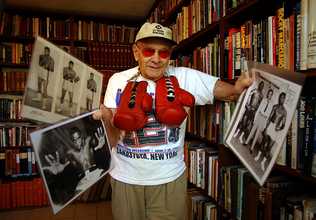
There was a nice article in the Miami Herald about the late Hank Kaplan’s collection of all things boxing. An excerpt from the article by Santos Perez:

Kaplan was considered boxing’s preeminent historian. The two-car garage in his Kendall home became a library to thousands of boxing archives. Boxing writers, authors, researchers, filmmakers or anyone with an affinity for the sport marveled at Kaplan’s collection of books, newspaper and magazine clippings and other boxing memorabilia after a visit.

In his will, Kaplan donated the library’s archives to Brooklyn College. Kaplan was born in Brooklyn before settling in South Florida in the early 1950s.

An estimated 2,000 boxes of items were removed from Kaplan’s home and transferred to Brooklyn College in February. Now a Brooklyn College professor, who befriended Kaplan, is leading the effort to preserve the items and eventually open the library for public use and research.

See more about Mr Kaplan at the Brooklyn College Library web site.

Article referenced is copied in full at end of post.

——————————————————–
Brooklyn College aims to show late Hank Kaplan’s boxing mementos

Posted on Mon, Dec. 15, 2008

BY SANTOS A. PEREZ

Although difficult to imagine, Sunday marked the first-year anniversary of Hank Kaplan’s death. As Kaplan’s close friend Ramiro Ortiz said, “Boxing lost its best friend.”

Kaplan was considered boxing’s preeminent historian. The two-car garage in his Kendall home became a library to thousands of boxing archives. Boxing writers, authors, researchers, filmmakers or anyone with an affinity for the sport marveled at Kaplan’s collection of books, newspaper and magazine clippings and other boxing memorabilia after a visit.

In his will, Kaplan donated the library’s archives to Brooklyn College. Kaplan was born in Brooklyn before settling in South Florida in the early 1950s.

An estimated 2,000 boxes of items were removed from Kaplan’s home and transferred to Brooklyn College in February. Now a Brooklyn College professor, who befriended Kaplan, is leading the effort to preserve the items and eventually open the library for public use and research.

”We are at the fund-raising stage,” said Anthony Cucchiara, who teaches archival management at Brooklyn College. “Preserving material is costly.”

Cucchiara coordinated the transfer of items from Kaplan’s home and estimates the project will cost $250,000. Maintaining dated material, including some from the 1800s, requires special containers, folders and fluids.

In addition to archival maintenance, funds raised will help convert many of the items into digital form and create a library website. Cucchiara said once the upgrading of the items is complete, an archivist will be hired to oversee the library.

”We have put together a fund-raising committee consisting of writers and boxing historians,” Cucchiara said. “The library will need preservation and reorganization to make it usable.”

The project already has generated $3,500 in donations and a special fund-raising event is planned for next year, Cucchiara said. The advisory board also will submit an application to the National Foundation on the Arts and Humanities for additional assistance.

”I feel so committed to Hank and making the project a reality,” Cucchiara said. “He was so dedicated to boxing and its preservation. He poured his soul into boxing.”

According to Cucchiara, an independent appraisal done after the items were transferred to Brooklyn lists the library’s value at $2.94 million, ”And that appraisal might be a conservative one,” Cucchiara said. “This is a national resource.”

The items currently sit in storage at the college’s library.

Notice of Kaplan’s archives has resulted in the additional donation of items.

”People, whose fathers or uncles were in boxing, had items they didn’t know what to do with,” Cucchiara said. “Now those items will be part of the library.”

With the financial backing and re-organization, Cucchiara hopes the library could open within the next two to three years.

”It’s too early to tell, but I am confident this project will be completed,” Cucchiara said. “This library is not just about the history of the sport, but the growth and re-shaping of American society, of which boxing played an important role.”

To assist in the library’s fund-raising effort, checks can be made out to the Brooklyn College Library/Kaplan Boxing Collection and sent to Anthony Cucchiara, 2900 Bedford Avenue, Brooklyn, NY 11210.

HOLT KEEPS TITLE

Kendall Holt retained his World Boxing Organization junior-welterweight title late Saturday with a split decision victory over Demetrius Hopkins in Atlantic City, N.J.

COMING UP

Mike Alvarado vs. Miguel Huerta, 10 rounds, junior-welterweights 8 p.m., Friday (Telefutura-Ch. 69).
————————————————-

Posted in Sports | Tagged , | Leave a comment

Our Lady of Guadalupe

From the EWTN story about Our Lady of Guadalupe:

When the Indians had learned the news of Our Lady’s apparitions, an enthusiasm and joy such as had never been seen before spread among them. Renouncing their idols, superstitions, human sacrifices, and polygamy, many asked to be baptized. Nine years after the apparitions, nine million Indians had converted to the Christian faith—nearly 3,000 a day! The details of the Image of MARY moved the Indians deeply—this woman is greater than the sun-god since she appears standing before the sun. She surpasses the moon god since she keeps the moon under her feet. She is no longer of this world since she is surrounded by clouds and is held above the world by an angel. Her folded hands show her in prayer, which means that there is Someone greater than she…

See the entire article at end of post.

——————————————————–
Our Lady of Guadalupe – Feast: December 12

In the sixteenth century, the Blessed Virgin, moved with pity for the Aztec people who, living in the darkness of idolatry, offered to their idols multitudes of human victims, deigned to take into her own hands the evangelization of these Indians of Central America who were also her children. One of the Aztec gods, originally considered the god of fertility, had transformed himself over time into a ferocious god. A symbol of the sun, this god was in continuous battle with the moon and the stars and was believed to need human blood to restore his strength; if he died, life would be extinguished. Ever new victims, to be offered to him in perpetual sacrifice, therefore seemed essential.

An eagle on a cactus

Aztec priests had prophesied that their nomadic people would settle in the place where an eagle would be seen perched on a cactus, devouring a serpent. This eagle appears on the Mexican flag today. Having arrived on a swampy island, in the middle of Lake Texcoco, the Aztecs saw the foretold sign: an eagle, perched on a cactus, was devouring a serpent. This was in 1369. There they founded their town Tenochtitlan, which would become Mexico City. The town expanded to become a city on pilings, with many gardens abounding in flowers, fruit, and vegetables. The organization of the Aztec kingdom was very structured and hierarchical. The knowledge of their mathematicians, astronomers, philosophers, architects, doctors, artists, and artisans was excellent for that time. But the laws of the physical world remained scarcely known. Tenochtitlan drew its power and wealth primarily from war. The conquered cities had to pay a tribute of various foodstuffs and men for war and sacrifices. The Aztecs’ human sacrifices and cannibalism are almost unequaled throughout the course of history.

In 1474, a child was born who was given the name Cuauhtlatoazin (“speaking eagle”). After his father’s death, the child was taken in by his uncle. From the age of three, he was taught, as were all young Aztecs, to join in domestic tasks and to behave in a dignified manner. At school, he learned singing, dancing, and especially the worship of many gods. The priests had a very strong influence over the population, whom they kept in a submission bordering on terror. Cuauhtlatoazin was thirteen years old when the great temple at Tenochtitlan was consecrated. Over the course of four days, the priests sacrificed 80,000 human victims to their god. After his military service, Cuauhtlatoazin married a young woman of his social status. Together they led a modest life as farmers.

In 1519, the Spaniard Cortez disembarked in Mexico, leading 500 soldiers. He conquered the country for Spain, yet was not lacking in zeal for the evangelization of the Aztecs. In 1524 he obtained the arrival of twelve Franciscans to Mexico. These missionaries quickly integrated into the population. Their goodness contrasted with the harshness of the Aztec priests, as well as that of some conquistadors. They began to build churches. However, the Indians were reluctant to accept Baptism, primarily because it would require them to abandon polygamy.

Cuauhtlatoazin and his wife were among the first to receive Baptism, under the respective names of Juan Diego and Maria Lucia. After his wife’s death in 1529, Juan Diego withdrew to Tolpetlac, 14 km from Mexico City, to the home of his uncle, Juan Bernardino, who had become a Christian as well. On December 9, 1531, as was his custom every Saturday, he left very early in the morning to attend the Mass celebrated in honor of the Blessed Virgin, at the Franciscan fathers’ church, close to Mexico City. He walked past Tepeyac Hill. Suddenly, he heard a gentle and resounding song that seemed to come from a great multitude of birds. Raising his eyes to the top of the hill, he saw a white and radiant cloud. He looked around him and wondered if he was dreaming. All of a sudden, the song stopped and a woman’s voice, gentle and graceful, called him: “Juanito, Juan Dieguito!” He quickly climbed the hill and found himself in the presence of a very beautiful young woman whose garments shone like the sun.

“A church where I will show my love”

Speaking to him in Nahuatl, his native language, she said to him, “Juanito, my son, where are you going?”—”Noble Lady, my Queen, I am going to the Mass in Mexico City to hear the divine things that the priest teaches us there.”—”I want you to know for certain, my dear son, that I am the perfect and always Virgin MARY, Mother of the True God from Whom all life comes, the Lord of all things, Creator of Heaven and Earth. I greatly desire that a church be built in my honor, in which I will show my love, compassion, and protection. I am your Mother full of mercy and love for you and all those who love Me, trust in Me, and have recourse to Me. I will hear their complaints and I will comfort their affliction and their sufferings. So that I might show all My love, go now to the bishop in Mexico City and tell him that I am sending you to make known to him the great desire I have to see a church dedicated to me built here.”

Juan Diego went straight to the bishop. Bishop Zumárraga, a Franciscan, the first bishop of Mexico, was a pious man and full of zeal, who had a heart overflowing with kindness towards the Indians. He heard the poor man attentively, but fearing an illusion, did not put much faith in his story. Towards evening, Juan Diego started on his way home. At the top of Tepeyac Hill, he had the pleasant surprise of meeting the Apparition again. He told her about his mission, then added, “I beg you to entrust your message to someone more known and respected so that he will believe it. I am only a simple Indian whom you have sent as a messenger to an important person. Therefore, he didn’t believe me, and I do not want to greatly disappoint you.”—”My dearest son, “replied the Lady, “you must understand that there are many more noble men to whom I could have entrusted my message and yet, it is because of you that my plan will succeed. Return to the bishop tomorrow… Tell him that it is I myself, the Blessed Virgin MARY, Mother of God, who am sending you.”

On Sunday morning after the Mass, Juan Diego went to the bishop’s house. The prelate asked him many questions, then asked for a tangible sign of the truth of the apparition. When Juan Diego went home, the bishop had him discreetly followed by two servants. At Tepeyac Bridge, Juan Diego disappeared from their sight, and despite all their searches on the hill and in the surrounding area, they could not find him again. Furious, they declared to the bishop that Juan Diego was an impostor who must absolutely not be believed. During this time, Juan Diego told the beautiful Lady, who was waiting for him on the hill, about his most recent meeting with the bishop. “Come back tomorrow morning to seek the sign he is asking for,” replied the Apparition.

Roses, in the middle of winter!

Returning home, the Indian found his uncle ill, and the next day, he had to stay at his bedside to take care of him. As the illness got worse, the uncle asked his nephew to go look for a priest. At dawn on Tuesday, December 12, Juan Diego started on the road to the city. Approaching Tepeyac Hill, he thought it best to make a detour so as not to meet the Lady. But suddenly, he perceived her coming to meet him. Embarrassed, he explained his situation and promised to come back when he had found a priest to administer last rites to his uncle. “My dear little one,” replied the Apparition, “do not be distressed about your uncle’s illness, because he will not die from it. I assure you that he will get well… Go to the top of the hill, pick the flowers that you will see there, and bring them to me.” When he had arrived at the top of the hill, the Indian was stunned to find a great number of flowers in bloom, Castillian roses that gave off a very sweet fragrance. Indeed, in the winter, the cold allows nothing to survive, and besides, the place was too dry for flowers to grow there. Juan Diego gathered the roses, enfolded them in his cloak, or tilma, then went back down the hill. “My dear son,” said the Lady, “these flowers are the sign that you are to give the bishop… This will get him to build the church that I have asked of him.”

Juan Diego ran to the bishop. When he arrived, the servants made him wait for hours. Amazed at his patience, and intrigued by what he was carrying in his tilma, they finally informed the bishop, who, although with several people, had him shown in immediately. The Indian related his adventure, unfolded his tilma, and let the flowers, which were still shining with dew, scatter to the floor. With tears in his eyes, Bishop Zumárraga fell to his knees, admiring the roses from his country. All of a sudden, he perceived, on the tilma, the portrait of Our Lady. MARY’s image was there, as though printed on the cloak, very beautiful and full of gentleness. The bishop’s doubts gave way to a sure faith and a hope filled with wonder. He took the tilma and the roses, and placed them respectfully in his private oratory. The next day he went with Juan Diego to the hill where the apparitions had taken place. After having examined the sites, he let the seer return to his uncle’s house. Juan Bernardino had been completely cured. His cure had taken place at the very hour when Our Lady appeared to his nephew. He told him, “I have also seen her. She even came here and talked to me. She wants a church to be built on Tepeyac Hill and wants her portrait to be called ‘Saint MARY of Guadalupe.’ But she didn’t explain to me why.” The name “Guadalupe” is well known by the Spanish, because in their country there is a very old sanctuary dedicated to Our Lady of Guadalupe.

The news of the miracle spread quickly. In a short time, Juan Diego became well-known. “I will spread your fame,” MARY had told him, but the Indian remained as humble as ever. To make it easier to meditate on the Image, Bishop Zumárraga had the tilma transported to his cathedral. Then work was begun on the construction of a small church and a hermitage for Juan Diego on the hill of apparitions. The next December 25, the bishop consecrated his cathedral to the Most Blessed Virgin, to thank her for the remarkable favors with which she had blessed his diocese. Then, in a magnificent procession, the miraculous Image was carried to the sanctuary that had just been completed on Tepeyac Hill. To express their joy, the Indians shot arrows. One of them, shot carelessly, went through the throat of a participant in the procession, who fell to the ground, fatally wounded. A great silence fell and intense supplication rose to the Mother of God. Suddenly the wounded man, who had been placed at the foot of the miraculous Image, collected himself and got up, full of vigor. The crowd’s enthusiasm was at its peak.

Millions of Indians become Christian

Juan Diego moved into his little hermitage, seeing to the maintenance and cleaning of the site. His life remained simple—he carefully farmed a field close to the sanctuary that had been placed at his disposal. He received pilgrims in ever larger numbers, and enjoyed talking about the Blessed Virgin and untiringly relating the details of the apparitions. He was entrusted with all kinds of prayer intentions. He listened, sympathized, and comforted. A good amount of his free time was spent in contemplation before the image of his Lady. He made rapid progress in the ways of holiness. Day after day, he fulfilled his duty as a witness up until his death on December 9, 1548, seventeen years after the first apparition.

When the Indians had learned the news of Our Lady’s apparitions, an enthusiasm and joy such as had never been seen before spread among them. Renouncing their idols, superstitions, human sacrifices, and polygamy, many asked to be baptized. Nine years after the apparitions, nine million Indians had converted to the Christian faith—nearly 3,000 a day! The details of the Image of MARY moved the Indians deeply—this woman is greater than the sun-god since she appears standing before the sun. She surpasses the moon god since she keeps the moon under her feet. She is no longer of this world since she is surrounded by clouds and is held above the world by an angel. Her folded hands show her in prayer, which means that there is Someone greater than she…

Even in our time, the mystery of this miraculous Image remains. The tilma, a large apron woven by hand from cactus fibers, bears the holy Image, which is 1.43 meters tall. The Virgin’s face is perfectly oval and is a gray color verging on pink. Her eyes have a profound expression of purity and gentleness. The mouth seems to smile. The very beautiful face, similar to that of a mestizo Indian, is framed by a black head of hair that, up close, is comprised of silky locks. She is clad in a full tunic, of a pinkish red hue that no one has ever been able to reproduce, and that goes to her feet. Her bluish-green mantle is edged with gold braid and studded with stars. A sun of various shades forms a magnificent background, with golden rays shining out.

The fact that the tilma has remained perfectly preserved from 1531 to this day is inexplicable. After more than four centuries, this fabric of mediocre quality retains the same freshness and the same lively color as when it was new. By comparison, a copy of the Image of Our Lady of Guadalupe painted in the 18th century with great care, and preserved under the same climatic conditions as Juan Diego’s, had completely deteriorated in a few years.

At the beginning of the 20th century, a painful period of revolutions in Mexico, a load of dynamite was put by unbelievers at the foot of the Image, in a vase of flowers. The explosion destroyed the marble steps on the main altar, the candelabras, all the flower-holders. The marble altarpiece was broken into pieces, the brass Christ on the tabernacle was split in two. The windows in most of the houses near the basilica were broken, but the pane of glass that was protecting the Image was not even cracked. The Image remained intact.

The most moving experience of my life

In 1936, an examination conducted on two fibers from the tilma, one red and the other yellow, led to an astounding finding—the fibers contained no known coloring agent. Ophthalmology and optics confirm the inexplicable nature of the Image—it seems to be a slide projected onto the fabric. Closer analysis shows that there is no trace of drawing or sketching under the color, even though perfectly recognizable retouches were done on the original, retouches which moreover have deteriorated with time. In addition, the background never received any primer, which seems inexplicable if it is truly a painting, for even on the finest fabric, a coat is always applied, if only to prevent the fabric from absorbing the painting and the threads from breaking the surface. No brush strokes can be detected. After an infrared analysis conducted on May 7, 1979, a professor from NASA wrote, “There is no way to explain the quality of the pigments used for the pink dress, the blue veil, the face and the hands, or the permanence of the colors, or the vividness of the colors after several centuries, during which they ordinarily should have deteriorated… Studying this Image has been the most moving experience of my life.”

Astronomers have observed that all the constellations present in the heavens at the moment Juan Diego opened his tilma before Bishop Zumárraga on December 12, 1531, are in their proper place on MARY’s mantle. It has also been found that by imposing a topographical map of central Mexico on the Virgin’s dress, the mountains, rivers and principal lakes coincide with the decoration on this dress.

Ophthalmological tests have found that MARY’s eye is a human eye that appears to be living, and includes the retina, in which is reflected the image of a man with outstretched hands—Juan Diego. The image in the eye conforms to the known laws of optics, particularly to that which states that a well-lighted object can be reflected three times in an eye (Purkinje-Samson’s law). A later study allowed researchers to discover in the eye, in addition to the seer, Bishop Zumárraga and several other people present when the image of Our Lady appeared on the tilma. And the normal microscopic network of veins in the eyelids and the cornea of the Virgin’s eyes is completely recognizable. No human painter would have been able to reproduce such details.

Three months pregnant

Gynecological measurements have determined that the Virgin in the Image has the physical dimensions of a woman who is three months pregnant. Under the belt that holds the dress in place, at the very location of the embryo, a flower with four petals stands out—the Solar Flower, the most familiar of Aztec hieroglyphs, and which symbolized for them divinity, the center of the earth, heaven, time, and space. On the Virgin’s neck hangs a brooch, the center of which is decorated with a little cross, recalling the death of Christ on the Cross for the salvation of all mankind. Many other details of the Image of MARY form an extraordinary document for our age, which is able to observe them thanks to modern technology. Thus science, which has often been a pretext for unbelief, helps us today to give prominence to signs that had remained unknown for centuries and that science is unable to explain.

The Image of Our Lady of Guadalupe bears a message of evangelization: the Basilica of Mexico is a center “from which flows a river of the light of the Gospel of Christ, spreading throughout the earth through the merciful Image of MARY” (John Paul II, December 12, 1981 ). In addition, through her intervention on behalf of the Aztec people, the Virgin played a role in saving innumerable human lives, and her pregnancy can be interpreted as a special appeal on behalf of unborn children and the defense of human life. This appeal has a burning relevance in our time, when threats against the lives of individuals and peoples, especially lives that are weak and defenseless, are widespread and becoming more serious. The Second Vatican Council forcefully deplored crimes against human life: “All offenses against life itself, such as murder, genocide, abortion, euthanasia… all these and the like are criminal: they poison civilization ; and they debase the perpetrators more than the victims and militate against the honor of the Creator” ( Gaudium et Spes, 27). Faced with these plagues, which are expanding as a result of scientific progress and technology, and which benefit from wide social consensus as well as legal recognition, let us call upon MARY with confidence. She is an “incomparable model of how life should be welcomed and cared for… Showing us her Son, she assures us that in Him the forces of death have already been defeated” (John Paul II, Evangelium vitae, March 25, 1995, nos. 102, 105). “Death and life are locked in an incredible battle; the Author of life, having died, lives and reigns” (Easter Sequence).

Let us ask Saint Juan Diego, canonized by Pope John Paul II on July 31, 2002, to inspire us with a true devotion to our Mother of Heaven, for “MARY’s compassion extends to all those who appeal to her, even when this appeal is nothing more than a simple ‘Hail, MARY'” (Saint Alphonsus de Liguori ). Especially if we have fallen into serious sin, she who is Mother of Mercy will obtain for us the Mercy of God.
——————————————————————————

Posted in Catholic Faith & Inspiration | Tagged , | Leave a comment

Charlie Brown Meets the Luftwaffe Pilot

The title of this post sounds like an Oktoberfest cartoon. Not even close. I didn’t have to hunt for the obituaries today, the Miami Herald had the good sense to place Charlie Brown’s obituary— written by Charles Rabin–on the front page.

Here’s why:

At the break of dawn five days before Christmas 1943, Brown was piloting a B-17 bomber over Bremen, Germany, looking to strike an aircraft plant. The plane took heavy fire. Its nose was shot off, its engines damaged.

Spiraling toward earth with a dead tail gunner and nine other crew members, Brown — himself shot in the shoulder — regained control of the craft, broke formation and continued to take on German fighters.

Then a German pilot, flying a Messerschmitt Bf-109, motioned for Brown to land his crippled plane. Brown defied the order, shaking his head.

What happened next was unexpected: Instead of shooting down the bomber, the German pilot escorted Brown and his crew to the North Sea, saluted, rolled his plane in tribute and flew off.

Brown’s plane landed safely on the English coast.

The Allies never revealed the German pilot’s act, figuring he would be court-martialed and perhaps executed for failing to shoot down an enemy aircraft.

For decades, Brown wondered about the German pilot — through his post-war marriage to Delores, the birth of his two daughters in the 1950s, and well past his stint with the State Department during the Vietnam War.


As the picture to the right shows, it was not the last time they met. Read the rest of Rabin’s article at the end of the post. Statistics show that 9 out of the 10 people who won’t click through to read the entire obituary are Democrats. But the sample size is so small, it probably wasn’t worth mentioning–aside from it being a rather delicious cheap-shot. More about the story here.

———————————————————————————
WWII hero dies, but a remarkable story lives on

BY CHARLES RABIN

When World War II bomber pilot Charlie Brown is laid to rest Saturday, his burial will close a chapter on one of the most remarkable war stories in modern history.

It’s a tale of two pilots — one American, the other German — and of a bloody, deadly battle in the sky that led to an extraordinary friendship.

Brown, a fighter pilot, scientist, engineer and happy-hour connoisseur, died last month of heart complications. Born into poverty in West Virginia and a Miamian since the early 1970s, Brown will be buried Saturday at Woodlawn Park Cemetery South. He was 86.

His family and friends remember him as outgoing, gregarious, a man who invented a car part that allowed for greatly enhanced mileage, a loving father, a great friend.

”He was perpetually interested in the natural world, and what made it tick,” said friend Jim Brodie, director of legislative and cabinet affairs for the state Department of Veteran Affairs.

Brown’s story, and his enduring friendship with a German flying ace, is of fairy-tale caliber. It has been told before. It bears retelling.

At the break of dawn five days before Christmas 1943, Brown was piloting a B-17 bomber over Bremen, Germany, looking to strike an aircraft plant. The plane took heavy fire. Its nose was shot off, its engines damaged.

Spiraling toward earth with a dead tail gunner and nine other crew members, Brown — himself shot in the shoulder — regained control of the craft, broke formation and continued to take on German fighters.

Then a German pilot, flying a Messerschmitt Bf-109, motioned for Brown to land his crippled plane. Brown defied the order, shaking his head.

What happened next was unexpected: Instead of shooting down the bomber, the German pilot escorted Brown and his crew to the North Sea, saluted, rolled his plane in tribute and flew off.

Brown’s plane landed safely on the English coast.

The Allies never revealed the German pilot’s act, figuring he would be court-martialed and perhaps executed for failing to shoot down an enemy aircraft.

For decades, Brown wondered about the German pilot — through his post-war marriage to Delores, the birth of his two daughters in the 1950s, and well past his stint with the State Department during the Vietnam War.

Brown retired from the military as a lieutenant colonel in the early 1970s. Then he moved to Miami, where he spent the next three decades toying around with combustible engines and inventing things like the ”Brown Air Charging System” — a device Brodie swears Brown attached to his car to get better gas mileage.

With free time at hand, Brown began a search for the German pilot who spared his life. Not long after a 1986 story of the incident ran in a German newsletter, Brown found Franz Stigler, a German World War II ace living in Surrey, British Columbia, and still flying a Messerschmitt at air shows.

The two met, compared notes and realized Stigler was the pilot. Stigler later said he didn’t shoot down the plane because it was so badly damaged it would have been like shooting at a parachute.

Stigler, who died in March, was a legend of the sky. Along with his 487 flights and 28 kills, he was shot down 17 times. From 1990 until Stigler’s death earlier this year, he and Brown and their wives were exceptional friends, visiting each other at least twice a year.

”Charlie called him his big brother, and that about sums it up,” said Stigler’s 77-year-old widow, Helga Stigler.

She said her husband had often wondered what happened to the American plane he escorted to sea — a secret he kept from everyone but her.

Brodie, the Veteran Affairs liaison, met Brown in 1995 after persuading him to tell his story to a South Miami-Dade Rotary Club. Brown took Stigler with him.

”There wasn’t a dry eye in the house,” Brodie said.

In 2007, Brown and his crew received what had been long overdue: recognition. His story was told on the floor of Florida’s House of Representatives. Soon after, the Air Force opened its archives on the incident.

In February, the Air Force awarded Brown and the surviving crew members on that December 1943 flight Silver Stars for valor in combat. Brown also received the Air Force’s second-highest honor, the Air Force Cross.

In March, Brown’s wife of 58 years, Delores, died. Brown succumbed to heart disease not long after, two days before Thanksgiving.

”He wasn’t really the type to give up. But he was lost without her,” said daughter Kimberly.

Brown will be buried with full military honors Saturday. He is survived by daughters Carol Dawn Warner and Kimberly Arnstiger, and three grandchildren.
————————————————————————–

Posted in RIP | Tagged , , | 4 Comments