
The Estefan’s Crossover Timing

January 2010: Scene at the Washington offices of Smooth & Glib Consultants, LLP [formerly the Academy of Tobacco Studies].

Gloria Estefan: Look, I don’t care how this gets done, but I want it done. If I ever have to ask another adult about reindeer’s, I at least want one of us to be in a sanitarium.
Nick Naylor – President and Founder of S&G: You’re upset and you should be.
Gloria Estefan: Emilio, please ask him to stop talking.
Emilio Estefan: Just listen to him please. We’re paying him enough.
Nick Naylor: He’s right you know.
Gloria Estefan: [Gives Naylor a dirty look].
Nick Naylor: Look, you’re here because both of you, quite properly I believe, live in fear of offending your somewhat maniacally loyal hometown fan base. So we have to offset two competing desires; the desire to speak your mind, even when your politics have diverged from your those of your loyal fans and the desire to start your car without any remote control devices.
Gloria Estefan: That’s a stereotypical cheap shot.
Nick Naylor: No doubt. By the way, is there another reason my Outlook calendar reads ‘meet Mr & Mrs Juan Valdes?’
Emilio Estefan: Just get to your point please.
Nick Naylor: You need cover on this. Look even Jack Bauer doesn’t run into any building without first having Chloe O’Brien send him the schematics first.
Gloria Estefan: So what’s our cover, what’s your idea?
Nick Naylor: The reason you’re paying me so well, and you are, is that I’m the guy who let’s you know that making up a cover will backfire. I’m the guy who tells you to sit tight until the right moment comes, even if your petulant little heart doesn’t like it. While reindeer’s maybe one of the few things you are actually qualified to discuss with the President of the United States, given enough money, I will put you in a position to discuss much more. For now we wait.
Gloria Estefan: That’s it? We wait?
Nick Naylor: Yes. When it’s time, it will be so obvious, it won’t even look planned. By the way, I can validate that for you, Mrs Valdes.

Recent Miami Herald headlines:

While I clearly don’t share the Estefan’s domestic political agenda, I think the fund-raiser is something everyone who cares about a free Cuba should understand and even appreciate. The worst possible scenario for those of us who care about a free Cuba is having whoever is in the White House thinking they have no chance to win over Cuban-American votes or having no chance of winning Florida even with Cuban-American votes. If the Estefan’s weren’t doing this of their own accord, we should organize a telethon and put them up to it.

In the end, the prospects of a free Cuba trumps current US domestic political concerns with respect to engaging President Obama. The cause of a free Cuba can no doubt be aided by having a US President with some ties to our exile community. Heck one of the inherent reasons we all are so happy to be Americans is that US politics are typically not conducted at the ‘patria o muerte’ wattage level [except for the whole Civil War thing].

So I hope their fund-raiser is a big success and that the Democrats lose big in November 2010 and 2012. I believe that like Tessio, the Estefan’s have made a smart move for themselves and that our exile community can benefit in the process. Then again, things kinda backfired on ol’ Salvatorre.

The most recent Miami Herald article referenced is copied in full at end of post.

———————————————————————–
Emilio and Gloria Estefan to host President Obama

Posted on Fri, Apr. 02, 2010

BY LESLEY CLARK
lclark@MiamiHerald.com

President Barack Obama conveyed his harshest rebuke yet of Havana’s government last week and, hours later, Gloria Estefan protested repression in Havana from the streets of Miami.

Now, they’ll be together again when the Cuban-born singer and her husband, Emilio, host Obama at their Miami Beach home April 15 for a Democratic National Committee fundraiser, when the president comes to Florida to talk about cuts to the NASA space program.

The $30,400-a-couple cocktail reception is the Estefans’ first political fundraiser, said Democratic consultant Freddy Balsera, who advised Obama’s campaign on Hispanic issues and is close to the couple. The Estefans — who were traveling and unavailable Thursday for comment — orchestrated a massive march through Miami’s Little Havana in support of Cuba’s Damas de Blanco, or Ladies in White, peaceful dissidents who were attacked by government security forces in Havana.

“They’re both at a place in their lives where they believe giving back is important and patriotism is important,” Balsera said. Obama will also attend a fundraiser at the Adrienne Arsht Center for the Performing Arts in downtown Miami that same day. Tickets for that event start at $250 and $1,250.

Though they’ve kept a low political profile, the Estefans are no strangers to the White House. Gloria performed at the inaugural festivities for President George W. Bush in 2005, following Bush’s 2002 appointment of Emilio to the President’s Committee on the Arts and Humanities and the President’s Advisory Committee on the Arts.

Emilio met with Obama at the White House last May, according to the Washington Times, which reported at the time that Emilio hoped to have Obama over for dinner to talk about U.S.-Cuba relations.

“We just want freedom,” he told the newspaper.

In September, Obama appointed Emilio to a commission to study the feasibility of a National Museum of the American Latino, and Gloria Estefan — along with Marc Anthony, Jose Feliciano and others — performed at the White House in October as it celebrated Hispanic music. The president quoted Gloria in his welcoming remarks, noting that in her words, “the most beautiful things in this country have the flavor of other places.”

Gloria also scored a pre-Christmas interview with Obama for Univision.

The pair chatted about Santa and reindeer, with Estefan prompting Obama to deliver a holiday message in what he jokingly called his “flawless” Spanish.

Obama’s reception in Florida may not be entirely celebratory. He’s convened a conference on the Space Coast that day to defend his plans to cancel a NASA space exploration program — a decision that has prompted howls of protest from Florida’s congressional delegation.

Read more: http://www.miamiherald.com/2010/04/01/v-print/1559519/star-power-estefans-to-host-obama.html#ixzz0k9OPJUzb
———————————————————————

Posted in Cuba | Tagged , | Leave a comment

Garden Variety: Eden, Gethsemane & Arimathea’s

Have you ever reflected on the role gardens play in our Christian faith? I hadn’t thought of it until I read this homily by Fr Valle. An excerpt from his Easter homily:

It is very interesting that Mary ends up in a garden looking for Jesus. After all, this whole lovely and terrible game of sin and salvation began in a garden way back in Genesis. John Paul II tells us that if we understand the first three chapters of Genesis, we understand the entire history of sin and salvation. While a pope who many call great, doesn’t need me to tell him that he is right, the Pope is exactly right. What began in the garden of Eden comes full circle in the garden of Joseph of Arimathea, where they buried the body of Jesus in an empty tomb.

The email address to request to be put on Vallee’s email distribution list is Cioran262@aol.com. To see the entire homily click on ‘read more.’ Search for other Fr Vallee homilies in this blog by entering ‘Vallee’ in the search box in the upper left hand corner or look for Fr Vallee in the Labels.


—————————————————————————-
Fr Vallee Easter 2010 Homily

I. John Paul II
It is very interesting that Mary ends up in a garden looking for Jesus. After all, this whole lovely and terrible game of sin and salvation began in a garden way back in Genesis. John Paul II tells us that if we understand the first three chapters of Genesis, we understand the entire history of sin and salvation. While a pope who many call great, doesn’t need me to tell him that he is right, the Pope is exactly right. What began in the garden of Eden comes full circle in the garden of Joseph of Arimathea, where they buried the body of Jesus in an empty tomb.

II. Where are you?
Chapter three of Genesis gives a perfect picture of what exactly went wrong with sin or what is precisely wrong with sin. Notice the last verse of chapter two: “The man and woman were both naked and yet they felt no shame.” This is an interesting passage. Nakedness and sexuality are both innocent. Adam and Eve feel no shame before one another and before God because there is nothing of which to be ashamed. Shame comes with disobedience and sin in chapter three. But that is a small point. Here is the main point: After the Fall, God walks in the cool of the garden and calls out, “Adam, where are you?” Adam replies, “we heard you walking in the cool of the garden and we hid ourselves for we were naked.” God replies, “who told you that you were naked, did you eat of the fruit of which I told you not to eat?” Adam then blames Eve, Eve blames the snake, and so it goes.

III. The Hebrew You
The blame game aside, here is what is interesting. Hebrew is more like Spanish or French, than like English, in one specific sense. In English there is only one word for “you.” If I am talking to the president, it is “you.” If I am talking to my niece, it is still just “you.” In Spanish, if I am talking to the President, it is usted. If I am talking to my niece, it is tu. Hebrew, however, has not two but 32 different forms of the pronoun you, each signifying different degrees of intimacy and formality. This makes perfect sense. We have one word for snow. The Eskimos have many words for snow. The Jews were a tribal people, hence the question of the other’s precise relationship to me is of crucial importance. When God says, “where are you, Adam?” He is using the most intimate possible form of you. When Adam replies, “We heard you walking in the cool of the garden,” He uses the form of you one would use with a judge, something like, We heard you, “Sir.”

IV. Got to get ourselves back to the garden…
If you know about Jewish theology, you know that this an amazing phrase and is almost sui generis [JC: unique]. The Jews held that you were not even allowed to speak or write down the name of God. Yet here in Genesis, Adam and God speak with utter intimacy. This is the whole point. The deepest and most deadly effect of sin is loss of intimacy with our God. Because of sin, human beings and God are no longer on a first name basis. Adam, after sin, calls God, “Sir,” not “daddy.” We no longer stand face-to-face with God in the garden and call one another by our first names. Loss of intimacy with God is the result of sin. And the whole history of salvation is nothing but an attempt, in the words of the Joni Mitchell song, “to get our ourselves back to the garden.”

V. Abba in Gethsemane
Let’s fast forward to another garden, the Garden of Gethsemane. There Jesus faces torture and death. Notice his prayer in that garden. He prays, “Abba, let this cup pass me by, yet not my will but your will be done.” Abba is a very interesting word. It is an Aramaic word and it is a baby’s word. It means dada or papi. Jesus realizes, as he bares the full weight of our sins, even though he himself does not sin, that loss of intimacy with his Father is the most terrible thing he must face. On the cross he will cry out “My God, my God, why have you abandoned me?” Foreseeing that most horrible moment, Jesus cries out, Abba, daddy, papi. Be with me as a father is with his little baby.

VI. The Garden of the Tomb
We come, now, to the final garden, the garden of the empty tomb. I have always loved the Gospel text from St. John. Jesus appears to Mary Magdalene but she does not recognize him, she thinks he is the gardener. It is a lovely passage. Jesus almost seems to be teasing her. I mean he knows very well who she is looking for and why she is crying. Still, he asks: “Woman, who are you looking for?” Mary, then, kind of falls apart. She is somewhat hysterical: “Please, Sir, tell me where you have taken his body, so that I can go and be with him.” Finally, it is as if Jesus cannot stand to tease her any longer and he breaks the tension with a single word: “Mary.” With that word, her name, Mary recognizes her Lord.

VII. Full circle
With that one word, we have come full circle from Genesis. Jesus Christ by his Passion, death and rising, restores what was lost at the Fall. Now Mary Magdalene, a human being, stands face to face with her God in the garden and they call each other by their first names — playfully, tenderly, with utter intimacy. John Paul II is saw it so clearly. If you understand the first three chapters of Genesis, you understand the entire history of sin and salvation. What was lost in a garden is regained in a garden, human beings once again stand face to face with God and whisper tender endearments … Christ has conquered death by death. And the result of that victory is that God is once again “daddy, papi, abba.”
———————————————————————

Tagged , , | Leave a comment

Bill Gates and copyright infringement. Not even death do them part

Ed Roberts with the Altair 8800 computer in 1997

Bill Gates takes copyright infringement so seriously, he can’t even let it go when he has literally buried his opponent.

H. Edward Roberts, credited by Bill Gates as the inventor of the PC and a native Miamian [Miami Senior High graduate, of course], passed away in 2010. See his obituary in the NYT and WSJ. Mr Roberts invention – the Altair 8800 – created the key opportunity for Paul Allen and Bill Gates entry into the the fledgling computer industry. The relationship between Mr Roberts and Gates and Microsoft had a falling out – excerpts from the NYT obituary:

Over the years, there was some lingering animosity between the two men, and Dr. Roberts pointedly kept his distance from industry events. But in recent months, after learning that Dr. Roberts was ill, Mr. Gates made a point of reaching out to his former boss and customer. Mr. Gates sent Dr. Roberts a letter last December and followed up with phone calls, another son, Dr. John David Roberts, said. Eight days ago, Mr. Gates visited the elder Dr. Roberts at his bedside in Macon.

“Any past problems between those two were long since forgotten,” said Dr. John David Roberts, who had accompanied Mr. Gates to the hospital. He added that Mr. Allen, the other Microsoft founder, had also called the elder Dr. Roberts frequently in recent months.

Allow me a non-politically correct translation:

Mr Roberts was entrepreneurial and innovative, but just missed out on capitalizing on the mega-wealth creation his innovation spawned. Bill Gates did not. Despite his debt to the man and his clear dominance in the industry, Gates pressed his advantage to the point of alienating a person whose true innovation Gates so greatly benefited from. Bottom line, the borrowing [another man’s ripping-off] of superior ideas was not something began with Apple or Steve Jobs.

Mr Gates was moved enough to share his remembrance of Mr Roberts in the WSJ. In that remembrance, Mr Gates wrote the following:

So MITS was the pioneer of a lot of things – helping to create computer clubs, getting a software library going, lots of new additions to their personal computer including the disk. Ed kept a firm hand running the company but was frustrated by some of the complexity. He decided to sell the company and reached a deal with PERTEC, a California company that did magnetic tape stuff mostly.

I was surprised when Ed decided to move back to Georgia and give up working in the computer field. Microsoft had a dispute with PERTEC where they interpreted our license with them as giving them an exclusive on our BASIC and that went to arbitration as the contract called for and we won that on many different grounds.

I didn’t see Ed many times after that. I knew he was first a farmer in Georgia and then a doctor. There were a few reunion things and I went to one of those. Six months ago I heard that Ed got pneumonia and went into the hospital. After three months in the hospital he was still not getting well I wrote him a letter talking about his great contributions.

After two more months his situation wasn’t great so I arranged to go see him and I spent several hours with him and his son at the hospital last Friday. Ed was sick enough that he barely knew I was there but I recounted some of these old stories to his son which I hope he understood. In any case his son will have those to pass along to Ed’s five other children and all of the grandchildren.”

My interpretation again:

Sure Ed came up with the Altair, but he was quickly in over his head [“complexity”]. He tried to wet his beak [“interpreted”], but we don’t do compromise and wiped the floor [“many different grounds”] with them. Ed was pissed and I didn’t care [“I was surprised Ed moved”].

When I heard he was sick I felt bad. When it was clear he wasn’t getting better, I dropped him a note. When I realized that he would die, I figured I should go. I got there too late to truly speak with him before he passed, but at least I went.

I hope the reason Mr Gates remembrance took on such a petty tone is that is that the Microsoft legal team did the last rewrite. Pending said disclosure, it’s settled then, money can’t buy you everything, i.e. class or compassion. Just one more thing Mr Roberts could have taught Mr Gates. Hey, maybe they’ll meet again? In whose shoes would you rather be at that meeting? Cheer up Bill, it can’t be as bad as the one between Ted Kennedy and Mary Jo Kopechne.

A few of the highlights from Mr Roberts interesting life:

  • Born in Miami, September 13, 1941 [exactly 20 years before my family arrived].
  • Father was a household appliance repairman and his mother was a nurse.
  • In preparing to be a doctor, he helped build electronics for an experimental heart-lung machine at the University of Miami.
  • Inspired by his work at the University of Miami, he eventually studied electrical engineering at Oklahoma State University.
  • Served as an officer in the Air Force, based in Albuquerque, N.M., and was trained as an engineer.
  • In 1969 founded MITS Inc., in Albuquerque.
  • MITS created the the first inexpensive general-purpose microcomputer – the Altair 8800.
  • The January 1975 issue of Popular Electronics featured the Altair 8800 on its cover.
  • The Altair 8800 inspired Paul Allen and Bill Gates to travel to Albuquerque and begin working for and with Mr Roberts.
  • In 1977, Mr. Roberts sold MITS and as a condition of the sale, agreed not design computers for five years.
  • Invested in farmland in Georgia.
  • Decided to follow up on his first dream, to study medicine, earning his degree from Mercer University in Macon 1n 1986 – Mr Roberts was 45.
  • Moved to rural Cochran, Ga., where the town’s only doctor had recently died. He set up a clinic with a modern laboratory.

Bill Gates remembrance of Henry Edward Roberts is copied in full at end of post.

———————————————————————-
Bill Gates Remembers Personal Computer Pioneer

April 2, 2010, 5:40 PM ET

Bill Gates, co-founder and chairman of Microsoft, on Friday sent the Wall Street Journal this remembrance of Henry Edward Roberts, who died Thursday at the age of 68. Gates, who argues that Roberts deserves to be called the father of the personal computer, discusses the origins of Roberts’ company, MITS, how Gates and Microsoft co-founder Paul Allen came to write software for the early machine, and visiting Roberts in his final days.

“Ed Roberts was in the Air Force and ended up at the base in Albuquerque. In his spare time he started a company to sell kits for things you would put on rockets–something to take the temperature when it gets to the top or take a photo. He called the company Micro Instrumentation Telemetry Systems and it did a small amount of business. Then he came up with a kit calculator and that sold in significant volume and made money.

Then Bowmar (and later Texas Instruments) came out with an assembled calculator that was cheaper than Ed’s kit calculator. MITS (they had renamed it to just the initials at that point) had ordered a lot of parts and had enough costs that it looked like they wouldn’t be able to repay their debts. So Ed looked into the Intel microprocessor and together with an engineer Bill Yates created a kit computer called the Altair 8800.

The name was chosen because the Editor of Popular Electronics liked that name and they wanted to get on the cover. In fact the January 1975 issue (which came out in December 1974) had the Altair on the cover. It sold for $360 which was the same price as just buying a single 8080 chip from Intel so some people wondered if the parts were genuine and high quality. They were since MITS got a good discount on the chip. The kit could not do much once you put it together. If you didn’t have a teletype (think of a typewriter that can send character to the computer and receive commands to type from the computer) all you could do was make the lights flash with simple programs you have to enter in with the switches.

Paul Allen and I saw the Popular Electronics article and called to say we were doing software. They thought that was interesting. We worked hard and a month later we called back to ask what instructions to use to connect to a teletype. They said we were the first people who had asked that so maybe we did have something. We had used a simulator on a PDP-10 to create the BASIC interpreter which ran in 4K bytes. It is hard to believe how little memory these machines had.

Paul flew out to MITS with the paper tape and Ed met him at the airport. Paul figured out how to load the BASIC and it ran the first time on one of the few kits MITS itself had ever assembled. Everyone was amazed. This was in April 1975.

I went on leave from Harvard in June and negotiated the license agreement with MITS in July. Microsoft got a royalty for each BASIC sold. Then we wrote fancier versions of the BASIC – 8k Basic, Extended Basic and Disk Basic. Paul actually worked for MITS as VP of Software although I did not. We got a software library going and wrote regular articles for the Altair newsletter that David Bunnell was hired by MITS to create. I gave my first speech at an Altair convention. MITS got a big GM van and went around the country helping to set up computer clubs.

The Altair was the first personal computer by most definitions of the term. It was before the Apple 1 or any other machine people know. A company in Canada sold a few machines and MCM in France sold a few machines but they were a bit after MITS and not aimed at low price high volume. MITS sold over 10,000 of the Altairs and had to hire people to deal with the volume. Ed deserves to be called the father of the personal computer.

Ed was a strong personality and people were a bit intimidated by him. When they thought he was doing something wrong in the company they sometimes tried to get me to talk to Ed since I was also a strong personality and the least intimidated by him.

Ed was a good entrepreneur. MITS moved into doing assembled machines with far more power and adding an 8 inch floppy disk and building a dealer network. Some competitors came along – people no one knows today like Imsai, Processor Technology, Sphere, Ohio Scientific, Billings,…. One problem was that one generation of memory chips – the 4k RAM turned out to be unreliable and that messed up the whole industry particularly MITS since customers had problems with their machines. This was NOT MITS’ fault at all – I spent 2 months writing test programs to figure out which chips were failing and how.

So MITS was the pioneer of a lot of things – helping to create computer clubs, getting a software library going, lots of new additions to their personal computer including the disk. Ed kept a firm hand running the company but was frustrated by some of the complexity. He decided to sell the company and reached a deal with PERTEC, a California company that did magnetic tape stuff mostly.

I was surprised when Ed decided to move back to Georgia and give up working in the computer field. Microsoft had a dispute with PERTEC where they interpreted our license with them as giving them an exclusive on our BASIC and that went to arbitration as the contract called for and we won that on many different grounds.

I didn’t see Ed many times after that. I knew he was first a farmer in Georgia and then a doctor. There were a few reunion things and I went to one of those. Six months ago I heard that Ed got pneumonia and went into the hospital. After three months in the hospital he was still not getting well I wrote him a letter talking about his great contributions.

After two more months his situation wasn’t great so I arranged to go see him and I spent several hours with him and his son at the hospital last Friday. Ed was sick enough that he barely knew I was there but I recounted some of these old stories to his son which I hope he understood. In any case his son will have those to pass along to Ed’s five other children and all of the grandchildren.”
———————————————————————

Posted in Miami Senior High | Tagged , , , , , | Leave a comment

Apologists for repressive regimes

In the thankless world of apologists for repressive regimes, the cradle to grave dedication of the New York Times to the Castro [Barabbas?] dictatorship is something to read [Behold the Apologists?]. Gray Lady meet Pontius Pilate, the most egregious example of living with a bad decision, eternally speaking.

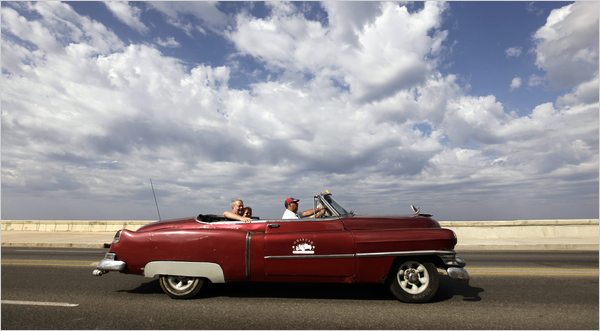
One month after the death of Orlando Zapata Tamayo, weeks into the hunger strike of Guillermo Fariñas and smack in the middle of viral-like attention to the Damas de Blanco, the New York Times regales us with a such a regime-friendly story, that one wonders if it would make Bill Ayers and North Korean guards blush. With the tone of a global warming scientist on an Earth Day lecture tour, the article diligently explains how much the United States is missing out by not investing in Cuba [otherwise known as PLEASE LIFT THE EMBARGO muzak to us veteran observers]. The photograph which accompanies the article, along with it’s comical caption, appear below:

“… a pleasure few Americans have experienced in decades” – New York Times, March 28, 2010

In the photograph, we can make out an Anglo-looking couple in the back seat of a 1952 convertible Cadillac taxi ferreting tourists along Havana’s El Malecón. The male is looking particularly pleased, the type of happiness typically limited to people who star in infomercials. The driver less so. For the driver of the vehicle — whose Morgan Freeman-like role gives the picture an added level of discomfort — the quaintness of the moment somehow escapes him.

Would it be impolite to note that the reason Americans haven’t had the “pleasure of driving 1952 Cadillacs in decades” is that driving 58 year-old vehicles is mainly a pleasurable activity when one is a collector driving around a prized and meticulously kept piece of machinery. When the vehicle in question still exists due to shortages which are endemic to centrally planned economies and only functions due to mechanical improvisations born of desperation, then the thrill be gone brother.

If I didn’t know any better, I’d say the guy in the back seat was Tyler Cowen, the Über-blogging economist from one of my favorite blogs. But upon closer inspection, the codger is a bit too spry to be confused with Mr Cowen. But at a minimum, they share a passion for visiting places before they suffer an improvement in their standards of living. Ahh the cultural left, they are different.

What I can wish upon them is limited, especially during Holy Week. But the Gospel of Matthew comes to mind, as in, “… they have received all the reward they will ever get.”

Article referenced is copied in full at end of post.

———————————————————————-
March 28, 2010
Dreaming of Cuban Profits in Post-Embargo World
By MARC LACEY

CANCÚN, Mexico — Would Americans’ playing bingo in a Havana retirement home violate the Cuban government’s socialist ethos? How about avowed capitalists living on their 401(k) accounts in condominiums along the Cuban coastline? Or, horror of horrors, fast food outlets offering Big Macs, Whoppers and buckets of fried chicken along the seaside Malecón?

Although Cuba remains closed to American investment, dreamers in both countries are actively considering the money-making possibilities that the island might offer once the half-century-old travel and trade embargoes imposed by the United States become policies of the past.

“Cuba does have problems,” said Kirby Jones, a business consultant, stating the obvious at the start of a meeting last week that brought American travel industry executives and Cuban government officials to Cancún to strategize on what might, and what might not, play out in the years ahead.

Mr. Jones urged potential investors to banish certain words from their minds — Bay of Pigs, dissidents, Elián González, hijackers and socialism, for instance — and to focus on the fact that the Cuban government had already joined more than 200 joint ventures with foreign corporations, none of them American.

“Everyone is there, except us,” he told the travel agents, hoteliers, tour operators, charter companies and others with an eye on Cuba. “There are offices and representatives of over 500 companies around the world. Nobody knows when it will open up for Americans, but it will.”

But as Cuban officials nodded and participants scribbled notes, the likelihood of wholesale change in American-Cuban relations, widely considered a possibility in the early days of the Obama administration, seemed slim.

On Wednesday, the day the conference began, President Obama was scolding Cuba for its treatment of dissidents. “Instead of embracing an opportunity to enter a new era, Cuban authorities continue to respond to the aspirations of the Cuban people with a clenched fist,” Mr. Obama said in a statement.

And Cuban papers were reporting Fidel Castro’s written comments the same day calling Mr. Obama a “fanatic” when it comes to capitalism and dismissing his remarks on Cuba as “foolishness.”

Senator Byron L. Dorgan, a North Dakota Democrat, is pushing legislation that would lift the ban on travel, and he offered an optimistic view of his bill’s chance of passing this year. But he also told the Cuban officials at the meeting that they were endangering the legislation by jailing an American government contractor, Alan P. Gross, whom the Cubans accuse of espionage but the State Department says was engaged in democracy-building.

“That sort of thing is a problem and a hindrance to change U.S. policy toward Cuba,” said Mr. Dorgan, addressing the conference by telephone.

The highest ranking Cuban official in attendance, Tourism Minister Manuel Marrero Cruz, brushed off questions of Mr. Gross’s jailing as being outside his portfolio. But he did say that the Cuban government was not concerned about large numbers of visiting Americans prompting any change to Cuba’s government or culture.

As for the likelihood that the embargo would end soon, he shrugged. “It’s impossible to predict,” Mr. Marrero said. “We have many scenarios. We are not waiting for the Americans. We’re developing tourism for others around the world.”

The same thing has happened in other aspects of Cuba’s economy, as the government, which is dependent on imports, has struck deals with countries like China, Venezuela and Iran as well as Britain, France and Spain.

“Cuba already trades with the rest of the world,” said Philip Peters, an expert on the Cuban economy at the Virginia-based Lexington Institute, a policy research group. “A lot of the opportunities are taken already.”

But Cuba may yet offer healthy profits one day to American entrepreneurs who manage to get in.

“It’s going to be a very slow process,” said John S. Kavulich II, an adviser to the U.S.-Cuba Trade and Economic Council in New York, who criticized the Cancún meeting as a show that would probably not lead any of the attendees to real deals in Cuba. “The Cuban government is going to be very cautious about turning over the keys to the country.”

In a telephone interview, Mr. Kavulich said that Cubans already closely identified with many American brands. And he envisions that Coca-Cola, McDonalds and others will have no problem one day establishing themselves, even though Cuban government enterprises now control the market when it comes to cola and fast food.

Katia Alonzo, director of Cuba’s Ministry of Foreign Trade and Investment, made clear that there would be no unregulated rush of outside investment into Cuba. She outlined a few areas the government had identified as essential, including mining, oil exploration and tourism development.

She left unsaid the risks of doing business in a country where the government is used to operating unchecked, like Cuba’s decision last year to freeze hundreds of millions of dollars in bank accounts held by foreign companies.

Already, there is more of an American imprint on the island than during the Bush years. The Cuban government said that 250,000 Cuban-Americans visited from the United States in 2009, up from roughly 170,000 the year before. Mr. Obama’s loosening of restrictions on Cuban-Americans’ travel last year prompted such a crush of new visitors that the Cubans have begun remodeling the airport terminal used for flights arriving from Miami, New York and Los Angeles.

But that is still a long way from opening travel to all Americans, which legislation in Congress would couple with an easing of restrictions on American farm exports to Cuba. The Cuban government has been permitted to buy agricultural products from the United States since 2001, but the Cubans must wire payments to third-country banks before goods are shipped, making other countries’ products far easier to buy. All the same, the agricultural exports to Cuba, which include American meat, shellfish, coffee, bread, wine, cigarettes and pistachios, among other products, reached a peak of $710 million in 2008.

Until other business is allowed, however, the dreaming goes on.

Frank C. Weed, head of real estate investment for The Americas Group, which helps businesses break into emerging markets in Latin America, envisions retirement communities in Cuba one day and American-run golf courses linked with residences that give buyers longtime rights to their vacation homes.

“Not everybody will want to live there,” he acknowledged. “They have to be an adventure seeker.”
———————————————————————

Posted in Cuba | Tagged , , , , | Leave a comment

Marching For Freedom In Cuba On SW 8th Street

Update Mar 27: Click to see the fair Washington Post article about the march.

Practically every person of Cuban descent fortunate enough to be living in the United States hopes and fears the following about the latest turmoil in Cuba: God, please let this be the spark which leads to the end of the dictatorship. Soon after though, our own Screwtape’s are whispering, … ‘and just how many times have you thought that before. Don’t get your hopes up [it was ‘kid’ when I first started hoping] viejo.’

We must ignore the demons in our heads, even as the Orlando Zapata’s and Yoani Sanchez’s of Cuba ignore the demons in their faces. This may not be ‘it,’ but when it happens, it will likely evolve as this has evolved. A few brave women and men taking a stand against a corrupt oppressor. As the struggle expands, more become aware and join in. We await the Tipping Point. The outer band of the struggle hits Miami on Thursday.

Leading the march is Gloria and Emilio Estefan – this from the Miami Herald article:

Dressed in white at a news conference, the Cuba-born singer and songwriter passionately urged Cuban exiles and others to join her in the march as an expression of solidarity with the Cuban women who last week were violently harassed during a street march to mark the anniversary of the 2003 jailing of 75 dissidents. The Miami march is being held on Calle Ocho, beginning at 6 p.m. Thursday.

“The moment has arrived for us, the Cubans who live in freedom, and all those who wish to join, to offer absolute support and encouragement to the ladies and the people of Cuba,” said Estefan, standing at a lectern in the main dining room of Bongos Cuban Cafe at the American Airlines Arena in downtown Miami.

The announcement comes just a week after members of Ladies in White were confronted violently by Cuban security forces and pro-government civilians in Havana. Members said they were punched, pinched, scratched and had their hair pulled by security agents and civilians, who made rude gestures and swore at them. Agents also dragged them away in buses.

On Tuesday, Estefan asked those who plan to take part in Thursday’s march to wear white, the color worn by the Cuban women’s group. She also encouraged non-Cubans to join her and Cuban exiles: “Our Anglo brothers, our African-American brothers, our Haitian brothers . . . people from all nationalities . . . anybody that loves freedom, anybody that wants to join our cause, of course is invited and welcome.”

Thanks to Rolando Pulido for the graphic above and as usual, to Babalu and Robert Molleda for keeping the rest of us aware of those out there helping in whatever way they can.

The Miami Herald article about the upcoming march is copied in full at end of post.

———————————————————————–
Gloria Estefan calls for march to support Cuba’s ‘Ladies in White’

Posted on Wed, Mar. 24, 2010

BY ALFONSO CHARDY
achardy@ElNuevoHerald.com

Cuban music star Gloria Estefan, speaks during a press conference with a group of artists to call for a march along SW 8 ST next Thursday to support Las Damas de Blanco- Ladies in White marching on Havana Streets for the last seven years asking for their relative freedom. The event took place at Bongo’s Cafe in Miami.

Cuban music star Gloria Estefan, speaks during a press conference with a group of artists to call for a march along SW 8 ST next Thursday to support Las Damas de Blanco- Ladies in White marching on Havana Streets for the last seven years asking for their relative freedom. The event took place at Bongo’s Cafe in Miami.
In a rare personal move, Miami musical icon Gloria Estefan stepped into the international political spotlight Tuesday to say she was organizing a Little Havana march in support of Las Damas de Blanco (Ladies in White), the wives and mothers of imprisoned Cuban opponents of the Raúl Castro regime.

Dressed in white at a news conference, the Cuba-born singer and songwriter passionately urged Cuban exiles and others to join her in the march as an expression of solidarity with the Cuban women who last week were violently harassed during a street march to mark the anniversary of the 2003 jailing of 75 dissidents. The Miami march is being held on Calle Ocho, beginning at 6 p.m. Thursday.

“The moment has arrived for us, the Cubans who live in freedom, and all those who wish to join, to offer absolute support and encouragement to the ladies and the people of Cuba,” said Estefan, standing at a lectern in the main dining room of Bongos Cuban Cafe at the AmericanAirlines Arena in downtown Miami.

The announcement comes just a week after members of Ladies in White were confronted violently by Cuban security forces and pro-government civilians in Havana. Members said they were punched, pinched, scratched and had their hair pulled by security agents and civilians, who made rude gestures and swore at them. Agents also dragged them away in buses.

On Tuesday, Estefan asked those who plan to take part in Thursday’s march to wear white, the color worn by the Cuban women’s group. She also encouraged non-Cubans to join her and Cuban exiles: “Our Anglo brothers, our African-American brothers, our Haitian brothers . . . people from all nationalities . . . anybody that loves freedom, anybody that wants to join our cause, of course is invited and welcome.”

She also personally relayed news of the Miami march to Laura Pollán, spokeswoman for the Ladies in White, reached by phone in Havana during the news conference.

Pollán expressed gratitude. “It’s an honor,” Pollán said, during a shaky phone connection in which every other word was audible.

Estefan and exile community leaders hope the singer’s leadership and name recognition will draw international media attention to the plight of dissidents in Cuba, particularly the Ladies in White, and independent journalist Guillermo Fariñas, who has been on a hunger strike since Feb. 24.

Estefan’s aides said that while she has not shied away from broaching opposition to the Cuban regime during her public career, this represents the first time the beloved artist has taken up the issue on a “grand scale.”

So it was on Tuesday when a very different Estefan stepped up to the podium — emerging as a leader with a very political message to deliver.

At the event were several prominent Cuban exile leaders, including Jorge Más Santos of the Cuban American National Foundation, and Ninoska Pérez-Castellón, of the Cuban Liberty Council. Also joining her: singer Willy Chirino, Mayor Tómas Regalado of Miami and several former Cuban political prisoners.

Estefan was dressed in white and, before the announcement, sat among a group of women also dressed in white. She stood at a lectern flanked by photos of the Ladies in White being dragged away by security agents.

Behind Estefan: a photo of Orlando Zapata Tamayo, a dissident who died Feb. 23 after an 83-day hunger strike, in the middle of a Cuban flag.

Regalado said Miami police planned to close Calle Ocho beginning at 2 p.m. Thursday and that Estefan planned to cover expenses incurred by city police in providing security.

In addition to wearing white, Estefan asked that everyone carry gladiolas and march in silence from 27th to 22nd Avenues, beginning at 6 p.m.

The Ladies in White was formed in 2003 after the Black Spring government crackdown against dissidents in which husbands and sons were picked up and became political prisoners. The women wear white and march periodically, flowers in hand — mostly gladiolas. Last week, the group marched for seven consecutive days to mark the seventh anniversary of the crackdown.

Read more: http://www.miamiherald.com/2010/03/23/v-print/1544287/estefan-calls-for-march-to-support.html#ixzz0j6zHYyVD
———————————————————————

Posted in Cuba | Tagged , | Leave a comment

CBO Numbers Outsourced: Imagine The Potential

Congressional Democrats success at selling numbers produced by the Congressional Budget Office [CBO] which are based on assumptions which no one believes got me to thinking. Perhaps we can outsource the CBO to other organizations which could benefit from such rigorous wishful thinking.

If CBO is allowed to produce financial projections for private industries, these headlines might be coming to a blog or newspaper near you:

  • Higher taxes not expected to adversely impact economic growth
  • Government workers are actually more motivated than those who are self-employed
  • Strong unions not seen as an impediment to productivity
  • Family economic hardships have no effect on decisions to divorce
  • New Oreo diet rocks the world of nutrition
  • Insecurity and indecisiveness seen as aphrodisiacs by women [courtesy of Albert Brooks]
  • New federal government entitlement to pay for itself [this study is being offered at a discount, given that it has already been used].

Proposed CBO Warning Label

Tagged , , | Leave a comment

If Uncle George Had Ovaries, She’d Be Aunt Megan

That’s George Will and Megan McArdle. While not a conservative, she is Will-like in her logic and arguments. Some recent examples:

Ms McArdle on the Democrat’s abortion of a health care bill:

What I hope is that the Democrats take a beating at the ballot box and rethink their contempt for those mouth-breathing illiterates in the electorate. I hope Obama gets his wish to be a one-term president who passed health care. Not because I think I will like his opponent–I very much doubt that I will support much of anything Obama’s opponent says. But because politicians shouldn’t feel that the best route to electoral success is to lie to the voters, and then ignore them.

We’re not a parliamentary democracy, and we don’t have the mechanisms, like votes of no confidence, that parliamentary democracies use to provide a check on their politicians. The check that we have is that politicians care what the voters think. If that slips away, America’s already quite toxic politics will become poisonous.

Read as Ms McArdle takes on the supposed claims of the benefits to be derived from the health care legislation, as the proponents are already running away from any measurable effects which can be attributed to the new federal entitlement:

Americans were not told that American households would be 1% less worried about bankruptcy, or that we’d save a hundred thousand lives over thirty years. They were regaled with eye-popping statistics on deaths from lack of health insurance–I certainly was, by many of the very same commentators who are now suddenly wary of prediction making. If you quoted those statistics, you were committing to a pretty strong position on the benefits of this bill.

I mean, maybe we say that there are a bunch of combo benefits: we reduce bankruptcies by a third, save five thousand lives a year, get some harder-to-measure morbidity benefits, and so on. But there have to be some measurable benefits. If this helps families stave off financial ruin, we should see a meaningful and sustained reduction in the number of bankruptcies. If it improves health, that should show up in life expectancy. If it doesn’t, then the bill doesn’t do what you said you expected it to do. That’s valuable information! Not so much about you, as about health care bills.

If you don’t think that any of the effects of this bill will be large enough to measure and hopefully, large enough to justify the price tag of this bill, then I have to ask two questions:

1) Why the hell are we spending $200 billion a year, plus the mandated spending by individuals and employers on premiums, plus the new money the states will have to spend on Medicaid?

2) Why on earth did you bring up all these apparently irrelevant statistics?

I’m all for accountability for beliefs. That’s how you make your beliefs better. That’s why I want to see all the people who threw around all sorts of theatrical arguments commit to what they are actually reasonably willing to predict will happen. Then explain why the outcomes that they are actually confident enough to predict justify spending about $2000 for every household in the country.

I don’t think that’s unreasonable. I sure wish people had done it before the bill passed–it would keep us more honest in our debates. But post-facto accountability is still a lot better than nothing. Otherwise the bill’s supporters, and opponents, will be too tempted to move the goalposts.

Tagged , | Leave a comment

Welcome to the Gradual Revolution

Posted in Current Affairs & History | Tagged , | Leave a comment

How Expensive Will The Nanny State Become?

One of the best blogging academic economists — Greg Mankiw — gives his perspective on the federal health care takeover:

In the end, while I understood the arguments in favor of the bill, I could not support it. In part, that is because I am generally more of a libertarian than a communitarian. In addition, I could not help but fear that the legislation will add to the fiscal burden we are leaving to future generations. Some economists (such as my Harvard colleague David Cutler) think there are great cost savings in the bill. I hope he is right, but I am skeptical. Some people say the Congressional Budget Office gave the legislation a clean bill of health regarding its fiscal impact. I believe that is completely wrong, for several reasons (click links). My judgment is that this health bill adds significantly to our long-term fiscal problems.

The Obama administration’s political philosophy is more egalitarian and more communitarian than mine. Their spending programs require much higher taxes than we have now and, indeed, much higher taxes than they have had the temerity to propose. Here is the question I have been wondering about: How long can the President wait before he comes clean with the American people and explains how high taxes needs to rise to pay for his vision of government?

I assume the question is rhetorical. A public figure, like our president, who can’t even bring himself to allow mere citizens to see his college transcripts and papers, will not soon be fessing up about the prohibitive cost of operating his version of government.

By the way, Communitarian or Nanny State, are politically correct labels for political philosophies which are closer, or prefer, socialized forms of government as opposed to a more laissez-faire form of government. The point is not whether we are strictly in one category or another [we are exclusively in neither], but rather which form of government are we moving towards. There is no question that the Obama administration is moving us aggressively away from laissez-faire form of government. In my book, Socialism lies at the other end of that spectrum. So the question to be answered by those who object to the Socialist label is: What aspects of Socialism are objectionable to today’s leaders of the Democrat party?

Tagged , | Leave a comment

Realpolitik or Rationalizing a Lack of Nerve?

The WSJ’s Mary Anastasia O’Grady highlights the moral cowardice of Latin American leaders.

Mexican President Felipe Calderón wore a broad smile as he warmly greeted Cuba’s Raúl Castro at the Rio Group summit on the posh Mexican Riviera last week. The two men, dressed in neatly pressed guayabera shirts, shook hands as Mr. Calderón, with no small measure of delight, gestured to his audience to welcome Mexico’s very special guest.

A mere 300 miles away, in a military prison hospital in Havana, political prisoner Orlando Zapata lay in a coma. For 84 days the 42-year-old stone mason of humble origins had been on a hunger strike to protest the Castro regime’s brutality toward prisoners of conscience. His death was imminent.

But over at the Playa del Carmen resort on the Yucatán, Mr. Calderón wasn’t about to let Zapata spoil his fiesta, or his chance to improve his image among the region’s undemocratic governments. The summit went on as planned with no mention of Havana’s human-rights hell. On Tuesday Zapata passed away.

Zapata’s death while Latin American leaders broke bread with Castro is a coincidence that captures the cowardice and expediency toward Cuban oppression that has defined the region for a half century. Now the Latin gang, with Cuba as a prominent member, has decided to form a new regional body to “replace” the Organization of American States. To make their intentions clear, they banned Honduras’s democratically elected President Porfirio Lobo from last week’s meeting.

The Castro’s, Chavez’s and Jong-il’s of the world aside, let’s assume for the sake of argument that a majority of leader’s are decent people with good intentions. Their problems in governing are more complicated than those of us not privy to all the facts can appreciate.

So if you’re a Felipe Calderón — a self-described devout Catholic — perhaps you hold your nose, say a silent prayer for Orlando Zapata and stick out your hand towards the oncoming Raúl Castro. You do so because you have been reminded repeatedly — as was your predecessor and mentor, Vicente Fox — that your country’s especially large and poor population would be very susceptible to the type socialist snake-oil pitch which allowed totalitarian dictatorships to consolidate power in Cuba and Venezuela. In short, you are now the latest practitioner of Realpolitik.

My first crushing awareness of Realpolitik occurred when President Ford refused to meet with Alexander Solzhenitsyn. All seemed lost at the time. If the US president was too cowed to meet one of the great heroes in the struggle against communism, what hope was there?

Obviously, all was not lost. Within 5 years — Pope John Paul II, Thatcher, Reagan and Afghanistan — conditions would so change that it would mark the beginning of the end for the biggest practitioner of communism. We also know from the history of the period that Ford himself took many other steps during his administration to oppose communism. He just did not feel he could take that particular step at that particular time.

Unfortunately for Ford — who went on to lose the election, partly due to the fact that he had to fight off a primary challenge from the right in Ronald Reagan, partly due to his Solzhenitsyn snub — his Chief of Staff, Dick Cheney, was right. Solzhenitsyn was not just another meeting. He was not just another chip before a summit with the Soviets. In fact, it turns out that the summit for which Solzhenitsyn was sacrificed was a low point in the Cold War for the US, the Helsinki Accords.

My point being that leaders practice Realpolitik all the time, trusting their instincts — another word for morals — about when to shake that blood soaked hand and when to refuse. Ford’s instincts failed him in the Solzhenitsyn decision and he paid a price in an appropriate manner. Political defeat and the self-knowledge of having acted fecklessly in one very public test of character.

If the death of Orlando Zapata sparks the revolt those of us rooting for Cuba’s freedom hope it will, then perhaps Felipe Calderón’s moral cowardice at the summit will eventually be seen by all as it was accurately described by Ms. O’Grady.

One thing is certain if Felipe Calderón is a devout Catholic. At the outset of this Lenten season, he turned his back on the poor, sick and oppressed to be in the company of a latter day version of the Sanhedrin. If you are standing behind Felipe waiting to confess, may I suggest an alternate location? Then again, these are the types of actions that can keep people, mistakenly, away from confession altogether.

The O’Grady WSJ column referenced is copied in full at end of post.

—————————————————————————-
Viva Zapata

A Cuban dissident is murdered while Latin leaders schmooze with Castro.

By MARY ANASTASIA O’GRADY

Mexican President Felipe Calderón wore a broad smile as he warmly greeted Cuba’s Raúl Castro at the Rio Group summit on the posh Mexican Riviera last week. The two men, dressed in neatly pressed guayabera shirts, shook hands as Mr. Calderón, with no small measure of delight, gestured to his audience to welcome Mexico’s very special guest.

A mere 300 miles away, in a military prison hospital in Havana, political prisoner Orlando Zapata lay in a coma. For 84 days the 42-year-old stone mason of humble origins had been on a hunger strike to protest the Castro regime’s brutality toward prisoners of conscience. His death was imminent.

Zapata’s grim condition was no secret. During his strike, for 18 days, he had been denied water and placed in front of an air conditioner. His kidneys had failed and he had pneumonia. For months human-rights groups had been pleading for international attention to his case.

But over at the Playa del Carmen resort on the Yucatán, Mr. Calderón wasn’t about to let Zapata spoil his fiesta, or his chance to improve his image among the region’s undemocratic governments. The summit went on as planned with no mention of Havana’s human-rights hell. On Tuesday Zapata passed away.

Zapata’s death while Latin American leaders broke bread with Castro is a coincidence that captures the cowardice and expediency toward Cuban oppression that has defined the region for a half century. Now the Latin gang, with Cuba as a prominent member, has decided to form a new regional body to “replace” the Organization of American States. To make their intentions clear, they banned Honduras’s democratically elected President Porfirio Lobo from last week’s meeting.

The Mexican foreign ministry did not respond to several requests last week for a statement from Mr. Calderón on Zapata’s death. Its silence suggests that the only thing the Mexican president regrets is the unfortunate timing of the dissident’s demise.

Yet Zapata hasn’t gone quietly. His passing has once more elevated the truth about the lives of 11 million Cubans enslaved for the last 50 years under a totalitarian regime. And it has embarrassed the likes of Mr. Calderón. Newspapers across the globe, from Buenos Aires to Madrid, are denouncing the mind-boggling hypocrisy of those who feign concern for human rights while embracing Castro.

Like most Cuban dissidents, Zapata did not so much choose his role as martyr as it chose him. Born in the province of Holguin in the eastern part of the country, he moved through the Cuban education system as any ordinary citizen.

But the requisite Marxist indoctrination didn’t take. Like so many Cuban patriots before him, once his conscience had been awakened no measure of cruelty could stop him from speaking out.

Zapata became part of a wave of peaceful resistance that began to organize and grow bolder in the late 1990s and early 2000s. He was detained three times in 2002. According to Miami’s Cuban Democratic Directorate, which tracks dissident activity, he was arrested for a fourth time on Dec. 6, 2002, “along with [the prominent pacifist and medical doctor] Oscar Elías Biscet.”

Dr. Biscet, a devout Catholic and disciple of Martin Luther King Jr.’s adherence to nonviolence, began opposing the regime when he learned of its policy of suffocating babies who survived abortions. Today he is considered one of the island’s most important human-rights defenders. His continuing imprisonment and torture are well documented. It is not known whether Mr. Calderón, who also describes himself as a Catholic, discussed Mr. Biscet’s plight with his guest Raúl.

Zapata was arrested again in March 2003 along with 74 others in what the resistance calls the “black spring.” This time he was held and in May 2004 he was sentenced to 25 years. But his commitment to his brethren never wavered. Indeed, it deepened.

In July 2005, at the Taco Taco prison, he took part in a nonviolent protest marking the 1994 massacre of 41 Cubans who had tried to flee the island on a tugboat and were drowned by state security. That got him another 15 years in the clink.

Zapata was judged guilty of “disobedience to authority” and was repeatedly tortured. But he died a free man, unbroken and unwilling to give up his soul to the regime, which is more than can be said for Mr. Calderón. Word is that Mr. Calderón noticed the offshore drilling contracts Castro has given to Brazil’s Petrobras and is cuddling up to the dictator in hopes that Mexico’s Pemex will be next.

As to Cuban freedom, the yearning lives on, and Zapata’s death is already serving as a source of renewed inspiration to the movement. The regime knows this, which is why state security put his hometown on lockdown the day of his funeral. Even as Cubans mourn their loss, it is certain that, treasuring his personal triumph over evil and his gift of bravery to the nation, they will not let his death be in vain.

Write to O’Grady@wsj.com
———————————————————————

Posted in Cuba | Tagged , | Leave a comment