
How AMT confuses taxpayers

WSJ Tax article
——————————————————————
How AMT Confuses Taxpayers

AUGUST 13, 2008

By TOM HERMAN

If you’re confused by the alternative minimum tax, you have lots of company.

A new Treasury Department report says about 226,000 federal income-tax returns filed in 2006 either failed to include the AMT when it apparently should have been or contained “discrepancies” in calculating the amount of the tax. The report, issued by the Treasury Inspector General for Tax Administration, also found a few cases in which the Internal Revenue Service itself made errors.

Of those 226,000 returns, about 165,000 showed differences between what taxpayers thought they owed and what the IRS later calculated they owed, says the report. The other 61,000 returns appeared to owe more tax because of the AMT but didn’t include it.
Additional Reading

The AMT, originally designed to make sure a small number of high-income Americans pay at least some federal income tax, has become one of the biggest and most tangled tax-law webs ever devised by Congress. Last year, the tax ensnared an estimated four million taxpayers, up from about 1.1 million in 2001. Unless Congress changes the law, the number of AMT victims will soar to more than 26 million this year, the Treasury Department estimates.

One reason many people may assume they don’t have to worry about the AMT is that they’d heard it was originally aimed only at the rich. True enough. But the tax has expanded rapidly, especially over the past decade, and now is hitting many not-so-wealthy people, too — often much to their amazement.

“Many people discover they’re in the AMT only after they’ve filed and later get a notice” from the IRS informing them they hadn’t paid enough because they neglected to calculate their AMT liability, says Len Burman, director of the Urban-Brookings Tax Policy Center and a former Treasury official.

Even if you’ve done your own return for years, the AMT can be surprisingly deep water. “I would guess virtually all of these errors are inadvertent and reflect taxpayer confusion and ignorance about their requirement to pay AMT or how to compute it,” says Eric Toder, a former IRS director of research and now a senior fellow at the Urban Institute. Mr. Toder also says the number of taxpayer errors could grow much larger if Congress fails to curb the AMT’s rapid growth.
[chart]

Congress is expected to approve a stopgap measure this year, known in Washington parlance as a “patch,” designed to prevent the number of AMT victims from soaring. The Bush administration and influential members of both political parties agree on the need for some kind of temporary solution. But nobody knows when Congress will act or precisely what it will do.

Speculation is growing that Congress may even wait until after the elections, in a special “lame duck” session, to act on this issue and also to resurrect several popular tax breaks that expired at the end of last year. Among those breaks is the option to deduct state and local sales taxes, instead of state and local income taxes, on federal returns.

The AMT operates under many different rules than the regular tax system. For example, it has different allowable deductions, credits and other items. For example, some popular deductions allowed under the regular system, such as state and local taxes, aren’t permitted under the AMT. Among those taxpayers most likely to be affected by the AMT are large families who live in high-tax areas, such as New York City, Washington, D.C., California and New Jersey, and whose income ranges between $100,000 and $500,000.

Winslow Marston, a retired bond analyst who lives in Morristown, N.J., was one of those who were surprised by the AMT last year. “I am one of the poor little schlemiels who is now trapped by the AMT,” he says. He assumes the main reason was his family’s high New Jersey taxes. “This part of the tax code strikes me as not only illogical, but even unconstitutional,” he says. “Basically, it makes no sense to tax people more who already are paying more taxes at the state level.”

The Treasury report urges the IRS to provide information to its examiners reiterating the importance of correctly resolving AMT discrepancies and highlighting specific issues that could lead “incorrect resolution.” The IRS said it agrees and will do so late this year.

One way to avoid an AMT-related mistake on your return is to use tax-preparation software, such as Intuit Inc.’s TurboTax. That can help alert you to whether you’re subject to the AMT and do the number-crunching for you.

A web site offers help to investors who may benefit from a recent IRS courtroom defeat.

Many insurance companies that once were owned by their policyholders converted years ago into publicly traded companies, a process known as “demutualization.” The IRS said the shares that policyholders received in the process had a tax cost of zero. Last week, the U.S. Court of Federal Claims disagreed. For a copy of the opinion and background on the topic, go to http://www.demutualization.biz. This site was set up by Charles D. Ulrich, a Baxter, Minn., certified public accountant who has long argued the IRS was wrong.

A Justice Department spokesman says “no determination has been made as yet” on whether to appeal the decision.
———————————————————–
Posted in Business & Economics | Tagged , , , | Leave a comment

>Theme Parks – Separate and Unequal?

>I visited the Disney World and Universal theme parks in Orlando on vacation recently. It reminded me of the difference in how they choose to manage the lines for their rides. Universal allows visitors to pay their way out of long lines [Express pass] with an additional daily charge or for staying at one of their resorts. Disney [Fast pass] allows visitors to select which rides they can eliminate their wait times for, but severely restricts the number times of times it can be used.

I prefer Disney’s way of attempting to manage the lines. Here I must admit to a socialist tendency in my otherwise right-wing-Cuban-exile DNA. In our increasingly [by choice] segregated lives, I much prefer the ‘we’re all equal here’ mind-set which the Disney way encourages. Part of the appeal in visiting a theme park is the people-watching aspect. Some of it can be mean-spirited [obesity on parade? – see Michael Fumento]. But mostly it’s a very positive reinforcement of those things we have in common with other people, and especially parents, who don’t look like us.

At Disney, when you stroll past those in a regular line with your Fast pass, there are no issues since you are exercising an option which was available to them as well. To paraphrase John [keeping it Rielle] Edwards, the two Americas are on the same vacation page. But that all changes at Universal.

At Universal, it feels as though social stratification never takes a vacation. I’ve had Universal’s Express pass the last few times I’ve visited and I find myself never making eye contact with the people in line I’m walking past – almost like I don’t want to rub it in. Now the guy in line with the 2.5 kids may have $2.5 million in an IRA and fully funded his kid’s college tuition, but that’s not the point. He may also be getting embarrassed and then resentful about having to explain to his kids that they can’t afford the pass which is allowing others to walk past them.

Those of you without kids may be tempted to suggest that if you just explain …, please rid yourself of such nonsensical notions now. If as a parent you’re having that conversation, you have officially left ‘happy-land’ and won’t be returning until you get on the ride or the next purchase.

Some basics about Theme Park attendance as provided by TEA – in 2007 the combined visitors to the 4 Disney parks in Orlando totaled approx 47 million as compared to the 2 Universal parks total of 11.5 million – or about 25% of Disney’s visitors – see the worldwide top 15 list below.

  1. MAGIC KINGDOM at Walt Disney World, Lake Buena Vista, FL, USA 17,060,000
  2. DISNEYLAND, Anaheim, CA, USA 14,870,000
  3. TOKYO DISNEYLAND, Tokyo, Japan 13,906,000
  4. TOKYO DISNEYSEA, Tokyo, Japan 12,413,000
  5. DISNEYLAND PARIS, Marne-La-Vallee, France 12,000,000
  6. EPCOT at Walt Disney World, Lake Buena Vista, FL, USA 10,930,000
  7. DISNEY’S HOLLYWOOD STUDIOS at Walt Disney World, Lake Buena V 9,510,000
  8. DISNEY’S ANIMAL KINGDOM at Walt Disney World, Lake Buena Vista, FL 9,490,000
  9. UNIVERSAL STUDIOS JAPAN, Osaka, Japan 8,713,000
  10. EVERLAND, Kyonggi-Do, South Korea 7,200,000
  11. UNIVERSAL STUDIOS at Universal Orlando, Orlando, FL 6,200,000
  12. SEAWORLD FLORIDA, Orlando, FL, USA 5,800,000
  13. DISNEY’S CALIFORNIA ADVENTURE, Anaheim, CA, USA 5,680,000
  14. PLEASURE BEACH, Blackpool, UK 5,500,000
  15. ISLANDS OF ADVENTURE at Universal Orlando, Orlando, FL, USA 5,430,000

Posted in 2TG Favorites | Tagged | 2 Comments

House-hoppers may suffer

WSJ Tax article
——————————————————————
House-Hoppers May Suffer Under New Tax Rules Housing Package Makes It Harder To Exclude Gains

AUGUST 6, 2008

By TOM HERMAN

Life is getting tougher for some people who own more than one home.

Part of the housing-stimulus package signed into law last week by President George W. Bush could reduce — though not eliminate — the appeal of a tax-saving strategy used by wealthy home-hoppers.

While the new law won’t affect the vast majority of the nation’s homeowners, it will likely affect some people planning to sell their primary residence, claim the full home-sale exclusion to pay little or no capital-gains taxes — and then move to a second or third home they’ve owned for some time, convert it into their primary residence, sell it and once again pay little or no capital-gains tax.

Under both the old and new law, most homeowners can sell their primary residence and exclude as much as $250,000 of the gain if they’re single, or as much as $500,000 if they’re married and filing jointly with their spouse. To qualify for the full exclusion, owners typically must have owned the home and used it as their primary residence for at least two of the five years prior to the sale.
[chart]

But under the new law, which takes effect next year, many owners might not be eligible to claim the full exclusion on a vacation or rental home they convert to a primary residence.

Congressional staffers estimate the new restrictions will raise about $1.4 billion in revenue for the U.S. Treasury Department over the coming decade. The move was designed to help offset costs of other breaks in the new law and also plug what congressional staffers viewed as a major loophole in a law enacted in the late 1990s.

The new law “will certainly complicate tax returns” and tax planning for some people, says John Olivieri, a tax partner at the White & Case law firm in New York. It also “contains traps for the unwary,” he says.

Most people don’t have to worry about the new law since most don’t own multiple homes, and many who do will never convert theirs to a principal residence. Even if they did, they wouldn’t dream of moving and jumping through legal hoops just to save taxes — and their second or third home might not work well as their primary residence anyway. Also, with home prices in a deep slump, many homeowners probably don’t have large gains to shelter.

Even so, tax lawyers predict the new law probably will prompt some wealthy people who own several homes to rethink the home-hopper strategy. “I know one individual with four homes who had planned to convert each of his three vacation and resort properties to a principal residence” and sell each at varying intervals to take advantage of the full home-sale exclusion, thus paying little or no capital gains tax, says Linda Goold, tax counsel at the National Association of Realtors in Washington. “It won’t be as easily done now.”

Here’s a primer on the basics and a summary of the changes, along with an example of how it’s supposed to work:

The basics. When the law was changed in 1997, government officials said it would mean that most people who sell their primary residence don’t owe any federal capital-gains taxes. Even if you can’t meet the requirements for the full home-sale exclusion, you may still be able to claim a partial exclusion depending on how long you owned and lived in the home and why you sold it.

For example, you might be eligible for a partial exclusion if you had to sell because of a change in your place of employment, or for health reasons, or for certain “unforeseen circumstances,” such as the death of your spouse, says Bob D. Scharin, senior tax analyst at the tax and accounting business of Thomson Reuters.

As with so many other tax laws, there are important exceptions. For example, there are special rules for members of the uniformed services and the Foreign Service, and for certain employees of the intelligence community, such as the Central Intelligence Agency. Also, the exclusion doesn’t apply to the extent the gain is attributable to depreciation allowed for rental or business use of your principal home for periods after May 6, 1997.

These home-sale exclusion rules apply only when you sell your primary residence. But in the late 1990s, real-estate agents, developers and others discovered special benefits for home-hoppers: These owners could pay little or no capital-gains taxes by carefully timing which home they used as their primary residence and when they sold it.

For example, consider a married couple with several homes who had lived in their main home for two years or more. They typically could sell their primary residence, exclude as much as $500,000 of the gain from tax — and then move into a vacation home, make it their new primary residence, live in it two years or more, sell it and once again take advantage of the full $500,000 exclusion.

A new twist. Under the new law, you can’t exclude the gain from the sale of the home allocated to periods of “nonqualified use.” That typically refers to any period (after the end of 2008) when the property isn’t used by you, your spouse or former spouse as a principal residence, according to a congressional staff summary. Also, the new law is effective only for sales beginning next year.

Here’s an example: Suppose a married couple buys a home on Jan. 1 next year for $600,000, says Mr. Olivieri of White & Case. They plan to hold it as an investment. On Jan. 1, 2012 — three years later — they begin using it as their principal residence. They live there two years and sell it on Jan. 1, 2014 for $1.1 million, for a profit of $500,000.

Under the old law, they would have been able to exclude the entire $500,000 gain from their taxable income, Mr. Olivieri says. But under the new law, they could exclude only two-fifths of the gain, or $200,000, since the other three-fifths would be considered attributable to the three years the home wasn’t their principal residence, he says.

So what, if anything, should homeowners do? For starters, before buying a second home, consider consulting a tax professional, says White & Case’s Mr. Olivieri. He points out there are important exceptions to the new rules. It’s remarkably easy for people who aren’t experts and who rely solely on common sense to make costly mistakes.

For more details and examples of how the new law works, visit the Web site of Congress’s Joint Committee on Taxation (www.jct.gov) and look for publication JCX-63-08, dated July 23, 2008.

Many taxpayers who take the standard deduction get a new break.

The new housing law includes a property-tax deduction for people who claim the standard deduction instead of itemizing. They are allowed to claim an additional standard deduction for 2008 for the state and local property taxes they paid during the year — up to $1,000 for married couples filing jointly and $500 for other filers, says Bob Trinz, senior tax analyst at the Tax & Accounting business of Thomson Reuters.

If the actual amount of property taxes you paid is less than that, you can deduct only the amount you actually paid. Taxes written off as business deductions don’t count, Mr. Trinz says. This new deduction is available only for 2008.

Taxpayers most likely to benefit from it include “homeowners who have paid off their mortgage (and, therefore, no longer itemize interest payments) and lower-income homeowners (whose overall itemized deductions generally do not exceed their standard deduction),” according to a report by CCH, a Wolters Kluwer business.

About 63% of all the federal individual income-tax returns filed for 2006 claimed the standard deduction instead of itemizing, according to IRS preliminary data.
———————————————————–

Posted in Financial Planning | Tagged , , , , | Leave a comment

They eat their own PhD’s – A PC tale

Be afraid, be very afraid. If there was a cheesy documentary made about the side effects of political correctness, that’s your opening voice-over. What’s sobering about the person whose plight I highlight is that he was one of, if not the, beautiful people. A brief description of Larry Summers from a 2007 NYT article:

At age 52, he has already finished his first three careers. The son of two economists at the University of Pennsylvania and the nephew of two Nobel-winning economists, he enrolled at M.I.T. when he was 16. Then came the swift rise to tenure at Harvard, a flurry of research papers on seemingly every major topic in economics and an award called the John Bates Clark Medal, given every other year to the best economist under 40. “I’ve been around some pretty smart people,” said Jonathan Gruber, an M.I.T. economist and a former student of Summers’s. “But it’s a different level with Larry.”

His PC crime? In 2005, as president of Harvard, he wondered whether there were some innate differences between men and women which accounted for men dominating the field of science. An uproar ensued and he was forced to apologize and then resign … yada yada yada. My favorite reaction was that of the MIT professor, Nancy Hopkins, who said the following:

When he started talking about innate differences in aptitude between men and women, I just couldn’t breathe because this kind of bias makes me physically ill.

OK, so we got a brilliant scholar who gets his privates cut off for thinking out loud. Big deal, academia is the birthplace of PC, this stuff is common. Posner’s blog even makes the case that CEO types shouldn’t really expect to enjoy freedom of speech. But that’s not the punch line. The punch line is that he was right.

Right as in proven. Right as in various independent studies confirmed his hypothesis. If I was ever that right about something I had been vilified about, the victims of my subsequent I told you so’s could probably light up a suicide hotline’s switchboard. But I hate to brag and digress.

Anyways, it gets better. As the data and studies accumulate which prove Mr Summers correct, reputable news publications continue to state the opposite. Like lower-weight Mexican boxers, PC soldiers don’t go down easily! See the post from the Marginal Revolution blog copied below:

Summers Vindicated (again)

For the past week or so the newspapers have been trumpeting a new study showing no difference in average math ability between males and females. Few people who have looked at the data thought that there were big differences in average ability but many media reports also said that the study showed no differences in high ability.

The LA Times, for example, wrote:

The study also undermined the assumption — infamously espoused by former Harvard University President Lawrence H. Summers in 2005 — that boys are more likely than girls to be math geniuses.

Scientific American said:

So the team checked out the most gifted children. Again, no difference. From any angle, girls measured up to boys. Still, there’s a lack of women in the highest levels of professional math, engineering and physics. Some have said that’s because of an innate difference in math ability. But the new research shows that that explanation just doesn’t add up.

The Chronicle of Higher Education said:

The research team also studied if there were gender discrepancies at the highest levels of mathematical ability and how well boys and girls resolved complex problems. Again they found no significant differences.

The Marginal Revolution blog continued; “All of these reports and many more like them were false.”

In fact, consistent with many earlier studies (JSTOR), what this study found was that the ratio of male to female variance in ability was positive and significant, in other words we can expect that there will be more math geniuses and more dullards, among males than among females. I quote from the study (VR is variance ratio):

Greater male variance is indicated by VR > 1.0. All VRs, by state and grade, are >1.0 [range 1.11 to 1.21].

Notice that the greater male variance is observable in the earliest data, grade 2. (In addition, higher male VRS have been noted for over a century). Now the study authors clearly wanted to downplay this finding so they wrote things like “our analyses show greater male variability, although the discrepancy in variances is not large.” Which is true in some sense but the point is that small differences in variance can make for big differences in outcome at the top. The authors acknowledge this with the following:

If a particular specialty required mathematical skills at the 99th percentile, and the gender ratio is 2.0, we would expect 67% men in the occupation and 33% women. Yet today, for example, Ph.D. programs in engineering average only about 15% women.

So even by the authors’ calculations you would expect twice as many men as women in engineering PhD programs due to math-ability differences alone (compare with the media reports above). But what the author’s don’t tell you is that the gender ratio will get larger the higher the percentile. Larry Summers in his infamous talk, was explicit about this point:

…if one is talking about physicists at a top twenty-five research university, one is not talking about people who are two standard deviations above the mean…But it’s talking about people who are three and a half, four standard deviations above the mean in the one in 5,000, one in 10,000 class. Even small differences in the standard deviation will translate into very large differences in the available pool substantially out.

If you do the same type of calculation as the authors but now look at the expected gender ratio at 4 standard deviations from the mean you find a ratio of more than 3:1, i.e. just over 75 men for every 25 women should be expected at say a top-25 math or physics department on the basis of math ability alone (see the extension for details on my calculation). Now does this explain everything that is going on? I doubt it. As Summers also pointed out it takes more than ability to become a professor at Harvard and if there are variance differences in characteristics other than ability (and there are) we can easily get a even larger expected gender ratio.

Does this mean that discrimination is not a problem? Certainly not but we need the media and academia to accurately present the data on ability if we are to understand how large a role other issues may play.

Addendum: Andrew Gelman points out that perhaps alone among the media, Keith Winstein at the WSJ reported the story correctly.

Posted in 2TG Favorites, Current Affairs & History, Random Observations | Tagged , , , , , | Leave a comment

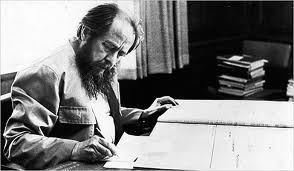
Aleksandr Solzhenitsyn, RIP

A great hero in the struggle against communism, or totalitarianism, has passed. I read Warning to the West, which was based on his speech at Harvard in 1978, and it had a great impact on me.

Specifically, it sold me on the idea that the prospects of victory should not be the determinant of political beliefs. Solzhenitsyn, like Whittikar Chambers before him, was a critical figure in the fight against communism and yet believed that the West was on the losing side of history.

Solzhenitsyn: “Untouched by the breath of God, unrestricted by human conscience, both capitalism and socialism are repulsive.”

In reading his NYT obituary, I was struck by the absence of any mention of God, faith, or Christianity in an article which ran 5,797 words. There was one use of the word religion, to note that Solzhenitsyn, at the age of 12, was religious and [yet] had joined a Communist youth organization. It is a very good example of how a secular press exerts its influence. But given how deeply the man’s Christian faith infused his views, it is a terrible distortion to suggest, by omission, otherwise.

To get a sense of how much of an influence his faith was on his work, aside from the above quote, please see the following exchanges from an interview with Joseph Pearce published in Catholic Education in 2003:

Pearce: A British journalist recently stated that you believe that Russia has overthrown the evils of communism only to replace them with the evils of capitalism, is that a fair statement of your position and, if so, what do you feel are the worst evils of capitalism?

Solzhenitsyn: In different places over the years I have had to prove that socialism, which to many western thinkers is a sort of kingdom of justice, was in fact full of coercion, of bureaucratic greed and corruption and avarice, and consistent within itself that socialism cannot be implemented without the aid of coercion. Communist propaganda would sometimes include statements such as “we include almost all the commandments of the Gospel in our ideology”. The difference is that the Gospel asks all this to be achieved through love, through self-limitation, but socialism only uses coercion. This is one point.

Pearce: Do you feel that many of the problems in the modern world are due to an inadequate grasp of spiritual and philosophical truth by the population as a whole?

Solzhenitsyn: This is certainly true. Man has set for himself the goal of conquering the world but in the processes loses his soul. That which is called humanism, but what would be more correctly called irreligious anthropocentrism, cannot yield answers to the most essential questions of our life. We have arrived at an intellectual chaos.

I’ve copied the National Review editorial on Solzhenitsyn below.

When 1999 turned into 2000, a lot of people asked, “Who was the Man of the Century?” And many answered, “Solzhenitsyn.” That was a very solid choice.

Born in 1918, Aleksandr Isayevich Solzhenitsyn became the voice and conscience of the Russian people. There was no greater or more effective foe of Communism, or of totalitarianism in general. His Gulag Archipelago was a crushing blow to the Soviet Union — after its publication in the mid-1970s, the USSR had no standing, morally. The book was effective because it was true.

Because he was such a great and important man, it is sometimes overlooked how great, versatile, and prolific a writer he was. He wrote novels, novellas, short stories, poems, memoirs, essays, speeches, and more. The Gulag Archipelago, he called “an experiment in literary investigation.”

The First Circle, a novel, is many people’s favorite book. So is another novel, Cancer Ward.

He wrote no more gripping or beautiful work than The Oak and the Calf, his literary memoir. The title refers to an old folk image of a calf butting its head up against an oak: This symbolizes futility. And that was a writer — a lone, persecuted, hounded writer — trying to bring down the Soviet state. Yet the oak fell.

With this memoir and The Gulag in mind, Norman Podhoretz once wrote, “[Solzhenitsyn] is returning [to the Russian people] their stolen or ‘amputated’ national memory, reopening the forcibly blocked channels of communication between the generations, between the past and the present . . .” Few writers have written under such pressure. He would receive mail saying, “Look after your health, Aleksandr Isayevich — we are all depending on you.”

In his later years — after age 50 or so — he had the support of a wonderful family, consisting of three boys and his wife, Natalia. Their exile home in Cavendish, Vt., was kind of Solzhenitsyn, Inc.: They all helped with the many tasks of writing and publishing. Out on the grounds of their home is a large rock — a boulder. Solzhenitsyn used to tell the boys, when they were little, that this was a magic horse, which would fly them back, when Russia was free.

Solzhenitsyn returned to his homeland in 1994.

Like everyone else, he had his critics: He was accused of being a megalomaniac, a Slavophile, a right-wing nationalist, an anti-Semite. He was too humane for any of that.

And he did not spend much time on his critics, for better or worse — some of his admirers wished he had. But, as his son Ignat once put it, he could have written The Red Wheel (his multi-novel magnum opus, treating the Bolshevik Revolution) or he could have kept up with his critics. He could not do both. He was not interested in popularity or fame. He simply wanted to tell the truth, wherever it took him.

Truth was the essential ingredient of his controversial 1978 commencement address at Harvard: “A World Split Apart.” He told the graduates, “[T]ruth eludes us if we do not concentrate with total attention on its pursuit. And even while it eludes us, the illusion still lingers of knowing it and leads to many misunderstandings. Also, truth is seldom pleasant; it is almost invariably bitter.” Solzhenitsyn went on to discuss the multiple ailments of the West.

This speech rocked the country, with many prominent liberals — e.g., Arthur Schlesinger Jr. — denouncing him for it. Sidney Hook wrote, “Rarely in modern times . . . has one man’s voice provoked the Western world to an experience of profound soul-searching.”

Years later, another of Solzhenitsyn’s sons, Stephan, caught some flak in the press for a position he took on an environmental issue. One of his opponents said, “Didn’t he learn anything from his father?” Stephan answered, “Yes — mainly that the truth isn’t always popular.”

The hope Solzhenitsyn gave to millions is immeasurable — but we can measure some of it. There is a woman, Youquin Wang, who chronicles China’s Cultural Revolution. She does this from the safety of the United States. But, as a girl, she was less safe. Back in the PRC, she found two authors who changed her life: Anne Frank and Solzhenitsyn. After she read The Gulag, she knew what she would do with her life: commit the lives of the lost to historical memory.

National Review is grateful to have had a relationship with Solzhenitsyn. Mainly, we admired and cheered him. But occasionally we published him — he once sent us a piece over the transom, which is to say, unsolicited. No magazine could dream of more.

Malcolm Muggeridge called him “the noblest human being alive.” After passing away yesterday, he is now one of the noblest human beings on earth or in heaven. He is one of the greatest witnesses in all history. And, like all great witnesses, he was inspired by love, the crowning quality of his work and life.

Posted in RIP | Tagged , , , | Leave a comment

Vincent Bugliosi channels Jim Garrison

I listened to Bugliosi’s speech about his latest book, The Prosecution of George W. Bush for Murder, given on 6/25/08 and carried by C-SPAN2on 8/3/08 – here’s what I heard [while scanning Marlins boxscores]:

  • 9:00 – Began – much background about himself and tellingly describes how outraged he was about the Supreme Court ruling which ended appeals to the 2000 election – admits to orneriness in his old age – thinks Ken Starr is one of the most contemptible individuals in the US
  • 9:35 – 1st factual point – Bush gave a speech claiming Iraq was an imminent danger 6 days after receiving a classified intelligence memo which indicated that Iraq would only be a danger to US if it was worried about being attacked themselves
  • 9:40 – 2nd point – Manning memo – An aide to Prime Minister Tony Blair wrote a memo which summarized a meeting between Bush and Blair which indicated that Bush had speculated on how to draw Iraq into a conflict, even if under false pretenses
  • 9:47 – 3rd point – Bush smiles in public and seems in good spirits, all during a period where people are dying in Iraq. He quotes friends who claim that Bush is a happy man and asks, “What type of a monster is this man?”

Later, taking questions from the audience, he made the following points:

  • Will conduct a search [American Libel?] for a prosecutor in America who would agree to bring murder charges against Bush once he leaves office. He would prefer the death sentence as punishment.
  • During an attack on the left wing in America, which he feels is intimidated, he quotes Mario Cuomo as saying that ‘he admires Rush Limbaugh,’ and states, “How is that humanly possible.”
  • Defended Bill Clinton for being attacked for what he considers consensual sex with Monica Lewinsky [this should earn him a J-ESPY, given each year to the public figure who most resembles the quintessential lost WWII Japanese soldier who won’t give up the fight when there is no longer a fight – JC].
  • Warns about Bush fleeing to Paraguay once he leaves office.

His strongest point would seem to be the Manning memo, yet it was odd to hear him put so much emphasis on that and not comment on Blair’s role in the meeting and the overall war. The reason seems clear, Blair is liked, Bush is hated, keep the emphasis on Bush. That strategy makes sense if you want to sell books and be a hero to the left, but not if the truth is your goal.

I read and enjoyed Helter Skelter a long time ago. His book about the OJ Simpson case – Outrage – made great practical arguments [e.g. who would bleed all over their home after a cut]. But I thought it was odd when his previous book about the Kennedy assassination, ignored that other books, especially Case Closed, had effectively ended the Oswald conspiracy theories. It did however give Bugliosi something in common with Seth Rogan and his buddies in Knocked Up, both realized too late that someone else had already executed their payday idea – The Skinny meets Mr Skin.

The crowd, as would naturally be expected, were revealed during the Q&A as heavy-duty left-wingers. It was odd to hear such a crowd cheer at the thought of Bush being executed. How depressing, it means those grating advertising-types have a point when they claim that ‘it’s all how you frame it’ [or who you frame]. After all, I’m assuming they are normally anti-death penalty types. Apparently they make exceptions for republicans.

The worse thing I can say about such a noted former prosecutor is that his arguments were unconvincing and even laughable [Bush should not smile] at times.

Posted in Random Observations | Tagged , , , , | Leave a comment

Pat Buchanan’s isolationism

Pat Buchanan is pitching isolationism and I don’t buy it. The beginning of the column comes from a book he just wrote which argues that the 2 World Wars were unnecessary – as he believes that Iraq was – he asks:

If the United States intends to bring Georgia and Ukraine into NATO and arm them to fight Russia, why should Russia not dissolve the Treaty on Conventional Forces in Europe and move her tank armies into Belarus and up to the borders of Estonia, Latvia and Lithuania?

If that happens, it means that Russia does not acknowledge the end of the Soviet Union – over which we engaged in a long Cold War over – I’m sure Pat’s next book will explain how unnecessary that was – I love the guy on MSNBC, but he’s found a niche and is milking it big time – the niche is that ‘he’s the real conservative and conservatives don’t believe the world is perfect so the US should not be trying to fix the world’s problems

But the essence of conservatism is that we practice the politics of reality – the US’s reality is that of sole superpower – the fact that conflicts start over non-grand themes or just mistakes is unfortunate but not new or even avoidable – they begin, they exist and the US’s options are to act or acquiesce – I prefer that we act.

For a different perspective on what to do in Georgia – here’s the Economist:

This new Russian imperialism is bad news for all its neighbours. Mr Saakashvili is an impetuous nationalist who has lately tarnished his democratic credentials. His venture into South Ossetia was foolish and possibly criminal. But, unlike Mr Putin, he has led his country in a broadly democratic direction, curbed corruption and presided over rapid economic growth that has not relied, as Russia’s mostly does, on high oil and gas prices. America’s George Bush was right, if rather slow, to declare on August 11th that it was unacceptable in the 21st century for Russia to have invaded a sovereign neighbouring state and to threaten a democratically elected government.Yet the hard truth, for Georgians and others, is that pleas for military backing from the West in any confrontation with Russia are unlikely to be heeded. The Americans gave Mr Saakashvili token help when they transported Georgian troops home from Iraq (where 2,000 of them made up the third-largest allied contingent). And they have now sent in humanitarian aid in military aircraft and ships. But nobody is willing to risk a wider war with Russia over its claimed near-abroad. Among Russia’s immediate neighbours, only the Baltic states, which slipped into NATO when Russia was weak, can claim such protection.

That does not mean the West should do nothing in response to Russia’s aggression against Georgia. On the contrary, it still has influence over the Russians, who remain surprisingly sensitive about their international image. That is why Western leaders must make quite clear their outrage over the invasion and continued bombing of Georgia. Few have done that so far; the Italians and Germans in particular have been shamefully silent.

Above all, the West must make plain to Mr Putin that Russia’s invasion of Georgia means an end to business as usual, even if it continues to work with him on issues such as Iran. America has already cancelled some military exercises with Russia. America and the Europeans should ensure that Russia is not let into more international clubs, such as the Paris-based OECD or the World Trade Organisation. Now would also be an appropriate time to strengthen the rich-country G7, which excludes Russia, at the expense of the G8, which includes it.

Posted in Current Affairs & History | Tagged , , | Leave a comment

Keep the Busses Coming

Sen. Obama just keeps throwing people & positions under them. A few years ago, the NBA had a video ad campaign showing players wooing the Championship trophy. I thought of that image and it morphed into an Obama secularly-kneeling before his pseudo-Oval Office desk [you know he has it picked out], when I read of his latest reversal in his one year of national exposure. The flip-flop listnow includes:

  • Disavowal of Rev. Wright
  • Federal funding of faith-based services
  • Gun control
  • Iraq surge – prospects for success
  • Offshore drilling
  • Public funds for presidential campaign
  • Wiretapping – FISA legislation

Amazing. As David Brooks has written, don’t underestimate how serious he is about getting elected. I’m sure his grandmother would agree, if the Winnebago firmly resting on her upper torso would only allow her to speak.

Interesting to note that the list of Sen Obama’s reversals does not include abortion rights. This despite the fact that in “The Audacity of Hope,” Obama had written:

… the willingness of even the most ardent pro-choice advocates to accept some restrictions on late-term abortion marks a recognition that a fetus is more than a body part and that society has some interest in its development

That would seem to argue for a yes vote on partial birth abortion. But clearly there are some constituencies which he can not afford to upset. But given his reversals to date, not a long list.

Our guy, Sen. McCain, strikes me as more concerned about his post-defeat legacy than winning. That’s the most charitable assessment because if it isn’t that, some are asking if he’s just stupid. Although I thought his recent video ad mocking Obama was a good sign. I think selecting someone like Alaska Gov. Sarah Palin for VP is critical in recognizing that a business as usual approach [Pawlenty, Crist etc] will not work in 2008. The influential Bill Kristol also seems to like the idea

McCain would do well to follow the advice of the WSJ Editorial Board, who made the following point regarding Obama’s most recent reversal:

Even as he proposes to arbitrarily soak the profits from oil exploration, Barack Obama is finally beginning to bend on offshore drilling. Late last week he said he could perhaps support more U.S. energy exploration, so long as it was part of a larger “bipartisan” deal that presumably includes more rules for conservation, subsidies for noncarbon fuels, and other favorites of his green backers.

Leave aside the economic contradiction in allowing more drilling to find more oil only to strip the profits from companies that succeed in finding it. The real news here is political, as Mr. Obama and his advisers have begun to see the polls move against them on energy. With gas at $4 a gallon, voters even in such drilling-averse states as Florida increasingly see the need for more domestic oil supplies. So Mr. Obama is now doing a modified, limited switcheroo to block any John McCain traction on the issue.

Only last week, Mr. Obama couldn’t have been more opposed, calling more drilling a “scheme” that wouldn’t reduce gas prices. He’s also been telling voters that we don’t need to open more areas to drilling because the oil companies weren’t drilling enough on the leases they already have. That is nonsense, since not every lease yields oil in amounts worth developing and drilling permits aren’t automatic even on leased land.

The question for Mr. Obama is whether this latest switch is merely a rhetorical move for campaign purposes. If he’s serious, he’ll start to publicly lobby Democratic leaders on Capitol Hill to allow a vote on drilling when they return from their August recess. The McCain campaign should keep the pressure on until he does, and until Congress moves.

Posted in Current Affairs & History | Leave a comment

Pucho [Pero Why Not?] Fernandez, RIP

I don’t know how his material will hold up, but no matter. I will remember him fondly. Pucho ‘Cartucho’ Fernandez made my friend, fellow sports degenerate and current Herald Boxing writer, Santos Perez, laugh on literally hundreds of occasions in either listening to his material [classic ‘pero why not’ riff], but more often recalling that which [inexplicably] made us laugh back then. Truth be told, we knew he wasn’t any Richard Pryor, but he was ours [Cuban-born] dammit. Just learned that he was the son of the more-famous comedian, ‘Tres Patines’. Godspeed Leopoldo Fernandez.

See photo

Posted in RIP | Tagged , , , , | Leave a comment

>Microsoft Has a Cuba Policy, Who Knew?

>I kid Bill.

Actually Don Tennant from Computerworld weighed in on the matter and brought Allison Watson of Microsoft along for the ride.

“Frankly, from a Cuba perspective, Cuba’s not a bad word to anyone outside of the United States,” she said. “I don’t know, outside the United States, if [doing business with Cuba] is a good or bad thing, per se.”

She’s right, of course. The U.S. pretty much stands alone in its obstinate refusal to engage Cuba and enable the citizens of both countries to benefit from investment there.

To which I replied on his blog:

Greetings from the heartland of said obstinance, Miami FL. But fret not, this will be an outrage-free response.

Your article quotes Allison Watson of Microsoft as follows: “Frankly, from a Cuba perspective, Cuba’s not a bad word to anyone outside of the United States,” she said. “I don’t know, outside the United States, if [doing business with Cuba] is a good or bad thing, per se.”

First I am going to assume that when she notes ‘Cuba,’ she is in effect referring to the Cuban government. That said, if the first sentence were true, why the ambivalence in the second?

Leaving aside the fact that you conveniently blew past said ambivalence in your subsequent comments, the reason is elementary, while perhaps not to someone in dear Ms. Watson’s position. Her position being one of devising corporate strategy for Microsoft, not someone whose job it is to take responsible positions on foreign regimes which routinely violate their citizens human rights.

The elementary reason I refer to is that it is palpably untrue that the Cuban government is not criticized outside of the US. The list would include, but not limited to, the UN, the EU, Mexico, Spain and France.

Perhaps the problem is geographical. No one ever washes up on a raft [dead or alive] in the glorious northwest region with a connection to Cuba, aside from those sporting Che t-shirts.

Just another day on the Cuba dilettantes watch.

Posted in Cuba | 1 Comment