A Miami Herald Editorial Bull’s-Eye

No Irish bull. I thought Monday’s Miami Herald Editorial regarding the changes to the U.S. Cuba policy struck a perfect tone. An excerpt:

Considering the hoopla that preceded it, President Barack Obama’s decision to relax the rules governing travel and cash transfers to Cuba might seem to some like a daring new policy initiative — but it isn’t. Mr. Obama is making a marginal change in U.S. policy to signal that he is open to fundamental revision, but only if the Cuban government reciprocates — and that has always been the real stumbling block.

This is unlikely to happen soon, but we hope Mr. Obama’s decision will prompt other leaders in Latin America — who have been pressing for a change in U.S. policy toward Cuba — to call for Havana to mend its own ways. That, after all, is where the problem lies and where it must be addressed.

It must never be forgotten that the fundamental problem in U.S.-Cuba relations is the absence of freedom and civil liberties under the Castro regime. Until Cuba has a “normal” government — one that acts with the express consent of the governed — no U.S. government is likely to take steps toward “normalizing” relations.

Editorial referenced is copied in full at end of post.

—————————————————————————-
New Cuba rules send important signal

April 13, 2009

OUR OPINION: U.S. OPEN TO CHANGE, BUT ONLY IF HAVANA WILL RECIPROCATE

Considering the hoopla that preceded it, President Barack Obama’s decision to relax the rules governing travel and cash transfers to Cuba might seem to some like a daring new policy initiative — but it isn’t. Mr. Obama is making a marginal change in U.S. policy to signal that he is open to fundamental revision, but only if the Cuban government reciprocates — and that has always been the real stumbling block.

Policy reverts

Mr. Obama’s action is a commendable step, to be sure, but it needs to be put in perspective. In removing travel and gift restrictions for Cuban Americans, the president is reverting to rules that prevailed before a change imposed by President Bill Clinton. That came after the Cuban Air Force, in a cowardly act, shot down two unarmed Brothers to the Rescue planes in 1996, killing four innocent men. President George W. Bush tightened the restrictions after Fidel Castro cracked down on dissidents in 2003, sending scores into prisons where most still remain.

This history and the strong feelings that surround Cuban policy ensure that any change in policy, no matter how slight, carries political and policy risks for any U.S. president. Mr. Obama has made a calculated decision that the move will be largely welcomed by Cuban Americans who want to see the U.S. government get out of the business of regulating how often they see their families.

This fulfills an Obama campaign pledge, and it may give Cubans living under the yoke of the Castro brothers more freedom to act independently, but it hardly amounts to a significant change as far as most Americans are concerned. They are still banned from visiting Cuba; and the trade embargo is still in place.

For any further change to occur, the Cuban government would have to make reciprocal gestures. Such as putting an end to the usurious fees and other obstacles it imposes on Cubans who want to leave. Such as freeing more political prisoners. Such as making the Internet more accessible to average Cubans. Such as ending the ”tourism apartheid” that keeps most Cubans from having contact with tourists.

It’s up to Havana

This is unlikely to happen soon, but we hope Mr. Obama’s decision will prompt other leaders in Latin America — who have been pressing for a change in U.S. policy toward Cuba — to call for Havana to mend its own ways. That, after all, is where the problem lies and where it must be addressed.

It must never be forgotten that the fundamental problem in U.S.-Cuba relations is the absence of freedom and civil liberties under the Castro regime. Until Cuba has a “normal” government — one that acts with the express consent of the governed — no U.S. government is likely to take steps toward “normalizing” relations.
———————————————————————

Tagged | Leave a comment

Carl Hiaasen & The LSD-PL Syndrome

Carl Hiaasen is a great novelist. So sayeth Tom Wolfe, which is good enough for me. Hiaasen is also a long-time South Florida resident who has left of center political views and airs those views as a regular columnist for the Miami Herald. Among his left of center political views has been to oppose the U. S. limited economic embargo towards Cuba. So right away we know that we are dealing with someone who, from a policy perspective, has been butting heads with pro-embargo Cuban Americans for a long time.

My views on the the CANF’s recent policy proposal are that, merits aside, it is always a smart political move to get out in front of change. I would make a case that this position need not be seen as a repudiation of the thinking which helped define previous policy positions. But for people who have disagreed with our position, it’s payback time. That’s what most interested me about Hiaasen’s column. He tried to be Michael [“it’s not personal … strictly business”], but his response was pure Sonny [after some college and much counseling].

Let’s take a step back, we are almost too close to appreciate what is being debated. Hiaasen’s column is about what the proper U.S. foreign policy disposition should be towards the Cuban government in 2009. A 50-year dictatorship which has caused the U.S. periodic immigration problems and attempted to destabilize the region. He used the following words, presented in order, with a negative connotation.

  1. fire-breathing opponent – CANF, before their enlightenment
  2. failed strategy – CANF’s previous support of embargo
  3. hard-line – people for embargo
  4. utterly failed – results of U.S. embargo position
  5. bombastic leader spinning in his grave – Jorge Mas Canosa, founder and former leader of the CANF
  6. n/a – no actual words to quote here, but I am awarding bonus animus points for ripping a man who died of cancer over a decade ago in a current policy dispute
  7. treasonous – Hiaasen is predicting the language used to oppose the change in policy on AM radio by pro-embargo Cuban-Americans
  8. exile radio hosts – in any other market, they would just be local radio hosts
  9. decades of frustration and futility – effects of U.S. embargo position on Cuban-Americans
  10. huffing macho, as always – Bush administration
  11. tough rules – rules which limited remittances and travel
  12. cold-hearted – pro embargo position
  13. long-running botch job – results of U.S. embargo position
  14. Libya – direct role in blowing up plane
  15. vocal exile lobby – pro-embargo Cuban-Americans who vote
  16. fruitless course – pro embargo position
  17. chronic economic mess – Cuban economy

So there you have it, in an 811 word column, Mr Hiaasen makes 17 negative references, one against the Cuban economy, one against Libya, and the rest against, well … us, pro-embargo Cuban-Americans.

Here’s my take on the above language, it’s over the top, relative to a column about a former policy opponent which has amended their position. Someone is trying too hard when they resort to the language I’ve highlighted above. Typically, the better your argument, the less you resort to hyperbole–i.e. see any George Will column. When the person trying too hard is also a great novelist, that’s when you know the issue is not just business, it’s personal.

Given that we are now in the Easter season, I must make the most generous assumption possible in guessing at Mr Hiaasen’s motivations. Like Sally Fields, I can only hope that Carl really, really likes us–if only for all the material we provide–so I exclude personal animus towards us long-standing pro-embargo Cuban-Americans. No, I blame the ‘Long Suffering Dinner Party Leftists Syndrome’ [LSD-PLS].

I can’t help but think of Mr Hiaasen at all the ‘right’ dinner parties of the literary world or literary-world wannabees. I mean can’t you see and hear it too? Glasses, dishes and the silverware serving as a constant muted cymbals backdrop, cross-chatter with periodic laughter among the truly beautiful people, and then comes the inevitable question; “Carl, what’s it like down there with those [fill in the blanks]?” If you went to Vegas right now and wagered $1 that he typically answers that we are, on balance, the embodiment of the American dream as can be experienced by immigrants, you may have just won $10 million dollars!!!

See, Mr Hiaasen is their voice in this fight, made all the more heroic because of his Jonas-like location. Although the belly of a typical pro-embargo, middle-aged Cuban-American takes a back-seat to no whale, this crowd hungers for any leftist political victory, albeit one of a watered-down, too-little too-late variety.

As usual though, I think they and Mr Hiaasen have missed out on the bigger picture. You see the conversation on the other side of the table was about what a genius Bernie Madoff was, but the Hiaasen-wing of the dinner parties were in full-spittle fury at us at the time and thereby missed out on the hot financial tips.

Carl, like Footprints in the Sand, we were there for you and you didn’t even know it.

Column referenced is copied in full at end of post.

—————————————————————————-
CANF makes sober proposal about U.S. policy on Cuba

Posted on Sat, Apr. 11, 2009

By CARL HIAASEN

In an historic turnabout, the most prominent Cuban exile organization in the country now wants the Obama White House to expand and enhance relations with the Castro regime.

The Cuban American National Foundation, once a fire-breathing opponent of dialogue with Cuba, has produced a comprehensive 14-page proposal for a different — and long overdue — approach.

Published last week, the white paper is titled “A New Course for U.S.-Cuba Policy: Advancing

People-Driven Change.” It urges the Obama administration to discard the failed strategy of ”containment” in favor of a “people-to-people” initiative that focuses on improving the lives of Cuban citizens.

The paper is a frank acknowledgment that the old hard-line policies have utterly failed to destabilize Cuba’s communist leadership, or bring any meaningful reforms to the island.

As foundation president, Francisco J. Hernández, a Bay of Pigs veteran, explained: “For 50 years we have been trying to change the Cuban government, the Cuban regime. At the present time, what we have to do is change the emphasis to the Cuban people — because they are going to be the ones who change things in Cuba.”

For the first time, CANF is advocating direct diplomatic engagement between the United States and Cuba. Jorge Mas Canosa, the bombastic leader of the foundation in its early years, must be spinning in his grave.

The idea of communicating with Cuba will be denounced as treasonous by some exile radio hosts, but their time is fading. Polls show that a rising percentage of Cuban Americans are ready for a change, which isn’t surprising after decades of frustration and futility.

For many, the tipping point came in 2004 when the Bush administration — huffing macho, as always — imposed tough rules limiting how often exiles could visit relatives on the island, and how much cash they could send to family members.

The cold-hearted plan accomplished nothing except punishing the Cuban people. The Castro brothers suffered not one bit. That fairly sums up the story of the long-running botch job that passes for America’s Cuban policy.

We have diplomatic relations with many countries whose human-rights records are as bad, or worse. We eagerly converse (and heavily trade) with nations that lock up dissidents and journalists, or have no serious democratic aspirations.

We talk with China, Vietnam, Russia, Saudi Arabia — even Libya, a regime that had a direct role in blowing up a Pan Am jet full of innocent people.

It’s mainly because of South Florida’s vocal exile lobby that the United States has persisted on its fruitless course of trying to isolate Cuba. Ironically, the trade embargo turned out to be the best thing that ever happened to Fidel Castro, presenting him with a ready scapegoat for the country’s chronic economic mess.

Although the CANF white paper doesn’t call for an end to the embargo, the foundation does support a plan for allowing Cuban Americans and others to send cash, building materials and farm equipment to the island. It also favors an executive order allowing direct aid to pro-democracy groups in Cuba, which have struggled for outside funds under rules enacted during the Clinton administration.

As a top priority, CANF strongly supports President Obama’s promise to remove the punitive restrictions on travel and remittances, which the White House has said will happen probably this week.

Obama made this one of his campaign pledges, rightly calling it a humanitarian issue. Cuban Americans should be able to visit family members in Cuba as often as possible and send them as much money as they wish, as other immigrants and exiles are allowed to do.

The dramatic about-face by the Cuban American Foundation could bolster current efforts in Congress to broaden contact with Cuba. Both the House and the Senate are considering bipartisan legislation that would basically permit all Americans to travel there.

It’s likely that the Cuban-American members of South Florida’s congressional delegation will stick to the shrill hard line, but the political tide is turning. Many U.S. companies have been pushing for years to get the trade barriers lifted, and a receding domestic market makes Cuba look even more appealing.

Capitalism works

With Fidel frail and fading, and Raúl seeking to make his own mark, there’s an opportunity for the United States to finally start making a positive difference in the country. The best way is to establish a presence, beginning with tourists and then trade.

Nothing promotes capitalism as effectively as saturating a place with products, services and entertainment supplied by a capitalist system. China is still not a democracy, but its people today have more freedom — and a bigger appetite for freedom — than ever before.

What happened in Beijing could happen just as quickly in Havana, if the United States ever unleashed its potent weapons of mass consumption: Mountain Dew, Kentucky Fried Chicken, Levi’s jeans . . .

Raúl wouldn’t know what hit him.
———————————————————————

Posted in Cuba | Tagged , , | Leave a comment

Angels in Our Midst: Smile Pinki

The smiling little girl on the right might not appear to be someone who has overcome great odds, someone who inspired others to do God’s work. But that’s only because you haven’t seen the trailer to the movie, Smile Pinki.

As usual, thanks to the Freakonomics blog for the interesting subjects it chooses to give attention to.

See article at end of post.

—————————————————————————-
Pinki brings smile to UP village

Anuraag Singh, Hindustan Times
Email Author – Varanasi, January 25, 2009
First Published: 23:55 IST(25/1/2009)
Last Updated: 23:56 IST(25/1/2009)

The million-dollar Pinki smile has done it again.

The Oscar nomination for the Hindi-Bhojpuri documentary film Smile Pinki has come as a blessing in disguise for Rampur Dabahi village of Mirzapur district. This is the village where the film’s protagonist Pinki lives.

The district administration of Mirzapur, 300 km east of Lucknow, has been moved by the Oscar nomination for the film, which is shot largely in Rampur Dabahi. It has decided to adopt Rampur Dabahi and develop it as a model village.

The administration has also decided to pay for Pinki’s entire education. Pinki is a class II student at the government primary school in Rampur Dabahi.

Officiating district magistrate Jaswant Singh said on Sunday that the village would be developed as an ‘Adarsh Village’ (Model Village) through implementation of a 10-point programme. The programme includes developing or providing roads, power, potable water, schools and widow pension benefits.

Singh further said Pinki’s father Rajendra Sonkar, a daily wager, has been assured by the Uttar Pradesh government that her educational and other expenses would be paid for by the state.

“It’s an honour for the entire district that Pinki’s smile brought back by surgeons in Varanasi has put Mirzapur under a global spotlight. Now we want the world to know about a fully-developed Rampur Dabahi village,” Jaswant Singh said.

If the assurances of the authorities see the light of day, they will usher a new dawn in the lives of the villagers of Rampur Dabahi. They have complained that they have to travel two kilometres just to get potable water from a makeshift canal in Khoria village.

The residents of the hillside village had also told an HT team that the last electric pole was installed at Bairampur, three kilometres from Pinki’s village.

Smile Pinki, a 39-minute documentary by American director Megan Mylan, has Pinki as the protagonist. It is the real life agony-to-ecstasy tale of Pinki and other children born with cleft-lips, who have been given the million-dollar smile by a group of doctors in Varanasi led by young plastic surgeon Dr Subodh Singh under a global initiative, Smile Train Project.

http://www.hindustantimes.com/StoryPage/Print.aspx?Id=5bd24f44-0977-4172-ae3b-6201e7f39886
© Copyright 2007 Hindustan Times
———————————————————————

Tagged | Leave a comment

May 15th: Miami Heat will Shock the MVP

Tonight’s loss by the Philadelphia 76ers practically assures the Miami Heat of earning the 5th spot seeding in the Eastern Conference playoffs–they are now a game ahead of Philadelphia with 4 to play and hold an edge in the conference record tiebreaker. When they defeat the Atlanta Hawks in the 1st round, they will then likely play the Cleveland Cavaliers in the 2nd round. The NBA’s MVP winner will be announced right around that time, it will be Lebron James. On May 15th, the 6th game of the Eastern Conference semifinals will be played.

The Heat has a 1-3 record against Cleveland this year – here’s a Heat-vision recap of the 4 games:

  • Game 1 at Cleveland on 12/28 – Loss – Miami blew a double digit lead in the 4th quarter.
  • Game 2 at Miami on 12/30 – Win – Miami takes early lead and hangs on.
  • Game 3 at Miami on 03/02 – Loss – For the 2nd time this season, the Heat blow a double-digit lead 4th quarter lead to the Cavaliers as Mo Williams took over game.
  • Game 4 at Cleveland on 03/07 – Loss – Again, Mo Williams took the game over in the 4th quarter.

I realize that most NBA games come down to the final quarter, but it is significant that the Heat has had late leads in all these games. The point is that Miami matches up well against Cleveland, despite their much better record. If Wade and James largely cancel each other out, then it might come down to how the 2nd best player performs.

  • Mo Williams scoring in the series: 20 / 10 / 30 / 29
  • Michael Beasley scoring in the series: 9 / 8 / 8 / 17

I might not have given Beasley the advantage early in the year or even in the middle of the year, but more and more he looks like the 2nd pick in the draft. So that’s the why of my prediction: A future MVP will help lead the Heat past the current MVP, in support of a once and future Playoffs MVP.

Tagged | Leave a comment

Is Double-A the New Triple-A?

If you were once a position player with a MLB team and find yourself in Triple-A, unless it’s a rehab assignment, be afraid, be very afraid. The odds are high that you are not in your team’s future plans. In theory, you are still competing at the highest level of Minor League baseball. But the fact that you didn’t stick in your initial opportunity, means that you just went from hotshot to long shot.

When I read in the Juan C. Rodriguez’s Sun-Sentinel blog last week that the Marlins had released Dallas McPherson, I was surprised. Despite his poor Grapefruit League play, the man hit 42 home runs at Triple-A Albuquerque last season. Let me repeat that, Dallas McPherson led the minor leagues in home runs last season and was looking for a job a week before the next season opened. This was not a Crash Davis-type accomplishment either, the guy is only 28 years old.

So it made me wonder what it means to excel at the Triple-A level? To the casual fan [me], MLB’s minor league system represents a steadily increasing level of play, culminating at the Triple-A level. Back in 2003, the Marlins had two examples that indicated that something was amiss with the average fan’s perception that the Triple-A level would house your best prospects, when Miguel Cabrera and Dontrelle Willis both made their jumps to the big leagues from Double-A.

This is a subject worthy of in-depth analysis, but anecdotal thoughts are the best I can do during tax season. To do so, I need to invoke a name which, in a perfect world, mere mortals such as myself should really not be allowed to bandy about in a public forum. But this is not a perfect world and so his name is Bill James.

If you followed baseball and weren’t afraid of numbers in the early 80’s, Bill James was a revelation. He ripped the job title of ‘baseball analyst’ away from ex-players with network and local broadcasting jobs. He did so by delving into statistics with imagination and wit. It was eye-opening and intoxicating to realize that many of the ‘experts’ weren’t so much experts as they were cliche-machines. It was hard to seriously discuss baseball with anyone who hadn’t read James. Here’s what one well known economist and MLB fan, James Surowiecki, wrote in 2003:

Over the past 25 years, [Bill] James’ work on player evaluation, player development, and baseball strategy—which inaugurated the body of baseball research known as sabermetrics, has revolutionized baseball analysis and overturned decades’ worth of conventional wisdom.

I remembered that James had written that minor league statistics do mean something, that they had a correlation to a player’s eventual major league performance. I could not find that article to link. However, I did find an article by David Luciani in 1998 which discussed James initial article:

It has been more than fifteen years now since Bill James first wrote that minor league data meant something and it could be understood. James told us all that inevitably, major league baseball teams will eventually have to accept that. Surprisingly, major league GMs have paid too little attention to James’ philosophy and are suffering as a result of it.

In Luciani’s own analysis, he actually ascribed a percentage to predict various offensive categories going from minor to major leagues, i.e. 68% for home runs. Luciani summarized:

Quite simply, minor league statistics do mean something and perhaps the difficulty in accepting them has been because no one really knows how to read them. Even the so-called equivalencies that have become popular are useful but tend to over-reduce some columns and under-reduce others.

But enough of the serious math, back to my anecdotal analysis.

So is Double-A the new Triple-A? It reminds me of a kind of reverse Spinal Tap logic. [If you don’t think the volume knob reaching 11 is funny, please leave the blog now – see video here]. So let’s see how the current Marlins players [many who came up in other organizations] path to the big leagues have gone in terms of the number of games played at the various levels of Minor League baseball. While I do confine myself to players who were with the Marlins this Spring, only 4 of the 17 position players minor league careers were spent entirely with the Marlins, as such it is indicative of the mindset of various [18] organizations. The link to all the Marlins Minor League affiliates is here.

This is what I get from the numbers in my spreadsheet.

  • An organization’s best position player prospects are found in Double-A. That’s where an organization houses what they believe to be their gems. Rehab aside, Triple-A is more of a spare parts factory.
  • Where Chris Coghlan is reassigned to will reveal what they think of his prospects of being a MLB player. If it’s Double-A he’s still a hotshot, Triple-A he’s now a long shot.
  • A bigger appreciation of the kind of odds John Baker has overcome to earn a starting catcher’s position in MLB after over 348 games in Triple-A without having reached a MLB roster.
  • Even young stars pay their dues in the minor leagues. Hanley Ramirez spent four seasons in five cities affiliated with the Red Sox organization; Ft Myers [for loyal blog readers, this can not be used as one of our miracles] Lowell MA, Augusta GA and Portland ME. But not [of course] Pawtucket, RI–their Triple-A affiliate.
  • Players–like Dan Uggla–who never return to the minor leagues after getting their initial opportunity, are rare.
  • Partial guess, but the players with the most games at the Triple-A level probably constitute the next generation of coaches in professional baseball. These people have learned their craft, talent being a factor outside their control.
  • Players learn that baseball is a business long before they appear on the radar of us fans. A player is much more likely to have been traded and/or promoted based upon factors other than talent, i.e. arbitration timetables, another prospect at same position and teams using up their allotted player movements [i.e. Andino].

You have to feel for Triple-A players. They might appear to be closer than ever to their ultimate goal, but in effect they were told to get on a ship headed the wrong way based on someone’s evaluation. Those evaluations are an art, not a science. The contrast in expectations reminds me of a scene in the movie Rudy, where the reserves are told not to even look at the starters.

I picture a Triple-A player reading his morning paper during the season and learning that a player from Double-A was just called up. A player with less experience and who is competing against inferior competition than he is, is getting his shot. At that moment, Triple-A guy knows something intuitively that Double-A guy can not possibly imagine. While there are exceptions, as a matter of pure odds, another player’s dream just began to die.

Click on image to enlarge or print out
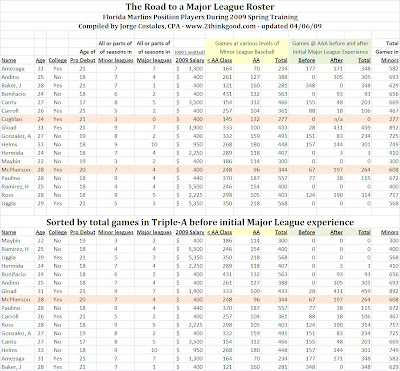
All articles referenced are copied in full at end of post.

—————————————————————————-
Marlins show McPherson the door – Posted by Juan C. Rodriguez

The Marlins continued to pare down their roster after Tuesday night’s game, releasing infielder Dallas McPherson and reassigning outfielders Michael Ryan and Alejandro De Aza, and left-hander John Koronka to minor league camp.

McPherson spent all of last season at Triple-A Albuquerque and led the minor leagues with 42 home runs. He batted .239 (11 for 46) with three doubles, a homer, five walks and 15 strikeouts in Grapefruit League play.

With McPherson, De Aza and Ryan out of the out of the picture, the Marlins will not have a left-handed bat off the bench until the switch-hitting Alfredo Amezaga is ready to come back from a sprained knee.

The moves bode well for Brett Carroll, who is the only reserve outfielder remaining in camp.
———————————————————————————–
Moneyball Redux
Slate talks to the man who revolutionized baseball.
By James Surowiecki
Posted Tuesday, June 10, 2003, at 1:15 PM ET

Although Michael Lewis’ new book Moneyball is about Billy Beane and his successful transformation of the Oakland A’s from also-rans to pennant contenders, the book’s unsung hero is a man named Bill James. Over the past 25 years, James’ work on player evaluation, player development, and baseball strategy—which inaugurated the body of baseball research known as sabermetrics—has revolutionized baseball analysis and overturned decades’ worth of conventional wisdom. For most of his career, though, James was the archetypical prophet in the wilderness. He had a dedicated following of readers—many of whom went on to do groundbreaking statistical work of their own. But baseball owners and general managers essentially ignored him. In the past five years, though, all this has changed. The success of the A’s, thanks in no small part to Billy Beane’s clever application of sabermetric insights, brought James new attention, and this year a major league team (the Boston Red Sox) hired him as a senior adviser. For the first time in his life, Bill James is no longer a baseball outsider. So, to accompany last week’s Book Club about Moneyball, I asked James to talk about Lewis’ book, the future of baseball analysis, and some sabermetric puzzles.

******

To begin with the obvious question, what did you think of Moneyball? More specifically, what did you think of the book’s account of your own work and of sabermetrics in general?

I tried to skip over the parts about myself. I established a policy many years ago of trying not to read anything written about myself. Mr. Lewis was very kind to me, and I appreciate his kind words, but … it is unhealthy to base one’s self-image on what other people say about you, even if they are generous.

For a lot of people, Moneyball will be the first sustained discussion of sabermetric analysis they’ve read. Given that, what do you think are the most important ideas—about player evaluation, player development, and team strategy—to take away from the book?

Well, of course, the ideas that made the greatest impression on me are the ones that aren’t mine. The stuff in there about how an offense actually works, the relative value of little ball to power baseball … I hardly saw that stuff as I read through it, because I knew that 20 years ago. What made an impression on me was, for example, the notion that some teams were paying a lot of money for unique packages of skills, when they could easily replace each of the individual skills by looking for different packages, different combinations of skills. The “front office view” of sabermetrics was extremely interesting to me, because I am trying to step up to the challenge of actually participating in a major league organization.

Reliably projecting a player’s future is central to the success of any organization that can’t—or doesn’t want to—pay market rates for already established players. What are the most important attributes to look at in projecting a player’s future? Is the future of a young hitter more predictable than the future of a young pitcher?

Yes, hitters are far more predictable than pitchers. Putting it backwards, because backwards is how you could measure it, the “unpredictability” of a pitcher’s career is 200 percent to 300 percent greater than the unpredictability of a hitter’s career.

In projecting a pitcher, by far the largest consideration is his health. There are a hundred pitchers in the minor leagues today who are going to be superstars if they don’t hurt their arms. The problem is, 98 of them are going to hurt their arms. At least 98 of them. Pitchers are unpredictable because it is very difficult to know who is going to get hurt and when they are going to get hurt.

One of your most important insights is the idea that minor league batting statistics predict major league batting performance as reliably as major league statistics do. There have been certain players—think of 1980s players like Mike Stenhouse, Doug Frobel, Brad Komminsk—who seemed as though they would be terrific hitters but never really made it in the big leagues. Did they not get enough of a shot? Are they outliers? Or is there such a thing as a Four A (too good for Triple A, not good enough for the majors) hitter?

Well, no, there is no such thing as a Four A hitter. That idea, as I understand it, envisions a “gap” between the majors and Triple A, with some players who fall into the gap. There is no such gap. In fact, there is a very significant overlap between the major leagues and Triple A. Many of the players in Triple A are better than many of the players in the majors.

The three examples you cite are three very different cases. Stenhouse never had 180 at bats in a major league season, so one would be hard pressed to argue that he got a full trial.

Frobel is a different [instance], in which I think there probably wasn’t a real strong case that he was a good hitter to begin with. Frobel hit .251 at Buffalo in ’81, hit .261 at Portland—Pacific Coast League—in 1982. We would expect, based on those seasons, that he would hit .200, .210 in the major leagues, with a pretty ghastly strikeout/walk ratio—which is what he did. Then he had the one good year at Hawaii in 1983, looked like a better hitter, and fooled some of us into thinking that he was better than he was. But … it was one year, 378 at bats, of performance that isn’t that impressive. It wasn’t enough, in retrospect, to conclude that he was actually a good hitter.

[Then] there are some players whose level of skill changes—drops—between two adjacent seasons or between two seasons separated by two or three years, usually because of an injury but sometimes because of some other factor. Frank Thomas is not the same hitter now that he was a few years ago; Tino Martinez isn’t; Mo Vaughn isn’t.

When those “disconnects” happen between major league seasons, we ascribe them to sensible causes—aging, injury, conditioning, motivation, luck, etc. Comparing major league seasons to minor league seasons, occasionally you get the same disconnect. Sometimes a guy simply loses it before he establishes himself in the major leagues. That’s what happened to Komminsk, I think—he shot his cannons in the minor leagues.

I’m trying to make two general points here. Point 1: When there is a disconnect between a player’s major league and minor league records, some people want to ascribe this to some mystical difference between major league baseball and minor league baseball. Unless you can say specifically what that difference is, this is akin to magical thinking—asserting that there is some magical “major league ability,” which is distinct from the ability to play baseball. The same sorts of disconnects happen routinely in the middle of major league careers—not often as a percentage, but they happen. Everybody who plays rotisserie baseball knows that some guys you paid big money for because they were good last year will stink this year. It is not necessary or helpful to create some magical “major league ability” to explain those occasional disconnects between major league and minor league seasons.

Second point … the creation of new knowledge or new understanding does not make the people who possess that new knowledge invulnerable to old failings. I can’t predict reliably who is going to be successful in the major leagues in 2004, even if we stick with the field of players who have been in the major leagues since 2000. I can’t do that, because there are limits to my knowledge, and there are flaws in my implementation of what I know. The principle that minor league hitting stats predict major league hitting stats as well as major league hitting stats predict major league hitting stats can be perfectly true—and yet still not enable me or you to reliably predict who will be successful in the major leagues in 2004, because I still have limits to my knowledge and flaws in the way I try to implement that knowledge.

Within the sabermetric community, a pitcher’s strikeouts-per-nine-innings ratio has traditionally been taken as a good indicator of his overall performance. The A’s starters in the last two years—and especially this year—have relatively mediocre strikeout rates but have done a very good job of keeping opponents from scoring runs. Is there anything surprising in this?

The question embodies four assumptions that I would be reluctant to sign on to. First, it assumes that statistics from a third of a season are meaningful. Second, it assumes that what is true of the individual pitcher must be true of the team. Third, the special importance that we attach to strikeouts has to do with projecting a pitcher into the future, not with evaluating the present. As to evaluating the present season … the strikeouts are no more important than the walks, probably less. Fourth, the A’s strikeout-to-walk ratio is better than the league average.

Right now, there are at least three teams—the Red Sox, the Blue Jays, and the A’s—who appear to be employing a sabermetric methodology with some rigor. Even with more outlets for experimentation, are there still ideas you’ve proposed (either in terms of player evaluation or game strategy or organizational structure) that are still too radical for teams to consider?

Oh, certainly. Well … it depends on what you mean by “proposed.” I follow the maxim that you never start an argument you can’t win. If an idea has no chance of gathering a following, I might sit on it rather than throwing it out to drown.

There’s a general perception in baseball that players are now aging differently and continuing to perform better for longer (players like Randy Johnson and Roger Clemens and Barry Bonds being obvious examples). Do you think this is actually true, or is it simply a matter of a few extraordinary outliers?

It’s just outliers. Randy Johnson and Clemens and Bonds are not only the obvious examples; they are the whole basis of the argument. Clemens and Johnson were born in 1962, 1963, and are still pitching well, and this focuses attention on them. But if you make a complete list of pitchers born in 1962 and 1963, their value peaked in 1990 and has declined by more than 80 percent. Other pitchers of the same age include Mark Gubicza, Doug Drabek, Jeff Montgomery, Randy Myers, Sid Fernandez, Danny Jackson, Chris Bosio, Mark Portugal, Jeff Brantley, Eric Plunk, Bill Wegman, Bobby Thigpen, Jose Guzman, Scott Bankhead, Greg Harris, Les Lancaster, Greg Cadaret, Todd Frohwirth, Jay Tibbs, John Dopson, Jeff Ballard, Charlie Kerfeld, Urbano Lugo, and Calvin Schiraldi. Have you seen Chris Bosio lately? He’s a pitching coach somewhere. … Looks like he’s about 63.

It seems as if one of the places where teams might be able to carve out a competitive advantage for themselves is in the area of keeping pitchers healthy. The A’s seem to think they’ve figured out how to do this. Do you think they have? If so—or if you think it’s possible to adopt a program that would keep pitchers healthy—what would the key components of that program be?

It is an area infinitely capable of research, learning, and improvement. So if you’re asking, “Are the A’s at the finish line?” the answer is “Nowhere near.” If you are asking if the A’s are ahead of the rest of us, the answer is “Apparently they are.”

To generalize wildly, defense has always seemed like the most difficult skill to capture statistically. Your Win Shares method seems to do a good job of describing players’ defensive performance. But what do you think of the prospects of using play-by-play analysis to differentiate players’ defensive skills? Is it possible to draw a meaningful separation between data and noise at the play-by-play level?

Yes, it is possible. But … this is among my primary projects right now, and I don’t want to talk about the sauce while it’s still in the skillet.

What’s the next frontier of baseball analysis that will be explored? What’s the next frontier that should be explored?

Whether it is the next great frontier, who the hell knows, but one area that is open is the area of league decision-making—trying to think logically and clearly about how leagues should behave. Teams try to behave logically; players try to behave logically. Leagues, because they are formed of competing interest groups, often fail to address issues clearly, and thus arrive at illogical positions from the failure to address issues proactively. Simple example: It would have been far better for [professional] baseball to have provided bats for the players. At the start of each game, the umpire brings out 24 bats to be used by the two teams; these bats are the only bats which can be used in the game. There are several reasons why this is better, from the league’s standpoint, than allowing the sporting goods companies to become pro bono suppliers of bats. But they didn’t do it, simply because nobody was thinking about the issue from the standpoint of the league.

In the 1984 Baseball Abstract, you wrote: “When I started writing I thought if I proved X was a stupid thing to do that people would stop doing X. I was wrong.” Twenty years later, at least a few teams have stopped doing X—and, just as important, started doing Y—because of your work, and the Red Sox are now paying you to tell them what they should be doing. Why did it take so long? How does it feel?

How does it feel … good, but our vocabulary to describe feelings is limited. The other thing—I wouldn’t write that anymore and can’t really relate to it. The world is a cacophony of competing explanations. It takes time for people to focus on what you are saying, to sort it out of the thousands of other explanations. It was a part of the naive arrogance of youth to suppose that the world would react quickly to things that I learned, as if I were a doctor tapping the knees of the baseball universe. At 53, I am astonished at how much people react to what I write, rather than how little.

Did you learn anything about baseball from Moneyball?

Yes; I didn’t have a real good idea of some of the things the A’s were doing until I read the book. Actually—shouldn’t admit this, I guess, but … I had been working for several years on a book about baseball history, and thus, for several years, had not paid an awful lot of attention to what was happening in our own time.

I didn’t, until reading the book, have any sense of who Billy Beane was, who J. P. Ricciardi was, or how they had been able to sustain the A’s organization through difficult times. Some of those things I didn’t know because I hadn’t really been paying attention, and some of them I didn’t know because, until the book came out, they hadn’t been reported.

Finally, do you think most baseball teams will eventually adapt, and incorporate sabermetrics into the way they work on a day-to-day basis? Or will there always be a Pope to the sabermetrician’s Galileo?

There will always be people who are ahead of the curve, and people who are behind the curve. But knowledge moves the curve.

James Surowiecki writes the financial column at The New Yorker.

Article URL: http://www.slate.com/id/2084193/
———————————————————————————-
What Minor League Stats Really Mean
by David Luciani
Published April 11, 1998

It has been more than fifteen years now since Bill James first wrote that minor league data meant something and it could be understood. James told us all that inevitably, major league baseball teams will eventually have to accept that. Surprisingly, major league GMs have paid too little attention to James’ philosophy and are suffering as a result of it.

Quite simply, minor league statistics do mean something and perhaps the difficulty in accepting them has been because no one really knows how to read them. Even the so-called equivalencies that have become popular are useful but tend to over-reduce some columns and under-reduce others.

I thought that if minor league numbers do mean something (and they do), then it would follow that some categories would translate to major league ability more than others. Before looking for data, my hypothesis was that a batters’ home runs would drop but that stolen bases would drop less, except as a result of a likely drop in times on base. Walks, I thought would go down and strikeouts would go up. Intentional walks would virtually disappear, at least in a player’s first year or two.

In order to “solve” the problem, we took data on every player who appeared in the major leagues the past four seasons and compared what they did in the majors to what they did at any one of a number of minor league levels in the same season. What a player did at Triple-A a year before playing in the majors doesn’t tell us what we want to know. A player can improve or decline during that year. We wanted years in which the player played in both the minors and majors and played a significant part in both seasons.

We then adjusted data for the environment in which the player appeared. If a player played half of his major league games in Oakland and half of his minor league games in Edmonton, we needed an adjustment for that. For pitchers, we needed to look at the league itself. Was it a hitter’s league or a pitcher’s league?

We made adjustments for playing time so that a player who had 500 plate appearances at Triple-A but 100 plate appearances in the majors has the 500 plate appearances at Triple-A reduced accordingly to match the context. We also performed a probability analysis on it to determine whether we had enough significant data to draw a conclusion.

What we discovered was that for batters, anything as far as down as the most competitive Single-A leagues, such as the Florida State League, can include significant data. For pitchers, anything below Double-A did not have any consistency whatsoever in relation to major league performance. Excluding playing time, we then examined everything on a per plate appearance (for batters) or per batter faced basis (for pitchers). Here were the results for the Triple-A level, results we often use in making projections of recently-promoted minor league players:

AAA BATTERS (% TRANSLATION PER PLATE APPEARANCE)
AB H 2B 3B HR R RBI BB IB K SH SF SB CS
101% 83% 76% 53% 68% 80% 74% 89% 55% 125% 172% 88% 76% 79%

AAA PITCHERS (% TRANSLATION PER BATTER FACED)
G GS CG IP H R ER HR HB BB IB K W L SV
127% 76% 22% 91% 110% 134% 139% 157% 119% 125% 198% 75% 63% 111% 21%

Note how much more a batter is asked to bunt in the majors. The best Triple-A hitter is just another bench player in the majors and the frequency of sacrificing reflects that. The speed translates pretty well, essentially the same when you consider how less frequently the batter will be on base in the majors.

For pitchers, look at how little Triple-A saves mean. Your 25 save guy from Triple-A becomes a five save guy even if he faces the same number of batters in the majors.

Obviously, you can’t just translate statistics and assume that it tells you exactly how a player would have done in the majors. You need first-hand knowledge of the player and witnessing his talents in person is the ultimate test. However, this tool gives you an accurate forecasting tool that can be used at least as a starting point, in combination with first-hand knowledge, to achieve better results.
———————————————————————


Posted in 2TG Favorites, Miami Marlins & MLB | Tagged , | 3 Comments

Faith, Hope and Clarity

I find much much to be distressed about in the news of the times and the latest charlatans. But if I remain distressed, it is due to a combination of my failures. First, is the failure of faith and then is the failure to appreciate history.

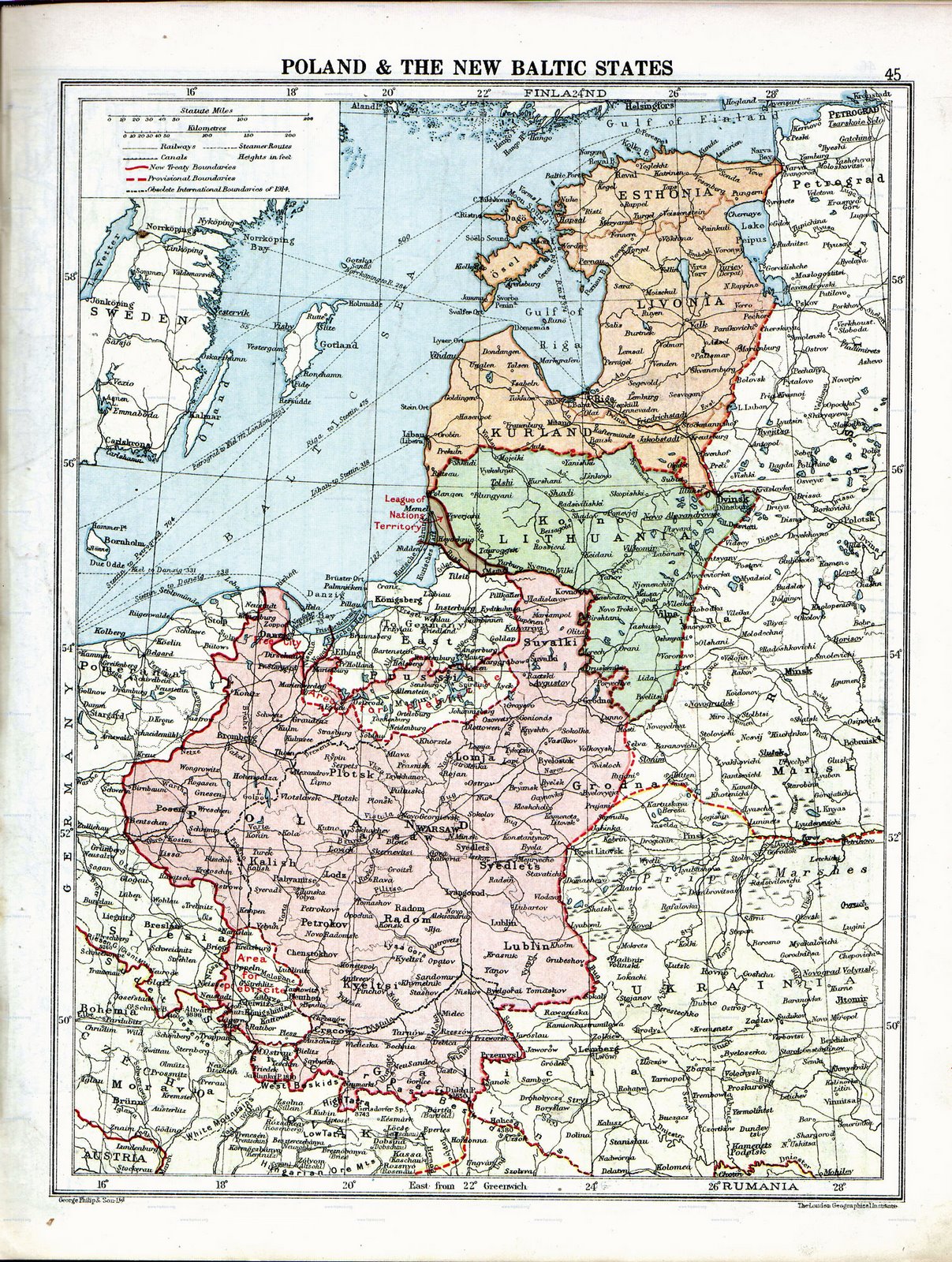
An example to make my point: What if we were dropped into Poland in 1918? Would we be more of less pessimistic than the average U.S. citizen today? If you were to have followed the local blogs at the time, you would probably have been informed of the following through the years:

  • 1918 – Partitioned for 123 years among her three predatory neighbors–Russia, Prussia and Austria–the newly resurrected Polish Second Republic came into existence following WWI.
  • Reborn Poland faced a host of daunting challenges: extensive war damage, a ravaged economy, a population one-third composed of wary national minorities, an economy largely under control of German industrial interests, and a need to reintegrate the three zones that had been forcibly kept apart during the era of partition.
  • 1919 – Treaty of Versailles settled the German-Polish borders in the Baltic region.
  • 1919 – The Polish-Soviet war began.
  • May 1920 – Poland gained its first major military victory since the battle of Vienna in 1683 and a conquering hero, Marshall Pilsudski.
  • 1921 – Poland adopted a constitution designed as a republic, modeled after the French Third Republic, vesting most authority in the legislature. The postwar Polish parliamentary system proved unstable and erratic, much like that of the French Third Republic.
  • May 1926 – Piłsudski assumed power in a Coup d’État. For the next decade, he dominated Polish affairs as strongman of a generally popular centrist regime.
  • The center of Poland’s postwar foreign policy was a political and military alliance with France, which guaranteed Poland’s independence and territorial integrity.
  • 1932 – Poland signed a non-aggression pact with the Soviets.
  • 1934 – Poland concluded another pact, with Germany’s new Nazi government, subsequently rejecting French proposals for a security pact directed against Germany, as it involved no guarantee of Poland’s eastern frontier with the Soviet Union.
  • September 1939 – Germany invaded Poland.

Here’s what we would likely have not been aware of.

  • August 1905 – Helena Kowalska was born in Glogowiec, a small villiage near Lodz.
  • 1912 – Kowalska heard a voice in her soul calling her to a more perfect way of life.
  • 1920 – Kowalska made her parents aware of desire to enter into the convent.
  • May 1920 – Karol Wojtyla was born in Wadowice, a small town near Krakow.
  • August 1925 – Kowalska applied for the second time to the Congregation of The Sister’s of Our Lady of Mercy and was accepted.
  • April 1926 – Kowalska received her habit and her name in religion, Sister Mary Faustina.
  • April 1929 – Karol Wojtyla’s mother died.
  • February 1931 – Sister Faustina had a vision of the Lord.
  • December 1932 – Wojtyla’s older brother Edmund, a doctor, contracted scarlet fever from one of his patients and died within five days. Edmund Wojtyla was 26 and Karol’s hero.
  • June 1934 – The Image of Divine Mercy was completed by artist E. Kazimierowski under the guidance of Sister Faustina.
  • April 1938 – Sister Faustina’s superiors decide to send her to the hospital in Pradnik. She is suffering from asthma and tuberculosis.
  • Summer 1938 – Karol Wojtyła and his father left Wadowice and moved to Kraków, where he enrolled at the Jagiellonian University.
  • October 1938 – Sister Mary Faustina dies.
  • 1939 – Nazi German occupation forces closed the Jagiellonian University. All able-bodied males were required to work.
  • 1940 – Wojtyła begins working various jobs–including a manual laborer in a limestone quarry–to avoid being deported to Germany.
  • February 1941 – Karol Wojtyla Senior died. The son had lost his entire family before he turned 21 and was greatly bothered that he had not been present for any of the deaths. He would later reminisce, “I never felt so alone.”
  • October 1942 – Wojtyla applies for the priesthood.

Which of the above sets of events do you think matter most today?

One final event:

  • April 2000 – Sister Maria Faustina Kowalska was canonized at St. Peter’s in Rome, Pope John Paul II presiding.

Lodz PL and Krakow PL are 188 kilometers apart [or about 117 miles], which is about the same distance between Miami and Ft Myers. So next time your faith is running low, just drive towards Ft Myers in silence and contemplate the saintly possibilities.

Tagged , , | Leave a comment

Their Own Separate or Private Idaho?

It turns out the B-52’s were ahead of their time. Not musically, of course. No, they were forerunners in the great privatization debate about the great state of Idaho.

Kidding of course, but the always interesting Marginal Revolution blog put its spotlight on the state and wonders how things would be different if the 1846 border dispute between the U.S. and Great Britain had ended differently. In the inevitable surfing which ensues, we end up with some interesting facts about Idaho:

  • Idaho first appeared as a Territory name in 1860, but was edged out at the last minute by Colorado in 1861
  • Idaho was supposed to be an Indian name signifying ‘Gem of the Mountain,’ but there was no mention of that in the newspapers of the time
  • There was an eccentric lobbyist / politician named George M. Willing, who claimed that he made up the name as a hoax
  • The Peoria Indians [today based in Miami, Oklahoma] told the first white settlers that the tribe living in that area (their rivals) was named the Moingoana, which became the root of Des Moines. But it turns out that Moingoana was really the Peoria word for ‘shitfaces.’

Lyrics to Private Idaho and article referenced are copied in full at end of post.

—————————————————————————-
Private Idaho Lyrics
Hoo Hoo Hoo Hoo Hoo Hoo Hoo Hoo Hoo
You’re living in your own Private Idaho
Living in your own Private Idaho
Underground like a wild potato.
Don’t go on the patio.
Beware of the pool,
blue bottomless pool.
It leads you straight
right through the gate
that opens on the pool.

You’re living in your own Private Idaho.

Keep off the path, beware the gate,
watch out for signs that say “hidden driveways”.
Don’t let the chlorine in your eyes
blind you to the awful surprise
that’s waitin’ for you at
the bottom of the bottomless blue blue blue pool.

You’re livin in your own Private Idaho. Idaho.
You’re out of control, the rivers that roll,
you fell into the water and down to Idaho.
Get out of that state,
get out of that state you’re in.
You better beware.

You’re living in your own Private Idaho.

Keep off the patio,
keep off the path.
The lawn may be green
but you better not be seen
walkin’ through the gate that leads you down,
down to a pool fraught with danger
is a pool full of strangers.

You’re living in your own Private Idaho,
where do I go from here to a better state than this.
Well, don’t be blind to the big surprise
swimming round and round like the deadly hand
of a radium clock, at the bottom, of the pool.

I-I-I-daho
I-I-I-daho
Woah oh oh woah oh oh woah oh oh
Ah ah ah ah ah ah ah ah
Get out of that state
You’re living in your own Private Idaho,
livin in your own Private…. Idaho
———————————————————————————-
Marginal Revolution blog
Would Idaho have more people if it were a separate country?

Call me silly but I think about questions like this. It’s a big state with only about 1.5 million people, even though it is the only place with six pointed star garnets (refined here). Much of the state is beautiful.

Imagine the counterfactual that, in 1846, when the U.S. and Great Britain resolved the border, one part of the area went its own way. Today an independent Idaho would probably a) be more “right wing” than the U.S. as a whole, and b) free ride upon U.S.-provided public goods, such as national defense. A federal Idaho government might be more concerned with boosting tax revenues (it would be full residual claimant) than is the current state-level government. All those factors would militate in favor of population increase. Most of all, I have the odd (Bayesian?) notion that since it would look and feel like an underpopulated country, more people would flow in.

On the other hand Idaho would face the risk of trade barriers and its legal order might be less secure than for the U.S. as a whole. The prospect of mobility barriers could either keep people in the area or out of it.

Would the place still be called “Idaho”? I doubt it. Might the town of Nampa — #2 in the state — be much better known to the world at large? I think so.

Does EU accession add or drain people from its smaller units, such as Slovakia and Estonia? There’s much at stake here, yet governments sign on to many agreements without thinking about the long-term consequences for their populations, whether pro or con.

Note: The comments section on this post is not for rehashing standard debates over immigration.

Posted by Tyler Cowen on March 30, 2009 at 08:26 AM in Political Science | Permalink
Comments

Additional to the question on the EU’s affect on smaller unit population, does the EU facillitate the creation of smaller units (such as “devolution” in Scotland, or Catalonian autonomy) by taking on the desirable qualities of the nation states they are currently a part of? And further to this, on Idaho, would it become more nation like if a multinational entity (say, NAFTA, for hyptohesising stakes) replaced many of the functions desirable in the United States?

Posted by: Richard Green at Mar 30, 2009 8:52:20 AM

The only way an Independent Idaho would beable to free-ride on national defense is if it weren’t afraid of being taken over by the US. Its own national defense would have to be quite strong if it felt threatened by the US or Canada.

Posted by: Rochelle at Mar 30, 2009 8:56:16 AM

Perhaps the best example for aspiring micro-nation population experts to examine would be Switzerland. Their cantons seem to remain much more distinct than US states; and they have on -Lichtenstein – that remained independant.

Posted by: Diversity at Mar 30, 2009 9:05:59 AM

This is essentially the crux of the Independant Quebec movement. Quebec meets alot of the descriptions outlined for Idaho and has the added perk of being the center of canadian finance. Quebec might make for an interesting template to think about Idaho, esp given how many opinion papers and how much research has been done both on the “for” and “against” side

Posted by: Farmer at Mar 30, 2009 9:08:42 AM

My curiosity is what the relationship would be between this federal Idaho government and the Mormon Church. Would the State have prevented the Mormons from moving there in the first place? Would the current residents have felt more threatened? Perhaps they would have allowed the Mormons to move in, and it would have created a safe heaven. It seems to me it would have had to have gone one way or the other. I think the answer to this question would have a large impact on the question of whether Idaho would be more or less populated today.

Posted by: anon at Mar 30, 2009 9:09:53 AM

Idaho probably would not be more “right-wing” than the rest of America. Depends how you define it. My guess is that Idaho would be more “cruncy con” – more family focused than the US, socially more conservative but that independent Idahoans would have less sympathy for American neoliberal/neocon interventionist foreign policies. Also as a small fairly homogeneous country Idaho would probably be much further to the “left” on welfare issues like healthcare and social security and would tend to be more influenced by its northern neighbor Canada in these areas.

Posted by: vanya at Mar 30, 2009 9:09:58 AM

The European examples are a bit odd, Slovakia and Estonia were very recently parts of larger countries. In Estonia, there was a large influx of Russians. Czechoslovakia saw a faster population growth of Slovaks than of Czechs, but I don’t think there was a large flow from one side of the country to the other.

Some important points here are that very few European regions are underpopulated in an American sense of the word, and that language barriers can be much more important in the long run than trade or legal barriers. I doubt Idaho can teach us much about the EU.

Posted by: Zamfir at Mar 30, 2009 9:10:44 AM

I think Idaho would be indepenedent in name only. Since it would be much smaller than Canada and without access to water, it would be very difficult to maintain truly independent trade policy, as well as economic and foreign policy.
Independent Idaho would not be independent in any meaningful way (it could legalize pot maybe, but not much else).

Also, if I’m not mistaken, rural, low-population states generally receive large transfers of wealth from large states like NY, California, etc via farm subsidies and income taxes so most Idaho citizens would be paying more.

Posted by: MS at Mar 30, 2009 9:15:50 AM

Why do large countries allow small countries to exist so close to them? Andora, San Marino, Losetho. Do these countries provide benefits to their larger neighbours?

Posted by: davidc at Mar 30, 2009 9:35:38 AM

Take it from someone who lived in Idaho for more than 20 years and visits family there all the time- it is already more right-wing than the rest of the country and free-rides on the federal government in a way that it would not be able to if it were independent. factor in that federal money largely made Idaho habitable (by building dams that allowed for the larger part of the agriculture) and the idea that it would have been a plausible independent country or more people would live there than do now seems unlikely.

Posted by: Matt at Mar 30, 2009 9:37:00 AM

I think Idaho would be indepenedent in name only. Since it would be much smaller than Canada and without access to water

Idaho actually has a port, the city of Lewiston, which is on the Columbia-Snake river system.

Posted by: Peter at Mar 30, 2009 9:39:33 AM

MS says: I think Idaho would be independent in name only.

Quirky history can produce small, landlocked states, although they are rare. Botswana is very similar in size, Luxembourg and Bhutan are smaller than Idaho, Paraguay and Switzerland are not that much larger. The former USSR and Yugoslavia have given us some new examples, but how long those will stay really independent is a bit of a guess.

Posted by: Zamfir at Mar 30, 2009 9:42:30 AM

Ports? I think this question would be much more interesting if the state was adjacent to the ocean and had ports. Then again, I suppose such a state wouldn’t be so underpopulated either.

Posted by: CJ at Mar 30, 2009 9:44:00 AM

Southern Idaho, curiously, has almost exactly the same climate as Switzerland.

Posted by: Sammler at Mar 30, 2009 9:44:02 AM

Quebec as the center of Canadian finance? Maybe before the 1970s that was correct, but the escalation separatist movement in the 1970s caused all the major banks, and much of corporate Canada to decamp to Toronto. Montreal was once Canada’s largest city but now Toronto is by far.

Separatism has helped Quebec earn substantial tax subsidies from the rest of Canada but otherwise the implied risk of political instability has hurt them economically, reduced direct investment and a relatively negative effect on population growth.

Posted by: Thomas Purves at Mar 30, 2009 9:57:10 AM

DavidC, Andorra and San Marino are independent countries in name only, more municipalities with some strange rules.

Lesotho is weird, with a complicated history including some recent struggles with South Africa. I think the answer to its independence is ironic: it was not independent until the 1960s or so, after which South Africa was not really in the position internationally to take it over.

Posted by: Zamfir at Mar 30, 2009 9:59:41 AM

Peter: But would Columbia-Snake river be considered international waters? I think the Dunabe is but I’m not
sure what the general practice is for rivers.

Zamfir: I think EU examples are a bit different. There we have many small countries and a few larger countries.
In the Idaho example, we have one giant supercountry (in terms of economy, culture, influence and so on) that is dominant globally, let alone in its own back yard. Sometimes when you are small, you can still choose your patron, other times you can’t.

I think Idaho could in theory be sovereign, but not really independent.

Posted by: MS at Mar 30, 2009 10:02:21 AM

Idaho is a small, agriculturally unproductive state which until recently lacked industry. It is heavily dependent on the federal government. It might possibly achieve some economic power by manufacture and smuggling of pot and crystal meth into the US and Canada.

Posted by: capitalistimperialistpig at Mar 30, 2009 10:05:28 AM

Tyler, great post. I think it offers a perfect segue: Your list of the best from Idaho?

Posted by: GG at Mar 30, 2009 10:06:49 AM

@Zamfir thanks for the info. Andorra seems to be a haven for certain activities that are not very popular with the Spanish/French government. Banking with lax regulations, distilling and prostitution. I wonder do such small principalities (gernsey the isle of man and gibralter also have odd tax status) serve to allow an acceptable level of ‘corruption’ (if that is the right word)?

Posted by: davidc at Mar 30, 2009 10:08:14 AM

A key question is how land usage would change in an independent Idaho. Over 60% of Idaho land is federally managed (http://crapo.senate.gov/idaho/fast_facts/idaho_lands.cfm). Presumably in an independent Idaho, some of those formerly federal lands would become open to commercial, agricultural, and residential uses, potentially increasing the likelihood of population increase.

Posted by: Todd P at Mar 30, 2009 10:08:22 AM

MS, I would say that realistically Tyler’s counterfactual would not necessarily have just Idaho independent. Or it could be a Lesotho-type situation: by the time Britain gave independence to Idaho, the US was no longer in a position to arbitrarily occupy land without hurting its standing. Like with Canada.

Posted by: Zamfir at Mar 30, 2009 10:13:47 AM

“Does EU accession add or drain people from its smaller units, such as Slovakia and Estonia? There’s much at stake here, yet governments sign on to many agreements without thinking about the long-term consequences for their populations, whether pro or con.”

I love this blog, but statements like this are what drive many of us nuts about economists, bloggers, and their deadly combos. What on earth gives you the confidence that governments don’t think about this? And, more generally, what is at stake in accession?

Posted by: Ani at Mar 30, 2009 10:14:54 AM

You have to look at the circumstances under which Idaho became “independent”. To me, the only plausible reason would have been if the local Indians had fought off the US cavalry and white settlers and had gained independence that way. Of course, such an “Idaho” would be very different from the current “Idaho” the state.

In other words, an independent Idaho is a contradiction in terms. “Idaho” only exists as a US state. Its boundaries were defined by the US Congress. Many of those Western states were admitted with low populations to boost Republican representation in Congress (maybe not Idaho, but this was definitely the case with Nevada and North Dakota). A more plausible counterfactual is that Idaho doesn’t become a state, either it remains a federal territory, maybe gains Commonwealth status, or is admitted as a state as part of a larger entity, maybe including eastern Oregon and eastern Washington.

These other microstates such as Luxemburg and Lesotho were formed before their much bigger neighbors, and for various reasons the neighbors decided not to absorb them.

A better counterfactual would be Utah as an independent country. The Mormons settled the area before it became US territory.

Posted by: Ed at Mar 30, 2009 10:27:24 AM

@ Thomas
re: Quebec
That’s why it’s interesting! That is has (almost) been done before. the results seem to be you loose enterprise but you gain rents.

Posted by: Farmer at Mar 30, 2009 10:32:44 AM
———————————————————————

Posted in Current Affairs & History | Tagged , , | Leave a comment

Looking for God? Be Quiet

A portion of Fr Vallee’s homily on the last Sunday of Lent

We will be judged based on what we hear and how we hear, on what we are listening for in our lives. You see, and this is the point, grace is all around us and within us. There is no place in all of creation where grace is not present. The problem is that some of us are listening and some of us are not. Actually the problem is more subtle than that. The problem is that even those of us who might be listening are only listening sometimes and none of us is listening perfectly, as Jesus listens. The irony is that God is always speaking but we misinterpret it – sometimes we only hear the loud and horrible crack of thunder, sometimes we hear the veiled whispering of angels. Only rarely do we catch a bit of the voice of God. God is always speaking but sin and hurt are like wax in our ears. To borrows a phrase from Augustine, we must find a way to clear out the “ears of our hearts.” The voice of God is there for our sakes. We will be judged, and are being judged, on what we are listening for and what we hear. Angels are better than thunder. But God is better than angels. Listen! Listen carefully! God is in all this mess. But he tends to speak more in silence than in shouts. The thing is we have grown so noisy that we can’t hear much of anything below the level of a shout. Shhhh! Be quiet, that’s where God is.

The email address to request to be put on Vallee’s email distribution list is Cioran262@aol.com. To see the entire homily click on ‘read more.’ Search for other Fr Vallee homilies in this blog by entering ‘Vallee’ in the search box in the upper left hand corner.

—————————————————————————-
Fr Vallee Homily: Last Sunday of Lent

I. Sir, we would like to see Jesus
There is an odd and lovely passage in today’s Gospel: “Some Greeks came to Philip and said, “Sir, we would like to see Jesus. Philip goes and tells Andrew. Then Andrew and Philip go and tell Jesus.” I say this is odd because it seems so out of character for Jesus who tended to meet and talk with anyone who came up to him. In fact, he precisely gets into trouble with the religious authorities because he is not too picky about the company he keeps – Prostitutes, tax collectors and Samaritans, for example. Here, it seems more like the wonderful land of Oz: “No one gets in to see the Wizard, not no way, not no how!”

II. Two Possible explanations
We must consider two possibilities which might help to explain this oddity. First, remember that Jesus had just cleared the Temple and as he says, “His hour was upon him.” It was, doubtless, dangerous for Jesus to appear so publicly at this point. The cleansing of the Temple made a lot of very powerful people very angry. So the Greeks might not have been able to find Jesus just teaching in the streets and the Temple courtyard as he had always done. The authorities were looking for a way to trap him. A second possible explanation is that the Greeks had to go through Philip as a translator. Philip is a Greek name. He, perhaps, spoke Greek. Andrew and Jesus almost surely did not; Mel Gibson’s fancy of making Jesus an omniglot notwithstanding.

III. Jesus does not respond, voice of the Father
Of course, however, the most interesting part of the story is the response of Jesus. We have no way of knowing whether Jesus meets with the Greeks or not. Jesus does not seem to respond to the request at all. Instead, he launches into an anguished meditation about he coming Passion and Death. It is almost as though he sees the end coming and has no time left for social engagements, trivialities or small talk. He turns to talk to his Father and the Father responds: “I have glorified your name and I will continue to glorify it.” What I have always found interesting is the reaction of the people who are standing around to the voice of the Father. Some just hear thunder, a meaningless noise. Others hear what sounds like the voice of an angel, pure intellectual or intuitive knowledge. Jesus hears the voice of his Father. Then Jesus says, “It is not for my sake that the voice came, but for yours. Now is the judgement of this world.”

IV. Conclusion
To me this is fascinating and deeply profound. We will be judged [we are being judged–I assume this is included as a typo–JC] based on what we hear and how we hear, on what we are listening for in our lives. You see, and this is the point, grace is all around us and within us. There is no place in all of creation where grace is not present. The problem is that some of us are listening and some of us are not. Actually the problem is more subtle than that. The problem is that even those of us who might be listening are only listening sometimes and none of us is listening perfectly, as Jesus listens. The irony is that God is always speaking but we misinterpret it – sometimes we only hear the loud and horrible crack of thunder, sometimes we hear the veiled whispering of angels. Only rarely do we catch a bit of the voice of God. God is always speaking but sin and hurt are like wax in our ears. To borrows a phrase from Augustine, we must find a way to clear out the “ears of our hearts.” The voice of God is there for our sakes. We will be judged, and are being judged, on what we are listening for and what we hear. Angels are better than thunder. But God is better than angels. Listen! Listen carefully! God is in all this mess. But he tends to speak more in silence than in shouts. The thing is we have grown so noisy that we can’t hear much of anything below the level of a shout. Shhhh! Be quiet, that’s where God is.
———————————————————————

Posted in Catholic Faith & Inspiration | Tagged | 3 Comments

Florida Marlins Attendance: Fact vs Myth

Tuesday I heard an experienced local sports writer on the radio discussing Marlins attendance. He basically said that a new stadium would not significantly affect attendance and that “we’ll look back and wonder why we built this stadium.” I’m not naming the writer because this is not meant to be a criticism, since I believe what he expressed to be the conventional wisdom. There was something missing from his opinion though, quantifying what increase in attendance would constitute ‘significantly.’ The writer went on to note that the Marlins would “never draw 30,000 in average attendance.”

Talk radio is typically a numbers-free zone and it is just made for controversial topics like the new ballpark. Typical is the call from the guy whose voice [a world-weary, former 2-pack-a-day guy] just screams Aventura, ‘they sold us out … that’s why Miami is a banana republic … etc.’

I’d like to ask everyone whose attaches the banana republic tag to Miami to explain the Big Dig to me. How could THAT have happened THERE, most of their immigrants being at least four generations into the process? My point being that corruption and mismanagement are more attributable to how government works [or doesn’t], as opposed to the ethnic composition of a particular government.

But back to attendance. Why do we have a conventional wisdom about something we can look up past numbers on and project accordingly? Here’s why I think there is an aversion to numbers. The #1 reason is that numbers can be conversation and controversy killers.

Radio Caller: So and so is a great clutch player!
Radio Host: Ugh no, he’s hitting .238 in late game pressure situations… hello?
Radio Host: Plenty of phone lines open in Miami-Dade County.

The second reason is that if you’re not a numbers person, they’re like … work. Sometimes, not always I admit, but sometimes the numbers or facts can be more interesting than uninformed opinions. I urge my fellow sports degenerates to–in the words of a future saint–be not afraid and visit web sites like Shysterball and Sabernomics.

Look at the attendance numbers in the spreadsheet below–please click on the image to enlarge and/or print out. The numbers are from an ESPN Attendance web site which provides numbers back to the 2001 season. My interpretations are optimistic, but at least they originate from facts.

Question: If the Marlins have had the worst attendance in MLB since 2006, what reason is there to believe that the reason for that is something other than a lack of a fan base in South Florida? Do the numbers indicate that attendance is impacted by non-team performance factors?

  • In took MLB attendance 12 years to recover from the Strike in 1994. During a time of significantly increasing revenue, it still took 12 years for the average attendance in 2006 to surpass the 1994 numbers.
  • In addition to the Strike, Marlins fans have dealt with 2 additional strike-like events. The salary dumps after the 1997 and 2005 seasons.
  • On top of those three significant and measurable events, the Marlins since 1998 have been under the cloud of possible relocation, something which is currently affecting the Oakland franchise.
  • Recent Marlins TV ratings [middle of the pack] have consistently been proportionately higher than their attendance [last]. Which indicates that their fan base exceeds what is reflected by their attendance figures.

Question: Even so, why didn’t the 2 World Championships have a greater impact?

  • The Marlins average attendance in 1997 was 29,190. It could have realistically been expected to increase the following season, but the sell-off of players began immediately after the 1997 season.
  • The 2003 team’s success was obviously unexpected. While the attendance increased 62% [to 16,290] during that season, the preceding season [2002] was so poor [10,038], that it loses any statistical significance. However, we can see the effect of the Championship in that the 2004 attendance increased another 35% and then another 3% in 2005.

Question: Aren’t the Marlins and Rays skewing MLB attendance figures?

  • Just like the Marlins and Rays have been having a downwards impact on the average, so do the Yankees and Mets excess of 50,000 skew the numbers at the other end.
  • However, average MLB attendance drops only by 1,400 if you exclude the NY teams and increases only by 900 if you exclude the Florida teams.
  • Attendance has been typically pretty evenly spread-out, in that the median and average attendance have both been close to 30,000.

Question: Are we going to call any improvement in attendance success? What constitutes an acceptable average attendance for a MLB team?

  • For those who claim that the Marlins could never average 30,000 in attendance, they exceeded that in their 1st and 2nd years and averaged 29,190 in their 5th season. Which obviously could have been expected to increase in their 6th season, following the Championship.
  • In fact, the Marlins exceeded the MLB average in 3 of their first 5 seasons. The post-strike season, their 3rd, was the first season they did not exceed the MLB average.
  • I believe that Marlins attendance in 2005–22,792, which represented 74% of the MLB average–is the most conservative indicator of what to expect in the new ballpark, past the first year. It also represents the percentage achieved by the Pittsburgh Pirates in 5 of their first 6 seasons following their new stadium. That would represent a 43% increase over last year’s attendance–which could obviously increase between now and then. I believe that would be significant.
  • Further, I say that 70% of the MLB average attendance is an acceptable attendance for a smaller market team. What say you? But more importantly, why do say what you say?

Posted in Marlins Ballpark & Finances | 4 Comments

Why Are You Parking? … You Can’t be Serious

The analytical Jay Cost does a good job of explaining why President Obama has been so ideological to date. I prefer analysis that attempts to understand how behavior may be rational. The only thing irrational about Obama, is that his supporters thought he would be different.

Those trust-filled Obama supporters are kinda like a lady on what appeared to be a promising first date. Until that is, he parked the car and made his move before they arrived at the restaurant [clearly a fictionalized account-JC]. She realizes what’s happening, she just can’t believe she could have been so wrong. She’s no saint, mind you. But the guy just ain’t Turnpike rest stop-worthy. See that’s the thing, he had the ‘nice’ thing working for him, absent that ….

Jay Cost summarizes:

Thus, bipartisanship is of little political use to him now. As a rallying cry against the Bush administration, which pulled the policy needle to the right, it was extremely helpful. However, not any more. When the “old categories” suddenly give you an opening, why “transcend” them? Why court the other side, which will only slow you down and moderate your programs? Instead, the politically savvy move is to do exactly what Obama has done: stuff bipartisanship, see how much you can squeeze out of Congress before the next “correction,” and get your name into the history books.

I expect politicians of both parties to do this. Their commitment to bipartisanship is typically situational: they praise it when they’re in the minority, then forget it when they’re in the majority. Of course, Obama promised to be above politics as usual. That’s why he pursued his party’s nomination against Hillary Clinton, whose experience was greater but who had the “taint” of politics on her. Obama didn’t have the taint, and assured us he never would.

So much for that.

Article referenced is copied in full at end of post.

—————————————————————————-
Obama’s Liberal Moment By Jay Cost

RealClearPolitics – March 23, 2009

Last week, the Washington Post ran a front page story on the Obama administration’s legislative strategy.

Senior members of the Obama administration are pressing lawmakers to use a shortcut to drive the president’s signature initiatives on health care and energy through Congress without Republican votes…

The shortcut, known as “budget reconciliation,” would allow Obama’s health and energy proposals to be rolled into a bill that cannot be filibustered, meaning Democrats could push it through the Senate with 51 votes, instead of the usual 60. Presidents Ronald Reagan and Bill Clinton both used the tactic to win deficit-reduction packages, while George W. Bush used it to push through his signature tax cuts.

Yet Senator Obama writes this in The Audacity of Hope:

There’s an instructive story about the negotiations surrounding the first round of Bush tax cuts, when Karl Rove invited a Democratic senator over to the White House to discuss the senator’s potential support for the President’s package…[The senator] suggested a few changes that would moderate the package’s impact.

“Make these changes,” the senator told Rove, “and not only will I vote for the bill, but I guarantee you’ll get seventy votes out of the Senate.”

“We don’t want seventy votes,” Rove reportedly replied. “We want fifty-one.”

Recently, I noted my concern that the President is willing to engage in tactics he made a name opposing. This Washington Post story indicates this is not limited to rhetoric, but extends to legislative maneuvers as well.

Why has the President adopted such a highly partisan posture, one he was decrying just three years ago?

The following graph might help answer this question. It outlines the median ideological scores of the House and Senate from 1932 to 2008 (-1 is liberal, 1 is conservative). It runs from FDR to George W. Bush. It shades periods blue for liberal government (both chambers have a liberal tilt and there is a Democratic President), red for conservative government (both chambers have a conservative tilt and there is a Republican President), and purple for an ideological mix (one chamber or the President is of a different ideological bent than the others).
Ideological Scores.jpg

This graph likely understates the extent of ideologically mixed government. The median senator is not the critical vote in the upper chamber. Instead, the 60th (filibuster) senator is. Thus, practically speaking, the Senate has been more moderate than pictured here.

Notice the historical power of Southern Democrats. Though Democrats held the House from 1954 to 1994, an alliance between Republicans and Southern Democrats could often check liberals.

Clearly, “realignment” has some explanatory power, but it oversimplifies a great deal. Overall, there are not really extended spans of liberal or conservative government; instead they are more like moments, lasting a few cycles until they are “corrected” by the other side.

Scanning to the present day, we can appreciate why Senator Obama would plead for bipartisanship in The Audacity of Hope. That book was written during the most conservative government in more than 75 years. Additionally, the GOP seemed by then to have over-reached. Preaching the virtues of bipartisanship was smart politics for an ambitious Democratic pol in 2006.

But notice the leftward swing in that year’s midterm, which was extended in the current Congress (not pictured in the graph). Add in a new Democratic President, and the country is now in another liberal moment.

Three observations about these moments are relevant.

They have been short. FDR’s moment basically lasted six years – the longest of all. Johnson and Clinton’s were extremely brief, followed by conservative “corrections.”

They have not necessarily yielded policy innovations. FDR won major programmatic changes, as did Johnson. However, Carter had nothing to show for his moment, and Clinton had little.

They have been rare. Not reducible to the grand ideological march of history – they have been partially contingent on historical events, like the Great Depression and Watergate.

So, President Obama has a unique opportunity. He cannot presume that it will last long, that it will assuredly yield significant changes in policy, or that he’ll have another chance.

Thus, bipartisanship is of little political use to him now. As a rallying cry against the Bush administration, which pulled the policy needle to the right, it was extremely helpful. However, not any more. When the “old categories” suddenly give you an opening, why “transcend” them? Why court the other side, which will only slow you down and moderate your programs? Instead, the politically savvy move is to do exactly what Obama has done: stuff bipartisanship, see how much you can squeeze out of Congress before the next “correction,” and get your name into the history books.

I expect politicians of both parties to do this. Their commitment to bipartisanship is typically situational: they praise it when they’re in the minority, then forget it when they’re in the majority. Of course, Obama promised to be above politics as usual. That’s why he pursued his party’s nomination against Hillary Clinton, whose experience was greater but who had the “taint” of politics on her. Obama didn’t have the taint, and assured us he never would.

So much for that.

———————————————————————

Tagged | Leave a comment