Sowell on oil supply and demand

Perception: Increasing oil prices may be a complicated issue, but we know that certain parties – i.e. oil companies and President Bush – are exploiting the situation.

Economic Reality: Oil prices are not immune to increased demand price pressures. The incentives to address the problem politically [identify bad guys] differ from potential economic solutions – decrease demand [kill Commies] or increase supply [kill environmentalists]. Gee, can’t we do both Santa? See the column by economist Thomas Sowell – an excerpt below:

“Is there anything complex about the fact that with two countries– India and China– having rapid economic growth, and with combined populations 8 times that of the United States, they are creating an increased demand for the world’s oil supply?

The problem is not that supply and demand is such a complex explanation. The problem is that supply and demand is not an emotionally satisfying explanation. For that, you need melodrama, heroes and villains.”

Posted in Business & Economics | Tagged | Leave a comment

Ridicule trumps outrage

George Will sets his sights on Sen. Clinton:

Hillary Clinton, 60, Illinois native and Arkansas lawyer, became, retroactively, a lifelong Yankee fan at age 52 when, shopping for a U.S. Senate seat, she adopted New York state as home sweet home. She may think, or at least would argue, that when she was 12 her Yankees really won the 1960 World Series, by standards of “fairness,” because they trounced the Pirates in runs scored, 55-27, over seven games, so there.

Here is the complete column.

May 08, 2008

The Demise of the Razorback Yankee

By George Will

WASHINGTON — Hillary Clinton, 60, Illinois native and Arkansas lawyer, became, retroactively, a lifelong Yankee fan at age 52 when, shopping for a U.S. Senate seat, she adopted New York state as home sweet home. She may think, or at least would argue, that when she was 12 her Yankees really won the 1960 World Series, by standards of “fairness,” because they trounced the Pirates in runs scored, 55-27, over seven games, so there.

Unfortunately, baseball’s rules — pesky nuisances, rules — say it matters how runs are distributed during a World Series. The Pirates won four games, which is the point of the exercise, by a total margin of seven runs, while the Yankees were winning three by a total of 35 runs. You can look it up.

After Tuesday’s split decisions in Indiana and North Carolina, Clinton, the Yankee Clipperette, can, and hence eventually will, creatively argue that she is really ahead of Barack Obama, or at any rate she is sort of tied, mathematically or morally or something, in popular votes, or delegates, or some combination of the two, as determined by Fermat’s Last Theorem, or something, in states whose names begin with vowels, or maybe consonants, or perhaps some mixture of the two as determined by listening to a recording of the Beach Boys’ “Help Me, Rhonda” played backward, or whatever other formula is most helpful to her, and counting the votes she received in Michigan, where hers was the only contending name on the ballot (her chief rivals, quaintly obeying their party’s rules, boycotted the state, which had violated the party’s rules for scheduling primaries), and counting the votes she received in Florida, which, like Michigan, was a scofflaw and where no one campaigned, and dividing Obama’s delegate advantage in caucus states by pi multiplied by the square root of Yankee Stadium’s ZIP code.

Or perhaps she wins if Obama’s popular vote total is, well, adjusted, by counting each African-American vote as only three-fifths of a vote. There is precedent, of sorts, for that arithmetic (see the Constitution, Article I, Section 2, before the 14th Amendment).

“We,” says Geoff Garin, a Clinton strategist who possesses the audacity of hopelessness required in that role, “don’t think this is just going to be about some numerical metric.” Mere numbers? Heaven forefend. That is how people speak when numerical metrics — numbers of popular votes and delegates — are inconvenient.

Gen. Douglas MacArthur said that every military defeat can be explained by two words: “too late.” Too late in anticipating danger, too late in preparing for it, too late in taking action. Clinton’s political defeat can be similarly explained — too late in recognizing that the electorate does not acknowledge her entitlement to the presidency, too late in understanding that she had a serious challenger, too late in anticipating that she would not dispatch Barack Obama by Super Tuesday (Feb. 5), too late in planning for the special challenges of caucus states, too late in channeling her inner shot-and-a-beer hard hat.

Most of all, she was too late in understanding how much the Democratic Party’s mania for “fairness,” as mandated by liberals like her, has, by forbidding winner-take-all primaries, made it nearly impossible for her to overcome Obama’s early lead in delegates. If Democrats, who genuflect at the altar of “diversity,” allowed more of it in their delegate selection process, things might look very different. If even, say, Texas, California and Ohio were permitted to have winner-take-all primaries (as 48 states have winner-take-all allocation of their electoral votes), Clinton would have been more than 400 delegates ahead of Obama before Tuesday and today would be at her ancestral home in New York planning to return some of its furniture to the White House next January.

Tuesday night must have been almost as much fun for John McCain as for Obama. The Republican brand has been badly smudged by recent foreign and domestic policies, which are the only kinds there are, so McCain’s hopes rest on the still-unattached cohort called “Reagan Democrats,” who still seem somewhat resistant to Obama.

McCain’s problem might turn out to be the fact that Obama is the Democrats’ Reagan. Obama’s rhetorical cotton candy lacks Reagan’s ideological nourishment, but he is Reaganesque in two important senses: People like listening to him, and his manner lulls his adversaries into underestimating his sheer toughness — the tempered steel beneath the sleek suits.

Posted in Current Affairs & History | Tagged | Leave a comment

The audacity of self-reliance

The quote below is a good example of why Thomas Sowell is David Mamet’s favorite philosopher.

“People on the far left like to flatter themselves that they are for the poor and the downtrodden. But what is most likely to lift people out of poverty– telling them that the world has done them wrong or promoting the work ethic of the Korean girls, the dogged determination of my Harvard classmate with the newspaper in his shoe, or the self-reliance of my fellow junior high school student in Harlem who had too much pride to take charity?”

See the rest of Mr Sowell’s column.

Posted in Business & Economics | Tagged , | Leave a comment

Do all MLB Teams have to lie about their finances?

Question: Do all MLB Teams have to lie about their finances?

Answer: Only before they get their stadium built.

In attempting to deny profitability, Florida Marlins President David Samson ends up stating obvious lies as I document in my posting [Why Silence is Golden]. But apparently, it doesn’t always have to be that way.

Pittsburgh Pirates Team President, Frank Coonlley, states the following in an April 18th article by Bob Biertempfel of the Pittsburgh Tribune-Review:

  • The Pirates are profitable.
  • The Pirates have chosen to broadly define “on-field performance” to include paying down team debt.
  • Therefore, the Pirates don’t believe that using Revenue Sharing monies to pay down their debt violates the CBA provisions on how they must spend their Revenue Sharing monies.
  • The Pirates expect to receive $35 million in Revenue Sharing monies in 2008.

Two things to note regarding the statements:

  • No one who follows MLB finances will be surprised by the things being admitted to.
  • All of the above is largely true of the Florida Marlins as well, except that the Marlins are accumulating revenue sharing monies to pay for their portion of the planned stadium constriction costs instead of the debt in the case of the Pirates.

Now Pirate fans can make informed opinions about their team’s ownership and their current actions vs their promises when they were attempting to secure public monies for a stadium.

I wonder what us Florida Marlin fans will get first, a completed stadium [opening 2011] or a similar admission as to the real use of RS monies?

Posted in Marlins Ballpark & Finances | Tagged , | Leave a comment

Rove Electoral Map — May 2008 — McCain +24

Please click on map to enlarge or print.

Tagged | Leave a comment

Can Conspiracists Ever Be Dissuaded?

Perception: Oil companies are manipulating prices and President Bush won’t do anything about it.

Economic Reality: Since demand is exceeding supply, prices are rising. Oil companies profits increase when they sell more of their product. See the column by Newsweek economist Robert Samuelson – excerpt below:

“It may surprise Americans to discover that the United States is the third-largest oil producer, behind Saudi Arabia and Russia. We could be producing more, but Congress has put large areas of potential supply off-limits. These include the Atlantic and Pacific coasts and parts of Alaska and the Gulf of Mexico. By government estimates, these areas may contain 25-30 billion barrels of oil (against about 30 billion of proven U.S. reserves today) and 80 trillion cubic feet or more of natural gas (compared with about 200 tcf of proven reserves). 

What keeps these areas closed are exaggerated environmental fears, strong prejudice against oil companies and sheer stupidity. Americans favor both “energy independence” and cheap fuel. They deplore imports — who wants to pay foreigners? — but oppose more production in the United States. Got it?”

I was reading the column thinking how depressing this must be for an oil conspiracist to read about. Which naturally raises the question; Can conspiracists ever be dissuaded?

Tagged | 1 Comment

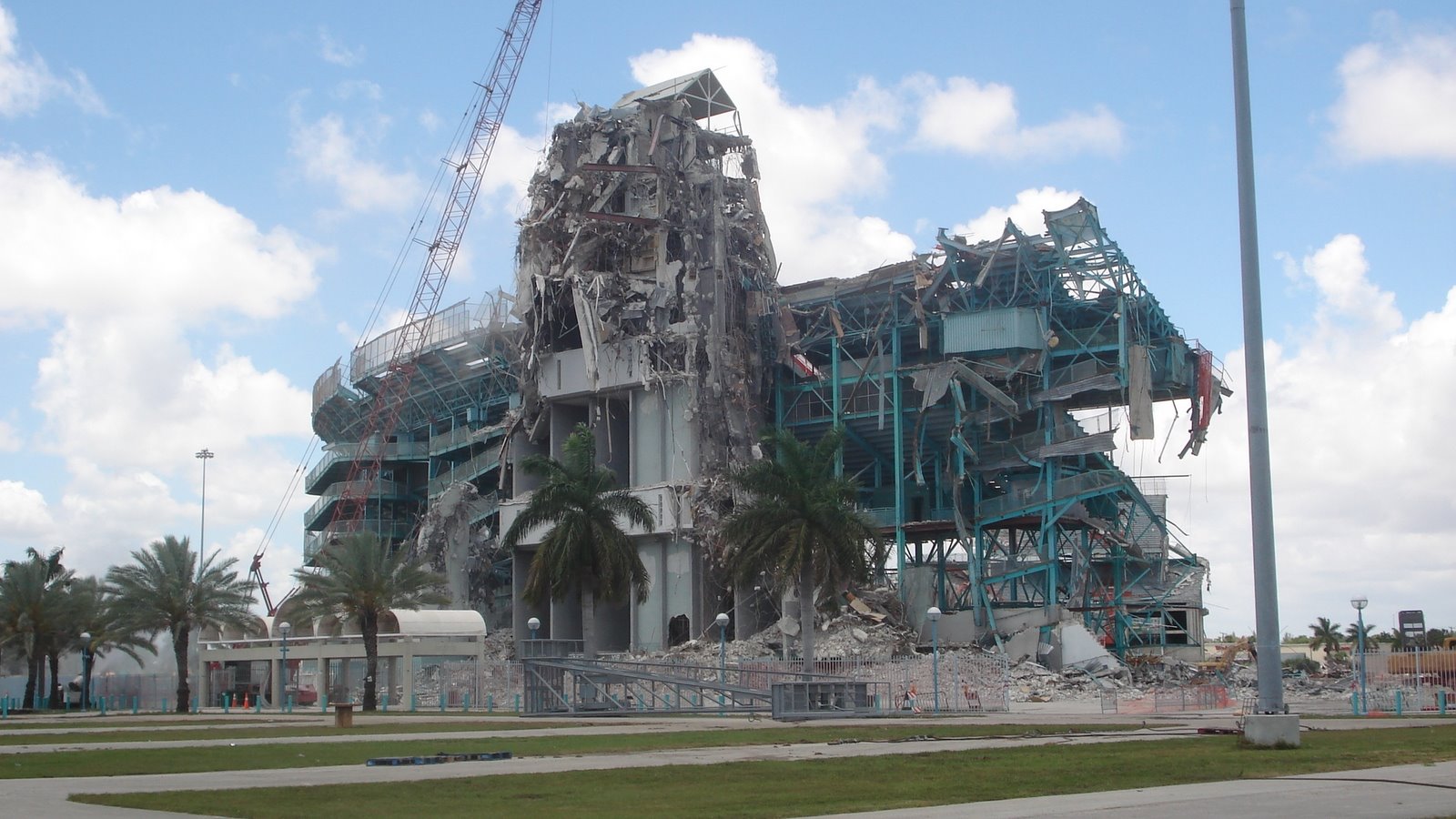
Orange Bowl RIP — 1937 – 2008

The good news is that another stadium is going up in its place. Fitting usage of sacred grounds.

If this looks like just another building being torn down to you. It probably means you weren’t there for any of the following:

  • Dec 1962 – President Kennedy / Bay of Pigs – my Dad was there and I still have his plastic Cuban souvenir flag which was handed out. Plan to use it again soon.
  • Jan 1969 – Super Bowl 3 – At the age of 9, I snuck into the game by myself with no money. Good lesson for life, cheap thrill set me up for a long and difficult day. I can confirm that there were no empty seats that day and that the ushers all brought their ‘A’ game. Rep Tancredo, long time ago dude, put the phone down.
  • Nov 1971 – Florida Gators Flop – could not for the life of me figure out how they all fell at once.
  • Jan 1972 – Orange Bowl Classic – Nebraska was using and rapidly discarding tear-away jerseys which I unsuccessfully begged #35 [Jeff Kinney, RB] to toss me at the end of the game.
  • Jan 1972 – AFC Championship vs. Colts – This was my father’s [Adolfo] first & last football game with my brother and me. Experienced my 1st live sports nirvana moment on Griese to Warfield’s 75-yard touchdown pass play. Image of Rick Volk trying to chase down Paul Warfield on the play, please.
  • 1974 – 1977 – Attended numerous games for my beloved Miami Senior High.
  • Aug 1975 – Miami Toros soccer championship – I don’t really like soccer, but I chased supposedly loose Killian high school girls through the bowels of the OB. Toros lost, but I did ok.
  • Jan 1982 – San Diego Chargers OT – I confess I wanted to leave at halftime. For once, my brother Fernando fought the impulse to leave early.
  • Nov 1985 – Notre Dame – Introduction to a Jimmy Johnson [pronounced as one word in Little Havana] style whupping.
  • Nov 1989 – Notre Dame – 3rd & 44.
  • Oct 1992 – FSU – One of the wide-rights. Sorry, I get them confused.
  • Mar 1996 – Brothers to the Rescue Prayer Ceremony.
  • Oct 2000 – FSU – Dorsey to Shockey.
  • Sept 2003 – Gators – Comeback against a truly hated opponent. Sweet.
  • Oct 2006 – FIU – Blame myself for the scuffle. First time I ever had good seats at the OB.
Posted in Uncategorized | Tagged , | Leave a comment

Friend of terrorists – Rep James McGovern

A WSJ Editorial highlights the shameful efforts of James McGovern (D., Mass.).

A hard drive recovered from the computer of a killed Colombian guerrilla has offered more insights into the opposition of House Democrats to the U.S.-Colombia Free Trade Agreement.A military strike three weeks ago killed Raúl Reyes, No. 2 in command of the FARC, Colombia’s most notorious terrorist group. The Reyes hard drive reveals an ardent effort to do business directly with the FARC by Congressman James McGovern (D., Mass.), a leading opponent of the free-trade deal. Mr. McGovern has been working with an American go-between, who has been offering the rebels help in undermining Colombia’s elected and popular government.

Mr. McGovern’s press office says the Congressman is merely working at the behest of families whose relatives are held as FARC kidnap hostages. However, his go-between’s letters reveal more than routine intervention. The intervenor with the FARC is James C. Jones, who the Congressman’s office says is a “development expert and a former consultant to the United Nations.” Accounts of Mr. Jones’s exchanges with the FARC appeared in Colombia’s Semana magazine on March 15. This Mr. Jones should not be confused with the former Congressman and ambassador to Mexico of the same name from Oklahoma.

“Receive my warm greetings, as always, from Washington,” Mr. Jones began in a letter to the rebels last fall. “The big news is that I spoke for several hours with the Democratic Congressman James McGovern. In the meeting we had the opportunity to exchange some ideas that will be, I believe, of interest to the FARC-EP [popular army].”

Mr. Jones added that “a fundamental problem is that the FARC does not have, strategically, a spokesman that can communicate directly with persons of influence in my country like Mr. McGovern.” Semana reports that in the documents Mr. Jones “rules himself out as the spokesman but offers himself as a ‘bridge’ of communication between the FARC and the congressman.” Semana says when it spoke with Mr. Jones, he verified the letter and explained that “he made the offer because the guerrillas need interlocutors if they want to achieve peace and that it is a mistake to isolate them.”

But communications among FARC rebels suggest the goal was to isolate Colombia’s government. A letter that Reyes wrote to top FARC commander Manuel Marulanda on October 26 reads: “According to [Jones’s] viewpoint, [President Álvaro] Uribe is increasingly discredited in the U.S. . . He believes that the safe haven [for the rebels] in the counties can be had for reasons mentioned. Congressional Democrats have invited him to Washington to talk about the Colombian crisis in which the principal theme is the swap.”

Semana reports that Mr. Jones made some proposals to the FARC, including a Caracas meeting with representatives of Venezuela, Colombia, the FARC, other South American countries, U.S. Congressmen and the Catholic Church. “It would be almost impossible for Uribe to reject such a meeting,” Mr. Jones wrote, “without burning himself a lot, nationally and internationally. If he persists in being against it, I have understood that there are ways to pressure him from my country [the U.S.].”

In a letter to Semana, Mr. Jones said his words were taken out of context. He says he is not in favor of the “violent methods of the guerrilla” or “the military solutions” of the government. He had only a professional relationship with the FARC and had to address them as he did because he had to build trust. Mr. McGovern’s office says it knew what Mr. Jones was doing and engaged with him because “we need to find an interlocutor who could discuss these things including the safe haven” for the guerrillas.

We think the documents reveal something else entirely: Some Democrats oppose the Colombia trade deal because they sympathize more with FARC’s terrorists than with a U.S. anti-terror ally.

Posted in Current Affairs & History | Tagged , , | Leave a comment

Why silence is golden or Why operational incomes are stubborn things

Please click on the spreadsheet to enlarge or print

Recently, the Marlins made a claim as to what they spend [$10 million] on marketing and suggested that that has implications as to their perceived profitability, i.e. “hidden costs.”

Based on the Forbes analysis, marketing expenses, and all expenses other than ‘Player [major & minor leagues salaries & benefits] Expenses,’ are captured on our P&L in the the ‘National and Other Expenses’. If you think about it in terms of your own businesses, these are their operating expenses. These expenses are common to all MLB teams [minor league operations, player development, rent etc] and are the expenses which are least subject to fluctuation, as opposed to ‘Player Expenses’ which could vary significantly from one year to another – for example the Marlins in 2005 had $91 million in ‘Player Expenses’ and only $31 million one year later in 2006.

The spreadsheet above shows the ‘operating expenses’ attributable to the Marlins – $48 million in 2007 – are consistent with the other lowest revenue teams and could accommodate the $10 million in marketing and the over $20 million in farm system costs which the Marlins President David Samson stated [about halfway through] on his radio show. That December 2007 radio show, made after the Cabrera & Willis trade, gives us a good example of the smokescreen people in Mr Samson’s position are forced to attempt in denying profitability – let’s examine his various points:

  1. Farm system costs Marlins over $20 million, which does not include bonuses, and the Marlins do not own any of their minor league affiliates.
  2. People believe Forbes claims re the Marlins operational profitability [$43 million in 2006] because they assume that player expenses are the Marlins only expense.
  3. They have depreciation and interest expenses which are not being considered in the $43 million amount.

Here is my response to each point:

#1 – Farm system or player development costs:
Outside of salaries and bonuses, it’s difficult to see where significant costs for minor league operations would arise given how the Player Development Contract [PDC] – the document which governs the relationship between the big league and independent minor league teams – divides costs responsibilities. Again, aside from salaries, the costs entail the players medical treatment, uniforms and part of the transportation costs. Some minor league teams are owned by the major league team, who are then responsible for all the costs and receive the revenues. All 6 of the Marlins minor league affiliates are independently owned. See the minimum salaries according to the new CBA agreement.

To be fair, Mr Samson might have meant to say player development costs, which would include minor league player salaries, in the over $20 million figure. Noted sports economist, Andrew Zimbalist, has written recently that “the average MLB team spends over $20 million in player development costs, which includes $11.5 in minor league player salaries.” Important to note that the $48 million we have been referencing, does not include minor league salaries, which are captured under ‘Other Players & Benefits’ expenses in the Player expenses section of our P&L.

Bottom line, there is plenty of room in the $48 million of non-player expenses to accommodate all the expenditures the Marlins have stated or hinted at to date. Like facts, operational incomes are stubborn things.


#2 – Forbes assumes that player expenses are the Marlins only expense.
Bizarrely untrue. As noted, Forbes allows for $48 million in non-player expenses – National and Other Expenses in 2007.

#3 – Forbes does not consider the Marlins depreciation and interest expenses in determining their operational profitability.
Debt and interest costs are supposed to be excluded from operational income. That’s why it’s operational income as opposed to net income. Operational income is considered a better indicator as to how your core business is performing rather than including certain expenses, such as depreciation, which could create ‘paper’ losses and distort actual performance. This is not a complicated point, certainly one not lost on a former Wall Street professional like Mr. Samson. In fact, he made the very point to ESPN back in 2004.

The reason for the flip-flop? I hope you answered incentives. Mr. Samson acknowledged the distinction between operational and paper losses because at the time – the Marlins had an operational loss [$12 million] in 2003 – that served the Marlins purposes in explaining the need to cut costs. Interesting to note, Forbes loss estimate for 2003 was $12 million and the Marlins self-professed loss in the article was $20 million.

Interests costs – Forbes does estimate each teams interests costs for their valuation analysis, but I do not use that part of their work.

Here is the most constructive way to think about it; How reasonable is it to believe that the Marlins, especially prior to the stadium deal being secured, would have spent a significantly higher percentage of their revenues on how they operate their franchise than the other 4 teams in MLB which had revenues under $150 million? I would say that would be very unlikely and uncharacteristic of how Mr Loria would operate a franchise which could have been looking to relocate. There is a track record for Mr Loria’s behavior in similar circumstances and it did not involve increased marketing expenditures in an effort to lure fans. Forbes again! Hey maybe they just have it in for the guy? OK, try this.

The only “hidden costs” are those hidden from us fans and with good reason. The more that is revealed, the less the wiggle room. This is a good example of why MLB teams avoid discussing the specifics of their finances.


Posted in Marlins Ballpark & Finances | Tagged | Leave a comment

P1 – Rationale behind the numbers

Hey don’t those highlighted amounts on your Florida Marlins P&L Financial Statement mean you are guessing?

Yes.

But do me a favor, please print it out and follow me here – it won’t hurt.

Each of the amounts highlighted ties into the Forbes Total Revenue amount. So, the guess is about the breakdown of the highlighted amounts only. For example, if one of the estimates were changed to be $3 million higher, another one of the estimates would have to be lowered by $3 million. Within the highlighted amounts, it’s a zero-sum game.

Think of this as a puzzle for which Forbes has already provided every key piece [Gate Receipts, Total Revenues, Total Player Expenses and Operating Income or Loss]. To the extent to which additional information can be uncovered, there is less which has to be approximated to fill in the individual revenue items.

For example, there was a State of Wisconsin Legislative Audit Bureau review report released in 2004 [see page 7 of report], which provided the MLB Central Fund revenues for 1998 through 2003. In addition, Rob Manfred, chief labor executive for MLB, disclosed that the Marlins had received $41 million in Revenue Sharing monies across the two years ending in 2003.

For our purposes, the year 2005 was a very good year. Apparently due to the CBA negotiations ongoing in 2006, MLB Central and Revenue Sharing amounts for 2005 were disclosed in various reports – see list of articles below. So the only guesses involved the Marlins Local Revenues. Using the USA Today 2001 forecasts for each revenue line item, allowed me to approximate the Local Revenues which tied into the Forbes Total Revenue amount. While their attendance has obviously been low, the Marlins have had good ratings for their local broadcasts and likely benefited from an aggressive Fox Sports regional sports network [RSN] efforts to acquire MLB broadcast rights and dissuade teams from setting up their own team-owned RSN.

Note re Revenue Sharing – In the world of MLB finances, Revenue Sharing [based on Local Media revenues] and Luxury [based on payroll] taxes are all part of the revenues which are taken from from certain teams. However, only Revenue Sharing is redistributed to the other [low revenue] MLB teams. Luxury taxes are collected and kept at the MLB Commissioner’s office level.

Those differ from MLB Central revenues [National broadcast & cable contracts, MLB Advanced Media, merchandise, etc] which are derived from external sources and distributed equally among all the teams.

In the case of MLB Central revenues, there is a strong basis to assume that each team’s share has been growing consistently. Revenue Sharing amounts are the revenue item subject to the most fluctuation. Therefore, other than in 2005, I treated it as the last component and plugged the amount needed to match Forbes Total Revenues.

  • MLB Central Fund & Revenue Sharing info – NYT – Murray Chass
  • MLB Central Fund & Revenue Sharing info – WSJ – Stefan Fatsis
  • MLB Central Fund & Revenue Sharing info – NYT – Michael Lewis
  • MLB Yearly Attendance info – ESPN
  • MLB Yearly Major League Player Salaries info – USA Today
  • Posted in Marlins Ballpark & Finances | Tagged | Leave a comment