Episcopal Church – Catholic Road Map?

At times this blog is a more efficient version of the emailed article, ‘hey you gotta read this.’ While I always feel the tug to comment, when it’s George Will, … please.

Hey you gotta read George Will’s column about the American Anglican Church–they of the killer nickname, The Frozen Chosen–he writes:

It is not the secessionists such as Duncan who are, as critics charge, obsessed with homosexuality. The Episcopal Church’s leadership is latitudinarian — tolerant to the point of incoherence, Duncan and kindred spirits think — about clergy who deviate from traditional church teachings concerning such core doctrines as the divinity of Christ, the authority of scripture and the path to salvation. But the national church insists on the ordination of openly gay clergy and on blessing same-sex unions.

The Anglican communion once was a “via media,” a middle way, between Catholicism and Protestantism. Now, Duncan says, the national leadership of the Episcopal Church thinks of itself as a bridge between Protestantism and the culture. Duncan and other protesters agree with the late Flannery O’Connor, the Catholic novelist: “You have to push as hard as the age that pushes against you.”

The Episcopal Church once was America’s upper crust at prayer. Today it is “progressive” politics cloaked — very thinly — in piety. Episcopalians’ discontents tell a cautionary tale for political as well as religious associations. As the church’s doctrines have become more elastic, the church has contracted. It celebrates an “inclusiveness” that includes fewer and fewer members.

See entire column at end of post.

——————————————————–

October 19, 2008
The Shrinking Episcopal Church
By George Will

WASHINGTON — The Rev. Robert Duncan, 60, is not a Lutheran, but he is a Luther, of sorts. The former Episcopal bishop of Pittsburgh has, in effect, said the words with which Martin Luther shattered Christendom and asserted the primacy of individual judgment and conscience that defines the modern temperament: “Ich kann nicht anders” — I cannot do otherwise.

The Episcopal Diocese of Pittsburgh recently became the second diocese (the first was in Fresno, Calif.) to secede from the U.S. Episcopal Church since, but not entirely because of, the 2003 ordination in New Hampshire of an openly gay bishop — Gene Robinson, a classmate of Duncan’s at General Theological Seminary in New York in the 1970s. Before the Robinson controversy, other Episcopalians, from South Carolina to Southern California, had disassociated from the Episcopal Church and put themselves under the authority of conservative Anglican bishops who serve where the church is flourishing — often in sub-Saharan Africa, where a majority of Anglicans live.

It is not the secessionists such as Duncan who are, as critics charge, obsessed with homosexuality. The Episcopal Church’s leadership is latitudinarian — tolerant to the point of incoherence, Duncan and kindred spirits think — about clergy who deviate from traditional church teachings concerning such core doctrines as the divinity of Christ, the authority of scripture and the path to salvation. But the national church insists on the ordination of openly gay clergy and on blessing same-sex unions.

In the 1960s, Bishop James Pike of California, who urged the church to jettison such “theological baggage” as the doctrines of Original Sin and the Trinity, was the last active bishop disciplined for theological reasons. Duncan doubts whether Pike would be disciplined today.

Duncan became a bishop in 1995, at age 47, in an Episcopal Church already roiled by dissension about the ordination of women, revision of the prayer book and other matters. But, Duncan says, “I wish it” — the issue that finally precipitated secession — “had been some other issue.” He means some controversy, other than Robinson’s ordination, turning on scriptural authority.

The shrinking Episcopal Church (2.4 million members, down from 3.5 million at its peak in 1965) is a small sliver of the worldwide Anglican communion (at least 77 million and expanding rapidly). Its travails are, Duncan says, yet another lingering echo of the 1960s.

The Anglican communion once was a “via media,” a middle way, between Catholicism and Protestantism. Now, Duncan says, the national leadership of the Episcopal Church thinks of itself as a bridge between Protestantism and the culture. Duncan and other protesters agree with the late Flannery O’Connor, the Catholic novelist: “You have to push as hard as the age that pushes against you.”

Every 10 years there is a Lambeth Conference of Anglican bishops, presided over by the archbishop of Canterbury. This year only 650 of the nearly 900 bishops attended — 150 of them representing only the tiny U.S communion. The bishops from three of the Anglican communion’s five largest provinces — Nigeria, Uganda and Kenya — boycotted.

Today, the typical Anglican is a middle-aged African woman. The burgeoning Nigerian church says it has 20 million Anglicans; Duncan believes it may have 25 million but perhaps chooses to underreport so as not to exacerbate tensions with Nigerian Muslims.

In London, more Muslims attend Friday prayers than Anglicans attend Sunday services. Last December, on the Sunday after former Prime Minister Tony Blair was received into the Catholic Church, more Catholics than Anglicans attended services in England, an increasingly common occurrence now, five centuries after the Reformation.

“I think,” Duncan says, “the 21st century will be for the archbishop of Canterbury what the 20th century was for the royal family.” That is, an era of diminution.

Because Protestantism has no structure of authority comparable to the Vatican, and because it does not merely tolerate but enjoins individual judgments by “the priesthood of all believers” concerning beliefs and obligations, all Protestants are potential Luthers. Hence it is evidence of spiritual vigor that Episcopalians in Quincy, Ill., and Fort Worth, Texas, will vote on disassociation from the U.S. communion on Nov. 7 and Nov. 14, respectively.

The Episcopal Church once was America’s upper crust at prayer. Today it is “progressive” politics cloaked — very thinly — in piety. Episcopalians’ discontents tell a cautionary tale for political as well as religious associations. As the church’s doctrines have become more elastic, the church has contracted. It celebrates an “inclusiveness” that includes fewer and fewer members.
georgewill@washpost.com

Copyright 2008, Washington Post Writers Group
Page Printed from: http://www.realclearpolitics.com/articles/2008/10/the_shrinking_episcopal_church.html at November 18, 2008 – 07:17:57 AM PST
————————————————-

Posted in Catholic Faith & Inspiration | Tagged , , , | Leave a comment

Telefutura Drops Boxing

Bad news for local boxing. The Miami Herald article by Santos Perez explains:

Telefutura’s recent decision to cancel its Friday night boxing series has the sport’s insiders pursuing options. After Telefutura presents its final Solo Boxeo telecast next month, Telemundo will be the only Spanish- language network broadcasting fights.

The network televises Boxeo Telemundo 12 Friday nights a year, including Friday night’s telecast from Kissimmee. ”They try to pique my interest in whether we would do more shows,” Hidalgo said of the callers he spoke to last week. “Right now we are sticking to our plan, which is: Less is better.”

A downturn in the economy prompted Telefutura to scrap its boxing series, despite strong ratings. The telecasts enabled top promotional companies such as Golden Boy Promotions and Top Rank to push their fighters.

Like Telefutura’s fight shows, Telemundo enjoys solid ratings, said Hidalgo. The network has presented boxing for 17 years.

Article referenced is copied in full at end of post.

——————————————————————————-
Telefutura drops its Friday boxing broadcasts

Posted on Tue, Nov. 18, 2008

BY SANTOS A. PEREZ

One outlet for showcasing fighters will soon dry out, suddenly making Jorge Hidalgo a highly targeted television network executive.

Telefutura’s recent decision to cancel its Friday night boxing series has the sport’s insiders pursuing options. After Telefutura presents its final Solo Boxeo telecast next month, Telemundo will be the only Spanish- language network broadcasting fights.

”Yes, I have been getting a lot of phone calls,” said Hidalgo, Telemundo’s senior executive vice president for news and sports. “I have been talking more about boxing than I normally do.”

The network televises Boxeo Telemundo 12 Friday nights a year, including Friday night’s telecast from Kissimmee. ”They try to pique my interest in whether we would do more shows,” Hidalgo said of the callers he spoke to last week. “Right now we are sticking to our plan, which is: Less is better.”

A downturn in the economy prompted Telefutura to scrap its boxing series, despite strong ratings. The telecasts enabled top promotional companies such as Golden Boy Promotions and Top Rank to push their fighters.

Like Telefutura’s fight shows, Telemundo enjoys solid ratings, said Hidalgo. The network has presented boxing for 17 years.

But Boxeo Telemundo never has deviated from a monthly concept. Telemundo already is committed to 12 shows next year presented by Miami-based promoter Felix Zabala Jr.

”The way we go about our boxing is we try to keep the travel to a minimum,” Hidalgo said. “Moving your shows from site to site on a weekly basis could lead to cost overruns — especially now, with difficult economic times.”

Telemundo divides most of its telecasts between Kissimmee and the Miccosukee Resort and Gaming in West Miami-Dade. On occasion, the network broadcasts shows from the West Coast and Mexico. ”We’re going to produce a more competitive fight on a monthly basis,” Hidalgo said. “That has been our concept, and it has proved successful.”

TAYLOR POUNDS LACY

Jermain Taylor won a lopsided decision over fellow 2000 U.S. Olympian Jeff Lacy Late Saturday in Nashville.

Taylor, in his first fight since losing a decision to Kelly Pavlik on Feb. 16, controlled the pace throughout the 12-round, super-middleweight bout with lead left jabs, straight rights to the head and left and right uppercuts.

Taylor, a former middleweight champion who trained for the Lacy bout in Miami, won 119-109 on two judges’ scorecards and 118-110 on the third.

”It was a comeback fight. I knew Jeff was a strong fighter,” said Taylor, now 28-2-1. “It’s all about getting your confidence back.”

Lacy fell to 24-2.

A LOGJAM AT 122 POUNDS

Nine months after Israel Vazquez and Rafael Marquez waged the third of their thrilling super-bantamweight title bouts, two other fighters will attempt to stake claims as the best fighter in the 122-pound class.

Panama’s Celistino Caballero and Canada’s Steve Molitor will fight in a title unification bout Friday in Rama, Canada. Caballero (30-2, 21 KOs) has made five successful title defenses since winning the World Boxing Association crown in October 2006. One of those was over Ricardo Castillo at the Hard Rock Live Arena in March 2007.

Molitor (28-0, 11 KOs) won the International Boxing Federation belt in November 2006 and also has five successful defenses.

”This is a fight that I’ve been dreaming of since I started boxing nearly 20 years ago,” Molitor, 28, said in a conference call last week. “It’s something I’ve always wanted — to be the best of the best. And when you have two champions fighting, that is what you’re going to get — the best of the best.”
———————————————————————————

Tagged , | Leave a comment

Auto Industry Bailout Debate

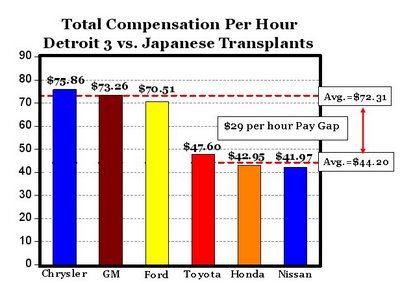
The chart comes by way of Greg Mankiw’s blog

It’s fascinating to watch the auto industry bailout debate unfold. I have a natural aversion to arguments designed to pull at my heart strings, so if I see any version of ‘millions of families’ in the first paragraph, I suspect they are hiding a weak argument and move on. I’ll try to give a flavor of where the argument is today. I have to mention one thing that shocked me. Richard Posner was the first person I respect to use the word depression to describe where he believes we are headed.

Michael Levine in the WSJAgainst:

GM has about 7,000 dealers. Toyota has fewer than 1,500. Honda has about 1,000. These fewer and larger dealers are better able to advertise, stock and service the cars they sell. GM knows it needs fewer brands and dealers, but the dealers are protected from termination by state laws. This makes eliminating them and the brands they sell very expensive. It would cost GM billions of dollars and many years to reduce the number of dealers it has to a number near Toyota’s.

Jeffrey Sachs in the Washington PostFor:

Some want to see the industry punished for its neglect of energy and environmental realities, but we should acknowledge that the SUV era reflected poor judgment across society. Yes, the industry ignored warnings about energy insecurity and climate, but so did the public and politicians. Rather than kill the auto industry, and destroy the U.S. economy in the process, we should fix the industry with a sense of national responsibility and purpose. (We should also fix our ramshackle health-care system, which has burdened the industry and the economy with punitively high costs.)

There are many crucial issues for the design of a long-term restructuring. The government needs the authority to steer a public-private consortium to create a high-mileage-vehicle economy in the coming decade. Public and private funding will be needed for research, development and demonstration of breakthrough technologies. During the restructuring, taxpayers will need protections, including warrants or equity shares, limits on industry compensation, and an equitable restructuring of worker benefits, a process that has already begun because of market hardships.

We face an unprecedented financial calamity, energy crisis and environmental threat. A vibrant, growing U.S. automobile industry should play an essential role in solving all three. The technologies that will win the day are in sight; industry has already made important advances. A partnership with government is vital and should begin this week.

Gary BeckerAgainst:

Bankruptcy would help GM and Ford become more competitive by abrogating significant parts of their labor contracts with the UAW. One of the greatest needs would be sizable reduction in their health costs through sharp increases in the deductibility and co-payments, and a reduced coverage of medical procedures. Bankruptcy should also help bring the wage rates of GM and Ford in line with those of foreign producers in the US. Some of their pension liabilities may be shifted onto the Pension Benefit Guarantee Corp, but even that would be preferable to an overall bailout.

Judge PosnerFor:

The likely psychological impact of a bankruptcy of the U.S.-owned auto industry should not be underestimated. Already consumers, rendered fearful by repeated misinformation from government officials concerning the gravity of the economic situation (including their reluctance to acknowledge that the nation was even in a “recession,” long after it was obvious to the man in the street that we were in something worse), are reducing their buying, precipitating big layoffs in the retail industry, which in turn reduce buying power, which in turn spurs more layoffs. This vicious cycle would be accelerated by the laying off of hundreds of thousands of workers in the automobile industry, including employees of suppliers and dealers as well as of the manufacturers.

All articles referenced are copied in full at end of post.

——————————————————–

Why Bankruptcy Is the Best Option for GM
Chapter 11 would better preserve the valuable parts of the company than an ad hoc bailout.
By MICHAEL E. LEVINE

General Motors is a once-great company caught in a web of relationships designed for another era. It should not be fed while still caught, because that will leave it trapped until we get tired of feeding it. Then it will die. The only possibility of saving it is to take the risk of cutting it free. In other words, GM should be allowed to go bankrupt.

Consider the costs of tackling GM’s problems with some kind of bailout plan. After 42 years of eroding U.S. market share (from 53% to 20%) and countless announcements of “change,” GM still has eight U.S. brands (Cadillac, Saab, Buick, Pontiac, GMC, Saturn, Chevrolet and Hummer). As for its more successful competitors, Toyota (19% market share) has three, and Honda (11%) has two.

GM has about 7,000 dealers. Toyota has fewer than 1,500. Honda has about 1,000. These fewer and larger dealers are better able to advertise, stock and service the cars they sell. GM knows it needs fewer brands and dealers, but the dealers are protected from termination by state laws. This makes eliminating them and the brands they sell very expensive. It would cost GM billions of dollars and many years to reduce the number of dealers it has to a number near Toyota’s.

Foreign-owned manufacturers who build cars with American workers pay wages similar to GM’s. But their expenses for benefits are a fraction of GM’s. GM is contractually required to support thousands of workers in the UAW’s “Jobs Bank” program, which guarantees nearly full wages and benefits for workers who lose their jobs due to automation or plant closure. It supports more retirees than current workers. It owns or leases enormous amounts of property for facilities it’s not using and probably will never use again, and is obliged to support revenue bonds for municipalities that issued them to build these facilities. It has other contractual obligations such as health coverage for union retirees. All of these commitments drain its cash every month. Moreover, GM supports myriad suppliers and supports a huge infrastructure of firms and localities that depend on it. Many of them have contractual claims; they all have moral claims. They all want GM to be more or less what it is.

And therein lies the problem: The cost of terminating dealers is only a fraction of what it would cost to rebuild GM to become a company sized and marketed appropriately for its market share. Contracts would have to be bought out. The company would have to shed many of its fixed obligations. Some obligations will be impossible to cut by voluntary agreement. GM will run out of cash and out of time.

GM’s solution is to ask the federal government for the cash that will allow it to do all of this piece by piece. But much of the cash will be thrown at unproductive commitments. And the sense of urgency that would enable GM to make choices painful to its management, its workers, its retirees, its suppliers and its localities will simply not be there if federal money is available. Like AIG, it will be back for more, and at the same time it will be telling us that it’s doing a great job under difficult circumstances.

Federal law provides a way out of the web: reorganization under Chapter 11 of the bankruptcy code. If GM were told that no assistance would be available without a bankruptcy filing, all options would be put on the table. The web could be cut wherever it needed to be. State protection for dealers would disappear. Labor contracts could be renegotiated. Pension plans could be terminated, with existing pensions turned over to the Pension Benefit Guaranty Corp. (PBGC). Health benefits could be renegotiated. Mortgaged assets could be abandoned, so plants could be closed without being supported as idle hindrances on GM’s viability. GM could be rebuilt as a company that had a chance to make vehicles people want and support itself on revenue. It wouldn’t be easy but, unlike trying to bail out GM as it is, it wouldn’t be impossible.

The social and political costs would be very large, but if GM fails after getting $50 billion or $100 billion in bailout money, it’ll be just as large and there will be less money to soften the blow and even more blame to go around. The PBGC will probably need money to guarantee GM’s pensions for its white- and blue-collar workers (pension support is capped at around $40,000 per year, so that won’t help executives much). Unemployment insurance will have to be extended and offered to many people, perhaps millions if you include dealers, suppliers and communities dependent on GM as it exists now. A GM bankruptcy will make addressing health-care coverage more urgent, which is probably a good thing. It would require job-retraining money and community assistance to affected localities.

But unless we are willing to support GM as it is indefinitely, the downsizing and asset-shedding will have to come anyway. Even if it builds cars as attractive and environmentally responsible as those Honda and Toyota will be building, they won’t be able to carry the weight of GM’s past.

GM CEO Rick Wagoner says “bankruptcy is not an option.” Critics of a bankruptcy say that GM won’t be able to get the loans it will need to guarantee warranties, pay its operating losses while it restructures, and preserve customers’ ability to finance purchases. While consumers buy tickets from bankrupt airlines, electronics from bankrupt retailers, and apartments from bankrupt builders, they say consumers won’t buy cars from a bankrupt auto maker. But bankruptcy no longer means “liquidation” or “out of business” to a generation of consumers used to buying from firms in reorganization.

GM would guarantee warranty support with a segregated fund if necessary. And debtor-in-possession (DIP) financing — loans that provide the near-term cash for reorganizing companies — is very safe, because the DIP lender has priority over all other claimants. In normal markets, it would certainly be available to a GM that has assets to sell, including a viable overseas business. Such financing is probably available even now.

In any event, it would be lined up before a filing, not after, so any problems wouldn’t be a surprise. As a last resort, we could at least consider a public DIP loan to support a reorganizing GM with a good chance to survive — as opposed to subsidizing a GM slowly deflating.

The fate of Daewoo — the Korean auto maker that collapsed in 2000 after filing for bankruptcy, leaving about 500 dealers stranded in the U.S. — is often cited as “proof” that a GM bankruptcy won’t work. But Daewoo was headquartered in a part of the world where bankruptcy still carries a major stigma and usually means liquidation. Daewoo’s experience is largely irrelevant to a major U.S. company undergoing a well-publicized positive transformation, almost certainly under new management.

GM as it is cannot survive without long-term government life support. If it gets that support, it can’t change enough and won’t change fast enough. Contrary to Mr. Wagoner’s brave declaration, bankruptcy is an option. In fact, it’s the only option that merits public support and actually has a chance at succeeding.

Mr. Levine, a former airline executive, is a distinguished research scholar and senior lecturer at NYU School of Law.
———————————————————————————
Gary Becker
Bail Out the Big Three Auto Producers? Not a Good Idea-Becker

The big three American auto producers General Motors, Ford, and Chrysler, are in terrible financial shape. They have asked the government for a bailout, and the Democratic leadership in Congress is eager to give them one. The United Auto Workers union was a strong supporter of President-elect Obama and of Democratic candidates.

These companies have lost tens of billions of dollars during the past few years, and they will shortly run out of cash. GM’s shares have lost almost all their value, and Ford has not done much better. Cerberus Capital, a private equity company, owns Chrysler, and it has lost most of what it invested in the company. For this reason Cerberus is trying get out of the automobile manufacturing business. All three companies were heavily into producing trucks and SUV’s when the sharp run up in gas prices induced consumers to shift away from these gas-guzzlers and toward smaller and more fuel-efficient cars. Moreover, what money GM had been making came mainly not from car production but from its automobile credit business, (GMAC). This company would borrow from banks to lend to consumers who needed help in financing their GM car purchases. The financial crisis has dried up the money available to auto financing companies, and hence eliminated the major source of their profits.

If GM is not bailed out, the company claims it will be forced into bankruptcy within a few months, and Ford’s situation is only slightly better. GM is blitzing Congress, President Bush, and President -elect Obama with pleas for a bailout, followed by a warning that bankruptcy will also hurt auto suppliers throughout the nation that depend on GM’s business. GM is also claiming that bankruptcy will put major financial pressure on the Pension Benefit Guaranty Corp, the federal agency that insures benefits to retirees in the auto industry as well as to million of other workers.

Nevertheless, I believe bankruptcy is better than a bailout for American consumers and taxpayers. The main problem with American auto companies is that during the good times of the 1970s, 1980s and 1990s, they made overly generous settlements with the United Auto workers (UAW) on wages, pensions, and health benefits. Only a couple of years ago, GM was paying $5 billion per year in health benefits to retirees and current employees because their plans had wide health coverage with minimal co-payments and deductibility on health claims by present and retired employees. In those days, the UAW was one of the most powerful unions in the US, and it bargained aggressively with the auto manufacturers, carrying out strikes when its demands were not met. When the American auto industry began to face tough competition from Japanese and German carmakers, they were saddled with excessive pay to their workers, and vastly excessive pensions and health benefits to their current and retired workers.

It is not that cars cannot be produced profitably with American workers: the American plants of Toyota and other Japanese companies, and of German auto manufacturers, have been profitable for many years. The foreign companies have achieved this mainly by setting up their factories in Southern and border states where they could avoid the UAW, and thereby introduce efficient methods of production. Their workers have been paid well but not excessively, and these companies have kept their pension and health obligations under control while still maintaining good morale among their employees. In recent years GM and the other American manufacturers have chipped away at their generous fringe benefits, but their health and retirement benefits still considerably exceed those received by American auto workers employed by foreign companies. As a result of lower costs, better management, and less hindrance from work rules imposed by the UAW, about 1/3 of all cars produced in the US now come from foreign owned plants.

Bankruptcy would help GM and Ford become more competitive by abrogating significant parts of their labor contracts with the UAW. One of the greatest needs would be sizable reduction in their health costs through sharp increases in the deductibility and co-payments, and a reduced coverage of medical procedures. Bankruptcy should also help bring the wage rates of GM and Ford in line with those of foreign producers in the US. Some of their pension liabilities may be shifted onto the Pension Benefit Guarantee Corp, but even that would be preferable to an overall bailout.

A good analogy is what happened to United Airlines. By entering bankruptcy it was able to reduce its inflated cost structure by breaking contracts it had with the pilots union and other employee unions. It exited bankruptcy a slimmer and more efficient airline. Whether it is able to compete effectively in the long run is still not certain, but it is in much better shape to compete than before it entered bankruptcy.

Bankruptcy may also force out the current management of GM and Ford. I do not know for certain whether they have competent management- GM surely did not have top management for much of its recent history. I do believe, however, that when a coach of a team loses a few games, he might legitimately explain that by injuries, bad luck, or even bad officiating. These excuses become lame when he consistently loses many games, and the correct and common practice is then to fire the coach. The same considerations apply to top management. When a company consistently does badly while some of its competitors (like Toyota) are doing well, its time to fire the management team, and see if another team can do better.

Is GM “too big” to fail? I do not believe the company is too big to go into a reorganization-which is what bankruptcy would involve. Such reorganization would abrogate its untenable labor contracts, and give it a chance to survive in long run. A bailout, by contrast, would simply postpone the needed reforms in these labor contracts, the business model of GM, and its management.

Posted by becker at 08:34 PM | Comments (13) | TrackBack (0)
————————————————-
Richard Posner
Bail Out the Detroit Auto Manufacturers? Posner’s Comment

Becker has laid out the case for refusing to bail out GM, Ford, and Chrysler. It is a powerful case, and if the drop in auto sales that is driving these companies toward insolvency had occurred two years ago, there would be in my view no case, other than a political one, for a bailout. But in the current financial crisis, I believe a bailout is warranted, provided that the shareholders and managers of the companies are not allowed to profit from it.

There are two types of corporate bankruptcy: liquidation and reorganization (Chapter 7 and Chapter 11 of the Bankruptcy Code, respectively). In a liquidation the bankrupt company closes down, lays off all its workers, and sells all its assets. That probably would not be the efficient solution to the problems of the Detroit automakers. They are still producing millions of motor vehicles per year, and if they suddenly ceased production entirely there would be a big shortage even though demand is way down. To put this another way, although at present the companies are probably losing money on virtually every vehicle they sell, at a lower level of production the price at which they sold their vehicles would exceed marginal cost.

The alternative to liquidation–reorganization–can work well in normal times, as in the United Air Lines bankruptcy that Becker mentions. The reorganized business is able to borrow money because its post-bankruptcy borrowings (“debtor in possession” loans, as they are called) are given priority over its pre-bankruptcy debts, which are usually written down in bankruptcy, reducing the reorganized firm’s debt costs and thereby enabling it to recover solvency. The debts that get written down can include health and pension benefits, which in the case of the auto companies continue to be a big drag on profitability.

The major problems with allowing the automakers to be forced into bankruptcy within the next few months are three, all arising from the depression that the nation appears to be rapidly sinking into. The first problem is that the companies might have to liquidate, because they might be unable to attract the substantial post-bankruptcy loans that they would need to enable them to remain in business. The credit crunch–less politely the near insolvency of much of the banking industry–has made that industry unable or unwilling to make risky loans, and loans to the auto companies after they declared bankruptcy would be risky.

Second, not only the size of the automakers, but peculiarities of the industry, would cause bankruptcy to greatly exacerbate the nation’s already dire economic condition. In the very short term, the automakers would probably stop paying their suppliers, which would precipitate a number of the latter–already in perilous straits because of the plunge in the number of motor vehicles being produced–into bankruptcy. Many of the suppliers would probably liquidate, generating many layoffs. At the other end of the supply-distribution chain, consumers would be reluctant to buy cars or other motor vehicles manufactured by a bankrupt company because they would worry that the manufacturer’s warranties would be unenforceable. So more dealerships would close, producing more bankruptcies, liquidations, and layoffs. With the demand for the vehicles made by the Detroit automakers further depressed and the supply-distribution chain in disarray, the liquidation of those companies would begin to loom as a real and imminent possibility. Liquidation of the automakers would produce an enormous number of layoffs up and down the chain of supply and distribution. Such prospects reinforce the unlikelihood that a reorganized industry could survive on debtor in possession loans.

The likely psychological impact of a bankruptcy of the U.S.-owned auto industry should not be underestimated. Already consumers, rendered fearful by repeated misinformation from government officials concerning the gravity of the economic situation (including their reluctance to acknowledge that the nation was even in a “recession,” long after it was obvious to the man in the street that we were in something worse), are reducing their buying, precipitating big layoffs in the retail industry, which in turn reduce buying power, which in turn spurs more layoffs. This vicious cycle would be accelerated by the laying off of hundreds of thousands of workers in the automobile industry, including employees of suppliers and dealers as well as of the manufacturers.

The U.S.-owned auto industry may be doomed; it may simply be unable to compete with foreign manufacturers (including foreign manufacturers that have factories in the U.S.); or a reorganization in bankruptcy may be the industry’s eventual salvation. But the automakers should be kept out of the bankruptcy court until the depression bottoms out and the economy begins to grow again. (Recall that the government bailed out the airlines after 9/11, allowing United Air Lines to have an orderly bankruptcy reorganization beginning the following year and ending in 2006.) Any bailout, however, should come with strict conditions, to minimize the inevitable moral hazard effects of government bailouts of sick companies. The government should insist on being compensated by receipt of preferred stock in the companies, on the companies’ ceasing to pay dividends, and on caps on executive compensation, including severance pay.

A possible alternative would be for the government to refuse to bail out the industry but agree to provide the necessary debtor in possession loans to keep the auto companies from liquidating after they declare bankruptcy. But this would be a kind of bailout, and probably would not be sufficient to avert the shock effects that I have described.

Posted by Richard Posner at 06:59 PM | Comments (18) | TrackBack (0)
—————————————————————————–
Jeffrey Sachs
A Bridge for the Carmakers
The Future Is in Sight. They Just Need Help Getting There.

By Jeffrey D. Sachs
Monday, November 17, 2008; A19

A government-supported restructuring of the auto industry is urgently needed for our economic and energy security. If the Bush administration allows the auto industry to collapse, it will compound the panic that started with the bankruptcy of Lehman Brothers. Washington should seize the opportunity to begin a new era of U.S. technological leadership in the global auto industry, starting with an immediate loan.

First, this is an opportunity to embark on a major industry restructuring to position the United States to lead the world in producing cars that get 100 miles or more per gallon. This achievement is closer than many suppose, with the pathbreaking plug-in hybrid Chevy Volt set to arrive in 2010 and several new hybrid models on the way. American-made fuel-cell cars may be a large-scale reality within a decade. Success would dramatically improve energy and national security, climate security, and U.S. global competitiveness, and a public-private partnership is needed to bring about this transformation.

Second, the sudden closure of an automaker would be catastrophic, possibly pushing our economy from recession to depression. Because of the impact on parts suppliers, the shutdown of one company would imperil domestic production across the board, and the jobs at risk include not only the 1 million in vehicle assembly and parts but millions more that would be caught in the resulting cascade of failures. The industrial Midwest — especially Michigan, Ohio, Indiana, Illinois and Tennessee — would be devastated, and the shock waves would reverberate across the world.

Third, any restructuring under Chapter 11 bankruptcy rules would be a death knell. Yes, in some industries, Chapter 11 can provide breathing space. For the automakers, however, it would accelerate the collapse of consumer demand and the mass bankruptcy of parts manufacturers. Consumers choose vehicles in part on their expectation of the long-term health of the companies that make them, which they rely on for parts, service and resale values.

The industry does not need a shakeout but a change of technology for long-term energy and climate security. The recent collapse of annual sales, from 17 million vehicles to 11 million, is not permanent but cyclical. Over time, sales will increase, especially as people in China, India and other emerging markets become buyers. A forecast of U.S. sales of 15 million to 20 million units a year is justified by normal replacements among the 240 million passenger vehicles Americans now own, and the U.S. market will also grow along with population and income.

Yet the automakers cannot turn to ordinary borrowing to tide them over until that happens because of the ravaged capital markets. The risk spreads of corporate bonds over U.S. Treasuries are the highest ever, and many borrowers can’t get credit at any price. That’s why the government has embarked on nearly $1 trillion in direct interventions. A small part of that should be used for the auto industry.

In this environment, the normal market test of consumer demand can’t be used to judge which industries should survive. We are experiencing the steepest temporary decline in consumer spending since the Depression. Consumer financing for autos has collapsed. Households are retrenching after the greatest wealth loss in equities and housing in history.

And a transformation of the type that’s required for long-term sustainability of the automakers will require both the market and government. Public policies and funding are needed to support the research and development of high-performance batteries and fuel cells and, especially, to modernize the national power grid and other infrastructure. These are steps that individual auto companies (and even the industry as a whole) could not accomplish on their own.

Some want to see the industry punished for its neglect of energy and environmental realities, but we should acknowledge that the SUV era reflected poor judgment across society. Yes, the industry ignored warnings about energy insecurity and climate, but so did the public and politicians. Rather than kill the auto industry, and destroy the U.S. economy in the process, we should fix the industry with a sense of national responsibility and purpose. (We should also fix our ramshackle health-care system, which has burdened the industry and the economy with punitively high costs.)

There are many crucial issues for the design of a long-term restructuring. The government needs the authority to steer a public-private consortium to create a high-mileage-vehicle economy in the coming decade. Public and private funding will be needed for research, development and demonstration of breakthrough technologies. During the restructuring, taxpayers will need protections, including warrants or equity shares, limits on industry compensation, and an equitable restructuring of worker benefits, a process that has already begun because of market hardships.

We face an unprecedented financial calamity, energy crisis and environmental threat. A vibrant, growing U.S. automobile industry should play an essential role in solving all three. The technologies that will win the day are in sight; industry has already made important advances. A partnership with government is vital and should begin this week.

Jeffrey D. Sachs is director of the Earth Institute at Columbia University and the author of “Common Wealth: Economics for a Crowded Planet.”
————————————————-

Posted in Business & Economics | Tagged , , , , , | Leave a comment

God-incidences and Synchronicity

I was part of a Catholic Retreat [Emmaus] this weekend. It was a great experience. God-incidences are what some people of faith use to describe what might secularly be described as fate, or coincidences. Hard to describe, but between my wife and I, over the past week we’ve had a series of encounters with a local Parish priest which left her in possession of a beautiful prayer by Cardinal Newman and me with an insight into the teachings of a Swiss psychologist Carl Jung.

Synchronicity is the experience of two or more events which are causally unrelated occurring together in a meaningful manner. In order to be synchronous, the events should be unlikely to occur together by random chance.The concept does not question, or compete with, the notion of causality. Instead, it maintains that just as events may be grouped by cause, they may also be grouped by their meaning. Since meaning is a complex mental construction, subject to conscious and subconscious influence, not every correlation in the grouping of events by meaning needs to have an explanation in terms of cause and effect.

Events which can be grouped by their meaning would suggest intelligent design.

Posted in Catholic Faith & Inspiration | Tagged , | Leave a comment

Prayer of Cardinal Newman

The prayer of Venerable John Henry Cardinal Newman:

Dear Jesus, help me to spread Your fragrance everywhere I go.
Flood my soul with Your Spirit and Life.
Penetrate and possess my whole being so utterly
that my life may only be a radiance of Yours.
Shine through me and be so in me
that every soul I come in contact with
may feel Your presence in my soul.
Let them look up and see no longer me but only Jesus!

Stay with me and then I shall begin to shine as You shine,
so to shine as to be a light to others.
The light, O Jesus, will be all from You;
none of it will be mine. It will be You,
shining on others through me.
Let me thus praise You in the way which You love best,
by shining on those around me.

Let me preach You without preaching,
not by my words but by my example,
by the catching force,
the sympathetic influence of what I do,
the evident fullness of the love my heart bears for You.

Amen.

Found a page with various prayers.

Posted in Catholic Faith & Inspiration | Tagged | Leave a comment

Vicious internet rumor alert

Please be advised that I would not, repeat NOT be offended is anyone reading this blog were to consider hiring me for CPA related work. I don’t know how some of these rumors get started….

Posted in Random Observations | Leave a comment

Tom Wolfe on Cuban-Americans in the US

Aside from telling great stories, Tom Wolfe tells those stories through the prism of how he believes people view themselves and their overall place in society, namely their ‘status.’ Wolfe has written often about the influence German sociologist Max Weber had on his thinking.

That insight gives us an idea about how Wolfe has been so prescient in spotting or identifying trends in American society. He once explained how once he saw that once he saw that regular guys started wearing their hair longer in the early 70’s, he knew that college guys would soon be cutting theirs. He gave the 70’s its moniker of the ‘Me Decade.’ Reporting on fighter pilots, he identified the ‘right stuff‘ which separated them from the pack, already heavy with over-achievers to begin. Wall Street in the 80’s generated ‘masters of the universe.’

Through it all he has been a big proponent of the need for writers to immerse themselves in the subjects they are writing about, instead of relying on inspiration in seclusion. He is a huge fan of Carl Hiaasen’s work. Towards that end he has been spending time in Miami [I have no idea how much] since at least 2005 in preparation for his next book, a book about immigration based in Miami and scheduled to be released in 2009.

As a Cuban-American, I take great pride in my background, but increasingly it is just that. In the background. You might say that as an almost native Miamian, the shift during adulthood may initially have been imperceptible, but the accent in Cuban-American has long been on the latter not the former. However, when my favorite writer, one of the greatest American writers ever, sets his sites on my city and specifically my beloved tribe, then it is time to take stock, open a bottle and toast the USofA and our achievements here.

I don’t have to wait for the book to come out to figure out how we fare. Read the excerpt below. That does not mean he won’t reveal flaws about us as a group, even embarrassing [but funny] ones, but the bottom line for me is that how we have been allowed to prosper here is further evidence that ‘this is the greatest country ever.’ Our success is the latest in a series of amazing immigrant success stories, a uniquely American experience.

Now if on publication day, a secretly taped conversation with the Castro brothers is leaked [someone get me David Shuster’s cell please] where they reflect on their time in power and end up bemoaning in unison, ‘pero que cagada hemos hecho aqui … caballero!’ Then I’ll be as happy as Tom Wolfe was at Leonard Bernstein’s duplex apartment on Park Avenue in the late 60’s and as my former opponents were on Nov 4th.

Speaking of publication day in 2009, we will likely be in the midst of a change in Cuba itself by then. That will be an obvious cause for a national reflection on our experiences here in Miami. The fact that the person with the best combination of knowledge and skill to attempt to recap our experience will now likely be Tom Wolfe, in a way is reflective of the embarrasment of riches which have been our destiny in America.

So here it is, an excerpt of Wolfe’s 2006 interview with the WSJ:

“I’m very democratic,” he says after a time. “I think I’m the most democratic writer whom I know personally, though I don’t know all writers of course.” Silence. “I also believe in the United States. I think this is the greatest nation that ever existed, still is. It’s really the only really democratic country in the world. Find me one country, just one country in the entire world that would let a foreign people–different culture, different language, and in many cases different color than the majority of the native stock–take over politically an entire metropolitan area in less than one generation. I’m talking about the Cubans in Miami . . .”

Mr. Wolfe has a habit of using experience and anecdote to gird an argument or shade a meaning, and he carries on like this for some time. Then, abruptly: “I really love this country. I just marvel at how good it is, and obviously it’s the simple principle of freedom. . . . Intellectually this is the system where people tend to experiment more and their experiments are indulged. Whatever we’re doing I think we’ve done it extremely, extremely, extremely well.” Silence. “These are terrible things to be saying if you want to have any standing in the intellectual world.”

Well. There is certainly something admirably American about Tom Wolfe–in the preoccupation with the varieties of experience; in his self-created literary persona, the Mark Twain or Ben Franklin of the 20th century. And also, especially, in his exceptionalism. If there is atavism about him, it is not a retreat from the American scene but a risk-all affirmation of its richness and possibilities. What’s the point, he’s asking, if you’re not going all out?

“I’ve begun the research for a book on immigration,” he notes. “When people ask me what I’m doing, I always tell them that, and the response is always the same. ‘How interesting’–and then their heads fall over. ‘God, how dull can it be.’ . . . But immigration I swear is an exciting topic.” Don’t worry: Tom Wolfe, the man of the world, will be back. “Of course,” his voice touched with autumn, “I have to find some economical way to do the research that won’t take forever. Careers don’t last forever, you know.”

Article referenced is copied in full at end of post.

——————————————————–
Tom Wolfe’s advice: Escape the “parenthesis states” and explore America.

THE WEEKEND INTERVIEW – Status Reporter by JOSEPH RAGO
Saturday, March 11, 2006 12:01 A.M. EST

NEW YORK–Tom Wolfe turned out the manuscript of his last novel on a manual typewriter and “quite a bit of it by hand,” he adds, “only because I had badly injured a finger and couldn’t do the typing.” It will probably be one of the last major books–if not the last–to be so composed, since Mr. Wolfe too has made concessions to high technology. “I’m now using a computer,” he says, “because keeping a typewriter is pretty hard. It really is like owning a buggy. You have to have all these parts made, or else cannibalized from somewhere, and you have to have your ribbons re-inked. That tells you it’s time to move on.”

Mr. Wolfe says he has “no theoretical bias against any of it,” but still, he seems to find our relentless digital pitch rather cretinous. “Using the Internet is the modern form of knitting,” he continues. “It’s something to do with idle hands. When you knitted, though, you actually had something to show for it at the end. Thomas Jefferson used to answer all his mail from the day before as soon as he got up at dawn. In his position, think of the number of emails he’d have had. He never would have been Thomas Jefferson if he’d been scrupulous about answering all these things. I think email is a wonderful time-waster. It’s peerless. Here it is,” he concludes, “you can establish contact–useless contact–with innumerable human beings.”

Tom Wolfe is a spry fellow, arch and gently convivial in his well-appointed Manhattan apartment. He is dressed precisely as you would expect him to be. Of course, this points up–suits, you might say–the larger predicament: Is there anything new left to be said about Tom Wolfe? His books are not so much published as unfurled, met by blasts of reviews and countless profiles. His story is well-trod: the New Journalist, the wicked social inquisitor, the novelist with the death-clamp on the American Zeitgeist, etc., etc. Despite his uncommon charm, character and appeal, he’s also a figure covered in the barnacles of the familiar.

And that word new, insofar as it relates to Mr. Wolfe, is honeycombed with contradictions. He’s achieved considerable success by registering what’s new, but seems himself consciously removed from modernity. More so than the old-line attire or the aversion to computers, Mr. Wolfe, born 1930, telegraphs a deeply atavistic sensibility. Like any skilled reporter, he keeps a critical distance from his subject; but if your concern is the way we live now, perhaps it helps to put yourself apart from the contemporary ruck, to see as fresh and unusual the things everybody else takes for granted.

But such psychologizing gets us nowhere. So take Mr. Wolfe’s politics. He denies outright any agenda: “I’m just giving the news,” he says, more than once. Fair enough. Yet Mr. Wolfe is a wild goose. “I Am Charlotte Simmons,” particularly in its notice of the coarse sexuality governing campus life, is a book a liberal would never write, as corroborated in the many negative reviews: “‘Oh, big deal, they’re having sex in college, yawn, yawn, what a surprise,'” as Mr. Wolfe puts it. “I do not disallow the possibility that they just didn’t like it,” he continues, but he was frankly taken aback by those who took it “as a counterrevolutionary attack on the sexual revolution. . . . Then it really dawned on me that so many people are proud of the sexual revolution, you know, ‘We freed ourselves from those damned religious people and this Puritanism.'” “At least in the story,” he pains to note, all this “has a very deleterious affect on a very innocent albeit egotistical girl–and that’s I think what’s there.” Sign of the times, I suppose, when you’re considered conservative for exploring the very real consequences of cultural change.

This is Tom Wolfe’s MO–sorting out and at once demolishing pretension, snobbery, vanity in all its guises. “There is such a thing as intellectual fashion–just as we get our clothing fashions–and often it does not mean anything more,” he says. “One follows fashion in order to look proper, and it’s the same thing with ideas.” An example: “We know Sigmund Freud was a quack–the guy believed in dream interpretation, like every witch doctor in the history of the world. . . . How could Freud, a sophisticated man, go around interpreting dreams?”

Mr. Wolfe offers a personal incident as evidence of “what a fashion liberalism is.” A reporter for the New York Times called him up to ask why George W. Bush was apparently a great fan of the “Charlotte Simmons” book. “I just assumed it was the dazzling quality of the writing,” he says. In the course of the reporting, however, it came out that Mr. Wolfe had voted for the Bush ticket. “The reaction among the people I move among was really interesting. It was as if I had raised my hand and said, ‘Oh, by the way, I forgot to tell you, I’m a child molester.'” For the sheer hilarity, he took to wearing an American flag pin, “and it was as if I was holding up a cross to werewolves.”

George Bush’s appeal, for Mr. Wolfe, was owing to his “great decisiveness and willingness to fight.” But as to “this business of my having done the unthinkable and voted for George Bush, I would say, now look, I voted for George Bush but so did 62,040,609 other Americans. Now what does that make them? Of course, they want to say–‘Fools like you!’ . . . But then they catch themselves, ‘Wait a minute, I can’t go around saying that the majority of the American people are fools, idiots, bumblers, hicks.’ So they just kind of dodge that question. And so many of them are so caught up in this kind of metropolitan intellectual atmosphere that they simply don’t go across the Hudson River. They literally do not set foot in the United States. We live in New York in one of the two parenthesis states. They’re usually called blue states–they’re not blue states, the states on the coast. They’re parenthesis states–the entire country lies in between.”

We’ve plowed headfirst into one of Mr. Wolfe’s great themes. He has long argued American literature was going through a bad patch, and the condition wouldn’t improve until authors engaged with the density and complexity of “this wild, bizarre, unpredictable, Hog-stomping Baroque country of ours.” So any change, 15-odd years later? “No, I don’t see any at all,” he says acutely. “The great emphasis is still put on the psychological novel, and to dig your hands into the dirty social reality is really unrefined . . . as if the social context doesn’t mean a thing.”

That’s the thing, the social context. “All of us are products of this vast plane called the social reality, the weight of the time and place we live, intersecting vertically with the individual psychology, or our impulses. And a person’s psyche, to use a vague term, is the result of the intersection.” He discusses the work of a path-breaking Spanish brain physiologist named Jose Delgado, who held that “each of us is a transient–that was his phrase–combination of elements from the environment. And as killing as that idea is in one sense, it’s pretty close to being true. It all goes back to Hegel’s original theory of the Zeitgeist, which is that each age has a moral tone–that’s his phrase, too, from 1808, I think–and that you cannot escape that moral tone, no matter what you try to do, and it’s going to affect your life in a fundamental way.”

You can’t “make all the relationships” as a writer, as Mr. Wolfe has it, unless you’ve got a theory. The conceptual rigging for his own work is the notion of status–as he neatly defines it, the standing of “the human beast” as compared with the other beasts, combined with our overriding awareness of the cues that mark hierarchy. “I think every living moment of a human being’s life, unless the person is starving or in immediate danger of death in some other way, is controlled by a concern for status,” he says.

So how does Mr. Wolfe’s status theory apply to his own life? “Well,” he says, largely circumventing the question, “it’s much easier for people to talk about their sexual lives–which I’m not about to do–than their status lives.” If it’s difficult for people to assess their own status, though, he wryly remarks he hates theories that apply to everyone but the theorist. Then, unbidden, he casts his white suit as metaphor, “a very mild rebellion,” he puts it, a way to attract attention and maybe a status cue. “Incidentally,” he comments, in a way that suggests he’s letting you in on the joke, “I have this pimped-up car now, which is all white, with total white interior; there’s synthetic white suede that covers the roof and ceiling; they call it the headliner. White leather seats, and the rims are powder-painted white, and it has white sidewalls. I figured why spend all that time on the highway and not be noticed?”

I asked a personal question, and Mr. Wolfe has no obligation to obey the laws of our celebrity culture. But while his reply was a hoot, it was also nonresponsive and, in its way, representative of the man–a brilliant exterior concealing darker, unknowable corridors. Straining out the comic extravagance and the reportage, Mr. Wolfe’s reading of the world seems at bottom rather grim. If, as he argues, we can’t escape or define our age’s moral tone, if status pours the foundation for our innermost lives–well, what’s the point? What’s there to admire, or aspire to? What is it that Tom Wolfe believes in?

“I’m very democratic,” he says after a time. “I think I’m the most democratic writer whom I know personally, though I don’t know all writers of course.” Silence. “I also believe in the United States. I think this is the greatest nation that ever existed, still is. It’s really the only really democratic country in the world. Find me one country, just one country in the entire world that would let a foreign people–different culture, different language, and in many cases different color than the majority of the native stock–take over politically an entire metropolitan area in less than one generation. I’m talking about the Cubans in Miami . . .”

Mr. Wolfe has a habit of using experience and anecdote to gird an argument or shade a meaning, and he carries on like this for some time. Then, abruptly: “I really love this country. I just marvel at how good it is, and obviously it’s the simple principle of freedom. . . . Intellectually this is the system where people tend to experiment more and their experiments are indulged. Whatever we’re doing I think we’ve done it extremely, extremely, extremely well.” Silence. “These are terrible things to be saying if you want to have any standing in the intellectual world.”

Well. There is certainly something admirably American about Tom Wolfe–in the preoccupation with the varieties of experience; in his self-created literary persona, the Mark Twain or Ben Franklin of the 20th century. And also, especially, in his exceptionalism. If there is atavism about him, it is not a retreat from the American scene but a risk-all affirmation of its richness and possibilities. What’s the point, he’s asking, if you’re not going all out?

“I’ve begun the research for a book on immigration,” he notes. “When people ask me what I’m doing, I always tell them that, and the response is always the same. ‘How interesting’–and then their heads fall over. ‘God, how dull can it be.’ . . . But immigration I swear is an exciting topic.” Don’t worry: Tom Wolfe, the man of the world, will be back. “Of course,” his voice touched with autumn, “I have to find some economical way to do the research that won’t take forever. Careers don’t last forever, you know.” Neither, in the end, do typewriters.

Mr. Rago is an assistant editorial features editor at The Wall Street Journal.
————————————————-

Posted in Cuba, Entertainment | Tagged | Leave a comment

Glen Johnson Win

Miami Herald boxing article by Santos Perez on Glen Johnson.

———————————————————————————–
Miami boxer scores quick win, raises his profile

Posted on Wed, Nov. 12, 2008

BY SANTOS A. PEREZ

Glen Johnson remained in the mix for possible marquee fights with a quick victory Tuesday night at Hard Rock Live Arena.

The Miami resident scored a fourth round-technical knockout over Aaron Norwood in the main event of a seven-bout card.

Unable to withstand Johnson’s repeated pressure, Norwood retreated early in the fourth round after being punished with combinations to the head and body. Johnson (48-12-2, 33 KOs) found his opening and landed two solid left hooks and straight rights to the head.

Referee Brian Garry spared Norwood (26-11-2) from additional punishment and stopped the bout at 1:20 of the round.

”I wished the guy would have engaged more but it is what it is,” Johnson said. “We’re looking for the bigger fights and the bigger opponents. Hopefully, they’ll step up and answer the call.”

Johnson established the pace in the first round with a lead left jab to the head. Norwood didn’t mount much offensively. In the second, Johnson increased pressure with jabs and left hooks and rights to the body.

Earlier, James McGirt Jr. and Marcus Upshaw fought to a majority draw.

McGirt (19-1-1) floored Upshaw in the first round with a left to the head. But Upshaw (8-3-1) frustrated McGirt with rights and lefts to the head the remainder of the bout.
————————————————————————————–

Posted in Sports | Tagged , , , | Leave a comment

T. S. Eliot and the Miami Marlins Parking Garage

T. S. Eliot never once wrote:

This is the way the Megaplan ends
Not with a parking garage but with aluminum car ports
[lacking permits naturally]
in every Little Havana front yard.

There are three things worth highlighting from yesterday’s Miami Herald articlewhich reported the remaining obstacles to the Megaplan’s approval.

  1. The idea that Norman Braman needs any sort of ‘prompting’ to file a lawsuit or motions in Judge Cohen’s courtroom would only be believable in a ‘stalkers’ support group. Being Braman’s attorney in these matters reminds me of the joke about why Dermatologists have a great job; their patients never really get better or die.
  2. Read between the lines on the commissioners concerns. The compromise is there for the taking. A scaled back garage plan, along with an increased Marlins commitment should produce the ‘self-sustaining’ numbers which everyone wants to see. While not spelled out in the Herald article, Miami Today reported on why the estimates would vary–different scales of the project.
  3. Should governments invest or be concerned about deficits during a recession? Recent Nobel prize winning economist, Paul Krugman, the most influential economist on the left, weighs in:

And this is also a good time to engage in some serious infrastructure spending, which the country badly needs in any case. The usual argument against public works as economic stimulus is that they take too long: by the time you get around to repairing that bridge and upgrading that rail line, the slump is over and the stimulus isn’t needed. Well, that argument has no force now, since the chances that this slump will be over anytime soon are virtually nil. So let’s get those projects rolling.

… The responsible thing, right now, is to give the economy the help it needs. Now is not the time to worry about the deficit.

A prominent economist on the right, and a McCain advisor, Martin Feldstein concurs:

The only way to prevent a deepening recession will be a temporary program of increased government spending. Previous attempts to use government spending to stimulate an economic recovery, particularly spending on infrastructure, have not been successful because of long legislative lags that delayed the spending until a recovery was well underway. But while past recessions lasted an average of only about 12 months, this downturn is likely to last much longer, providing the scope for successful counter-cyclical spending.

I think there are many good reasons for our community to build a facility that will ensure that we keep our MLB team, but the economics argument was always the weakest link. However, the recession we are in, or about to enter into, has effectively shifted that debate. There is now broad agreement that major public works projects are exactly what national and local governments should be pursuing during the recession.

If the stadium finally does get done, much experienced GOP grief counselors are available for Mr. Braman.

All articles referenced are copied in full at end of post.

——————————————————–
Miami, Miami-Dade to again vote on Marlins stadium
BY CHARLES RABIN AND MICHAEL VASQUEZ

In a near echo from this time last year, Miami and
Miami-Dade commissioners are expected to take rapid-fire votes between Thanksgiving and Christmas to cement the future of a new Little Havana baseball stadium for the Florida Marlins.

Last December — after secretive negotiations — city and county commissioners voted separately, but on the same day, to lay the foundation to extend two Community Redevelopment Agencies, a move that would create enough money to help build a series of downtown projects, including a ballpark.

Now, those same political bodies are expected to meet once more, this time to approve a slate of final contracts for the long-sought new stadium.

Like the earlier approval, the final votes are sure to spur controversy. Now, much of the debate may center on the cost of a new parking garage to rise near the park.

The December vote date isn’t locked in yet, but County Manager George Burgess said he expects commissioners to see the contracts in the next few weeks and vote by early December.

Proponents considered last year’s votes, pushed heavily by Miami Mayor Manny Diaz and Miami-Dade County Mayor Carlos Alvarez, sound and decisive public policy. The Marlins viewed it as the savior to their franchise in South Florida, freeing them from continuing to play in a football stadium with no roof and little concession revenue.

”As long as everyone knows where we are, and what we do, and where the money goes, that’s important to me,” said County Commissioner Rebeca Sosa.

Critics called last year’s approvals a bid to stifle public discourse on a $3 billion public works investment, as the public was given little notice before the holiday 2007 votes. That perception led the project’s chief critic, auto magnate Norman Braman, to file suit in a bid to quash the stadium.

BRAMAN’S LAWSUIT

Braman’s suit has so far failed in court, but he is trying to jump-start the legal debate once more — over the parking garage — as the final votes near approval.

”Of course they don’t want public input, they never did,” said Braman, reached Monday in New York.

Braman’s suit contended that the $3 billion financing plan that would help build a tunnel, a park, and by extension the ballpark, was illegal and that spending almost $400 million in taxpayer money on a private enterprise didn’t serve a so-called “paramount public purpose.”

He’s been defeated on the first six of his seven counts, with Miami-Dade Circuit Court Judge Jeri Beth Cohen waiting for the state Supreme Court to rule on a similar Escambia County case before issuing a final opinion likely to quash his case altogether.

Braman added a new wrinkle to his lawsuit last week after Miami city commissioners, in a public meeting last month, weighed whether to move forward on a 6,000-space, $94 million parking garage the city is obligated to build near the new stadium.

The semi-independent Miami Parking Authority and a city-hired consultant estimated the garage’s cost would be considerably higher — and the MPA’s analysis said the city could lose hundreds of millions of dollars in the deal over the 30-year lifetime of the contract.

That prompted Braman to file a motion for a hearing before Cohen, where he will argue that the city withheld the information during the discovery phase of this summer’s trial.

”It undermines the argument,” said Braman attorney Bob Martinez, noting that the judge, at trial, said the garage helped support local government’s case “because it provided the city an economic benefit.”

Cohen is waiting for responses from the city and county before setting a hearing date.

But last week, Miami Parking Authority Chief Executive Art Noriega backed off his agency’s projections, saying they’re over a year old and the plans have since changed.

The city, county and Marlins want to build a $515 million, 37,000-seat, retractable-roof stadium, with 60 suites, to be ready for play Opening Day 2011. To do that, ground must be broken soon.

The Marlins are contributing $120 million of the stadium’s cost and repaying another $35 million loan in “rent payments.”

As for the garage, Miami City Manager Pete Hernandez denied hiding information and said estimates from the parking authority and consultant Jones Lang LaSalle were too high.

”We’re not doing a Merrick Park garage,” Hernandez said, alluding to a high-end retail mall in Coral Gables. “It’s a garage for a baseball stadium.”

Commissioners will decide if it’s more financially feasible for the city to run the garage or to hire a private firm.

Earlier this year the parking authority estimated the garage’s cost at $150 million, and determined the city would lose more than $8 million a year running it, with profits going to the ball club.

The Baseball Stadium Agreement that the city and county commission agreed to calls for the team to purchase 5,750 of the garage’s 6,000 spaces for between $10 and $12 for each of the team’s 81 homes games during the regular season.

The Marlins say that means the team assumes the risk — which is true — but it also assumes any profit made for selling any parking space for more than those amounts would revert to the ball club.

Still, when city commissioners learned of the parking authority and consulting analyses a few weeks back, it set off alarms.

Commission chairman Joe Sanchez, whose district includes the Little Havana stadium site, said ”there’s no way” he could support a garage with annual losses footed by taxpayers.

And Commissioner Marc Sarnoff said to get his vote, “it’s got to be a self-sustaining parking garage.”

Noriega, the parking authority chief executive, said he could not say if the city would lose money running the garage. ”I couldn’t answer that question without guessing, and I don’t want to guess,” he said.

Before ground can be broken, city and county commissioners must approve management, construction, assurance and nonrelocation contracts. The city must also approve the parking garage agreement.

OTHER ISSUES

Other issues could affect the upcoming votes: A super majority, or nine of the 13 county commissioners, must accept the management and construction contracts because the Marlins did not go out to bid before hiring contractors.

And, with the economy in flux and credit markets nearly frozen, the question is: Do commissioners have the will to spend almost $1 billion of taxpayer money to help revitalize downtown in the larger public works project?

Commissioner Carlos Gimenez said he was ”absolutely” concerned about the economy. ”I want to see the numbers on how they expect to pay this off in the future,” he said.

Mayors Alvarez and Diaz counter that the public works projects, including the stadium, would spur much-needed investment and create jobs.
——————————————————————
October 17, 2008
Op-Ed Columnist
Let’s Get Fiscal
By PAUL KRUGMAN

The Dow is surging! No, it’s plunging! No, it’s surging! No, it’s …

Nevermind. While the manic-depressive stock market is dominating the headlines, the more important story is the grim news coming in about the real economy. It’s now clear that rescuing the banks is just the beginning: the nonfinancial economy is also in desperate need of help.

And to provide that help, we’re going to have to put some prejudices aside. It’s politically fashionable to rant against government spending and demand fiscal responsibility. But right now, increased government spending is just what the doctor ordered, and concerns about the budget deficit should be put on hold.

Before I get there, let’s talk about the economic situation.

Just this week, we learned that retail sales have fallen off a cliff, and so has industrial production. Unemployment claims are at steep-recession levels, and the Philadelphia Fed’s manufacturing index is falling at the fastest pace in almost 20 years. All signs point to an economic slump that will be nasty, brutish — and long.

How nasty? The unemployment rate is already above 6 percent (and broader measures of underemployment are in double digits). It’s now virtually certain that the unemployment rate will go above 7 percent, and quite possibly above 8 percent, making this the worst recession in a quarter-century.

And how long? It could be very long indeed.

Think about what happened in the last recession, which followed the bursting of the late-1990s technology bubble. On the surface, the policy response to that recession looks like a success story. Although there were widespread fears that the United States would experience a Japanese-style “lost decade,” that didn’t happen: the Federal Reserve was able to engineer a recovery from that recession by cutting interest rates.

But the truth is that we were looking Japanese for quite a while: the Fed had a hard time getting traction. Despite repeated interest rate cuts, which eventually brought the federal funds rate down to just 1 percent, the unemployment rate just kept on rising; it was more than two years before the job picture started to improve. And when a convincing recovery finally did come, it was only because Alan Greenspan had managed to replace the technology bubble with a housing bubble.

Now the housing bubble has burst in turn, leaving the financial landscape strewn with wreckage. Even if the ongoing efforts to rescue the banking system and unfreeze the credit markets work — and while it’s early days yet, the initial results have been disappointing — it’s hard to see housing making a comeback any time soon. And if there’s another bubble waiting to happen, it’s not obvious. So the Fed will find it even harder to get traction this time.

In other words, there’s not much Ben Bernanke can do for the economy. He can and should cut interest rates even more — but nobody expects this to do more than provide a slight economic boost.

On the other hand, there’s a lot the federal government can do for the economy. It can provide extended benefits to the unemployed, which will both help distressed families cope and put money in the hands of people likely to spend it. It can provide emergency aid to state and local governments, so that they aren’t forced into steep spending cuts that both degrade public services and destroy jobs. It can buy up mortgages (but not at face value, as John McCain has proposed) and restructure the terms to help families stay in their homes.

And this is also a good time to engage in some serious infrastructure spending, which the country badly needs in any case. The usual argument against public works as economic stimulus is that they take too long: by the time you get around to repairing that bridge and upgrading that rail line, the slump is over and the stimulus isn’t needed. Well, that argument has no force now, since the chances that this slump will be over anytime soon are virtually nil. So let’s get those projects rolling.

Will the next administration do what’s needed to deal with the economic slump? Not if Mr. McCain pulls off an upset. What we need right now is more government spending — but when Mr. McCain was asked in one of the debates how he would deal with the economic crisis, he answered: “Well, the first thing we have to do is get spending under control.”

If Barack Obama becomes president, he won’t have the same knee-jerk opposition to spending. But he will face a chorus of inside-the-Beltway types telling him that he has to be responsible, that the big deficits the government will run next year if it does the right thing are unacceptable.

He should ignore that chorus. The responsible thing, right now, is to give the economy the help it needs. Now is not the time to worry about the deficit.
——————————————————————————
The Washington Post

Thursday, October 30, 2008; Page A23

The Stimulus Plan We Need Now
The President-Elect Won’t Have to Wait Till January to Act
By Martin Feldstein

(PDF Version)

Further legislation to deal with the economic crisis should not wait until the new president takes office. Fortunately, the president-elect will be a senator and can propose legislation without waiting to be sworn in as president. Immediately after Nov. 4, the winner could, and should, take the lead in the legislative process.
The economy faces two separate problems: the downward spiral of home prices, which hangs over the financial markets, and the decline in aggregate spending, which could cause a deep and prolonged recession.

Home prices have already fallen about 25 percent from their peak in 2006, and experts say they must fall an additional 10 to 15 percent to get back to pre-bubble levels. But they could fall much further than that as a result of mortgage defaults and foreclosures. Further declines from the current level would increase the number of homeowners whose mortgages exceed the value of their homes, creating a strong incentive to default. Defaults and the resulting foreclosures would put more homes on the market, driving down prices even more.

And this fear of a deep drop in home prices depresses the value of mortgage-backed securities, contributing to the difficulty that banks are having raising funds and to their reluctance to make loans.

Although home prices must get back to pre-bubble levels, Congress should enact policies to reduce defaults that could drive prices down much further. Direct help to the 12 million homeowners who already have negative equity in their homes could help to stop foreclosures. But it is important for Congress to go further and stop declining prices from pushing a large portion of the other 37 million homeowners with mortgages into negative equity, which could tempt them to default. The mortgage replacement loan plan that I suggested on this page in June, essentially a congressionally enacted mortgage “firewall” to prevent prices from dropping too far, is one possible way to do that.

Falling home prices have already reduced homeowner wealth by about $3 trillion; the stock market decline has cut wealth by an additional $8 trillion. This reduced household wealth is causing consumers to cut spending, leading to lower employment, lower incomes and, therefore, further cuts in consumer spending.

Other components of aggregate demand are also falling. The decline in consumer spending will lead to less business investment in plants and equipment. And the recession in Europe and Japan will further reduce our net exports.

With the Fed’s benchmark interest rate down to 1 percent, there is no scope for an easier monetary policy to stop the downward spiral in aggregate demand.

Another round of one-time tax rebates won’t do the job. The rebates that Congress enacted this spring failed to stimulate consumer spending: More than 80 percent of tax rebate dollars were saved or used to pay down existing debt.

The only way to prevent a deepening recession will be a temporary program of increased government spending. Previous attempts to use government spending to stimulate an economic recovery, particularly spending on infrastructure, have not been successful because of long legislative lags that delayed the spending until a recovery was well underway. But while past recessions lasted an average of only about 12 months, this downturn is likely to last much longer, providing the scope for successful countercyclical spending.

A fiscal package of $100 billion is not likely to be large enough to revive the economy. The fall in household wealth resulting from the collapse of the stock market and the decline of home prices may cut aggregate spending by $300 billion a year or more.

The president-elect should focus on developing a mechanism for identifying and funding spending initiatives that can occur quickly and that would otherwise not be done. While it would be good if some of the increased spending also contributed to long-term productivity, the key is to stimulate demand. Any plan to finance this spending by raising taxes, even if postponed, as Sen. Barack Obama has suggested, would hurt the recovery by causing affected taxpayers to cut their spending now.

The increased government spending should include not only money for infrastructure such as bridges and roads but also for a wide range of equipment. Rebuilding some of the military capacity that has been depleted by the wars in Iraq and Afghanistan could be done relatively quickly and should be part of the overall package.

Although the economy is facing severe challenges, the president-elect can turn the situation around by introducing legislation to deal with the downward spiral in home prices and with the declining level of aggregate demand. It is important that such legislation be enacted as quickly as possible.

The writer, an economics professor at Harvard University and an adviser to the McCain campaign, is president emeritus of the National Bureau of Economic Research.
——————————————————————-

Posted in Marlins Ballpark & Finances | Tagged , , , , | Leave a comment

Glen Johnson Preview

Miami Herald boxing article by Santos Perez on Glen Johnson.

————————————————————————————–
Miami boxer Glen Johnson seeks redemption Tuesday at Hard Rock Live Arena

Posted on Tue, Nov. 11, 2008

BY SANTOS A. PEREZ

Glen Johnson continues to scrutinize his loss to Chad Dawson in a title fight on April 12.

Johnson believes he should have won the World Boxing Council light-heavyweight title bout in Tampa. Instead, Dawson won and retained his title with a disputed unanimous decision in another in a long line of disappointing verdicts that have defined the Miami resident’s career.

”I’ve watched that fight 12 times,” Johnson said. “Strategically, I am not just praising my work but criticizing my work as well.

“At the end, I still see myself winning the fight.”

But the three judges favored Dawson’s counter-punching and boxing skill over Johnson’s aggression.

”I’m still dealing with it,” Johnson said. “It’s in the past, but it doesn’t completely go away. Sometimes you just have to use these things as motivation.”

And for Johnson, 39, incentive from the Dawson outcome begins Tuesday night at Hard Rock Live Arena, where he will fight Aaron Norwood in a scheduled 10-round match that headlines an eight-bout card.

”I don’t want to quit on boxing,” Johnson said. “There is still more for me to accomplish.

“I am against the politics of boxing. That is my biggest opponent. The opponent in the ring is not what is defeating me.”

On the same card that Johnson fought Dawson, Antonio Tarver defeated Clinton Woods. Showtime, which broadcast the card, polled its viewers to select the best fighter of the telecast, and Johnson won with more than 80 percent of the vote.

Nonetheless, Dawson and Tarver fought last month in another bout on Showtime. Dawson won by unanimous decision.

Johnson believes TV networks and powerful promoters push a select list of fighters. Dawson’s and Tarver’s victories resulted in their eventual bout.

”It is a tough situation when you have a few people in charge that they don’t want you to succeed and have a vested interest in the other fighter,” Johnson said. “The fans are great — they know exactly what they are looking at. But promoters and TV are the units I need to be successful against. They put on the other two fighters people did not cheer for.”

With the exception of 2004, when he won decisions against Tarver and Woods and knocked out Roy Jones Jr., Johnson (47-12-2, 32 KOs) usually falls short in signature fights.

Lacking a premium cable network telecast, Johnson will seek to capitalize on his appearance Tuesday night against the veteran Norwood (26-10-2, 13 KOs).

”All I can do is fight the people that are available,” Johnson said. “I am trying to put myself in a situation where the so-called top fighters will have to fight me.

“They have to step up and do the right thing.”
—————————————————————————————

Posted in Sports | Tagged , , , | Leave a comment