Generation Y [Not] Somewhere Else

You’ll think of Cuban ‘volunteers’ differently after reading what may be going through their minds according to Yoani Sanchez in her much praised blog from inside Cuba, Generation Y:

When the eighth leak appeared in the dining room ceiling, you accepted the mission to go to Venezuela as a doctor. You knew that with each month’s salary you’d never have been able to tear out the paneling and replace the worn out columns. Also, the resale of some appliances you bought there would help pay for the cost of cement and rebar. In Havana, your bank account would grow with the fifty convertible pesos you’d receive each month for your stay in Caracas. Your wife ordered a laptop and your youngest son asked for Play Station.

The first months you slept badly with the sounds of gunfire coming into the small room shared with five other colleagues. To chase away the nostalgia, you thought about your relatives’ faces when they’d learn about all the nice clothes you had gotten at a discount. Meanwhile, the small bank account grew in Cuba, under the condition that you could enjoy it only at the end of your mission.

Someone in the group confessed one night that he was going to cross the border and take off for Miami. You listened to him with the trembling of one who can forget about the leak, the new roof, and the requested laptop, and use your savings to start a new life. Suddenly you remembered the nurse who escaped and has never been able to get her family off the Island. Deserters are punished with separation, marked by the impossibility of being reunited with their families.

So you spent your two years curing people and saving lives, suffering the separation, the fear and the shared housing. With relief, you got news that your wife had started to buy the bags of cement to repair the roof. When it was almost time for you to return, someone announced that an agreement to stay another six months could be made by signing a paper. “No problem,” you thought, “with the extra money I’ll earn in that time, maybe I’ll have enough to repair the walls of the house.”

Tagged | Leave a comment

Plutarchians for a Planet Pluto

Plutarch was a bright dude. If he was around today, I know he would be championing Pluto’s cause, if for nothing other than the plentiful alliterations which it plovides us to play with.

Since this blog is positively starving for reader comments. Imagine my glee this afternoon when I received a 480-word response to my 270-word post about Pluto. There it was finally, proof! One of the things I love about this technology, is that I believe there are people out there who care enough to learn and inform others about seemingly everything. And so it is dear readers that Pluto, and it’s place among the planets, has an advocate.

As such, my 1 day fling with thinking of Pluto as something less than a planet, questioning it’s planethood in effect, is over. See the original post about Pluto in the Blog for Highland Park. In addition, please see the petition protesting the IAU’s irresponsible actions.

All Planet Pluto comments which in appeared in the comments section of the earlier Pluto blog post, are copied in full at end of this post.

—————————————————————————-
Laurel Kornfeld in the Blog for Highland Park

Pluto IS a planet because unlike most objects in the Kuiper Belt, it has attained hydrostatic equilibrium, meaning it has enough self-gravity to have pulled itself into a round shape. When an object is large enough for this to happen, it becomes differentiated with core, mantle, and crust, just like Earth and the larger planets, and develops the same geological processes as the larger planets, processes that inert asteroids and most KBOs do not have.

Not distinguishing between shapeless asteroids and objects whose composition clearly makes them planets is a disservice and is sloppy science.

As of now, there are three other KBOs that meet this criterion and therefore should be classified as planets—Haumea, Makemake, and Eris. Only one KBO has been found to be larger than Pluto, and that is Eris.

The IAU definition makes no linguistic sense, as it states that dwarf planets are not planets at all. That’s like saying a grizzly bear is not a bear. Second, it defines objects solely by where they are while ignoring what they are. If Earth were placed in Pluto’s orbit, by the IAU definition, it would not be a planet. That is because the further away an object is from its parent star, the more difficulty it will have in clearing its orbit.

Significantly, this definition was adopted by only four percent of the IAU, most of whom are not planetary scientists. No absentee voting was allowed. It was done so in a highly controversial process that violated the IAU’s own bylaws, and it was immediately opposed by a petition of 300 professional astronomers saying they will not use the new definition, which they described accurately as “sloppy.” Also significant is the fact that many planetary scientists are not IAU members and therefore had no say in this matter at all.

Many believe we should keep the term planet broad to encompass any non-self-luminous spheroidal object orbiting a star.

We can distinguish different types of planets with subcategories such as terrestrial planets, gas giants, ice giants, dwarf planets, super Earths, hot Jupiters, etc.

We should be broadening, not narrowing our concept of planet as more objects are being discovered in this and other solar systems.
In a 2000 paper, Dr. Alan Stern and Dr. Hal Levison distinguish two types of planets—the gravitationally dominant ones and the smaller ones that are not gravitationally dominant. However, they never say that objects in the latter category are not planets.

I attended the Great Planet Debate, which actually took place in August 2008, and there was a strong consensus there that a broader, more encompassing planet definition is needed. I encourage anyone interested to listen to and view the conference proceedings at http://gpd.jhuapl.edu/ You can also read more about this issue on my blog at http://laurele.livejournal.com

You can find the petition of astronomers who rejected the demotion of Pluto here: http://www.ipetitions.com/petition/planetprotest/

January 12, 2009 4:42 PM
———————————————————————

Posted in 2TG Favorites, Science & Technology | Tagged , , | 1 Comment

Inauguration Journal – Day 11

Anthony Atwood’s Inauguration Journal – Day 11


MONDAY 12 – JAN09: Sunday night is worth documenting. The steak dinner was great. Some of us Navy people went next door to the American Legion for that steak dinner. They grilled the steaks outside, baked potato, veggies, and Caesar salad. The big story is on the television. All the bridges from Virginia into the city are going to be closed on I-Day. We are sitting with some of the local Legionaires and it is the topic du jour. “It has never happened before,” they vow. They are taking a homey pride in the unfolding events. The Billy Mitchell portrait in full-fig dress uniform and medals looks on agreeably.

We learn from the legionnaires how it came about we got so lucky to get the nice quarters we got: furnished apartments with sleek European décor; track lighting, gooseneck faucets, and picture windows look out over the city and its cathedral across the river. What it was is that the building went up planning to sell the units as condos. Just when they finished construction and were all primed to go on sale, the bottom dropped out of the market. They went into default. Like a lot of real estate, the place is tied up in knots. So the apartment house is as happy to have us, as we are to be there.

Like the unprecedented news the bridges will close, the preparations on the mall have been kicked up to the next level. There are long rows of porto-lets standing at parade rest along tree-lined green areas. The bleachers that were going up at the capitol are finished, and they have been painted white so they blend in with the building. If you did not know, they look like part of the building that has always been there. Reviewing stands are going up here and there, and intersections round-abouts are being closed off with jersey barriers. Red, white, and blue bunting is beginning to decorate window sills. The train station has hung some very big stars and stripes between the massive pillars. The lady is putting on her makeup.

At the steak dinner table I had confided to the Vietnam-era legionnaire guy next to me: “I think he’s going to be good.”

“So do I,” he nodded affirmatively.

Tagged | Leave a comment

If a Planet is dropped, will anyone notice?

By taking Pluto off the planetary map, Neil Degrasse Tyson has put himself on the astronomer map. But it took a while.

Do you remember the mnemonic about the planets? My Very Educated Mother Just Served Us Nine Pizzas. Mercury, Venus, Earth, Mars, Jupiter, Saturn, Uranus, Neptune, Pluto. Guess what, Mom turned out to be empty-handed.

Back around the year 2000, Tyson–director of Hayden Planetarium, part of the American Museum of Natural History–looked at the data and dropped Pluto from their new planetary exhibit. In effect, an obit from the planetary orbit. How could he not? At Caltech, someone had even discovered an iceball bigger than Pluto! Today Pluto is considered part of the icy worlds beyond Neptune.

Tyson–even though Mike Tyson has been referred to as ‘being from another planet‘, there is no relation–got a lot of negative feedback, not unlike this one from an elementary school child:

I think Pluto is a planet. Why do you think Pluto is no longer a planet? I do not like your answer!!! Pluto is my faveret planet!!! You are going to have to take all of the books away and change them. Pluto IS a planet!!!!!!!

Tyson’s problem was that the industry’s ruling society, the International Astronomical Union, would not get around to ruling on Pluto for a few more years. Actually, Tyson’s real problem was that no one noticed until an article by Kenneth Chang in 2001. Chang followed up recently to vindicate Tyson. Tyson has a new book about it all, The Pluto Files.

All articles referenced are copied in full at end of post.

—————————————————————————-
How I (Ken Chang) Tormented Neil Degrasse Tyson
January 8, 2009, 4:02 pm

By Kenneth Chang

Neil deGrasse Tyson is director of the Hayden Planetarium at the American Museum of Natural History here in Manhattan. This month, he has a new book coming out called “The Pluto Files.”

It’s all my doing, hee hee.

It’s a cool ego stroke to find an index entry for oneself at the back of a book: “Chang, Kenneth, 80-83, 85-87.” Turning to those pages, I found Dr. Tyson telling how a Kenneth Chang article “would disrupt my life for years to come.” He gets bonus points for describing me as “eager, smart, young.”

It’s also notable how rare something that I write in The New York Times generates identifiable ripples in the world.

A bit of backstory: When the museum’s Rose Center for Earth and Space opened in February 2000, it quietly left out planethood for Pluto, placing it instead among the “icy worlds” beyond Neptune. This was years before the International Astronomical Union officially reclassified Pluto as a dwarf planet. Yet almost no one noticed the museum’s actions. Actually, the New York Post noticed in its preview of the new center, and no one noticed that.

Months passed. Then someone in the sports department noticed and told Cory Dean, then the science editor. She called me over and said, “I don’t know if there’s anything to this, but check it out.” I called the museum, which yielded a quizzical response that they hadn’t done anything since the Rose Center opened months earlier. I interviewed Dr. Tyson and other astronomers. I tromped up to the museum a couple of times to look at the incriminating exhibits and talk to confused visitors.

The result was this article, published Jan. 22, 2001, two days after George W. Bush was inaugurated: “Pluto’s Not a Planet? Only in New York.”

I knew I had written a good article. I thought it was one of those “fun reads” that people would enjoy, share with friends, and forget in a week.

Man was I wrong. I turned Dr. Tyson into Public Enemy Astronomer #1, for years.

Take this letter he received from an elementary school child:

I think Pluto is a planet. Why do you think Pluto is no longer a planet? I do not like your answer!!! Pluto is my faveret planet!!! You are going to have to take all of the books away and change them. Pluto IS a planet!!!!!!!

And then there was the response he got from other scientists like Robert L. Staehle of NASA’s Jet Propulsion Laboratory:

What gives? Did someone there have a memory lapse? What will take to get Pluto back up there where it belongs?

The museum quickly added a plaque explaining, “Where’s Pluto?” I consider that my personal plaque. Until Dr. Tyson’s book, this was the one thing I could point to and say, “I caused that.”

But I didn’t cause any of the larger events, and there was little that I, or any other newspaper reporter, could have written to alter them much. Certainly, the media could not have saved Pluto’s planetary status. Pluto would have become a dwarf planet regardless, because Michael Brown of Caltech discovered an iceball bigger than Pluto. (Not that I was trying to change anything. I didn’t consider myself a persecutor or defender of Pluto. I just thought it was a fun story.)

Now, a year and a half after the International Astronomical Union decision, it seems to me that most people have reached the acceptance stage that there are eight planets in the solar system. And for all the grief Dr. Tyson suffered, at least he will get royalties.
—————————————————————————————
Pluto’s Not a Planet? Only in New York

January 22, 2001

By KENNETH CHANG

As she walked past a display of photos of planets at the Rose Center for Earth and Space, Pamela Curtice of Atlanta scrunched her brow, perplexed. There didn’t seem to be enough planets.

She started counting on her fingers, trying to remember the mnemonic her son had learned in school years ago.

My Very Educated Mother Just Served Us Nine Pizzas.

Mercury, Venus, Earth, Mars, Jupiter, Saturn, Uranus, Neptune.

”I had to go through the whole thing to figure out which one was missing,” she said.

Pluto.

Pluto was not there.

”Now I know my mother just served us nine,” Mrs. Curtice said. ”Nine nothings.”

Quietly, and apparently uniquely among major scientific institutions, the American Museum of Natural History cast Pluto out of the pantheon of planets when it opened the Rose Center last February. Nowhere does the center describe Pluto as a planet, but nowhere do its exhibits declare ”Pluto is not a planet,” either.

”We’re not that confrontational about it,” said Dr. Neil de Grasse Tyson, director of the museum’s Hayden Planetarium. ”You actually have to pay attention to make note of this.”

Still, the move is surprising, because the museum appears to have unilaterally demoted Pluto, reassigning it as one of more than 300 icy bodies orbiting beyond Neptune, in a region called the Kuiper Belt (pronounced KY-per).

”Pluto is noticeable by its difficulty to find,” Dr. Richard P. Binzel, a professor of planetary science at the Massachusetts Institute of Technology, said of the Rose exhibits. ”They went too far in demoting Pluto, way beyond what the mainstream astronomers think.”

Dr. S. Alan Stern, director of Southwest Research Institute’s space studies department in Boulder, Colo., also dislikes the change. ”They are a minority viewpoint,” he said. ”It’s absurd. The astronomical community has settled this issue. There is no issue.”

The International Astronomical Union, the pre-eminent society of astronomers, still calls Pluto a planet, one of nine of the solar system. Even a proposal in 1999 to list Pluto as both a planet and a member of the Kuiper Belt drew fierce protest from people who felt that the additional ”minor planet” designation would diminish Pluto’s stature.

The proposal was abandoned, and the astronomical union, which is based in Paris, released a statement reaffirming that Pluto was and is a planet. ”This process was explicitly designed to not change Pluto’s status as a planet,” the organization said.

But even some astronomers defending Pluto admit that were it discovered today, it might not be awarded planethood, because it is so small — only about 1,400 miles wide — and so different from the other planets.

While the international union’s debate stirred considerable astronomical passion, the Rose Center’s Plutoless planet display has not generated much controversy or consternation.

”I learned it one way for the first 50 years,” said Mrs. Curtice’s husband, William. ”I’ll learn it another way now, I guess.”

Jane Levenson, an ”explainer” at the center, says that perhaps one out of every 10 visitors asks her about the missing planet. She tells them about the debate over Pluto’s status and says ”a decision had to be made” as the museum was assembling the new exhibits.

”Children in particular ask,” she said. ”Children say, ‘Did they forget about Pluto?’ Some even say, ‘Did you forget my friend Pluto?’ ”

Ilisse Familia, a sixth grader from the Good Shepherd School in Manhattan, was surprised when she heard the museum no longer counted Pluto among the planets. ”No wonder I couldn’t find Pluto,” she said. ”It’s kind of weird.”

As a planet, Pluto has always been an oddball. Its composition is like a comet’s. Its elliptical orbit is tilted 17 degrees from the orbits of the other planets. Pluto was discovered on Feb. 18, 1930, by Clyde W. Tombaugh, and astronomers initially estimated it to be as large as Earth. They have since learned it is much smaller, smaller than Earth’s Moon.

But Pluto continued to be called a planet, because there was nothing else to call it. Then, in 1992, astronomers found the first Kuiper Belt object. Now they have found hundreds of additional chunks of rock and ice beyond Neptune, including about 70 that share orbits similar to Pluto’s, the so-called Plutinos.

”We’re much more subtle, but not deviously subtle,” Dr. Tyson, the planetarium director, said of the Hayden exhibits. ”We decided to organize the information for the visitor in such a way that Pluto’s classification would become self-evident.”

The exhibits refer to the inner four ”terrestrial planets” — Mercury, Venus, Earth, Mars — and the four gas giant planets — Jupiter, Saturn, Uranus and Neptune. Pluto, a small ball of rock and ice, does not fall into either group. ”Pluto does not have a family except for the icy bodies in the outer solar system,” Dr. Tyson said. ”So we simply group it with the Kuiper Belt. In a sense, we’re sidestepping the definitional problem altogether.”

A display describing the solar system includes this carefully worded sentence: ”Beyond the outer planets is the Kuiper Belt of comets, a disk of small, icy worlds including Pluto.”

A diagram of the planets shows eight, not nine, rings around the Sun.

Other planetariums have not followed the Rose Center’s lead. The entryway to the Adler Planetarium in Chicago includes bronze plaques of only eight planets, but that is because it opened just before Pluto was officially named. Inside, the exhibits include Pluto among the planets.

The Denver Museum of Nature and Science is building a $45 million, 30,000-square-foot space science center, scheduled to open in 2003. Those exhibits will also still count nine planets in the solar system. ”We’re sticking with Pluto,” said Dr. Laura Danly, curator of space sciences at the Denver museum. ”We like Pluto as a planet.”

But, she also said, ”I think there is no right or wrong on this issue. It’s a moving target right now, no pun intended, what is and is not a planet.”

Planet, in the original Greek word, meant ”wanderer,” referring to the dots of light that moved across the night sky. When the 16th-century astronomer Nicolaus Copernicus realized that the universe did not revolve around the Earth, Earth became another planet circling the Sun.

For Dr. Tyson, the redefining of Pluto has historical precedent. In 1801, astronomers combing the large gap between Mars and Jupiter discovered Ceres, and for a short while, Ceres was a planet. Then another large rock was found in the same region. And another. Soon it became apparent there was a ring of rocky bodies between Mars and Jupiter. Since astronomers did not want to call all of them planets, they renamed them asteroids.

Just as Ceres, which turned out to be about 580 miles wide, was reassigned from planet to asteroid, Pluto should join the Kuiper Belt objects, Dr. Tyson said. ”It’s entirely analogous to the asteroid belt,” he said, ”except there’s a 60-year delay between the discovery of the first and second objects.”

The new view of Pluto would recast it ”from puniest planet to king of the Kuiper Belt,” Dr. Tyson said. ”And I think it’s happier that way. I’m convinced our approach will prevail. It makes too much scientific sense and too much pedagogical sense.”
———————————————————————————


Posted in 2TG Favorites, Science & Technology | Tagged , , | 1 Comment

Giving Obama Credit, the non-TARP Kind

A bit silent here about Obama lately, except to note I was ‘comfortably numb‘ initially. But, in attempting to emulate the late great Ronald Reagan, I’ve become cautiously optimistic. I agree with everything Michael Barone says in this article about Obama’s economic strategy. The highlights from my perspective:

All of which strikes me as good politics. Congressional Democrats are complaining about the tax cuts and calling for more public works spending — even though, for all their talk of shovel-ready projects, pretty much everyone knows that such spending won’t provide much in the way of an immediate stimulus to the economy. And that’s especially true if their environmental group allies gin up lawsuits to protect this or that supposedly endangered species from imperilment from this or that highway or bridge.

Republicans, pleasantly surprised by the presence of tax cuts, are scurrying away from the demands for all-out opposition from the likes of Rush Limbaugh and movement conservatives. They’re pleased that Democrats like Speaker Nancy Pelosi are displeased by Obama’s unwillingness to raise taxes on high earners immediately.

Obama’s decision to include tax cuts as well as stimulative spending in his George Mason speech indicates that he’s not willing to bet on any one policy to succeed anytime soon — and that he’s interested in spreading any resulting political blame.

Article referenced is copied in full at end of post.

—————————————————————————-
Obama’s Economic Strategy By Michael Barone

January 10, 2009

How will Barack Obama govern as president? One clue, I think, is the site where he chose to make his first post-election policy speech, laying out his economic stimulus plan last week.

Presumably he had many invitations and could have made it anywhere in Washington. But he chose to trek out to Northern Virginia, to George Mason University, a school known for its free market economics department. And the plan he unveiled there is not exactly what you might have expected from a politician who in 2007 had the most liberal voting record in the Senate, according to National Journal.

To be sure, he called for massive infrastructure spending, for alternative energy investment, for more health care spending — all items from the Democratic wish list. But he also called for tax cuts for individuals and businesses — the sort of thing Republicans usually press for. Three weeks ago, I put forward the guess that Obama would hold himself aloof from and above his party, much as Dwight Eisenhower did in the 1950s. It seems that, for the moment anyway, I guessed right.

All of which strikes me as good politics. Congressional Democrats are complaining about the tax cuts and calling for more public works spending — even though, for all their talk of shovel-ready projects, pretty much everyone knows that such spending won’t provide much in the way of an immediate stimulus to the economy. And that’s especially true if their environmental group allies gin up lawsuits to protect this or that supposedly endangered species from imperilment from this or that highway or bridge.

Republicans, pleasantly surprised by the presence of tax cuts, are scurrying away from the demands for all-out opposition from the likes of Rush Limbaugh and movement conservatives. They’re pleased that Democrats like Speaker Nancy Pelosi are displeased by Obama’s unwillingness to raise taxes on high earners immediately.

Obama seems to have drawn this lesson from recent and comparatively ancient legislative history: that both parties need to be drawn into the legislative negotiations, even though Democrats have sufficient majorities to pass a bill all by themselves.

Ancient history: Bill Clinton’s decision to pass his 1993 economic package only with Democratic votes cost him and his party critical support. Recent history: The failure to draw the ordinarily powerless House Republican minority into discussions resulted in the (temporary) defeat of the $700 billion financial rescue package last September.

After 1994, Clinton pursued policies by way of “triangulation,” standing above and separate from both parties and negotiating with each. Last October, Democrats and the Bush Treasury made concessions to the House Republicans. Obama is doing the same sort of thing ahead of time.

The likelihood then is that the final stimulus package will be supported by many in both parties. And that both parties will be held responsible for the results. Moreover, Obama was careful to note that good results may be long in coming. Just as he eliminated the possibility of a primary challenge by Hillary Clinton in 2012, so Obama seems to be trying to remove an issue that Republicans might run on in 2010.

Good politics, then. But is it good policy? That’s harder to say. We are in the midst of a financial crisis unlike any we’ve seen in many years and are facing the threat of deflation, of the sort that choked off economic growth in America in the 1930s and Japan in the 1990s. Federal Reserve Chairman Ben Bernanke probably knows more about the economics of the 1930s than anyone else on earth. Outgoing Treasury Secretary Henry Paulson and incoming Treasury Secretary Timothy Geithner know as much about financial markets as just about any two experts you could find. Obama’s lead adviser Lawrence Summers, in the opinion of others as well as himself, is one of the world’s most knowledgeable economists.

But it is not apparent that any of them knows how to produce the optimal economic conditions that Americans have become used to over the past quarter-century at the speedy pace that American voters are inclined to demand. In a time of deflation, prices tend to fall — and so it makes sense to hold onto your money and buy things next year. In a time when households are overburdened with debt, it makes sense to pay your credit cards and your mortgage down and not take on more.

Obama’s decision to include tax cuts as well as stimulative spending in his George Mason speech indicates that he’s not willing to bet on any one policy to succeed anytime soon — and that he’s interested in spreading any resulting political blame.

Copyright 2009, Creators syndicate Inc.
Page Printed from: http://www.realclearpolitics.com/articles/2009/01/obamas_economic_strategy.html at January 11, 2009 – 02:08:02 AM PST
———————————————————————

Tagged , | Leave a comment

Inauguration Journal – Day 10

Anthony Atwood’s Inauguration Journal – Day 10

SUNDAY 11 – JAN09: Reveille Reveille: 0300. We are underway early this Sunday morning for a dry run in advance of the big parade. We report to the office and scatter on foot and in vans all over town to our assigned places. Mine is across the river at the Pentagon. There is a full moon overhead crossing the river. My duty station for the exercise is in the Pentagon parking lot, which is where the parade units will stage. A trailer has been pre-positioned there and that is a good thing as the dawn is nippy.

Early on I-Day, one hundred and one charter buses (don’t quote me on numbers) will converge on this parking lot bringing the various marching units for the parade. These groups are from across the country. Many are military, but many more are civilian participants, such as high school bands that have been invited. Because it is a large parade it is grouped into six divisions. The parking lot is spacious.

I-Day the bridges across the river will be closed to regular traffic. Once a parade division of buses has collected, they will depart the parking lot with police escort to the assembly area at the start of the parade. That would be the White House Ellipse (the big back yard), where the marchers will disembark from their buses, fall in, and step off. The route of the parade is such that it will bring them back to the same place. BTW, there is a host of information about it readily available, see it by clicking here.

This morning many of the local units have come in their buses and are there for the dry run. There are four busloads of Navy cadets from Annapolis. Go Navy! Our team huddles in the trailer for radio checks and to go over the plan. On I-Day it is expected that media will be on hand to report on their hometown marching units. I’ve heard a high school band from Broward County is in the line-up. Our team at the Capitol passes the word that some-350 media outlets have gathered there to cover this daybreak walk-through. That is a great amount of interest.

In the trailer the Army Major on our team is sitting on a folding chair framed in the window as we go over things. Over his shoulder in the distance the beautiful Washington Monument can clearly be seen rising above the trees, standing tall in the dawn.

Tagged | Leave a comment

Caveat: H&R Block Will Empty Your Tax Refund

H&R Block just settled a lawsuit for acting as a loan shark to people desperate to get their IRS tax refunds. No word yet on whether they will attempt to parlay these type of services into accepting betting on NFL games. When the commonly used Latin phrase for buyer beware, caveat emptor [caveat represents the beware part], is a part of your informational literature as a result of a court order, that’s always a tough nut to crack for financial advisors. The WSJ article explains:

In the complaint, filed in early 2006, Attorney General Edmund G. Brown Jr. alleged H&R Block disguised refund anticipation loans, which carry fees and other costs, as tax refunds, and used unfair debt collection practices where customers’ refund proceeds were used to pay off debts they supposedly owed.

“This settlement prevents H&R Block from marketing high-cost loans as early tax refunds,” Mr. Brown said. “This is especially important because often these loans go to those who can least afford them.”

Article referenced is copied in full at end of post.

—————————————————————————-
H&R Block Reaches Settlement in Ad Suit

JANUARY 2, 2009, 5:57 P.M. ET

By JOHN KELL

The California Attorney General’s office reached a $4.85 million settlement with H&R Block Inc. in a lawsuit that alleged the tax preparer used deceptive advertising of tax refund loans.

In the complaint, filed in early 2006, Attorney General Edmund G. Brown Jr. alleged H&R Block disguised refund anticipation loans, which carry fees and other costs, as tax refunds, and used unfair debt collection practices where customers’ refund proceeds were used to pay off debts they supposedly owed.

In the settlement, H&R Block agreed to pay $2.45 million in restitution for consumers who purchased a refund anticipation loan — a short-term loan secured by a taxpayer’s anticipated income tax refund — between January 2001 and December 2008. H&R Block will pay $500,000 in penalties and $1.9 million in fees and costs.

“This settlement prevents H&R Block from marketing high-cost loans as early tax refunds,” Mr. Brown said. “This is especially important because often these loans go to those who can least afford them.”

H&R Block denied any wrongdoing but said it has worked with Mr. Brown to improve its practices.

Additionally, H&R Block is required to offer disclosures to consumers prior to their purchases of the products.

Shares of H&R Block were even in after-hours trading after closing down 0.9% to $22.51 in the regular session.

Write to John Kell at john.kell@dowjones.com
———————————————————————

Tagged | Leave a comment

Inauguration Journal – Day 9

Anthony Atwood’s Inauguration Journal – Day 9

SATURDAY 10 – JAN09: 0630. This day is one of preparations for a coming trial-run of the parade on I-Day. There is a briefing in the basement, where a huge map of the parade route has been set up. I don’t mean set up on the wall. The map is larger than the floor space of some homes, so it is laid out on the floor of the basement. The team collects around the fringes and we go over tomorrow’s exercise; who’s on first, what’s on second, and so forth. You would be proud to see the loving care and attention to detail being poured out.

We are cut loose a bit early since the following day will start early. At mid-afternoon I set forth to find the Fort Myer thrift shop. Fort Myer borders Arlington. Military thrift shops are about the same as Goodwill stores, but with their own flavor. Such stores keep odd hours and offer a miscellany of items such as used golf clubs, secondhand toasters, footlockers, and bric-a-brac. I shop them looking for the items of historical militaria sometimes to be found. The post runs alongside Arlington National Cemetery and is home to the “Old Guard,” the elite soldiers who guard the Tomb of the Unknowns 24/7.

The thrift shop is located in an old brick stable and this warms my heart. Long after horses are no longer used for anything but occasional ceremonies and play, the Army has kept these sturdy and good looking buildings, restored them, and turned them around for creative reuse as warehouses, storerooms, office space, and… thrift shops. It is a fine application of historic preservation. Military posts may appear quaint and old-fashioned to the short-sighted. Yet in large measure they are the living repositories of our common American heritage.

My finds this day are a reproduction of a Romanoff family portrait, an Army Air Corps commemorative calendar, and an Air Force paperweight dating 1970. Price: two dollars, American. There are four second-hand Navy Bridge Coats hanging on a rack in the uniform section. These are long officer winter coats studded with gold buttons, and they are a uniform item in great demand among us, as we were all directed to report with one. Alas, I bought a brand new one before coming from Miami! So I pass, although they are going for a song. If those coats could talk, what would they tell about where they have been and who has worn them? Outside, the day has become rainy, and a scattering of light snow has fallen. Night comes quickly. Taps Taps. Lights out.

Tagged | Leave a comment

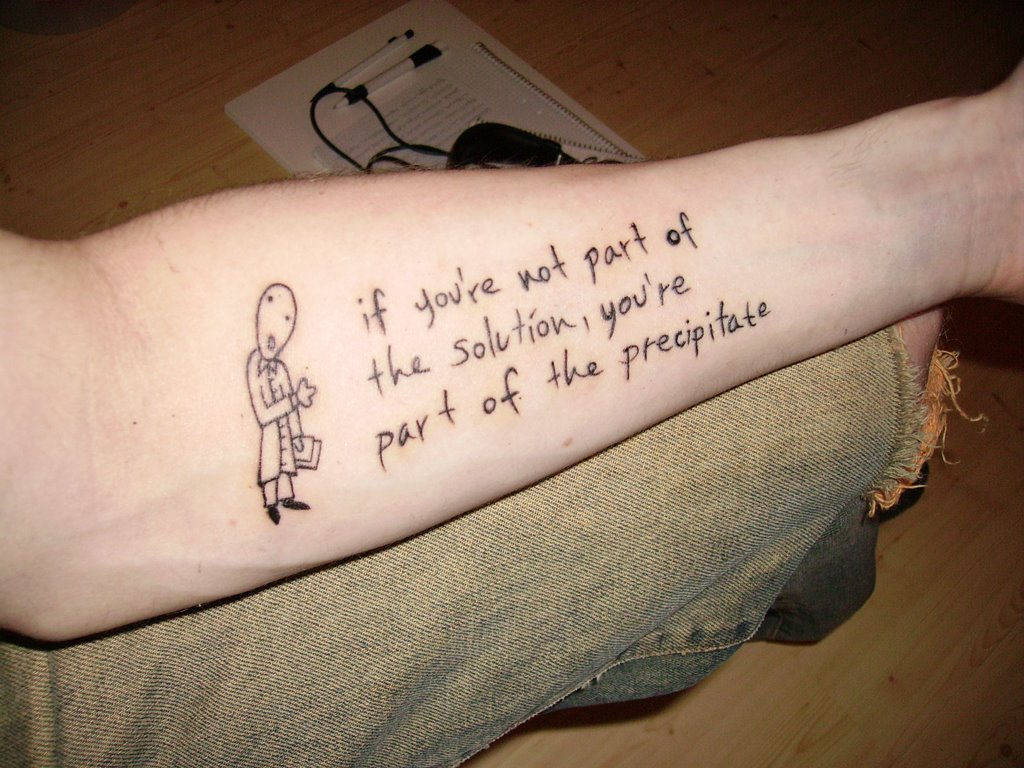
Tattoos, Peter Lynch and Good Investment Advice

I was walking on the Key Biscayne bridge Saturday morning and noticed an attractive woman runner. As she passed me, I cringed as I briefly confused the tattoo on her back with an open wound. In fairness, it probably more closely resembled a color depiction of a colonoscopy administered to Kobayashi following a competition and a side bet involving Push-Up® Frozen Treats [Rainbow Sherbet flavor].

It naturally made me think about investment strategies. A classic opportunity to use use common sense to help guide our investments, as often preached by Peter Lynch. If I were to miss the tattoo removal boom, I’m not sure I could forgive myself, it’s that obvious. Quick search turned up these companies, some are not public for now.


Finally, it made me wonder, what other, cosmetically speaking, spectacularly bad decisions can people make early in life that will haunt them more than their tattoos? Bad hairstyles and cuts grow out. Cosmetic surgery is typically available with the higher disposal income which comes in later years and besides, people get to decide when sober. Younger balding men can be bailed out by the shaved head alternative, thereby depressing the plug nation candidates. Tattoo’s really have no competition.

Which is why I see Peter Lynch’s investing philosophy in every tattoo.

Your investor’s edge is not something you get from Wall Street experts. It’s something you already have. You can outperform the experts if you use your edge by investing in companies or industries you already understand.

Posted in Business & Economics | Tagged | Leave a comment

Why Is Christ Baptized?

Fr Vallee weighs in on Sunday’s gospel reading and tackles the question, Why is Christ baptized?

Augustine tells us: “Discover why he was born and you will discover why he was baptized. There, I mean to say, you will discover the way of humility” [Sermon 292, 3-4]. In the birth of Christ, we see the ultimate power of God as powerlessness. He was God, yet he became a human being. He emptied himself and took the form of a slave. He humbled himself. John is clear as to his unworthiness: “it is you who should baptize me.” This is a great confession of humility. Jesus is teaching us by this action. He is teaching us that humility is the way of perfection and the only path to true love. Jesus did not need to be baptized, he did not need to be born either. He performs both actions out of pure love and humility and not for any external reason. The truest things we do, we do purely out of love and not for any ulterior or practical motive. As Gabriel Marcel said, “If you know exactly why you love me, you do not love me.”


Humility is the way of our Lord. If you understand why Christ was born, you will understand why he was baptized. Arrogance is death — death to life, death to love, death to faith. Being a Christian does not mean you support Christ the way you would support a political candidate. Being Christian means you are like Christ. The way of our Lord is not the way of power and politics. Religion is not convertible to a political platform on the right or the left. The way of our Lord is the way of love and humility.

Entire homily and gospel reading are copied in full at end of post.

—————————————————————————-
Why is Christ baptized?

I. Why is Christ baptized?
Bishop Noonan tells the cute story of his preaching at a children’s mass. He asked the children why Jesus was baptized. One of the kids said, “to get his big sin forgiven.” Bishop Noonan said, “big sin, what big sin?” The little boy said, “Remember, he ran from his parent s, then he talked back to them.” It really is a fair question. Why exactly was Jesus baptized? First, the baptism of John is not the baptism of the Christian faithful, is not the sacramental baptism which Jesus will give to his Church. I mean being baptized does not illogically make Jesus Christ a Christian. On the other hand, Jesus Christ does not have sins that need to be forgiven So, why did Jesus get baptized by John at all? Actually many theologians have taken up this question. Thomas Aquinas gives us three reasons: first so that we would recognize Christ; second, to sanctify baptism; and third to persuade us to do penance. These are all good reasons but my personal favorite comes from Augustine.

II. Discover why he was born and you will discover why he was baptized
Augustine tells us: “Discover why he was born and you will discover why he was baptized. There, I mean to say, you will discover the way of humility” [Sermon 292, 3-4]. In the birth of Christ, we see the ultimate power of God as powerlessness. He was God, yet he became a human being. He emptied himself and took the form of a slave. He humbled himself. John is clear as to his unworthiness: “it is you who should baptize me.” This is a great confession of humility. Jesus is teaching us by this action. He is teaching us that humility is the way of perfection and the only path to true love. Jesus did not need to be baptized, he did not need to be born either. He performs both actions out of pure love and humility and not for any external reason. The truest things we do, we do purely out of love and not for any ulterior or practical motive. As Gabriel Marcel said, “If you know exactly why you love me, you do not love me.”

III. Father’s birthday party
There is a story of an old Irish pastor, not Bishop Noonan this time, who was celebrating his birthday. The children came to bring Father presents. Little Suzie came first. Her mother ran the local bakery. When Father saw the round box, he said, “ah Suzie darling, thank you for the lovely cake.” Suzie said, “Father, how did you know it was a cake?” Father said, “sure enough, Father knows everything.” Jose came up next. Jose’s mom was a seamstress. When Father saw the bulky package, he said, “Jose lad, I sure do thank you for the beautiful sweater.” Jose said, “Father how did you know it was a sweater?” Father said, “Father knows everything you know.” Finally Johnnie came up. Johnnie’s dad ran the local liquor store and Johnnie came up with a package that was a bit wet at the bottom. Father said, “Johnnie thank you for the lovely bottle of scotch.” Johnnie said, “Oh no, Father, it isn’t scotch.” Father said, “it’s not? Let me see it then.” Then he touched it and said to himself, “Maybe not scotch.” So, he said, “gin then, is it gin you have there?” Johnnie said, “No Father, not gin.” Father decided to give it one last try and smelled the liquid carefully. He said “Bourbon, is it a nice bottle of bourbon you have there for me?” Johnnie said, “no it’s not bourbon.” Father said, “I give up then.” Johnnie proudly announced. “It’s a puppy.” Humility is the way of our Lord. If you understand why Christ was born, you will understand why he was baptized. Arrogance is death — death to life, death to love, death to faith. Being a Christian does not mean you support Christ the way you would support a political candidate. Being Christian means you are like Christ. The way of our Lord is not the way of power and politics. Religion is not convertible to a political platform on the right or the left. The way of our Lord is the way of love and humility.
———————————————————————————–
Mark 1: 7 – 11
7 And he preached, saying, “After me comes he who is mightier than I, the thong of whose sandals I am not worthy to stoop down and untie.
8 I have baptized you with water; but he will baptize you with the Holy Spirit.”
9 In those days Jesus came from Nazareth of Galilee and was baptized by John in the Jordan.
10 And when he came up out of the water, immediately he saw the heavens opened and the Spirit descending upon him like a dove;
11 and a voice came from heaven, “Thou art my beloved Son; with thee I am well pleased.”
———————————————————————

Tagged , | Leave a comment