Esquire recently selected what it considered to be the 7 greatest articles they ever published. One of them was by Tom Wolfe in March 1965. The article was about stock car racing and Junior Johnson. An excerpt:
The first lap of a stock-car race is a horrendous, a wildly horrendous spectacle such as no other sport approaches. Twenty, thirty, forty automobiles, each of them weighing almost two tons, 3700 pounds, with 427-cubic-inch engines, 600 horsepower, are practically locked together, side to side and tail to nose, on a narrow band of asphalt at 130, 160, 180 miles an hour, hitting the curves so hard the rubber burns off the tires in front of your eyes. To the driver, it is like being inside a car going down the West Side Highway in New York City at rush hour, only with everybody going literally three to four times as fast, at speeds a man who has gone eighty-five miles an hour down a highway cannot conceive of, and with every other driver an enemy who is willing to cut inside of you, around you or in front of you, or ricochet off your side in the battle to get into a curve first.
The speeds are faster than those in the Indianapolis 500 race, the cars are more powerful and much heavier, and the drivers have more courage, more daring, more ruthlessness than Indianapolis or Grand Prix drivers. The prize money in Southern stock-car racing is far greater than that in Indianapolis-style or European Grand Prix racing, but few Indianapolis or Grand Prix drivers have the raw nerve required to succeed at it.
 Junior Johnson was over in the garden by the house some years ago, plowing the garden barefooted, behind a mule, just wearing an old pair of overalls, when a couple of good old boys drove up and told him to come on up to the speedway and get in a stock-car race. They wanted some local boys to race, as a preliminary to the main race, “as a kind of side show,” as Junior remembers it.
“So I just put the reins down,” Junior is telling me, “and rode on over ‘ere with them. They didn’t give us seat belts or nothing, they just roped us in. H’it was a dirt track then. I come in second.”
Junior was a sensation in dirt-track racing right from the start. Instead of going into the curves and just sliding and holding on for dear life like the other drivers, Junior developed the technique of throwing himself into a slide about seventy-five feet before the curve by cocking the wheel to the left slightly and gunning it, using the slide, not the brake, to slow down, so that he could pick up speed again halfway through the curve and come out of it like a shot. This was known as his “power slide,” and — yes! of course! — every good old boy in North Carolina started saying Junior Johnson had learned that stunt doing those goddamned about-faces running away from the Alcohol Tax agents. … As far as Junior is concerned, dirt-track racing is not so much of a mechanical test for the car as those long five- and six-hundred-mile races on asphalt are. Gasoline, tire, and engine wear aren’t so much of a problem. It is all the driver, his skill, his courage — his willingness to mix it up with the other cars, smash and carom off of them at a hundred miles an hour or so to get into the curves first. Junior has a lot of fond recollections of mixing it up at places like Bowman Gray Stadium in Winston-Salem, one of the minor league tracks, a very narrow track, hardly wide enough for two cars. “You could always figure Bowman Gray was gonna cost you two fenders, two doors, and two quarter panels,” Junior tells me with nostalgia.
See the entire 1965 Esquire article here. Article copied in full at end of post.
—————————————————————————-
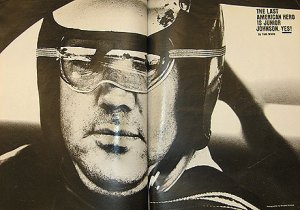
The Last American Hero Is Junior Johnson. Yes!
By: Tom Wolfe
Esquire — March 1965
Now one of America’s most legendary authors, Tom Wolfe broke out onto the national literary scene at age thirty-four with this breathless piece — an early step in the so-called New Journalism, a first reference for the term “good ol’ boy,” a deep breath into the future of the New South.
By: Tom Wolfe
Ten o’clock Sunday morning in the hills of North Carolina. Cars, miles of cars, in every direction, millions of cars, pastel cars, aqua green, aqua blue, aqua beige, aqua buff, aqua dawn, aqua dusk, aqua aqua, aqua Malacca, Malacca lacquer, Cloud lavender, Assassin pink, Rake-a-cheek raspberry. Nude Strand coral, Honest Thrill orange, and Baby Fawn Lust cream-colored cars are all going to the stock-car races, and that old mothering North Carolina sun keeps exploding off the windshields. Mother dog!
Seventeen thousand people, me included, all of us driving out Route 421, out to the stock-car races at the North Wilkesboro Speedway, 17,000 going out to a five-eighths-mile stock-car track with a Coca-Cola sign out front. This is not to say there is no preaching and shouting in the South this morning. There is preaching and shouting. Any of us can turn on the old automobile transistor radio and get all we want:
“They are greedy dogs. Yeah! They ride around in big cars. Unnh-hunh! And chase women. Yeah! And drink liquor. Unnh-hunh! And smoke cigars. Oh yes! And they are greedy dogs. Yeah! Unnh-hunh! Oh yes! Amen!”
There are also some commercials on the radio for Aunt Jemima grits, which cost ten cents a pound. There are also the Gospel Harmonettes, singing: “If you dig a ditch, you better dig two…”
There are also three fools in a panel discussion on the New South, which they seem to conceive of as General Lee running the new Dulcidreme Labial Cream factory down at Griffin, Georgia.
And suddenly my car is stopped still on Sunday morning in the middle of the biggest traffic jam in the history of the world. It goes for ten miles in every direction from the North Wilkesboro Speedway. And right there it dawns on me that as far as this situation is concerned, anyway, all the conventional notions about the South are confined to…the Sunday radio. The South has preaching and shouting, the South has grits, the South has country songs, old mimosa traditions, clay dust, Old Bigots, New Liberals — and all of it, all of that old mental cholesterol, is confined to the Sunday radio. What I was in the middle of — well, it wasn’t anything one hears about in panels about the South today. Miles and miles of eye-busting pastel cars on the expressway, which roar right up into the hills, going to the stock-car races. In ten years baseball — and the state of North Carolina alone used to have forty-four professional baseball teams — baseball is all over with in the South. We are all in the middle of a wild new thing, the Southern car world, and heading down the road on my way to see a breed such as sports never saw before, Southern stock-car drivers, all lined up in these two-ton mothers that go over 175 m.p.h., Fireball Roberts, Freddie Lorenzen, Ned Jarrett, Richard Petty, and — the hardest of all the hard chargers, one of the fastest automobile racing drivers in history — yes! Junior Johnson.
The legend of Junior Johnson! In this legend, here is a country boy, Junior Johnson, who learns to drive by running whiskey for his father, Johnson, Senior, one of the biggest copper still operators of all times, up in Ingle Hollow, near North Wilkesboro, in northwestern North Carolina, and grows up to be a famous stock-car racing driver, rich, grossing $100,000 in 1963, for example, respected, solid, idolized in his hometown and throughout the rural South, for that matter. There is all this about how good old boys would wake up in the middle of the night in the apple shacks and hear an overcharged engine roaring over Brushy Mountain and say, “Listen at him — there he goes!”, although that part is doubtful, since some nights there were so many good old boys taking off down the road in supercharged automobiles out of Wilkes County, and running loads to Charlotte, Salisbury, Greensboro, Winston-Salem, High Point, or wherever, it would be pretty hard to pick out one. It was Junior Johnson specifically, however, who was famous for the “bootleg turn” or “about-face,” in which, if the Alcohol Tax agents had a roadblock up for you or were too close behind, you threw the car into second gear, cocked the wheel, stepped on the accelerator and made the car’s rear end skid around in a complete 180-degree arc, a complete about-face, and tore on back up the road exactly the way you came from. God! The Alcohol Tax agents used to burn over Junior Johnson. Practically every good old boy in town in Wilkesboro, the county seat, got to know the agents by sight in a very short time. They would rag them practically to their faces on the subject of Junior Johnson, so that it got to be an obsession. Finally, one night they had Junior trapped on the road up toward the bridge around Millersville, there’s no way out of there, they had the barricades up and they could hear this souped-up car roaring around the bend, and here it comes — but suddenly they can hear a siren and see a red light flashing in the grille, so they think it’s another agent, and boy, they run out like ants and pull those barrels and boards and sawhorses out of the way, and then — Ggghhzzzzzzzhhhhhggggggzzzzzzzeeeeeong! — gawdam! there he goes again, it was him, Junior Johnson!, with a gawdam agent’s si-reen and a red light in his grille!
I wasn’t in the South five minutes before people started making oaths, having visions, telling these hulking great stories, and so forth, all on the subject of Junior Johnson. At the Greensboro, North Carolina, Airport there was one good old boy who vowed he would have eaten “a bucket of it” if that would have kept Junior Johnson from switching from a Dodge racer to a Ford. Hell yes, and after that — God-almighty, remember that 1963 Chevrolet of Junior’s? Whatever happened to that car? A couple of more good old boys join in. A good old boy, I ought to explain, is a generic term in the rural South referring to a man of any age, but more often young than not, who fits in with the status system of the region. It usually means he has a good sense of humor and enjoys ironic jokes, is tolerant and easygoing enough to get along in long conversations at places like on the corner, and has a reasonable amount of physical courage. The term is usually heard in some such form as: “Lud? He’s a good old boy from over at Crozet.” These good old boys in the airport, by the way, were in their twenties, except for one fellow who was a cabdriver and was about forty-five, I would say. Except for the cabdriver, they all wore neo-Brummellian wardrobe such as Lacoste tennis shirts, Slim Jim pants, windbreakers with the collars turned up, “fast” shoes of the winkle-picker genre, and so on. I mention these details just by way of pointing out that very few grits, Iron Boy overalls, clodhoppers or hats with ventilation holes up near the crown enter into this story. Anyway, these good old boys are talking about Junior Johnson and how he has switched to Ford. This they unanimously regard as some sort of betrayal on Johnson’s part. Ford, it seems, they regard as the car symbolizing the established power structure. Dodge is a kind of middle ground. Dodge is at least a challenger, not a ruler. But the Junior Johnson they like to remember is the Junior Johnson of 1963, who took on the whole field of NASCAR (National Association for Stock Car Auto Racing) Grand National racing with a Chevrolet. All the other drivers, the drivers driving Fords, Mercurys, Plymouths, Dodges, had millions, literally millions when it is all added up, millions of dollars in backing from the Ford and Chrysler Corporations. Junior Johnson took them all on in a Chevrolet without one cent of backing from Detroit. Chevrolet had pulled out of stock-car racing. Yet every race it was the same. It was never a question of whether anybody was going to outrun Junior Johnson. It was just a question of whether he was going to win or his car was going to break down, since, for one thing, half the time he had to make his own racing parts. God! Junior Johnson was like Robin Hood or Jesse James or Little David or something. Every time that Chevrolet, No. 3, appeared on the track, wild curdled yells, “Rebel” yells, they still have those, would rise up. At Daytona, at Atlanta, at Charlotte, at Darlington, South Carolina; Bristol, Tennessee; Martinsville, Virginia — Junior Johnson!
And then the good old boys get to talking about whatever happened to that Chevrolet of Junior’s, and the cabdriver says he knows. He says Junior Johnson is using that car to run liquor out of Wilkes County. What does he mean? For Junior Johnson ever to go near another load of bootleg whiskey again — he would have to be insane. He has this huge racing income. He has two other businesses, a whole automated chicken farm with 42,000 chickens, a road-grading business — but the cabdriver says he has this dream Junior is still roaring down from Wilkes County, down through the clay cuts, with the Atlas Arc Lip jars full in the back of that Chevrolet. It is in Junior’s blood — and then at this point he puts his right hand up in front of him as if he is groping through fog, and his eyeballs glaze over and he looks out in the distance and he describes Junior Johnson roaring over the ridges of Wilkes County as if it is the ghost of Zapata he is describing, bounding over the Sierras on a white horse to rouse the peasants.
A stubborn notion! A crazy notion! Yet Junior Johnson has followers who need to keep him, symbolically, riding through nighttime like a demon. Madness! But Junior Johnson is one of the last of those sports stars who is not just an ace at the game itself, but a hero a whole people or class of people can identify with. Other, older examples are the way Jack Dempsey stirred up the Irish or the way Joe Louis stirred up the Negroes. Junior Johnson is a modern figure. He is only thirty-three years old and still racing. He should be compared to two other sports heroes whose cultural impact is not too well known. One is Antonino Rocca, the professional wrestler, whose triumphs mean so much to New York City’s Puerto Ricans that he can fill Madison Square Garden, despite the fact that everybody, the Puerto Ricans included, knows that wrestling is nothing but a crude form of folk theatre. The other is Ingemar Johansson, who had a tremendous meaning to the Swedish masses — they were tired of that old king who played tennis all the time and all his friends who keep on drinking Cointreau behind the screen of socialism. Junior Johnson is a modern hero, all involved with car culture and car symbolism in the South. A wild new thing — Wild — gone wild. Fireball Roberts’ Ford spins out on the first turn at the North Wilkesboro Speedway, spinning, spinning, the spin seems almost like slow motion — and then it smashes into the wooden guardrail. It lies up there with the frame bent. Roberts is all right. There is a new layer of asphalt on the track, it is like glass, the cars keep spinning off the first turn. Ned Jarrett spins, smashes through the wood. “Now, boys, this ice ain’t gonna get one goddamn bit better, so you can either line up and qualify or pack up and go home — ”
I had driven from the Greensboro Airport up to Wilkes County to see Junior Johnson on the occasion of one of the two yearly NASCAR Grand National stock-car races at the North Wilkesboro Speedway.
It is a long, very gradual climb from Greensboro to Wilkes County. Wilkes County is all hills, ridges, woods and underbrush, full of pin oaks, sweet-gum maples, ash, birch, apple trees, rhododendron, rocks, vines, tin roofs, little clapboard places like the Mount Olive Baptist Church, signs for things like Double Cola, Sherrill’s Ice Cream, Eckard’s Grocery, Dr. Pepper, Diel’s Apples, Google’s Place, Suddith’s Place and — yes! — cars. Up onto the highway, out of a side road from a hollow, here comes a 1947 Hudson. To almost anybody it would look like just some old piece of junk left over from God knows when, rolling down a country road…the 1947 Hudson was one of the first real “hot” cars made after the war. Some of the others were the 1946 Chrysler, which had a “kick-down” gear for sudden bursts of speed, the 1955 Pontiac and a lot of the Fords. To a great many good old boys a hot car was a symbol of heating up life itself. The war! Money even for country boys! And the money bought cars. In California they suddenly found kids of all sorts involved in vast drag racing orgies and couldn’t figure out what was going on. But in the South the mania for cars was even more intense, although much less publicized. To millions of good old boys, and girls, the automobile represented not only liberation from what was still pretty much a land-bound form of social organization but also a great leap forward into twentieth-century glamour, an idea that was being dinned in on the South like everywhere else. It got so that one of the typical rural sights, in addition to the red rooster, the gray split-rail fence, the Edgeworth Tobacco sign and the rusted-out harrow, one of the typical rural sights would be…you would be driving along the dirt roads and there beside the house would be an automobile up on blocks or something, with a rope over the tree for hoisting up the motor or some other heavy part, and a couple of good old boys would be practically disappearing into its innards, from below and from above, draped over the side under the hood. It got so that on Sundays there wouldn’t be a safe straight stretch of road in the county, because so many wild country boys would be out racing or just raising hell on the roads. A lot of other kids, who weren’t basically wild, would be driving like hell every morning and every night, driving to jobs perhaps thirty or forty miles away, jobs that were available only because of automobiles. In the morning they would be driving through the dapple shadows like madmen. In the hollows, sometimes one would come upon the most incredible tar-paper hovels, down near the stream, and out front would be an incredible automobile creation, a late-model car with aerials, continental kit overhangs in the back, mudguards studded with reflectors, fender skirts, spotlights, God knows what all, with a girl and perhaps a couple of good old boys communing over it and giving you rotten looks as you drive by. On Saturday night everybody would drive into town and park under the lights on the main street and neck. Yes! There was something about being right in there in town underneath the lights and having them reflecting off the baked enamel on the hood. Then if a good old boy insinuated his hands here and there on the front seat with a girl and began…necking…somehow it was all more complete. After the war there was a great deal of stout-burgher talk about people who lived in hovels and bought big-yacht cars to park out front. This was one of the symbols of a new, spendthrift age. But there was a great deal of unconscious resentment buried in the talk. It was resentment against (a) the fact that the good old boy had his money at all and (b) the fact that the car symbolized freedom, a slightly wild, careening emancipation from the old social order. Stock-car racing got started about this time, right after the war, and it was immediately regarded as some kind of manifestation of the animal irresponsibility of the lower orders. It had a truly terrible reputation. It was — well, it looked rowdy or something. The cars were likely to be used cars, the tracks were dirt, the stands were rickety wood, the drivers were country boys, and they had regular feuds out there, putting each other “up against the wall” and “cutting tires” and everything else. Those country boys would drive into the curves full tilt, then slide maniacally, sometimes coming around the curve sideways, with red dirt showering up. Sometimes they would race at night, under those weak-eyed yellow-ochre lights they have at small tracks and baseball fields, and the clay dust would start showering up in the air, where the evening dew would catch it, and all evening long you would be sitting in the stands or standing out in the infield with a fine clay-mud drizzle coming down on you, not that anybody gave a damn — except for the Southern upper and middle classes, who never attended in those days, but spoke of the “rowdiness.”
But mainly it was the fact that stock-car racing was something that was welling up out of the lower orders. From somewhere these country boys and urban proles were getting the money and starting this sport.
Stock-car racing was beginning all over the country, at places like Allentown, Langhorne, and Lancaster, Pennsylvania, and out in California and even out on Long Island, but wherever it cropped up, the Establishment tried to wish it away, largely, and stock-car racing went on in a kind of underground world of tracks built on cheap stretches of land well out from the town or the city, a world of diners, drive-ins, motels, gasoline stations, and the good burghers might drive by from time to time, happen by on a Sunday or something, and see the crowd gathered from out of nowhere, the cars coming in, crowding up the highway a little, but Monday morning they would be all gone.
Stock-car racing was building up a terrific following in the South during the early Fifties. Here was a sport not using any abstract devices, any bat and ball, but the same automobile that was changing a man’s own life, his own symbol of liberation, and it didn’t require size, strength and all that, all it required was a taste for speed, and the guts. The newspapers in the South didn’t seem to catch on to what was happening until late in the game. Of course, newspapers all over the country have looked backward over the tremendous rise in automobile sports, now the second-biggest type of sport in the country in terms of attendance. The sports pages generally have an inexorable lower-middle-class outlook. The sportswriter’s “zest for life” usually amounts, in the end, to some sort of gruff Mom’s Pie sentimentality at a hideously cozy bar somewhere. The sportswriters caught on to Grand Prix racing first because it had “tone,” a touch of defrocked European nobility about it, what with a few counts racing here and there, although, in fact, it is the least popular form of racing in the United States. What finally put stock-car racing onto the sports pages in the South was the intervention of the Detroit automobile firms. Detroit began putting so much money into the sport that it took on a kind of massive economic respectability and thereby, in the lower-middle-class brain, status.
What Detroit discovered was that thousands of good old boys in the South were starting to form allegiances to brands of automobiles, according to which were hottest on the stock-car circuits, the way they used to have them for the hometown baseball team. The South was one of the hottest car-buying areas in the country. Cars like Hudsons, Oldsmobiles, and Lincolns, not the cheapest automobiles by any means, were selling in disproportionate numbers in the South, and a lot of young good old boys were buying them. In 1955, Pontiac started easing into stock-car racing, and suddenly the big surge was on. Everybody jumped into the sport to grab for themselves The Speed Image. Suddenly, where a good old boy used to have to bring his gasoline to the track in old filling-station pails and pour it into the tank through a funnel when he made a pit stop, and change his tires with a hand wrench, suddenly, now, he had these “gravity” tanks of gasoline that you just jam into the gas pipe, and air wrenches to take the wheels off, and whole crews of men in white coveralls to leap all over a car when it came rolling into the pit, just like they do at Indianapolis, as if they are mechanical apparati merging with the machine as it rolls in, forcing water into the radiator, jacking up the car, taking off wheels, wiping off the windshield, handing the driver a cup of orange juice, all in one synchronized operation. And now, today, the big money starts descending on this little place, the North Wilkesboro, North Carolina, Speedway, a little five-eighths-of-a-mile stock-car track with a Coca-Cola sign out by the highway where the road in starts.
The private planes start landing out at the Wilkesboro Airport. Freddie Lorenzen, the driver, the biggest money winner last year in stock-car racing, comes sailing in out of the sky in a twin-engine Aero Commander, and there are a few good old boys out there in the tall grass by the runway already with their heads sticking up watching this hero of the modern age come in and taxi up and get out of that twin-engine airplane with his blond hair swept back as if by the mother internal combustion engine of them all. And then Paul Goldsmith, the driver, comes in in a 310 Cessna, and he gets out, all these tall, lanky hard-boned Americans in their thirties with these great profiles like a comic-strip hero or something, and then Glenn (Fireball) Roberts — Fireball Roberts! — Fireball is hard — he comes in a Comanche 250, like a flying yacht, and then Ray Nichels and Ray Fox, the chief mechanics, who run big racing crews for the Chrysler Corporation, this being Fox’s last race for Junior as his mechanic, before Junior switches over to Ford, they come in in two-engine planes. And even old Buck Bake — hell, Buck Baker is a middling driver for Dodge, but even he comes rolling in down the landing strip at two hundred miles an hour with his Southern-hero face at the window of the cockpit of a twin-engine Apache, traveling first class in the big status boat that has replaced the yacht in America, the private plane.
And then the Firestone and Goodyear vans pull in, huge mothers, bringing in huge stacks of racing tires for the race, big wide ones, 8.20’s, with special treads, which are like a lot of bumps on the tire instead of grooves. They even have special tires for qualifying, soft tires, called “gumballs,” they wouldn’t last more than ten times around the track in a race, but for qualifying, which is generally three laps, one to pick up speed and two to race against the clock, they are great, because they hold tight on the comers. And on a hot day, when somebody like Junior Johnson, one of the fastest qualifying runners in the history of the sport, 170.777 m.p.h. in a one-hundred-mile qualifying race at Daytona in 1964, when somebody like Junior Johnson really pushes it on a qualifying run, there will be a ring of blue smoke up over the whole goddamned track, a ring like an oval halo over the whole thing from the gumballs burning, and some good old boy will say, “Great smokin’ blue gumballs god almighty dog! There goes Junior Johnson!”
The thing is, each one of these tires costs fifty-five to sixty dollars, and on a track that is fast and hard on tires, like Atlanta, one car might go through ten complete tire changes, easily, forty tires, or almost $2500 worth of tires just for one race. And he may even be out of the money. And then the Ford van and the Dodge van and the Mercury van and the Plymouth van roll in with new motors, a whole new motor every few races, a 427-cubic-inch stock-car racing motor, 600 horsepower, the largest and most powerful allowed on the track, that probably costs the company $1000 or more, when you consider that they are not mass produced. And still the advertising appeal. You can buy the very same car that these fabulous wild men drive every week at these fabulous wild speeds, and some of their power and charisma is yours. After every NASCAR Grand National stock-car race, whichever company has the car that wins, this company will put big ads in the Southern papers, and papers all over the country if it is a very big race, like the Daytona 500, the Daytona Firecracker 400 or the Atlanta and Charlotte races. They sell a certain number of these 427-cubic-inch cars to the general public, a couple of hundred a year, perhaps, at eight or nine thousand dollars apiece, but it is no secret that these motors are specially reworked just for stock-car racing. Down at Charlotte there is a company called Holman & Moody that is supposed to be the “garage” or “automotive-engineering” concern that prepares automobiles for Freddy Lorenzen and some of the other Ford drivers. But if you go by Holman & Moody out by the airport and Charlotte, suddenly you come upon a huge place that is a factory, for God’s sake, a big long thing, devoted mainly to the business of turning out stock-car racers. A whole lot of other parts in stock-car racers are heavier than the same parts on a street automobile, although they are made to the same scale. The shock absorbers are bigger, the wheels are wider and bulkier, the swaybars and steering mechanisms are heavier, the axles are much heavier, they have double sets of wheel bearings, and so forth and so on. The bodies of the cars are pretty much the same, except that they use lighter sheet metal, practically tinfoil. Inside, there is only the driver’s seat and a heavy set of roll bars and diagonal struts that turn the inside of the car into a rigid cage, actually. That is why the drivers can walk away unhurt — most of the time — from the most spectacular crackups. The gearshift is the floor kind, although it doesn’t make much difference, as there is almost no shifting gears in stock-car racing. You just get into high gear and go. The dashboard has no speedometer, the main thing being the dial for engine revolutions per minute. So, anyway, it costs about $15,000 to prepare a stock-car racer in the first place and another three or four thousand for each new race and this does not even count the costs of mechanics’ work and transportation. All in all, Detroit will throw around a quarter of a million dollars into it every week while the season is on, and the season runs, roughly, from February to October, with a few big races after that. And all this turns up even out at the North Wilkesboro Speedway with the Coca-Cola sign out front, out in the up-country of Wilkes County, North Carolina.
Sunday! Racing day! Sunday is no longer a big church day in the South. A man can’t very well go to eleven o’clock service and still expect to get to a two o’clock stock-car race, unless he wants to get into the biggest traffic jam in the history of creation, and that goes for North Wilkesboro, North Carolina, same as Atlanta and Charlotte.
There is the Coca-Cola sign out where the road leads in from the highway, and hills and trees, but here are long concrete grandstands for about 17,000 and a paved five-eighths-mile oval. Practically all the drivers are out there with their cars and their crews, a lot of guys in white coveralls. The cars look huge …and curiously nude and blind. All the chrome is stripped off, except for the grilles. The headlights are blanked out. Most of the cars are in the pits. The so-called “pit” is a paved cutoff on the edge of the infield. It cuts off from the track itself like a service road off an expressway at the shopping center. Every now and then a car splutters, hacks, coughs, hocks a lunga, rumbles out onto the track itself for a practice run. There is a lot of esoteric conversation going on, speculation, worries, memoirs:
“What happened?”
“Mother– condensed on me. Al brought it up here with him. Water in the line.”
“Better keep Al away from a stable, he’ll fill you up with horse manure.”
“…they told me to give him one, a cream puff, so I give him one, a creampuff. One goddamn race and the son of a bitch, he melted it….”
“…he’s down there right now pettin’ and rubbin’ and huggin’ that car just like those guys do a horse at the Kentucky Derby….”
“…They’ll blow you right out of the tub….”
“…No, the quarter inch, and go on over and see if you can get Ned’s blowtorch….”
“…Rear end’s loose….”
“…I don’t reckon this right here’s got nothing to do with it, do you?…”
“…Aw, I don’t know, about yea big….”
“…Who the hell stacked them gumballs on the bottom?…”
“…th’ow in rocks….”
“…won’t turn seven thousand…”
“…strokin’ it….”
“…blistered….”
“…spun out…”
“…muvva….”
Then, finally, here comes Junior Johnson. How he does come on. He comes tooling across the infield in a big white dreamboat, a brand-new white Pontiac Catalina four-door hard-top sedan. He pulls up and as he gets out he seems to get more and more huge. First his crew-cut head and then a big jaw and then a bigger neck and then a huge torso, like a wrestler’s, all done up rather modish and California modern, with a red-and-white candy-striped sport shirt, white ducks and loafers.
“How you doing?” says Junior Johnson, shaking hands, and then he says, “Hot enough for ye’uns?”
Junior is in an amiable mood. Like most up-hollow people, it turns out, Junior is reserved. His face seldom shows an emotion. He has three basic looks: amiable, amiable and a little shy, and dead serious. To a lot of people, apparently, Junior’s dead-serious look seems menacing. There are no cowards left in stock-car racing, but a couple of drivers tell me that one of the things that can shake you up is to look into your rearview mirror going around a curve and see Junior Johnson’s car on your tail trying to “root you out of the groove,” and then get a glimpse of Junior’s dead-serious look. I think some of the sportswriters are afraid of him. One of them tells me Junior is strong, silent — and explosive. Junior will only give you three answers, “Uh-huh,” “Uh-unh,” and “I don’t know,” and so forth and so on. Actually, I find he handles questions easily. He has a great technical knowledge of automobiles and the physics of speed, including things he never fools with, such as Offenhauser engines. What he never does offer, however, is small talk. This gives him a built-in poise, since it deprives him of the chance to say anything asinine. “Ye’uns,” “we’uns,” “h’it” for “it,” “growed” for “grew,” and a lot of other unusual past participles — Junior uses certain older forms of English, not exactly “Elizabethan,” as they are sometimes called, but older forms of English preserved up-country in his territory, Ingle Hollow.
Kids keep coming up for Junior’s autograph and others are just hanging around and one little old boy comes up, he is about thirteen, and Junior says: “This boy here goes coon hunting with me.”
One of the sportswriters is standing around, saying: “What do you shoot a coon with?”
“Don’t shoot ’em. The dogs tree ’em and then you flush ’em out and the dogs fight ’em.”
“Flush ’em out?”
“Yeah. This boy right here can flush ’em out better than anybody you ever did see. You go out at night with the dogs, and soon as they get the scent, they start barking. They go on out ahead of you and when they tree a coon, you can tell it, by the way they sound. They all start baying up at that coon — h’it sounds like, I don’t know, you hear it once and you not likely to forget it. Then you send a little old boy up to flush him out and he jumps down and the dogs fight him.”
“How does a boy flush him out?”
“Aw, he just climbs up there to the limb he’s on and starts shaking h’it and the coon’ll jump.”
“What happens if the coon decides he’d rather come back after the boy instead of jumping down to a bunch of dogs?”
“He won’t do that. A coon’s afraid of a person, but he can kill a dog. A coon can take any dog you set against him if they’s just the two of them fighting. The coon jumps down on the ground and he rolls right over on his back with his feet up, and he’s got claws about like this. All he has to do is get a dog once in the throat or in the belly, and he can kill him, cut him wide open just like you took a knife and did it. Won’t any dog even fight a coon except a coon dog.”
“What kind of dogs are they?”
“Coon dogs, I guess. Black and tans they call ’em sometimes. They’s bred for it. If his mammy and pappy wasn’t coon dogs, he ain’t likely to be one either. After you got one, you got to train him. You trap a coon, live, and then you put him in a pen and tie him to a post with a rope on him and then you put your dog in there and he has to fight him. Sometimes you get a dog just don’t have any fight in him and he ain’t no good to you.”
Junior is in the pit area, standing around with his brother Fred, who is part of his crew, and Ray Fox and some other good old boys, in a general atmosphere of big stock-car money, a big ramp truck for his car, a white Dodge, number 3, a big crew in white coveralls, huge stacks of racing tires, a Dodge P.R. man, big portable cans of gasoline, compressed air hoses, compressed water hoses, the whole business. Herb Nab, Freddie Lorenzen’s chief mechanic, comes over and sits down on his haunches and Junior sits down on his haunches and Nab says:
“So Junior Johnson’s going to drive a Ford.”
Junior is switching from Dodge to Ford mainly because he hasn’t been winning with the Dodge. Lorenzen drives a Ford, too, and the last year, when Junior was driving the Chevrolet, their duels were the biggest excitement in stock-car racing.
“Well,” says Nab, “I’ll tell you, Junior. My ambition is going to be to outrun your ass every goddamned time we go out.”
“That was your ambition last year,” says Junior.
“I know it was,” says Nab, “and you took all the money, didn’t you? You know what my strategy was. I was going to outrun everybody else and outlast Junior, that was my strategy.”
Setting off his California modern sport shirt and white ducks Junior has on a pair of twenty-dollar rimless sunglasses and a big gold Timex watch, and Flossie, his fiancée, is out there in the infield somewhere with the white Pontiac, and the white Dodge that Dodge gave Junior is parked up near the pit area — and then a little thing happens that brings the whole thing right back there to Wilkes County, North Carolina, to Ingle Hollow and to hard muscle in the clay gulches. A couple of good old boys come down to the front of the stands with the screen and the width of the track between them and Junior, and one of the good old boys comes down and yells out in the age-old baritone raw curdle yell of the Southern hills:
“Hey, hog jaw!”
Everybody gets quiet. They know he’s yelling at Junior, but nobody says a thing. Junior doesn’t even turn around.
“Hey, hog jaw!…”
Junior, he does nothing.
“Hey, hog jaw, I’m gonna get me one of them fastback roosters, too, and come down there and get you!”
Fastback rooster refers to the Ford — it has a “fastback” design — Junior is switching to.
“Hey, hog jaw, I’m gonna get me one of them fastback roosters and run you right out of here, you hear me, hog jaw!”
One of the good old boys alongside Junior says, “Junior, go on up there and clear out those stands.”
Then everybody stares at Junior to see what he’s gonna do. Junior, he don’t even look around. He just looks a bit dead serious.
“Hey, hog jaw, you got six cases of whiskey in the back of that car you want to let me have?”
“What you hauling in that car, hog jaw!”
“Tell him you’re out of that business, Junior,” one of the good old boys says.
“Go on up there and clean house, Junior,” says another good old boy.
Then Junior looks up, without looking at the stands and smiles a little and says, “You fish him down here out of that tree — and I’ll take keer of him.”
Such a howl goes up from the good old boys! It is almost a blood curdle —
“Goddamn, he will, too!”
“Lord, he better know how to do an about-face hisself if he comes down here!”
“Goddamn, get him, Junior!”
“Whooeeee!”
“Mother dog!”
A kind of orgy of reminiscence of the old Junior before the Detroit money started flowing, wild combats d’honneur up-hollow — and, suddenly, when he heard that unearthly baying coming up from the good old boys in the pits, the good old boy retreated from the edge of the stands and never came back.
Later on Junior told me, sort of apologetically, “H’it used to be, if a fellow crowded me just a little bit, I was ready to crawl him. I reckon that was one good thing about Chillicothe.
“I don’t want to pull any more time,” Junior tells me, “but I wouldn’t take anything in the world for the experience I had in prison. If a man needed to change, that was the place to change. H’it’s not a waste of time there, h’it’s good experience.
“H’it’s that they’s so many people in the world that feel that nobody is going to tell them what to do. I had quite a temper, I reckon. I always had the idea that I had as much sense as the other person and I didn’t want them to tell me what to do. In the penitentiary there I found out that I could listen to another fellow and be told what to do and h’it wouldn’t kill me.”
Starting time! Linda Vaughn, with the big blonde hair and blossomy breasts, puts down her Coca-Cola and the potato chips and slips off her red stretch pants and her white blouse and walks out of the officials’ booth in her Rake-a-cheek red showgirl’s costume with her long honeydew legs in net stockings and climbs up on the red Firebird float. The Life Symbol of stock-car racing! Yes! Linda, every luscious morsel of Linda, is a good old girl from Atlanta who was made Miss Atlanta International Raceway one year and was paraded around the track on a float and she liked it so much and all the good old boys liked it so much, Linda’s flowing hair and blossomy breasts and honeydew legs, that she became the permanent glamour symbol, of stock-car racing, and never mind this other modeling she was doing…this, she liked it. Right before practically every race on the Grand National circuit Linda Vaughn puts down her Coca-Cola and potato chips. Her momma is there, she generally comes around to see Linda go around the track on the float, it’s such a nice spectacle seeing Linda looking so lovely, and the applause and all. “Linda, I’m thirstin’, would you bring me a Coca-Cola?” “A lot of them think I’m Freddie Lorenzen’s girl friend, but I’m not any of ’em’s girl friend, I’m real good friends with ’em all, even Wendell,” he being Wendell Scott, the only Negro in big-league stock-car racing. Linda gets up on the Firebird float. This is an extraordinary object, made of wood, about twenty feet tall, in the shape of a huge bird, an eagle or something, blazing red, and Linda, with her red showgirl’s suit on, gets up on the seat, which is up between the wings, like a saddle, high enough so her long honeydew legs stretch down, and a new car pulls her — Miss Firebird! — slowly once around the track just before the race. It is more of a ceremony by now than the national anthem. Miss Firebird sails slowly in front of the stands and the good old boys let out some real curdle Rebel yells, “Yaaaaaaaaaaaaghhhhoooooo! Let me at that car!” “Honey, you sure do start my motor, I swear to God!” “Great God and Poonadingdong, I mean!”
And suddenly there’s a big roar from behind, down in the infield, and then I see one of the great sights in stock-car racing. That infield! The cars have been piling into the infield by the hundreds, parking in there on the clay and the grass, every which way, angled down and angled up, this way and that, where the ground is uneven, these beautiful blazing brand-new cars with the sun exploding off the windshields and the baked enamel and the glassy lacquer, hundreds, thousands of cars stacked this way and that in the infield with the sun bolting down and no shade, none at all, just a couple of Coca-Cola stands out there. And already the good old boys and girls are out beside the cars, with all these beautiful little buds in short shorts already spread-eagled out on top of the car roofs, pressing down on good hard slick automobile sheet metal, their little cupcake bottoms aimed up at the sun. The good old boys are lollygagging around with their shirts off and straw hats on that have miniature beer cans on the brims and buttons that read, “Girls Wanted — No Experience Required.” And everybody, good old boys and girls of all ages, are out there with portable charcoal barbecue ovens set up, and folding tubular steel terrace furniture, deck chairs and things, and Thermos jugs and coolers full of beer — and suddenly it is not the up-country South at all but a concentration of the modern suburbs, all jammed into that one space, from all over America, with blazing cars and instant goodies, all cooking under the bare blaze — inside a strange bowl. The infield is like the bottom of a bowl. The track around it is banked so steeply at the corners and even on the straightaways, it is like…the steep sides of a bowl. The wall around the track, and the stands and the bleachers are like…the rim of a bowl. And from the infield, in this great incredible press of blazing new cars, there is no horizon but the bowl, up above only that cobalt-blue North Carolina sky. And then suddenly, on a signal, thirty stock-car engines start up where they are lined up in front of the stands. The roar of these engines is impossible to describe. They have a simultaneous rasp, thunder, and rumble that goes right through a body and fills the whole bowl with a noise of internal combustion. Then they start around on two build-up runs, just to build up speed, and then they come around the fourth turn and onto the straightaway in front of the stands at — here, 130 miles an hour, in Atlanta, 160 miles an hour, at Daytona, 180 miles an hour — and the flag goes down and everybody in the infield and in the stands is up on their feet going mad, and suddenly here is a bowl that is one great orgy of everything in the way of excitement and liberation the automobile has meant to Americans. An orgy!
The first lap of a stock-car race is a horrendous, a wildly horrendous spectacle such as no other sport approaches. Twenty, thirty, forty automobiles, each of them weighing almost two tons, 3700 pounds, with 427-cubic-inch engines, 600 horsepower, are practically locked together, side to side and tail to nose, on a narrow band of asphalt at 130, 160, 180 miles an hour, hitting the curves so hard the rubber burns off the tires in front of your eyes. To the driver, it is like being inside a car going down the West Side Highway in New York City at rush hour, only with everybody going literally three to four times as fast, at speeds a man who has gone eighty-five miles an hour down a highway cannot conceive of, and with every other driver an enemy who is willing to cut inside of you, around you or in front of you, or ricochet off your side in the battle to get into a curve first.
The speeds are faster than those in the Indianapolis 500 race, the cars are more powerful and much heavier, and the drivers have more courage, more daring, more ruthlessness than Indianapolis or Grand Prix drivers. The prize money in Southern stock-car racing is far greater than that in Indianapolis-style or European Grand Prix racing, but few Indianapolis or Grand Prix drivers have the raw nerve required to succeed at it.
Although they will deny it, it is still true that stock-car drivers will put each other “up against the wall” — cut inside on the left of another car and ram it into a spin — if they get mad enough. Crashes are not the only danger, however. The cars are now literally too fast for their own parts, especially the tires. Firestone and Goodyear have poured millions into stock-car racing, but neither they nor anybody so far have been able to come up with a tire for this kind of racing at the current speeds. Three well-known stock-car drivers were killed last year, two of them champion drivers, Joe Weatherly and Fireball Roberts, and another, one of the best new drivers, Jimmy Pardue, from Junior Johnson’s own home territory, Wilkes County, North Carolina. Roberts was the only one killed in a crash. Junior Johnson was in the crash but was not injured. Weatherly and Pardue both lost control on curves. Pardue’s death came during a tire test. In a tire test, engineers, from Firestone or Goodyear, try out various tires on a car, and the driver, always one of the top competitors, tests them at top speed, usually on the Atlanta track. The drivers are paid three dollars a mile and may drive as much as five or six hundred miles in a single day. At 145 miles an hour average that does not take very long. Anyway, these drivers are going at speeds that, on curves, can tear tires off their casings or break axles. They practically run off from over their own automobiles.
Junior Johnson was over in the garden by the house some years ago, plowing the garden barefooted, behind a mule, just wearing an old pair of overalls, when a couple of good old boys drove up and told him to come on up to the speedway and get in a stock-car race. They wanted some local boys to race, as a preliminary to the main race, “as a kind of side show,” as Junior remembers it.
“So I just put the reins down,” Junior is telling me, “and rode on over ‘ere with them. They didn’t give us seat belts or nothing, they just roped us in. H’it was a dirt track then. I come in second.”
Junior was a sensation in dirt-track racing right from the start. Instead of going into the curves and just sliding and holding on for dear life like the other drivers, Junior developed the technique of throwing himself into a slide about seventy-five feet before the curve by cocking the wheel to the left slightly and gunning it, using the slide, not the brake, to slow down, so that he could pick up speed again halfway through the curve and come out of it like a shot. This was known as his “power slide,” and — yes! of course! — every good old boy in North Carolina started saying Junior Johnson had learned that stunt doing those goddamned about-faces running away from the Alcohol Tax agents. Junior put on such a show one night on a dirt track in Charlotte that he broke two axles, and he thought he was out of the race because he didn’t have any more axles, when a good old boy came running up out of the infield and said, “Goddamn it, Junior Johnson, you take the axle off my car here, I got a Pontiac just like yours,” and Junior took it off and put it on his and went out and broke it too. Mother dog! To this day Junior Johnson loves dirt-track racing like nothing else in this world, even though there is not much money in it. Every year he sets new dirt-track speed records, such as at Hickory, North Carolina, one of the most popular dirt tracks, last spring. As far as Junior is concerned, dirt-track racing is not so much of a mechanical test for the car as those long five- and six-hundred-mile races on asphalt are. Gasoline, tire, and engine wear aren’t so much of a problem. It is all the driver, his skill, his courage — his willingness to mix it up with the other cars, smash and carom off of them at a hundred miles an hour or so to get into the curves first. Junior has a lot of fond recollections of mixing it up at places like Bowman Gray Stadium in Winston-Salem, one of the minor league tracks, a very narrow track, hardly wide enough for two cars. “You could always figure Bowman Gray was gonna cost you two fenders, two doors, and two quarter panels,” Junior tells me with nostalgia.
Anyway, at Hickory, which was a Saturday night race, all the good old boys started pouring into the stands before sundown, so they wouldn’t miss anything, the practice runs or the qualifying or anything. And pretty soon, the dew hasn’t even started falling before Junior Johnson and David Pearson, one of Dodge’s best drivers, are out there on practice runs, just warming up, and they happen to come up alongside each other on the second curve, and — the thing is, here are two men, each of them driving $15,000 automobiles, each of them standing to make $50,000 to $100,000 for the season if they don’t get themselves killed, and they meet on a curve on a goddamned practice run on a dirt track, and neither of them can resist it. Coming out of the turn they go into a wild-ass race down the backstretch, both of them trying to get into the third turn first, and all the way across the infield you can hear them ricocheting off each other and bouncing at a hundred miles an hour on loose dirt, and then they go into ferocious power slides, red dust all over the goddamned place, and then out of this goddamned red-dust cloud, out of the fourth turn, here comes Junior Johnson first, like a shot, with Pearson right on his tail, and the good old boys in the stands going wild, and the qualifying runs haven’t started yet, let alone the race.
Junior worked his way up through the minor leagues, the Sportsman and Modified classifications, as they are called, winning championships in both, and won his first Grand National race, the big leagues, in 1955 at Hickory, on dirt. He was becoming known as “the hardest of the hard-chargers,” power sliding, rooting them out of the groove, raising hell, and already the Junior Johnson legend was beginning.
He kept hard-charging, power sliding, going after other drivers as though there wasn’t room on the track but for one, and became the most popular driver in stock-car racing by 1959. The automobile companies had suddenly dropped out of stock-car racing in 1957, making a devout covenant never again to capitalize on speed as a selling point, the Government was getting stuffy about it, but already the presence of Detroit and Detroit’s big money had begun to calm the drivers down a little. Detroit was concerned about Image. The last great duel of the dying dog-eat-dog era of stock-car racing came in 1959, when Junior and Lee Petty, who was then leading the league in points, had it out on the Charlotte raceway. Junior was in the lead, and Petty was right on his tail, but couldn’t get by Junior. Junior kept coming out of the curves faster. So every chance he got, Petty would get up right on Junior’s rear bumper and start banging it, gradually forcing the fender in to where the metal would cut Junior’s rear tire. With only a few laps to go, Junior had a blowout and spun out up against the guardrail. That is Junior’s version. Petty claimed Junior hit a pop bottle and spun out. The fans in Charlotte were always throwing pop bottles and other stuff onto the track late in the race, looking for blood. In any case, Junior eased back into the pits, had the tire changed, and charged out after Petty. He caught him on a curve and — well, whatever really happened, Petty was suddenly “up against the wall” and out of the race, and Junior won.
What a howl went up. The Charlotte chief of police charged out onto the track after the race, according to Petty, and offered to have Junior arrested for “assault with a dangerous weapon,” the hassling went on for weeks —
“Back then,” Junior tells me, “when you got into a guy and racked him up, you might as well get ready, because he’s coming back for you. H’it was dog eat dog. That straightened Lee Petty out right smart. They don’t do stuff like that anymore, though, because the guys don’t stand for it.”
Anyway, the Junior Johnson legend kept building up and building up, and in 1960 it got better than ever when Junior won the biggest race of the year, the Daytona 500, by “discovering” a new technique called “drafting.” That year stock-car racing was full of big powerful Pontiacs manned by top drivers, and they would go like nothing else anybody ever saw. Junior went down to Daytona with a Chevrolet.
“My car was about ten miles an hour slower than the rest of the cars, the Pontiacs,” Junior tells me. “In the preliminary races, the warmups and stuff like that, they was smoking me off the track. Then I remember once I went out for a practice run, and Fireball Roberts was out there in a Pontiac and I got in right behind him on a curve, right on his bumper. I knew I couldn’t stay with him on the straightaway, but I came out of the curve fast, right in behind him, running flat out, and then I noticed a funny thing. As long as I stayed right in behind him, I noticed I picked up speed and stayed right with him and my car was going faster than it had ever gone before. I could tell on the tachometer. My car wasn’t turning no more than 6000 before, but when I got into this drafting position, I was turning 6800 to 7000. H’it felt like the car was plumb off the ground, floating along.”
“Drafting,” it was discovered at Daytona, created a vacuum behind the lead car and both cars would go faster than they normally would. Junior “hitched rides” on the Pontiacs most of the afternoon, but was still second to Bobby Johns, the lead Pontiac. Then, late in the race, Johns got into a drafting position with a fellow Pontiac that was actually one lap behind him and the vacuum got so intense that the rear window blew out of Johns’ car and he spun out and crashed and Junior won.
This made Junior the Lion Killer, the Little David of stock-car racing, and his performance in the 1963 season made him even more so.
Junior raced for Chevrolet at Daytona in February, 1963, and set the all-time stock-car speed record in a hundred-mile qualifying race, 164.083 miles an hour, twenty-one miles an hour faster than Parnelli Jones’s winning time at Indianapolis that year. Junior topped that at Daytona in July of 1963, qualifying at 166.005 miles per hour in a five-mile run, the fastest that anyone had ever averaged that distance in a racing car of any type. Junior’s Chevrolet lasted only twenty-six laps in the Daytona 500 in 1963, however. He went out with a broken push rod. Although Chevrolet announced they were pulling out of racing at this time, Junior took his car and started out on the wildest performance in the history of stock-car racing. Chevrolet wouldn’t give him a cent of backing. They wouldn’t even speak to him on the telephone. Half the time he had to have his own parts made. Plymouth, Mercury, Dodge and Ford, meantime, were pouring more money than ever into stock-car racing. Yet Junior won seven Grand National races out of the thirty-three he entered and led most others before mechanical trouble forced him out.
All the while, Junior was making record qualifying runs, year after year. In the usual type of qualifying run, a driver has the track to himself and makes two circuits, with the driver with the fastest average time getting the “pole” position for the start of the race. In a way this presents stock-car danger in its purest form. Driving a stock car does not require much handling ability, at least not as compared to Grand Prix racing, because the tracks are simple banked ovals and there is almost no shifting of gears. So qualifying becomes a test of raw nerve — of how fast a man is willing to take a curve. Many of the top drivers in competition are poor at qualifying. In effect, they are willing to calculate their risks only against the risks the other drivers are taking. Junior takes the pure risk as no other driver has ever taken it.
“Pure” risk or total risk, whichever, Indianapolis and Grand Prix drivers have seldom been willing to face the challenge of Southern stock-car drivers. A.J. Foyt, last year’s winner at Indianapolis, is one exception. He has raced against the Southerners and beaten them. Parnelli Jones has tried and fared badly. Driving “Southern style” has a quality that shakes a man up. The Southerners went on a tour of Northern tracks last fall. They raced at Bridgehampton, New York, and went into the corners so hard the marshals stationed at each corner kept radioing frantically to the control booth: “They’re going off the track. They’re all going off the track!”
But this, Junior Johnson’s last race in a Dodge, was not his day, neither for qualifying nor racing. Lorenzen took the lead early and won the 250-mile race a lap ahead of the field. Junior finished third, but was never in contention for the lead.
“Come on, Junior, do my hand — ”
Two or three hundred people come out of the stands and up out of the infield and onto the track to be around Junior Johnson. Junior is signing autographs in a neat left-handed script he has. It looks like it came right out of the Locker book. The girls! Levi’s, stretch pants, sneaky shorts, stretch jeans, they press into the crowd with lively narbs and try to get their hands up in front of Junior and say:
“Come on, Junior, do my hand!”
In order to do a hand, Junior has to hold the girl’s hand in his right hand and then sign his name with a ballpoint on the back of her hand.
“Junior, you got to do mine, too!”
“Put it on up here.”
All the girls break into…smiles. Junior Johnson does a hand. Ah, sweet little cigarette-ad blonde! She says:
“Junior, why don’t you ever call me up?”
‘I’spect you get plenty of calls ‘thout me.”
“Oh, Junior! You call me up, you hear now?”
But also a great many older people crowd in, and they say:
“Junior, you’re doing a real good job out there, you’re driving real good.”
“Junior, when you get in that Ford, I want to see you pass that Freddie Lorenzen, you hear now?”
“Junior, you like that Ford better than that Dodge?”
And:
“Junior, here’s a young man that’s been waiting some time and wanting to see you — ” and the man lifts up his little boy in the middle of the crowd and says: “I told you you’d see Junior Johnson. This here’s Junior Johnson!”
The boy has a souvenir racing helmet on his head. He stares at Junior through a buttery face. Junior signs the program he has in his hand, and then the boy’s mother says:
“Junior, I tell you right now, he’s beside you all the way. He can’t be moved.”
And then:
“Junior, I want you to meet the meanest little girl in Wilkes County.”
“She don’t look mean to me.”
Junior keeps signing autographs and over by the pits the other kids are all over his car, the Dodge. They start pulling off the decals, the ones saying Holly Farms Poultry and Autolite and God knows whatall. They fight over the strips, the shreds of decal, as if they were totems.
All this homage to Junior Johnson lasts about forty minutes. He must be signing about 250 autographs, but he is not a happy man. By and by the crowd is thinning out, the sun is going down, wind is blowing the Coca-Cola cups around, all one can hear, mostly, is a stock-car engine starting up every now and then as somebody drives it up onto a truck or something, and Junior looks around and says:
“I’d rather lead one lap and fall out of the race than stroke it and finish in the money.”
“Stroking it” is driving carefully in hopes of outlasting faster and more reckless cars. The opposite of stroking it is “hard-charging.” Then Junior says:
“I hate to get whipped up here in Wilkes County, North Carolina.”
Wilkes County, North Carolina!
Who was it tried to pin the name on Wilkes County, “The bootleg capital of America”? This fellow Vance Packard. But just a minute….
The night after the race Junior and his fiancée, Flossie Clark, and myself went into North Wilkesboro to have dinner. Junior and Flossie came by Lowes Motel and picked me up in the dreamboat white Pontiac. Flossie is a bright, attractive woman, saftig, well-organized. She and Junior have been going together since they were in high school. They are going to get married as soon as Junior gets his new house built. Flossie has been doing the decor. Junior Johnson, in the second-highest income bracket in the United States for the past five years, is moving out of his father’s white frame house in Ingle Hollow at last. About three hundred yards down the road. Overlooking a lot of good green land and Anderson’s grocery. Junior shows me through the house, it is almost finished, and when we get to the front door, I ask him, “How much of this land is yours?”
Junior looks around for a minute, and then back up the hill, up past his three automated chicken houses, and then down into the hollow over the pasture where his $3100 Santa Gertrudis bull is grazing, and then he says:
“Everything that’s green is mine.”
Junior Johnson’s house is going to be one of the handsomest homes in Wilkes County. Yes. And — such complicated problems of class and status. Junior is not only a legendary figure as a backwoods boy with guts who made good, he is also popular personally, he is still a good old boy, rich as he is. He is also respected for the sound and sober way he has invested his money. He also has one of the best business connections in town, Holly Farms Poultry. What complicates it is that half the county, anyway, reveres him as the greatest, most fabled night-road driver in the history of Southern bootlegging. There is hardly a living soul in the hollows who can conjure up two seconds’ honest moral indignation over “the whiskey business.” That is what they call it, “the whiskey business.” The fact is, it has some positive political overtones, sort of like the I.R.A. in Ireland. The other half of the county — well, North Wilkesboro itself is a prosperous, good-looking town of 5,000, where a lot of hearty modern business burghers are making money the modern way, like everywhere else in the U.S.A., in things like banking, poultry processing, furniture, mirror and carpet manufacture, apple growing, and so forth and so on. And one thing these men are tired of is Wilkes County’s reputation as a center of moonshining. The U.S. Alcohol and Tobacco Tax agents sit over there in Wilkesboro, right next to North Wilkesboro, year in and year out, and they have been there since God knows when, like an Institution in the land, and every day that they are there, it is like a sign saying, Moonshine County. And even that is not so bad — it has nothing to do with it being immoral and only a little to do with it being illegal. The real thing is, it is — raw and hillbilly. And one thing thriving modern Industry is not is hillbilly. And one thing the burghers of North Wilkesboro are not about to be is hillbilly. They have split-level homes that would knock your eyes out. Also swimming pools, white Buick Snatchwagons, flagstone terrasse-porches enclosed with louvered glass that opens wide in the summertime, and built-in brick barbecue pits, and they give parties where they wear Bermuda shorts and Jax stretch pants and serve rum collies and play twist and bossa nova records on the hi-fi and tell Shaggy Dog jokes about strange people ordering martinis. Moonshining…just a minute — the truth is, North Wilkesboro….
So we are all having dinner at one of the fine new restaurants in North Wilkesboro, a place of suburban plate-glass elegance. The manager knows Junior and gives us the best table in the place and comes over and talks to Junior a while about the race. A couple of men get up and come over and get Junior’s autograph to take home to their sons and so forth. Then toward the end of the meal a couple of North Wilkesboro businessmen come over (“Junior, how are you, Junior. You think you’re going to like that fast-backed Ford?”) and Junior introduces them to me, from Esquire Magazine.
“Esquire,” one of them says. “You’re not going to do like that fellow Vance Packard did, are you?”
“Vance Packard?”
“Yeah, I think it was Vance Packard wrote it. He wrote an article and called Wilkes County the bootleg capital of America. Don’t pull any of that stuff. I think it was in American Magazine. The bootleg capital of America. Don’t pull any of that stuff on us.”
I looked over at Junior and Flossie. Neither one of them said anything. They didn’t even change their expressions.
Ingle Hollow! The next morning I met Junior down in Ingle Hollow at Anderson’s Store. That’s about fifteen miles out of North Wilkesboro on County Road No. 2400. Junior is known in a lot of Southern newspapers as “the wild man from Ronda” or “the lead-footed chicken farmer from Ronda,” but Ronda is only his post-office-box address. His telephone exchange, with the Wilkes Telephone Membership Corporation, is Clingman, North Carolina, and that isn’t really where he lives either. Where he lives is just Ingle Hollow, and one of the communal centers of Ingle Hollow is Anderson’s Store. Anderson’s is not exactly a grocery store. Out front there are two gasoline pumps under an overhanging roof. Inside there are a lot of things like a soda-pop cooler filled with ice, Coca-Colas, Nehi drinks, Dr. Pepper, Double Cola, and a gumball machine, a lot of racks of Red Man chewing tobacco, Price’s potato chips, OKay peanuts, cloth hats for working outdoors in, dried sausages, cigarettes, canned goods, a little bit of meal and flour, fly swatters, and I don’t know what all. Inside and outside of Anderson’s there are good old boys. The young ones tend to be inside, talking, and the old ones tend to be outside, sitting under the roof by the gasoline pumps, talking. And on both sides, cars; most of them new and pastel.
Junior drives up and gets out and looks up over the door where there is a row of twelve coon tails. Junior says:
“Two of them gone, ain’t they?”
One of the good old boys says, “Yeah,” and sighs.
A pause, and the other one says, “Somebody stole ’em.”
Then the first one says, “Junior, that dog of yours ever come back?”
Junior says, “Not yet.”
The second good old boy says, “You looking for her to come back?”
Junior says, “I reckon she’ll come back.”
The good old boy says, “I had a coon dog went off like that. They don’t ever come back. I went out ‘ere one day, back over yonder, and there he was, cut right from here to here. I swear if it don’t look like a coon got him. Something. H’it must of turned him every way but loose.”
Junior goes inside and gets a Coca-Cola and rings up the till himself, like everybody who goes into Anderson’s does, it seems like. It is dead quiet in the hollow except for every now and then a car grinds over the dirt road and down the way. One coon dog missing. But he still has a lot of the black and tans, named Rock, Whitey, Red, Buster are in the pen out back of the Johnson house, the old frame house. They have scars all over their faces from fighting coons. Gypsy has one huge gash in her back from fighting something. A red rooster crosses the lawn. That’s a big rooster. Shirley, one of Junior’s two younger sisters, pretty girls, is out by the fence in shorts, pulling weeds. Annie May is inside the house with Mrs. Johnson. Shirley has the radio outside on the porch aimed at her, The Four Seasons! “Dawn! — ahhhh, ahhhhh, ahhhhhh!” Then a lot of electronic wheeps and lulus and a screaming disc jockey, yessss! WTOB, the Vibrant Voice of Winston-Salem, North Carolina. It sounds like station WABC in New York. Junior’s mother, Mrs. Johnson, is a big, good-natured woman. She comes out and says, “Did you ever see anything like that in your life? Pullin’ weeds listenin’ to the radio.” Junior’s father, Robert Glenn Johnson, Sr. — he built this frame house about thirty-five years ago, up here where the gravel road ends and the woods starts. The road just peters out into the woods up a hill. The house has a living room, four bedrooms, and a big kitchen. The living room is full of Junior’s racing trophies, and so is the piano in Shirley’s room. Junior was born and raised here with his older brothers, L.P., the oldest, and Fred, and his older sister, Ruth. Over yonder, up by that house, there’s a man with a mule and a little plow. That’s L.P. The Johnsons still keep that old mule around to plow the vegetable gardens. And all around, on all sides like a rim, are the ridges and the woods. Well, what about those woods, where Vance Packard said the agents come stealing over the ridges and good old boys go crashing through the underbrush to get away from the still and the women start “calling the cows” up and down the hollows as the signal they were coming…
Junior motions his hand out toward the hills and says, “I’d say nearly everybody in a fifty-mile radius of here was in the whiskey business at one time or another. When we growed up here, everybody seemed to be more or less messing with whiskey, and myself and my two brothers did quite a bit of transporting. H’it was just a business, like any other business, far as we was concerned. H’it was a matter of survival. During the Depression here, people either had to do that or starve to death. H’it wasn’t no gangster type of business or nothing. They’s nobody that ever messed with it here that was ever out to hurt anybody. Even if they got caught, they never tried to shoot anybody or anything like that. Getting caught and pulling time, that was just part of it. H’it was just a business, like any other business. Me and my brothers, when we went out on the road at night, h’it was just like a milk run, far as we was concerned. They was certain deliveries to be made and…”
A milk run — yes! Well, it was a business, all right. In fact, it was a regional industry, all up and down the Appalachian slopes. But never mind the Depression. It goes back a long way before that. The Scotch-Irish settled the mountains from Pennsylvania down to Alabama, and they have been making whiskey out there as long as anybody can remember. At first it was a simple matter of economics. The land had a low crop yield, compared to the lowlands, and even after a man struggled to grow his corn, or whatever, the cost of transporting it to the markets from down out of the hills was so great, it wasn’t worth it. It was much more profitable to convert the corn into whiskey and sell that. The trouble started with the Federal Government on that score almost the moment the Republic was founded. Alexander Hamilton put a high excise tax on whiskey in 1791, almost as soon as the Constitution was ratified. The “Whiskey Rebellion” broke out in the mountains of western Pennsylvania in 1794. The farmers were mad as hell over the tax. Fifteen thousand Federal troops marched out to the mountains and suppressed them. Almost at once, however, the trouble over the whiskey tax became a symbol of something bigger. This was a general enmity between the western and eastern sections of practically every seaboard state. Part of it was political. The eastern sections tended to control the legislatures, the economy and the law courts, and the western sections felt shortchanged. Part of it was cultural. Life in the western sections was rougher. Religions, codes, and styles of life were sterner. Life in the eastern capitals seemed to give off the odor of Europe and decadence. Shays’ Rebellion broke out in the Berkshire hills of western Massachusetts in 1786 in an attempt to shake off the yoke of Boston, which seemed as bad as George III’s. To this day people in western Massachusetts make proposals, earnestly or with down-in-the-mouth humor, that they all ought to split off from “Boston.” Whiskey — the mountain people went right on making it. Whole sections of the Appalachians were a whiskey belt, just as sections of Georgia, Alabama, and Mississippi were a cotton belt. Nobody on either side ever had any moral delusions about why the Federal Government was against it. It was always the tax, pure and simple. Today the price of liquor is sixty-percent tax. Today, of course, with everybody gone wild over the subject of science and health, it has been much easier for the Federals to persuade people that they crack down on moonshine whiskey because it is dangerous, it poisons, kills, and blinds people. The statistics are usually specious.
Moonshining was illegal, however, that was also the unvarnished truth. And that had a side effect in the whiskey belt. The people there were already isolated, geographically, by the mountains and had strong clan ties because they were all from the same stock, Scotch-Irish. Moonshining isolated them even more. They always had to be careful who came up there. There are plenty of hollows to this day where if you drive in and ask some good old boy where so-and-so is, he’ll tell you he never heard of the fellow. Then the next minute, if you identify yourself and give some idea of why you want to see him, and he believes you, he’ll suddenly say, “Aw, you’re talking about so-and-so. I thought you said — ” With all this isolation, the mountain people began to take on certain characteristics normally associated, by the diffident civilizations of today, with tribes. There was a strong sense of family, clan, and honor. People would cut and shoot each other up over honor. And physical courage! They were almost like Turks that way.
In the Korean War, not a very heroic performance by American soldiers generally, there were seventy-eight Medal of Honor winners. Thirty-nine of them were from the South, and practically all of the thirty-nine were from small towns in or near the Appalachians. The New York metropolitan area, which has more people than all these towns put together, had three Medal of Honor winners, and one of them had just moved to New York from the Appalachian region of West Virginia. Three of the Medal of Honor winners came from within fifty miles of Junior Johnson’s side porch.
Detroit has discovered these pockets of courage, almost like a natural resource, in the form of Junior Johnson and about twenty other drivers. There is something exquisitely ironic about it. Detroit is now engaged in the highly sophisticated business of offering the illusion of Speed for Everyman — making their cars go 175 miles an hour on racetracks — by discovering and putting behind the wheel a breed of mountain men who are living vestiges of a degree of physical courage that became extinct in most other sections of the country by 1900. Of course, very few stock-car drivers have ever had anything to do with the whiskey business. A great many always lead quiet lives off the track. But it is the same strong people among whom the whiskey business developed who produced the kind of men who could drive the stock cars. There are a few exceptions, Freddie Lorenzen, from Elmburst, Illinois, being the most notable. But, by and large, it is the rural Southern code of honor and courage that has produced these, the most daring men in sports.
Cars and bravery! The mountain-still operators had been running white liquor with hopped-up automobiles all during the Thirties. But it was during the war that the business was so hot out of Wilkes County, down to Charlotte, High Point, Greensboro, Winston-Salem, Salisbury, places like that; a night’s run, by one car, would bring anywhere from $500 to $1000. People had money all of a sudden. One car could carry twenty-two to twenty-five cases of white liquor. There were twelve half-gallon fruit jars full per case, so each load would have 132 gallons or more. It would sell to the distributor in the city for about ten dollars a gallon, when the market was good, of which the driver would get two dollars, as much as $300 for the night’s work.
The usual arrangement in the white liquor industry was for the elders to design the distillery, supervise the formulas and the whole distilling process and take care of the business end of the operation. The young men did the heavy work, carrying the copper and other heavy goods out into the woods, building the still, hauling in fuel — and driving. Junior and his older brothers, L.P. and Fred, worked that way with their father, Robert Glenn Johnson, Sr.
Johnson, Senior, was one of the biggest individual copper-still operators in the area. The fourth time he was arrested, the agents found a small fortune in working corn mash bubbling in the vats.
“My Daddy was always a hard worker,” Junior is telling me. “He always wanted something a little bit better. A lot of people resented that and held that against him, but what he got, he always got h’it by hard work. There ain’t no harder work in the world than making whiskey. I don’t know of any other business that compels you to get up at all times of night and go outdoors in the snow and everything else and work. H’it’s the hardest way in the world to make a living, and I don’t think anybody’d do it unless they had to.”
Working mash wouldn’t wait for a man. It started coming to a head when it got ready to and a man had to be there to take it off, out there in the woods, in the brush, in the brambles, in the muck, in the snow. Wouldn’t it have been something if you could have just set it all up inside a good old shed with a corrugated metal roof and order those parts like you want them and not have to smuggle all that copper and all that sugar and all that everything out here in the woods and be a coppersmith and a plumber and a cooper and a carpenter and a pack horse and every other goddamned thing God ever saw in this world, all at once.
And live decent hours — Junior and his brothers, about two o’clock in the morning they’d head out to the stash, the place where the liquor was hidden after it was made. Sometimes it would be somebody’s house or an old shed or some place just out in the woods, and they’d make their arrangements out there, what the route was and who was getting how much liquor. There wasn’t anything ever written down. Everything was cash on the spot. Different drivers liked to make the run at different times, but Junior and his brothers always liked to start out from 3 to 4 a.m. But it got so no matter when you started out you didn’t have those roads to yourself.
“Some guys liked one time and some guys liked another time,” Junior is saying, “but starting about midnight they’d be coming out of the woods from every direction. Some nights the whole road was full of bootleggers. It got so some nights they’d be somebody following you going just as fast as you were and you didn’t know who h’it was, the law or somebody else hauling whiskey.”
And it was just a business, like any other business, just like a milk route — but this funny thing was happening. In those wild-ass times, with the money flush and good old boys from all over the county running that white liquor down the road ninety miles an hour and more than that if you try to crowd them a little bit — well, the funny thing was, it got to be competitive in an almost aesthetic, a pure sporting way. The way the good old boys got to hopping up their automobiles — it got to be a science practically. Everybody was looking to build a car faster than anybody ever had before. They practically got into industrial espionage over it. They’d come up behind one another on those wild-ass nights on the highway, roaring through the black gulches between the clay cuts and the trees, pretending like they were officers, just to challenge them, test them out, race…pour le sport, careening through the darkness, old Carolina moon. All these cars were registered in phony names. If a man had to abandon one, they would find license plates that traced back to…nobody at all. It wasn’t anything, particularly, to go down to the Motor Vehicle Bureau and get some license plates, as long as you paid your money. Of course, it’s rougher now, with compulsory insurance. You have to have your insurance before you can get your license plates, and that leads to a lot of complications. Junior doesn’t know what they do about that now. Anyway, all these cars with the magnificent engines were plain on the outside, so they wouldn’t attract attention, but they couldn’t disguise them altogether. They were jacked up a little in the back and had 8.00 or 8.20 tires, for the heavy loads, and the sound —
“They wasn’t no way you could make it sound like an ordinary car,” says Junior.
God-almighty, that sound in the middle of the night, groaning, roaring, humming down into the hollows, through the clay gulches — yes! And all over the rural South, hell, all over the South, the legends of wild-driving whiskey running got started. And it wasn’t just the plain excitement of it. It was something deeper, the symbolism. It brought into a modern focus the whole business, one and a half centuries old, of the country people’s rebellion against the Federals, against the seaboard establishment, their independence, their defiance of the outside world. And it was like a mythology for that and for something else that was happening, the whole wild thing of the car as the symbol of liberation in the postwar South.
“They was out about every night, patrolling, the agents and the State Police was,” Junior is saying, “but they seldom caught anybody. H’it was like the dogs chasing the fox. The dogs can’t catch a fox, he’ll just take ’em around in a circle all night long. I was never caught for transporting. We never lost but one car and the axle broke on h’it.”
The fox and the dogs! Whiskey running certainly had a crazy gamelike quality about it, considering that a boy might be sent up for two years or more if he were caught transporting. But these boys were just wild enough for that. There got to be a code about the chase. In Wilkes County nobody, neither the good old boys nor the agents, ever did anything that was going to hurt the other side physically. There was supposed to be some parts of the South where the boys used smoke screens and tack buckets. They had attachments in the rear of the cars, and if the agents got too close they would let loose a smoke screen to blind them or a slew of tacks to make them blow a tire. But nobody in Wilkes County ever did that because that was a good way for somebody to get killed. Part of it was that whenever an agent did get killed in the South, whole hordes of agents would come in from Washington and pretty soon they would be tramping along the ridges practically inch by inch, smoking out the stills. But mainly it was — well, the code. If you got caught, you went along peaceably, and the agents never used their guns. There were some tense times. Once was when the agents started using tack belts in Ardell County. This was a long strip of leather studded with nails that the agents would lay across the road in the dark. A man couldn’t see it until it was too late and he stood a good chance of getting killed if it got his tires and spun him out. The other was the time the State Police put a roadblock down there at that damned bridge at Millersville to catch a couple of escaped convicts. Well, a couple of good old boys rode up with a load, and there was the roadblock and they were already on the bridge, so they jumped out and dove into the water. The police saw two men jump out of their car and dive in the water, so they opened fire and they shot one good old boy in the backside. As they pulled him out, he kept saying:
“What did you have to shoot at me for? What did you have to shoot at me for?”
It wasn’t pain, it wasn’t anguish, it wasn’t anger. It was consternation. The bastards had broken the code.
Then the Federals started getting radio cars.
“The radios didn’t do them any good,” Junior says. “As soon as the officers got radios, then they got radios. They’d go out and get the same radio. H’it was an awful hard thing for them to radio them down. They’d just listen in on the radio and see where they’re setting up the roadblocks and go a different way.”
And such different ways. The good old boys knew back roads, dirt roads, up people’s back lanes and every which way, and an agent would have to live in the North Carolina hills a lifetime to get to know them. There wasn’t hardly a stretch of road on any of the routes where a good old boy couldn’t duck off the road and into the backcountry if he had to. They had wild detours around practically every town and every intersection in the region. And for tight spots — the legendary devices, the “bootleg slide,” the siren and the red light….
And then one day in 1955 some agents snuck over the ridges and caught Junior Johnson at his daddy’s still. Junior Johnson, the man couldn’t anybody catch!
The arrest caught Junior just as he was ready to really take off in his career as a stock-car driver. Junior says he hadn’t been in the whiskey business in any shape or form, hadn’t run a load of whiskey for two or three years, when he was arrested. He was sentenced to two years in the Federal reformatory in Chillicothe, Ohio.
“If the law felt I should have gone to jail, that’s fine and dandy,” Junior tells me. “But I don’t think the true facts of the case justified the sentence I got. I never had been arrested in my life. I think they was punishing me for the past. People get a kick out of it because the officers can’t catch somebody, and this angers them. Soon as I started getting publicity for racing, they started making it real hot for my family. I was out of the whiskey business, and they knew that, but they was just waiting to catch me on something. I got out after serving ten months and three days of the sentence, but h’it was two or three years I was set back, about half of ’56 and every bit of ’57. H’it takes a year to really get back into h’it after something like that. I think I lost the prime of my racing career.”
But, if anything, the arrest only made the Junior Johnson legend hotter.
And all the while Detroit kept edging the speeds up, from 150 m.p.h. in 1960 to 155 to 165 to 175 to 180 flat out on the longest straightaway, and the good old boys of Southern stock-car racing stuck right with it. Any speed Detroit would give them they would take right with them into the curve, hard-charging even though they began to feel strange things such as the rubber starting to pull right off the tire casing. And God! Good old boys from all over the South roared together after the Stanchion-Speed! Guts! –pouring into Birmingham, Daytona Beach, Randleman, North Carolina; Spartanburg, South Carolina; Weaverville, Hillsboro, North Carolina; Atlanta, Hickory, Bristol, Tennessee; Augusta, Georgia; Richmond, Virginia; Asheville, North Carolina; Charlotte, Myrtle Beach — tens of thousands of them. And still upper- and middle-class America, even in the South, keeps its eyes averted. Who cares! They kept on heading out where we all live, after all…even outside a town like Darlington, a town of 10,000 souls, God, here they come, down Route 52, up 401, on 340, 151 and 34, on through the South Carolina mesas. By Friday night already the good old boys are pulling into the infield of the Darlington raceway with those blazing pastel dreamboats stacked this way and that on the clay flat and the Thermos jugs and the brown whiskey bottles coming on out. By Sunday — the race! — there are 65,000 piled into the racetrack at Darlington. The sheriff, as always, sets up the jail right there in the infield. No use trying to haul them out of there. And now — the sound rises up inside the raceway, and a good old boy named Ralph goes mad and starts selling chances on his Dodge. Twenty-five cents and you can take the sledge he has and smash his car anywhere you want. How they roar when the windshield breaks! The police could interfere, you know, but they are busy chasing a good old girl who is playing Lady Godiva on a hog-backed motorcycle, naked as sin, hauling around and in and out of the clay ruts.
Eyes averted, happy burghers. On Monday the ads start appearing — for Ford, for Plymouth, for Dodge — announcing that we gave it to you, speed such as you never saw. There it was! At Darlington, Daytona, Atlanta — and not merely in the Southern papers but in the albino pages of the suburban women’s magazines, such as The New Yorker, in color — the Ford winners, such as Fireball Roberts, grinning with a cigar in his mouth in The New Yorker Magazine. And somewhere, some Monday morning, Jim Paschal of High Point, Ned Jarrett of Boykin, Cale Yarborough of Timmonsville and Curtis Crider from Charlotte, Bobby Isaac of Catawba, E.J. Trivette of Deep Gap, Richard Petty of Randleman, Tiny Lund of Cross, South Carolina; Stick Elliott of Shelby — and from out of Ingle Hollow.
And all the while, standing by in full Shy, in Alumicron suits — there is Detroit, hardly able to believe itself, what it has discovered, a breed of good old boys from the fastnesses of the Appalachian hills and flats — a handful from this rare breed — who have given Detroit…speed…and the industry can present it to a whole generation as…yours. And the Detroit P.R. men themselves come to the tracks like folk worshipers and the millions go giddy with the thrill of speed. Only Junior Johnson goes about it as if it were…the usual. Junior goes on down to Atlanta for the Dixie 400 and drops by the Federal penitentiary to see his Daddy. His Daddy is in on his fifth illegal distillery conviction; in the whiskey business that’s just part of it; an able craftsman, an able businessman, and the law kept hounding him, that was all. So Junior drops by and then goes on out to the track and gets in his new Ford and sets the qualifying speed record for Atlanta Dixie 400, 146.301 m.p.h.; later on he tools on back up the road to Ingle Hollow to tend to the automatic chicken houses and the road-grading operation. Yes.
Yet how can you tell that to…anybody…out on the bottom of that bowl as the motor thunder begins to lift up through him like a sigh and his eyeballs glaze over and his hands reach up and there, riding the rim of the bowl, soaring over the ridges, is Junior’s yellow Ford…which is his white Chevrolet…which is a White Ghost, forever rousing the good old boys…hard-charging!…up with the automobile into their America, and the hell with arteriosclerotic old boys trying to hold onto the whole pot with arms of cotton seersucker. Junior!
Find this article at: http://www.esquire.com/features/life-of-junior-johnson-tom-wolfe-0365
———————————————————————

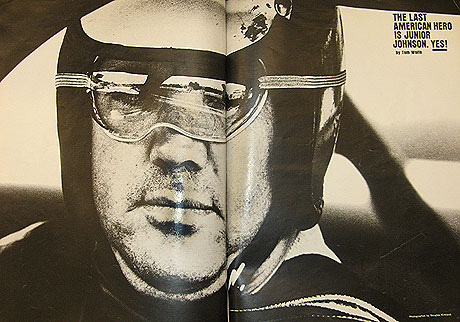


 2 Think Good