Fannie, Freddie and the Credibility GAAP

Accounting humor:

What’s the definition of an accountant? Someone who solves a problem you didn’t know you had in a way you don’t understand.

What’s an auditor? Someone who arrives after the battle and bayonets the wounded.

What are Generally Accepted Accounting Principles [GAAP]? The difference between accounting theory and practice.

In my world that’s funny, but this isn’t; In uncertain economic times, my accounting profession is part of the problem, not the solution.

Bloomberg.com reports the following:

Treasury Secretary Henry Paulson decided to take control of Fannie Mae and Freddie Mac after a review found the beleaguered mortgage-finance companies used accounting methods that inflated their capital, according to people with knowledge of the decision.Morgan Stanley, hired by the Treasury to probe the companies’ finances, concluded the accounting, while legal, enabled Freddie, and to a lesser extent Fannie, to overstate the value of their reserves, according to the people who declined to be identified because the findings are confidential.

See the WSJ and NYT articles describing the takeover.

The WSJ Editorial page weighs in on the bailout itself [complete editorial copied at end of post]:

We only wish Mr. Paulson had gone further and erased all private equity holders the way the feds do in a typical bank failure. Fan and Fred holders had profited handsomely for decades by exploiting an implicit taxpayer guarantee that their management claimed didn’t exist. Now that the taxpayers are in fact stepping in, the current common and preferred holders deserve to lose everything. Mr. Paulson apparently wanted to dodge that political fight. If Fan and Fred share prices rally this week, we’ll know Mr. Paulson didn’t demand enough.

Noted Economist Greg Mankiw makes a similar point:

I am saddened whenever any private profit-seeking enterprise gets bailed out, whether it is Chrysler, Long-term Capital Management, Bear Stearns, or the GSEs. Such bailouts sow the seeds of the next financial crisis by fostering expectations of future bailouts and encouraging excessive risk-taking. (And before anyone emails me that the GSE equity holders are not exactly getting a good deal here, let me point out that the debt holders are. In a capitalist system, you want those extending both debt and equity finance to bear the consequences of the risks they undertake. If the taxpayer is chipping in, someone is being insulated from risk.)

See the complete WSJ article on the coming changes in GAAP below.

————————————————————————————–
Closing the Information GAAP
September 8, 2008

What’s the definition of an accountant? Someone who solves a problem you didn’t know you had in a way you don’t understand.

What’s an auditor? Someone who arrives after the battle and bayonets the wounded.

And drum roll, please: What are Generally Accepted Accounting Principles? The difference between accounting theory and practice.

No joke, accountants are the Rodney Dangerfields of business. But perhaps they deserve some respect after all. Accountants in the U.S. are signing up for a fundamental rethinking of how they do their jobs. As a result, it should finally be possible for global investing and trade to operate on a common understanding, or accounting, of businesses.

The Securities and Exchange Commission recently announced that the U.S. will abandon Generally Accepted Accounting Principles — for almost 75 years, the bible for U.S. accountants — joining more than 100 countries around the world instead in using the London-based International Financial Reporting Standards. Pointing to the “remarkably quickening pace of acceptance of a true lingua franca for accounting,” SEC Chairman Chris Cox set out a timetable for all U.S. companies to drop GAAP by 2016, with the largest companies switching as early as next year.

There are specific differences between the two systems; for example, the international system only allows the first-in, first-out inventory accounting system. The most important difference is that the international standard is based on principles, whereas GAAP is based on rules. GAAP suffers from the complexity of trying to set rules for all situations, a complexity that often masks economic reality.

GAAP rules fill a nine-inch, three-volume set of pronouncements plus interpretive information. In contrast, IFRS is a slim two-inch book. GAAP was crafted in part by the pressures of the U.S. legal system. Companies have been glad for GAAP rules as defenses for claims of accounting irregularities. But these rules often only pretend to provide clarity. There are hundreds of pages of GAAP covering how to account for derivatives, but this didn’t stop opaque pricing mismatches, which helped create the credit crunch. GAAP rules allowed trillions of dollars in securitized financial assets and liabilities to stay off the books of U.S. financial firms, while the international standard, by focusing on the true underlying economics, kept these on the books for firms based elsewhere.

It’s surprising that there is no common language for measuring the performance of companies. Until recently, all major countries had their own accounting rules, but IFRS has become the approach of choice. Inconsistent approaches to accounting make it hard to compare an energy company based in Texas with one based in Amsterdam, a bank in New York with one in London, or a biotech firm in Boston with one in Singapore. A single set of accounting rules would mean more effective global disclosure and transparency. It would reduce costs for multinationals that must now prepare multiple books. It would also make U.S. exchanges more competitive for listings by eliminating accounting differences.

A measure of the importance of a single standard is the dislocation that getting there will cause. It will mean rewriting business school texts and retraining of corporate finance departments. The forensic accountants who sniff out problems will have to develop instincts using a new set of measures. The transition will also be tough on investors. Under the SEC proposal, larger companies in the same industry would switch to the international standard before smaller companies do. Investors for the transition period would have to compare similar companies using different accounting.

The big U.S.-based accounting firms generally support the abandonment of GAAP. Skeptics could call this switch in systems the equivalent of the accountant full-employment act for many years, but the profession itself also recognizes that GAAP often fails to reflect underlying economics.

A PriceWaterhouseCoopers briefing document for executives on the accounting change notes that changes will also be necessary in the law. “If an accounting and reporting framework that relies on professional judgment rather than detailed rules is to flourish in the U.S., the legal and regulatory environment will need to evolve in ways that remain to be seen.” These include that “regulators will need to respect well-reasoned professional judgments.”

A system based on principles could create new defenses for company boards and accountants who try to do the right thing, if they fully disclose why they thought that a particular accounting treatment made sense. The law will have to adjust to accept more ambiguity in accounting, as a necessary condition for reporting with maximum accuracy.

As technology has shown in other areas of life, agreed-upon standards and accepted operating systems drive usage and efficiency. Common measures add value to information. If even the belt-and-suspenders accounting profession is willing to take on the risks of switching its basic system for assessing businesses, we’re truly in an era when anything that adds to understanding belongs in the asset column, while anything that undermines transparency is a liability.
—————————————————————————————-
WSJ Editorial – REVIEW & OUTLOOK

Weekend at Henry’s
September 8, 2008; Page A18

In the 1989 movie “Weekend at Bernie’s,” a pair of young executives create the illusion that their dead boss is still alive to keep a party going. That’s not too far from the premise of this weekend’s Treasury bailout of Fannie Mae and Freddie Mac, the mortgage giants that have become financial zombies.
[Henry Paulson]

Treasury Secretary Henry Paulson wants to prop up the walking dead so the world keeps buying their mortgage-backed securities. His action may calm jittery credit markets, and it may get the companies through the current mortgage crisis — albeit at enormous cost to American taxpayers. The tragedy is that he and Congress didn’t act 18 months ago — when the cost would have been far less — and that he still isn’t killing the Fannie and Freddie business model that has done so much damage. These corpses could still return to haunt us again.
* * *

At least Mr. Paulson has finally figured out he’s been lied to. He arrived in Washington fresh from the Wall Street turnip truck saying that the battle over the two government-sponsored enterprises (GSEs) was nothing but a scrap between “ideologues.” So he bought the Congressional line that Fan and Fred weren’t a problem and would help financial markets through the housing recession. Even as he won new power this summer to add taxpayer capital to the companies, he said he had no intention to use that power and that he wanted to sustain them in their “current form.” That political theater merely prolonged the market agony, while giving the companies incentive to take even greater risks.

This weekend’s formal rescue puts an end to those illusions. Treasury and the new GSE regulator — the Federal Housing Finance Agency — both acknowledge that the companies are facing huge mortgage losses that will soon overwhelm their capital cushions. And this time Mr. Paulson has at least demanded something in return for his blank taxpayer check.

The new federal “conservatorship” is a form of nationalization that puts regulators firmly in control. The feds fired the company boards and CEOs, though the clean up needs to go further to change the corporate cultures. Both companies remain Beltway satraps that hire for reasons of political connection, not financial expertise.

The taxpayer purchase of preferred stock means that the feds will own about 80% of the companies if all the warrants are ultimately exercised. The feds also stopped dividend payments, saving about $2 billion a year. This amounts to significant dilution for current Fannie and Freddie shareholders, and it offers taxpayers some return on their bailout risk if the companies recover.

We only wish Mr. Paulson had gone further and erased all private equity holders the way the feds do in a typical bank failure. Fan and Fred holders had profited handsomely for decades by exploiting an implicit taxpayer guarantee that their management claimed didn’t exist. Now that the taxpayers are in fact stepping in, the current common and preferred holders deserve to lose everything. Mr. Paulson apparently wanted to dodge that political fight. If Fan and Fred share prices rally this week, we’ll know Mr. Paulson didn’t demand enough.

The Treasury chief also gave a free pass to the holders of some $18 billion in Fan and Fred subordinated debt. He did so even though these securities were understood not to have the same status as mortgage-backed securities or other Fannie debt, and even though this will set a bad precedent for other bailouts. Watch for Citigroup’s subordinated debt to jump in price as investors conclude that the feds would do the same thing if Citi needs a rescue.

By far the biggest risk here, however, is that the companies could still emerge with their business model intact. That model is the perverse mix of private profit and public risk, which gave them an incentive to make irresponsible mortgage bets with a taxpayer guarantee.

Mr. Paulson could have ended that model immediately by putting the companies into “receivership.” Both companies could have continued to securitize mortgages, even as their riskiest businesses were wound down. But Treasury says its lawyers at Wachtell Lipton advised that receivership might have triggered default claims and thus caused a run on Fannie and Freddie debt. We hear there’s some legal debate on that point. And in any case, had Mr. Paulson acted sooner and given markets time to understand that receivership doesn’t mean immediate liquidation, the risk of a run might now be far less.

The Treasury plan does at least put some useful limits on Fan and Fred risk-taking, albeit starting only in 2010. Until the housing market bottoms out, presumably in 2009, the feds want the two companies to keep securitizing and guaranteeing mortgages as they do now. But in January 2010, the companies will have to start reducing their portfolios of MBSs by 10% a year, to a total of $250 billion. That will reduce one giant source of systemic financial risk.

Also in 2010, the companies will have to start paying a fee to the feds in return for their taxpayer guarantee. The fee — which could be paid in cash, or in preferred stock and thus add to the government’s controlling stake — is designed to level the playing field with private mortgage securitizers.

Treasury says all of this will provide a motive for Congress and the new President to change how Fan and Fred do business, and in the meantime the conservator has also ordered a stop to their political lobbying. It’s also nice to see that on this point Mr. Paulson has found religion. In his statement Sunday, he blamed the need for a bailout on “the inherent conflict and flawed business model embedded in the GSE structure.” Welcome to our merry band of “ideologues,” Mr. Secretary.

The Treasury chief has nonetheless decided to leave the hardest political choices to his successor, who will have to face down the usual phalanx of Fannie apologists: Democratic barons Barney Frank and Chuck Schumer, the homebuilders, various Wall Street sages and left-wing journalists.

Both Barack Obama and John McCain are now saying sensible things about the need to change the companies. But who knows how the political mood will have shifted once the housing slump passes. It’s easy to imagine the next Treasury Secretary concluding that he also thinks the fight for permanent reform is too difficult. Then we are back to the same old stand.
* * *

The Fannie-Freddie bailout is one of the great political scandals of our age, all the more because it was so obviously coming for so long. Officials at the Federal Reserve warned about it for years, only to be ignored by both parties on Capitol Hill. The least we can do now is bury these undead monsters for all time.
Posted in Business & Economics | Tagged , , , , , | Leave a comment

A rare emotion for the Obama campaign – panic

By far, the Obama campaign has been the best run political organization this year. Today, they either made a mistake or panicked. It is a good indicator of how badly the Obama campaign thinks McCain’s POW-driven biography is hurting Obama with the independent voters they are both chasing.

Sen Obama claimed during an ABC interview on Sunday that he considered military service, but rejected the idea because we were not at war. Reread that — in effect, he rejected the idea of military service, because his odds of serving in combat were not high enough. If he had said he considered it because we were not at war, that at least would ring more honest. When you combine it with the fact that this Obama-thought escaped mention in his thirty-something hyper-introspective autobiography and that no other factors in his background suggests that volunteering for war was a plausible alternative to college, ‘finding himself,’ and recreational drug use, as self-described in his book, that makes the claim literally unbelievable. A rare misstep for the campaign.
—————————————————————————————

Posted in Current Affairs & History | Tagged | Leave a comment

John McCain’s Road to Emmaus

I am part of a Catholic Ministry which is based on a story, the Road to Emmaus, found in the Gospel of Luke [24:13-35]. The Emmaus story begins in gloom and despair and ends with hope and purpose. In our ministry, we equate trying to lead a life of faith with being on a ‘walk,’ on which we may veer off and stumble, but getting back on the road is our goal.

In his convention speech accepting the presidential nomination of his party, John McCain chose that moment to share a humbling experience:

On an October morning, in the Gulf of Tonkin, I prepared for my 23rd mission over North Vietnam. I hadn’t any worry I wouldn’t come back safe and sound. I thought I was tougher than anyone. I was pretty independent then, too. I liked to bend a few rules, and pick a few fights for the fun of it. But I did it for my own pleasure; my own pride. I didn’t think there was a cause more important than me.

Then I found myself falling toward the middle of a small lake in the city of Hanoi, with two broken arms, a broken leg, and an angry crowd waiting to greet me. I was dumped in a dark cell, and left to die. I didn’t feel so tough anymore…

A lot of prisoners had it worse than I did. I’d been mistreated before, but not as badly as others. I always liked to strut a little after I’d been roughed up to show the other guys I was tough enough to take it. But after I turned down their offer, they worked me over harder than they ever had before. For a long time. And they broke me.

While John McCain did not invoke his faith specifically in this part of his speech, anyone who has struggled with their actions, with respect to their faith, can relate to that humbling moment of self-realization. To have experienced it in the most extreme of conditions, makes it all the more impressive. To have shared it on his night of glory was a great example of humility. Jay Cost of RealClearPolitics summarizes his reaction to the speech:

Who does this in a nomination speech?

Typically, presidential candidates use their time in combat to reinforce the warrior virtues. Recall, “I’m John Kerry, and I’m reporting for duty!” McCain basically turned that on its head last night. It was not his heroism or leadership in war that shows he’s ready to command. Instead, it was the horror of war that made him understand how great our country is, and why it is worth fighting for. He was a cocky jerk prior to his captivity, but the brutality of that experience broke his selfish, independent spirit. It was the idea of America that saved him, and – per the speech – he was reborn her humble, imperfect servant.

Delivered in his blunt style, these passages reinforced the idea of McCain being honest even when it isn’t expedient. He’s willing to talk straight about anything, including his own frailties.

But this was not confession for its own sake. Last night – McCain did three things: (a) Reminded us that he’s a maverick; (b) Told us what the maverick would do if we elect him; (c) Told us why he’s a maverick. [So, contrary to some pundits, it was actually a very well-organized speech.] The confession at the end was the “why.” He fights for the country, not for a party, because it was in Hanoi that his country saved him. Country first, party second.

See the complete speech below.
———————————————————————————-
John McCain’s Acceptance Speech

St. Paul, Minnesota

Thank you all very much. Tonight, I have a privilege given few Americans — the privilege of accepting our party’s nomination for President of the United States. And I accept it with gratitude, humility and confidence.

In my life, no success has come without a good fight, and this nomination wasn’t any different. That’s a tribute to the candidates who opposed me and their supporters. They’re leaders of great ability, who love our country, and wished to lead it to better days. Their support is an honor I won’t forget.

I’m grateful to the President for leading us in those dark days following the worst attack on American soil in our history, and keeping us safe from another attack many thought was inevitable; and to the First Lady, Laura Bush, a model of grace and kindness in public and in private. And I’m grateful to the 41st President and his bride of 63 years, and for their outstanding example of honorable service to our country.

As always, I’m indebted to my wife, Cindy, and my seven children. The pleasures of family life can seem like a brief holiday from the crowded calendar of our nation’s business. But I have treasured them all the more, and can’t imagine a life without the happiness you give me. Cindy said a lot of nice things about me tonight. But, in truth, she’s more my inspiration than I am hers. Her concern for those less blessed than we are — victims of land mines, children born in poverty and with birth defects — shows the measure of her humanity. I know she will make a great First Lady.

When I was growing up, my father was often at sea, and the job of raising my brother, sister and me would fall to my mother alone. Roberta McCain gave us her love of life, her deep interest in the world, her strength, and her belief we are all meant to use our opportunities to make ourselves useful to our country. I wouldn’t be here tonight but for the strength of her character.

My heartfelt thanks to all of you, who helped me win this nomination, and stood by me when the odds were long. I won’t let you down. To Americans who have yet to decide who to vote for, thank you for your consideration and the opportunity to win your trust. I intend to earn it.

Finally, a word to Senator Obama and his supporters. We’ll go at it over the next two months. That’s the nature of these contests, and there are big differences between us. But you have my respect and admiration. Despite our differences, much more unites us than divides us. We are fellow Americans, an association that means more to me than any other. We’re dedicated to the proposition that all people are created equal and endowed by our Creator with inalienable rights. No country ever had a greater cause than that. And I wouldn’t be an American worthy of the name if I didn’t honor Senator Obama and his supporters for their achievement.

But let there be no doubt, my friends, we’re going to win this election. And after we’ve won, we’re going to reach out our hand to any willing patriot, make this government start working for you again, and get this country back on the road to prosperity and peace.

These are tough times for many of you. You’re worried about keeping your job or finding a new one, and are struggling to put food on the table and stay in your home. All you ever asked of government is to stand on your side, not in your way. And that’s just what I intend to do: stand on your side and fight for your future.

And I’ve found just the right partner to help me shake up Washington, Governor Sarah Palin of Alaska. She has executive experience and a real record of accomplishment. She’s tackled tough problems like energy independence and corruption. She’s balanced a budget, cut taxes, and taken on the special interests. She’s reached across the aisle and asked Republicans, Democrats and Independents to serve in her administration. She’s the mother of five children. She’s helped run a small business, worked with her hands and knows what it’s like to worry about mortgage payments and health care and the cost of gasoline and groceries.

She knows where she comes from and she knows who she works for. She stands up for what’s right, and she doesn’t let anyone tell her to sit down. I’m very proud to have introduced our next Vice President to the country. But I can’t wait until I introduce her to Washington. And let me offer an advance warning to the old, big spending, do nothing, me first, country second Washington crowd: change is coming.

I’m not in the habit of breaking promises to my country and neither is Governor Palin. And when we tell you we’re going to change Washington, and stop leaving our country’s problems for some unluckier generation to fix, you can count on it. We’ve got a record of doing just that, and the strength, experience, judgment and backbone to keep our word to you.

You know, I’ve been called a maverick; someone who marches to the beat of his own drum. Sometimes it’s meant as a compliment and sometimes it’s not. What it really means is I understand who I work for. I don’t work for a party. I don’t work for a special interest. I don’t work for myself. I work for you.

I’ve fought corruption, and it didn’t matter if the culprits were Democrats or Republicans. They violated their public trust, and had to be held accountable. I’ve fought big spenders in both parties, who waste your money on things you neither need nor want, while you struggle to buy groceries, fill your gas tank and make your mortgage payment. I’ve fought to get million dollar checks out of our elections. I’ve fought lobbyists who stole from Indian tribes. I fought crooked deals in the Pentagon. I fought tobacco companies and trial lawyers, drug companies and union bosses.

I fought for the right strategy and more troops in Iraq, when it wasn’t a popular thing to do. And when the pundits said my campaign was finished, I said I’d rather lose an election than see my country lose a war.

Thanks to the leadership of a brilliant general, David Petreaus, and the brave men and women he has the honor to command, that strategy succeeded and rescued us from a defeat that would have demoralized our military, risked a wider war and threatened the security of all Americans.

I don’t mind a good fight. For reasons known only to God, I’ve had quite a few tough ones in my life. But I learned an important lesson along the way. In the end, it matters less that you can fight. What you fight for is the real test.

I fight for Americans. I fight for you. I fight for Bill and Sue Nebe from Farmington Hills, Michigan, who lost their real estate investments in the bad housing market. Bill got a temporary job after he was out of work for seven months. Sue works three jobs to help pay the bills.

I fight for Jake and Toni Wimmer of Franklin County, Pennsylvania. Jake works on a loading dock; coaches Little League, and raises money for the mentally and physically disabled. Toni is a schoolteacher, working toward her Master’s Degree. They have two sons, the youngest, Luke, has been diagnosed with autism. Their lives should matter to the people they elect to office. They matter to me.

I fight for the family of Matthew Stanley of Wolfboro, New Hampshire, who died serving our country in Iraq. I wear his bracelet and think of him every day. I intend to honor their sacrifice by making sure the country their son loved so well and never returned to, remains safe from its enemies.

I fight to restore the pride and principles of our party. We were elected to change Washington, and we let Washington change us. We lost the trust of the American people when some Republicans gave in to the temptations of corruption. We lost their trust when rather than reform government, both parties made it bigger. We lost their trust when instead of freeing ourselves from a dangerous dependence on foreign oil, both parties and Senator Obama passed another corporate welfare bill for oil companies. We lost their trust, when we valued our power over our principles.

We’re going to change that. We’re going to recover the people’s trust by standing up again for the values Americans admire. The party of Lincoln, Roosevelt and Reagan is going to get back to basics.

We believe everyone has something to contribute and deserves the opportunity to reach their God-given potential from the boy whose descendents arrived on the Mayflower to the Latina daughter of migrant workers. We’re all God’s children and we’re all Americans.

We believe in low taxes; spending discipline, and open markets. We believe in rewarding hard work and risk takers and letting people keep the fruits of their labor.

We believe in a strong defense, work, faith, service, a culture of life, personal responsibility, the rule of law, and judges who dispense justice impartially and don’t legislate from the bench. We believe in the values of families, neighborhoods and communities.

We believe in a government that unleashes the creativity and initiative of Americans. Government that doesn’t make your choices for you, but works to make sure you have more choices to make for yourself.

I will keep taxes low and cut them where I can. My opponent will raise them. I will open new markets to our goods and services. My opponent will close them. I will cut government spending. He will increase it.

My tax cuts will create jobs. His tax increases will eliminate them. My health care plan will make it easier for more Americans to find and keep good health care insurance. His plan will force small businesses to cut jobs, reduce wages, and force families into a government run health care system where a bureaucrat stands between you and your doctor.

Keeping taxes low helps small businesses grow and create new jobs. Cutting the second highest business tax rate in the world will help American companies compete and keep jobs from moving overseas. Doubling the child tax exemption from $3500 to $7000 will improve the lives of millions of American families. Reducing government spending and getting rid of failed programs will let you keep more of your own money to save, spend and invest as you see fit. Opening new markets and preparing workers to compete in the world economy is essential to our future prosperity.

I know some of you have been left behind in the changing economy and it often seems your government hasn’t even noticed. Government assistance for unemployed workers was designed for the economy of the 1950s. That’s going to change on my watch. My opponent promises to bring back old jobs by wishing away the global economy. We’re going to help workers who’ve lost a job that won’t come back, find a new one that won’t go away.

We will prepare them for the jobs of today. We will use our community colleges to help train people for new opportunities in their communities. For workers in industries that have been hard hit, we’ll help make up part of the difference in wages between their old job and a temporary, lower paid one while they receive retraining that will help them find secure new employment at a decent wage.

Education is the civil rights issue of this century. Equal access to public education has been gained. But what is the value of access to a failing school? We need to shake up failed school bureaucracies with competition, empower parents with choice, remove barriers to qualified instructors, attract and reward good teachers, and help bad teachers find another line of work.

When a public school fails to meet its obligations to students, parents deserve a choice in the education of their children. And I intend to give it to them. Some may choose a better public school. Some may choose a private one. Many will choose a charter school. But they will have that choice and their children will have that opportunity.

Senator Obama wants our schools to answer to unions and entrenched bureaucracies. I want schools to answer to parents and students. And when I’m President, they will.

My fellow Americans, when I’m President, we’re going to embark on the most ambitious national project in decades. We are going to stop sending $700 billion a year to countries that don’t like us very much. We will attack the problem on every front. We will produce more energy at home. We will drill new wells offshore, and we’ll drill them now. We will build more nuclear power plants. We will develop clean coal technology. We will increase the use of wind, tide, solar and natural gas. We will encourage the development and use of flex fuel, hybrid and electric automobiles.

Senator Obama thinks we can achieve energy independence without more drilling and without more nuclear power. But Americans know better than that. We must use all resources and develop all technologies necessary to rescue our economy from the damage caused by rising oil prices and to restore the health of our planet. It’s an ambitious plan, but Americans are ambitious by nature, and we have faced greater challenges. It’s time for us to show the world again how Americans lead.

This great national cause will create millions of new jobs, many in industries that will be the engine of our future prosperity; jobs that will be there when your children enter the workforce.

Today, the prospect of a better world remains within our reach. But we must see the threats to peace and liberty in our time clearly and face them, as Americans before us did, with confidence, wisdom and resolve.

We have dealt a serious blow to al Qaeda in recent years. But they are not defeated, and they’ll strike us again if they can. Iran remains the chief state sponsor of terrorism and on the path to acquiring nuclear weapons. Russia’s leaders, rich with oil wealth and corrupt with power, have rejected democratic ideals and the obligations of a responsible power. They invaded a small, democratic neighbor to gain more control over the world’s oil supply, intimidate other neighbors, and further their ambitions of reassembling the Russian empire. And the brave people of Georgia need our solidarity and prayers. As President I will work to establish good relations with Russia so we need not fear a return of the Cold War. But we can’t turn a blind eye to aggression and international lawlessness that threatens the peace and stability of the world and the security of the American people.

We face many threats in this dangerous world, but I’m not afraid of them. I’m prepared for them. I know how the military works, what it can do, what it can do better, and what it should not do. I know how the world works. I know the good and the evil in it. I know how to work with leaders who share our dreams of a freer, safer and more prosperous world, and how to stand up to those who don’t. I know how to secure the peace.

When I was five years old, a car pulled up in front of our house. A Navy officer rolled down the window, and shouted at my father that the Japanese had bombed Pearl Harbor. I rarely saw my father again for four years. My grandfather came home from that same war exhausted from the burdens he had borne, and died the next day. In Vietnam, where I formed the closest friendships of my life, some of those friends never came home with me. I hate war. It is terrible beyond imagination.

I’m running for President to keep the country I love safe, and prevent other families from risking their loved ones in war as my family has. I will draw on all my experience with the world and its leaders, and all the tools at our disposal — diplomatic, economic, military and the power of our ideals — to build the foundations for a stable and enduring peace.

In America, we change things that need to be changed. Each generation makes its contribution to our greatness. The work that is ours to do is plainly before us. We don’t need to search for it.

We need to change the way government does almost everything: from the way we protect our security to the way we compete in the world economy; from the way we respond to disasters to the way we fuel our transportation network; from the way we train our workers to the way we educate our children. All these functions of government were designed before the rise of the global economy, the information technology revolution and the end of the Cold War. We have to catch up to history, and we have to change the way we do business in Washington.

The constant partisan rancor that stops us from solving these problems isn’t a cause, it’s a symptom. It’s what happens when people go to Washington to work for themselves and not you.

Again and again, I’ve worked with members of both parties to fix problems that need to be fixed. That’s how I will govern as President. I will reach out my hand to anyone to help me get this country moving again. I have that record and the scars to prove it. Senator Obama does not.

Instead of rejecting good ideas because we didn’t think of them first, let’s use the best ideas from both sides. Instead of fighting over who gets the credit, let’s try sharing it. This amazing country can do anything we put our minds to. I will ask Democrats and Independents to serve with me. And my administration will set a new standard for transparency and accountability.

We’re going to finally start getting things done for the people who are counting on us, and I won’t care who gets the credit.

I’ve been an imperfect servant of my country for many years. But I have been her servant first, last and always. And I’ve never lived a day, in good times or bad, that I didn’t thank God for the privilege.

Long ago, something unusual happened to me that taught me the most valuable lesson of my life. I was blessed by misfortune. I mean that sincerely. I was blessed because I served in the company of heroes, and I witnessed a thousand acts of courage, compassion and love.

On an October morning, in the Gulf of Tonkin, I prepared for my 23rd mission over North Vietnam. I hadn’t any worry I wouldn’t come back safe and sound. I thought I was tougher than anyone. I was pretty independent then, too. I liked to bend a few rules, and pick a few fights for the fun of it. But I did it for my own pleasure; my own pride. I didn’t think there was a cause more important than me.

Then I found myself falling toward the middle of a small lake in the city of Hanoi, with two broken arms, a broken leg, and an angry crowd waiting to greet me. I was dumped in a dark cell, and left to die. I didn’t feel so tough anymore. When they discovered my father was an admiral, they took me to a hospital. They couldn’t set my bones properly, so they just slapped a cast on me. When I didn’t get better, and was down to about a hundred pounds, they put me in a cell with two other Americans. I couldn’t do anything. I couldn’t even feed myself. They did it for me. I was beginning to learn the limits of my selfish independence. Those men saved my life.

I was in solitary confinement when my captors offered to release me. I knew why. If I went home, they would use it as propaganda to demoralize my fellow prisoners. Our Code said we could only go home in the order of our capture, and there were men who had been shot down before me. I thought about it, though. I wasn’t in great shape, and I missed everything about America. But I turned it down.

A lot of prisoners had it worse than I did. I’d been mistreated before, but not as badly as others. I always liked to strut a little after I’d been roughed up to show the other guys I was tough enough to take it. But after I turned down their offer, they worked me over harder than they ever had before. For a long time. And they broke me.

When they brought me back to my cell, I was hurt and ashamed, and I didn’t know how I could face my fellow prisoners. The good man in the cell next door, my friend, Bob Craner, saved me. Through taps on a wall he told me I had fought as hard as I could. No man can always stand alone. And then he told me to get back up and fight again for our country and for the men I had the honor to serve with. Because every day they fought for me.

I fell in love with my country when I was a prisoner in someone else’s. I loved it not just for the many comforts of life here. I loved it for its decency; for its faith in the wisdom, justice and goodness of its people. I loved it because it was not just a place, but an idea, a cause worth fighting for. I was never the same again. I wasn’t my own man anymore. I was my country’s.

I’m not running for president because I think I’m blessed with such personal greatness that history has anointed me to save our country in its hour of need. My country saved me. My country saved me, and I cannot forget it. And I will fight for her for as long as I draw breath, so help me God.

If you find faults with our country, make it a better one. If you’re disappointed with the mistakes of government, join its ranks and work to correct them. Enlist in our Armed Forces. Become a teacher. Enter the ministry. Run for public office. Feed a hungry child. Teach an illiterate adult to read. Comfort the afflicted. Defend the rights of the oppressed. Our country will be the better, and you will be the happier. Because nothing brings greater happiness in life than to serve a cause greater than yourself.

I’m going to fight for my cause every day as your President. I’m going to fight to make sure every American has every reason to thank God, as I thank Him: that I’m an American, a proud citizen of the greatest country on earth, and with hard work, strong faith and a little courage, great things are always within our reach. Fight with me. Fight with me.

Fight for what’s right for our country.

Fight for the ideals and character of a free people.

Fight for our children’s future.

Fight for justice and opportunity for all.

Stand up to defend our country from its enemies.

Stand up for each other; for beautiful, blessed, bountiful America.

Stand up, stand up, stand up and fight. Nothing is inevitable here. We’re Americans, and we never give up. We never quit. We never hide from history. We make history.

Thank you, and God Bless you.

John McCain, a U.S. Senator from Arizona, is the Republican presidential nominee.

Tagged , | Leave a comment

Who Do You Want Staring Down Ahmadinejad?

>

Peggy Noonan contrasts the choices:

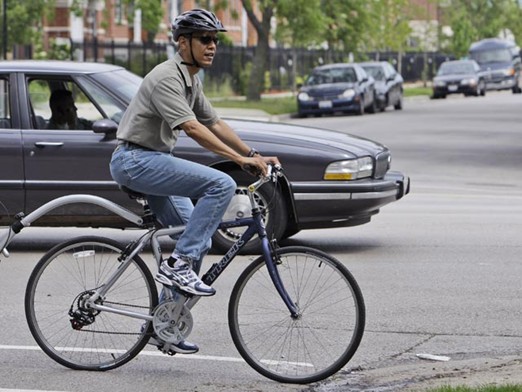
A certain normal-versus-sissy template was captured in a deadly email that is making the rounds. It offers two pictures. One is of a young Mrs. Palin in a short skirt, smiling at the camera as she leans against a big ol’ motorcycle. The other is of a thin and careful Obama on a bicycle, in a plastic safety helmet, looking like a tony suburban professional trying to lower his carbon footprint. The headline on the email: “This settles it.”There is no denying that Mr. Obama is in a bad place, that he must now be considered the underdog, that he’s wearing Loser-Glo. The slide started with the Rick Warren interviews in August, just as America was starting to pay attention. Verdict? McCain: normal. Obama: odd.

Then Mrs. Palin, and the catastrophe of the Democratic and media response to her. Books will be written about this, but because it’s so recent, and so known, we’re almost not absorbing how huge it was, and is. Here was the central liberal mistake: They used the atom bomb just a few days in. They used it so brutally, and yet so ineptly, in a way so oblivious to the true contours of the field, that the radiation blew back over their own lines. They used it without preliminary diplomatic talks, multilateral meetings or Security Council debate. They just went boom. And it boomeranged.

The atom bomb was personal and sexual perfidy, backwoods knuckle-draggin’ ma and pa saying, Tell the neighbors the baby’s ours. Then the ritual abuse of the 17-year-old girl. Then the rest of it—bad mother, religious weirdo. (On this latter it must be noted that Mrs. Palin never told a church that the Iraq war was God’s will; she asked them to pray that it was God’s will. It wasn’t the sound of Republican hubris, it was the sound of Christian humility: We can’t know the mind of God, we can only pray we are in accord with it.)

All of this was unacceptable to normal Americans. They experienced it as the town gossip spreading rumor and slander before the new neighbor even got to put down her bags. It offended the American sense of fairness. And—it still lives!—gallantry.

See the complete column below.

—————————————————————————————-
Miles to Go – September 12, 2008 – Peggy Noonan

Democrats, hit reset. Accept the fact that the race has changed utterly, that you’re up against a ticket that has captured the public imagination. Now you must go out and recapture it.

Out of the shirtsleeves, into the suit. Stop prowling the stage with what looks like Phil Donahue’s old mic. No more scattered, listless riffs; back to the podium and the prepared—and focused—speech. Campaign as a duo, Obama-Biden, together again. Obama alone looks like he’s part of nothing.

You must aim your fire at the top of the ticket, John McCain, and not at this beautiful girl, Sarah Palin, about whom you can do nothing.

You can never kill her now. Forget it. She can hurt herself, but in terms of Democratic attacks she is bulletproof. You made her that—she wasn’t that way when she walked in.

Hope that Mr. McCain stops campaigning with her and spins her off into her own orbit, to small towns and medium-sized cities. It will cut his recent power in half. Some press will follow her, but mostly on gaffe patrol. They will want to keep their main lens on Obama and McCain.

This is going to be the only way to contain her power: Ignore it.

* * *

This race is not over. Everyone I know thinks it is, but I don’t buy it. Mr. Obama just suffered a catastrophe, his first. Mr. McCain just enjoyed a triumph, maybe not his last. GOP strategists are experiencing premature triumphalism; they’re puffing up like blowfish, emitting great bubbles of self-regard. Democrats, be encouraged by this! They make mistakes when they’re winning. They always start to think they’re the reason.

Democratic strategists have their heads in their hands, knowing they took a bad hit but not understanding exactly how, or why. Republicans, be inspired by this! They can’t come up with the right cure if they can’t diagnose the illness.

Here’s why it’s not over: We are a more or less 50/50 nation experiencing 80% wrong-track numbers, alarming economic challenges and two continuing wars. New voters are about to flood to the polls. There are more than 50 days to go. The media environment is volatile. The Obama campaign has some experience in turning inevitable candidacies into evitable ones. Sen. Obama himself is talented, resourceful and compelling.

More important, obviously, the race shouldn’t be over. The nation deserves—and requires—a real debate, a real and spirited presenting of fact and argument. It won’t get that if the election is over. The candidates must argue this thing out or it means nothing. And the day after the election, for the winner in this tempestuous nation, it better mean something, or he won’t be able to govern.

* * *

After the past 10 days, it is not remarkable that Mr. McCain has caught up with Mr. Obama. It is amazing that Mr. Obama is still roughly even with Mr. McCain.

There is no denying that Mr. Obama is in a bad place, that he must now be considered the underdog, that he’s wearing Loser-Glo. The slide started with the Rick Warren interviews in August, just as America was starting to pay attention. Verdict? McCain: normal. Obama: odd.

Then Mrs. Palin, and the catastrophe of the Democratic and media response to her. Books will be written about this, but because it’s so recent, and so known, we’re almost not absorbing how huge it was, and is. Here was the central liberal mistake: They used the atom bomb just a few days in. They used it so brutally, and yet so ineptly, in a way so oblivious to the true contours of the field, that the radiation blew back over their own lines. They used it without preliminary diplomatic talks, multilateral meetings or Security Council debate. They just went boom. And it boomeranged.

The atom bomb was personal and sexual perfidy, backwoods knuckle-draggin’ ma and pa saying, Tell the neighbors the baby’s ours. Then the ritual abuse of the 17-year-old girl. Then the rest of it—bad mother, religious weirdo. (On this latter it must be noted that Mrs. Palin never told a church that the Iraq war was God’s will; she asked them to pray that it was God’s will. It wasn’t the sound of Republican hubris, it was the sound of Christian humility: We can’t know the mind of God, we can only pray we are in accord with it.)

All of this was unacceptable to normal Americans. They experienced it as the town gossip spreading rumor and slander before the new neighbor even got to put down her bags. It offended the American sense of fairness. And—it still lives!—gallantry.

Most crucially, the snobbery of it, the meanness of it, reminded the entire country, for the first time in a decade, what it is they don’t like about the left. Really, America had forgotten. Mr. Obama’s friends reminded them. Unforgettably.

And it wasn’t just excitable bloggers or 24-hour cable news shows desperate to fill the maw. The chairwoman of the South Carolina Democratic Party said this week that Mrs. Palin’s “primary qualification [for vice president] seems to be that she hasn’t had an abortion.”

The Democrats were up against Xena the Warrior Princess and came across, in response, as pale-lipped Puritans who actually, at the end of the day, don’t really like women all that much. Mrs. Palin radiates the sense that she’d never give up her femininity in her quest for power because her femininity is part of her power. (On the Democratic side, she can be compared in this to Nancy Pelosi.)

A certain normal-versus-sissy template was captured in a deadly email that is making the rounds. It offers two pictures. One is of a young Mrs. Palin in a short skirt, smiling at the camera as she leans against a big ol’ motorcycle. The other is of a thin and careful Obama on a bicycle, in a plastic safety helmet, looking like a tony suburban professional trying to lower his carbon footprint. The headline on the email: “This settles it.”

* * *

All of this is being exploited—so far relatively deftly, soon to be heavy-handedly—by the Republican Party, which is sending out emails saying that if you’ll click on this little link you’ll be able to contribute money to help stop the smears and lies aimed at Mrs. Palin.

Right now only Mrs. Palin can hurt Mrs. Palin. Messrs. Obama and Biden can’t do it and shouldn’t try. And the media can’t, because more than half the country won’t listen to them on this subject now, and for a while. The media could get videotape of Mrs. Palin saying, “We should invade Mars and it will be easy because Mars is hidden inside my hair!” and people would say, “Stop sliming Sarah!”

The mainstream media may themselves come down on Mr. Obama. They like him, but if he doesn’t come back and make this a race, he’ll embarrass them. They just might be on the edge of getting angry, having been left exposed. Forget what Mr. McCain and Mrs. Palin can do to Mr. Obama: If he embarrasses the media, they’ll kill him.

See all of today’s editorials and op-eds, plus video commentary, on Opinion Journal.

Posted in Current Affairs & History | Tagged , , | Leave a comment

Shake Hands and Head to Corners – I’ll be on the Right


We can analyze on the first Wednesday in November. Time to pick sides. Sarah Palin on Sen Obama:

And though both Senator Obama and Senator Biden have been going on lately about how they are always, quote, “fighting for you,” let us face the matter squarely.

There is only one man in this election who has ever really fought for you … in places where winning means survival and defeat means death … and that man is John McCain. In our day, politicians have readily shared much lesser tales of adversity than the nightmare world in which this man, and others equally brave, served and suffered for their country.

In the case of Sen Obama, I would go further and make the case that his conflicted feelings about America’s discriminatory past would prevent him from ever serving his country in that way. More from Palin:

I guess a small-town mayor is sort of like a “community organizer,” except that you have actual responsibilities. I might add that in small towns, we don’t quite know what to make of a candidate who lavishes praise on working people when they are listening, and then talks about how bitterly they cling to their religion and guns when those people aren’t listening.

We tend to prefer candidates who don’t talk about us one way in Scranton and another way in San Francisco.

See her complete speech below.
——————————————————————————–
September 03, 2008
Sarah Palin’s Address to the RNC
By Sarah Palin

St. Paul, Minnesota

Mr. Chairman, delegates, and fellow citizens: I am honored to be considered for the nomination for Vice President of the United States…

I accept the call to help our nominee for president to serve and defend America.

I accept the challenge of a tough fight in this election… against confident opponents … at a crucial hour for our country.

And I accept the privilege of serving with a man who has come through much harder missions … and met far graver challenges … and knows how tough fights are won – the next president of the United States, John S. McCain.

It was just a year ago when all the experts in Washington counted out our nominee because he refused to hedge his commitment to the security of the country he loves.

With their usual certitude, they told us that all was lost – there was no hope for this candidate who said that he would rather lose an election than see his country lose a war.

But the pollsters and pundits overlooked just one thing when they wrote him off.

They overlooked the caliber of the man himself – the determination, resolve, and sheer guts of Senator John McCain. The voters knew better.

And maybe that’s because they realize there is a time for politics and a time for leadership … a time to campaign and a time to put our country first.

Our nominee for president is a true profile in courage, and people like that are hard to come by.

He’s a man who wore the uniform of this country for 22 years, and refused to break faith with those troops in Iraq who have now brought victory within sight.

And as the mother of one of those troops, that is exactly the kind of man I want as commander in chief. I’m just one of many moms who’ll say an extra prayer each night for our sons and daughters going into harm’s way.

Our son Track is 19.

And one week from tomorrow – September 11th – he’ll deploy to Iraq with the Army infantry in the service of his country.

My nephew Kasey also enlisted, and serves on a carrier in the Persian Gulf.

My family is proud of both of them and of all the fine men and women serving the country in uniform. Track is the eldest of our five children.

In our family, it’s two boys and three girls in between – my strong and kind-hearted daughters Bristol, Willow, and Piper.

And in April, my husband Todd and I welcomed our littlest one into the world, a perfectly beautiful baby boy named Trig. From the inside, no family ever seems typical.

That’s how it is with us.

Our family has the same ups and downs as any other … the same challenges and the same joys.

Sometimes even the greatest joys bring challenge.

And children with special needs inspire a special love.

To the families of special-needs children all across this country, I have a message: For years, you sought to make America a more welcoming place for your sons and daughters.

I pledge to you that if we are elected, you will have a friend and advocate in the White House. Todd is a story all by himself.

He’s a lifelong commercial fisherman … a production operator in the oil fields of Alaska’s North Slope … a proud member of the United Steel Workers’ Union … and world champion snow machine racer.

Throw in his Yup’ik Eskimo ancestry, and it all makes for quite a package.

We met in high school, and two decades and five children later he’s still my guy. My Mom and Dad both worked at the elementary school in our small town.

And among the many things I owe them is one simple lesson: that this is America, and every woman can walk through every door of opportunity.

My parents are here tonight, and I am so proud to be the daughter of Chuck and Sally Heath. Long ago, a young farmer and habber-dasher from Missouri followed an unlikely path to the vice presidency.

A writer observed: “We grow good people in our small towns, with honesty, sincerity, and dignity.” I know just the kind of people that writer had in mind when he praised Harry Truman.

I grew up with those people.

They are the ones who do some of the hardest work in America … who grow our food, run our factories, and fight our wars.

They love their country, in good times and bad, and they’re always proud of America. I had the privilege of living most of my life in a small town.

I was just your average hockey mom, and signed up for the PTA because I wanted to make my kids’ public education better.

When I ran for city council, I didn’t need focus groups and voter profiles because I knew those voters, and knew their families, too.

Before I became governor of the great state of Alaska, I was mayor of my hometown.

And since our opponents in this presidential election seem to look down on that experience, let me explain to them what the job involves.

I guess a small-town mayor is sort of like a “community organizer,” except that you have actual responsibilities. I might add that in small towns, we don’t quite know what to make of a candidate who lavishes praise on working people when they are listening, and then talks about how bitterly they cling to their religion and guns when those people aren’t listening.

We tend to prefer candidates who don’t talk about us one way in Scranton and another way in San Francisco.

As for my running mate, you can be certain that wherever he goes, and whoever is listening, John McCain is the same man. I’m not a member of the permanent political establishment.

And I’ve learned quickly, these past few days, that if you’re not a member in good standing of the Washington elite, then some in the media consider a candidate unqualified for that reason alone.

But here’s a little news flash for all those reporters and commentators: I’m not going to Washington to seek their good opinion – I’m going to Washington to serve the people of this country. Americans expect us to go to Washington for the right reasons, and not just to mingle with the right people.

Politics isn’t just a game of clashing parties and competing interests.

The right reason is to challenge the status quo, to serve the common good, and to leave this nation better than we found it.

No one expects us to agree on everything.

But we are expected to govern with integrity, good will, clear convictions, and … a servant’s heart.

I pledge to all Americans that I will carry myself in this spirit as vice president of the United States. This was the spirit that brought me to the governor’s office, when I took on the old politics as usual in Juneau … when I stood up to the special interests, the lobbyists, big oil companies, and the good-ol’ boys network.

Sudden and relentless reform never sits well with entrenched interests and power brokers. That’s why true reform is so hard to achieve.

But with the support of the citizens of Alaska, we shook things up.

And in short order we put the government of our state back on the side of the people.

I came to office promising major ethics reform, to end the culture of self-dealing. And today, that ethics reform is the law.

While I was at it, I got rid of a few things in the governor’s office that I didn’t believe our citizens should have to pay for.

That luxury jet was over the top. I put it on eBay.

I also drive myself to work.

And I thought we could muddle through without the governor’s personal chef – although I’ve got to admit that sometimes my kids sure miss her. I came to office promising to control spending – by request if possible and by veto if necessary.

Senator McCain also promises to use the power of veto in defense of the public interest – and as a chief executive, I can assure you it works.

Our state budget is under control.

We have a surplus.

And I have protected the taxpayers by vetoing wasteful spending: nearly half a billion dollars in vetoes.

I suspended the state fuel tax, and championed reform to end the abuses of earmark spending by Congress.

I told the Congress “thanks, but no thanks,” for that Bridge to Nowhere.

If our state wanted a bridge, we’d build it ourselves. When oil and gas prices went up dramatically, and filled up the state treasury, I sent a large share of that revenue back where it belonged – directly to the people of Alaska.

And despite fierce opposition from oil company lobbyists, who kind of liked things the way they were, we broke their monopoly on power and resources.

As governor, I insisted on competition and basic fairness to end their control of our state and return it to the people.

I fought to bring about the largest private-sector infrastructure project in North American history.

And when that deal was struck, we began a nearly forty billion dollar natural gas pipeline to help lead America to energy independence.

That pipeline, when the last section is laid and its valves are opened, will lead America one step farther away from dependence on dangerous foreign powers that do not have our interests at heart.

The stakes for our nation could not be higher.

When a hurricane strikes in the Gulf of Mexico, this country should not be so dependent on imported oil that we are forced to draw from our Strategic Petroleum Reserve.

And families cannot throw away more and more of their paychecks on gas and heating oil.

With Russia wanting to control a vital pipeline in the Caucasus, and to divide and intimidate our European allies by using energy as a weapon, we cannot leave ourselves at the mercy of foreign suppliers.

To confront the threat that Iran might seek to cut off nearly a fifth of world energy supplies … or that terrorists might strike again at the Abqaiq facility in Saudi Arabia … or that Venezuela might shut off its oil deliveries … we Americans need to produce more of our own oil and gas.

And take it from a gal who knows the North Slope of Alaska: we’ve got lots of both.

Our opponents say, again and again, that drilling will not solve all of America’s energy problems – as if we all didn’t know that already.

But the fact that drilling won’t solve every problem is no excuse to do nothing at all.

Starting in January, in a McCain-Palin administration, we’re going to lay more pipelines … build more nuclear plants … create jobs with clean coal … and move forward on solar, wind, geothermal, and other alternative sources.

We need American energy resources, brought to you by American ingenuity, and produced by American workers. I’ve noticed a pattern with our opponent.

Maybe you have, too.

We’ve all heard his dramatic speeches before devoted followers.

And there is much to like and admire about our opponent.

But listening to him speak, it’s easy to forget that this is a man who has authored two memoirs but not a single major law or reform – not even in the state senate.

This is a man who can give an entire speech about the wars America is fighting, and never use the word “victory” except when he’s talking about his own campaign. But when the cloud of rhetoric has passed … when the roar of the crowd fades away … when the stadium lights go out, and those Styrofoam Greek columns are hauled back to some studio lot – what exactly is our opponent’s plan? What does he actually seek to accomplish, after he’s done turning back the waters and healing the planet? The answer is to make government bigger … take more of your money … give you more orders from Washington … and to reduce the strength of America in a dangerous world. America needs more energy … our opponent is against producing it.

Victory in Iraq is finally in sight … he wants to forfeit.

Terrorist states are seeking nuclear weapons without delay … he wants to meet them without preconditions.

Al Qaeda terrorists still plot to inflict catastrophic harm on America … he’s worried that someone won’t read them their rights? Government is too big … he wants to grow it.

Congress spends too much … he promises more.

Taxes are too high … he wants to raise them. His tax increases are the fine print in his economic plan, and let me be specific.

The Democratic nominee for president supports plans to raise income taxes … raise payroll taxes … raise investment income taxes … raise the death tax … raise business taxes … and increase the tax burden on the American people by hundreds of billions of dollars. My sister Heather and her husband have just built a service station that’s now opened for business – like millions of others who run small businesses.

How are they going to be any better off if taxes go up? Or maybe you’re trying to keep your job at a plant in Michigan or Ohio … or create jobs with clean coal from Pennsylvania or West Virginia … or keep a small farm in the family right here in Minnesota.

How are you going to be better off if our opponent adds a massive tax burden to the American economy? Here’s how I look at the choice Americans face in this election.

In politics, there are some candidates who use change to promote their careers.

And then there are those, like John McCain, who use their careers to promote change.

They’re the ones whose names appear on laws and landmark reforms, not just on buttons and banners, or on self-designed presidential seals.

Among politicians, there is the idealism of high-flown speechmaking, in which crowds are stirringly summoned to support great things.

And then there is the idealism of those leaders, like John McCain, who actually do great things. They’re the ones who are good for more than talk … the ones we have always been able to count on to serve and defend America. Senator McCain’s record of actual achievement and reform helps explain why so many special interests, lobbyists, and comfortable committee chairmen in Congress have fought the prospect of a McCain presidency – from the primary election of 2000 to this very day.

Our nominee doesn’t run with the Washington herd.

He’s a man who’s there to serve his country, and not just his party.

A leader who’s not looking for a fight, but is not afraid of one either. Harry Reid, the Majority Leader of the current do-nothing Senate, not long ago summed up his feelings about our nominee.

He said, quote, “I can’t stand John McCain.” Ladies and gentlemen, perhaps no accolade we hear this week is better proof that we’ve chosen the right man. Clearly what the Majority Leader was driving at is that he can’t stand up to John McCain. That is only one more reason to take the maverick of the Senate and put him in the White House. My fellow citizens, the American presidency is not supposed to be a journey of “personal discovery.” This world of threats and dangers is not just a community, and it doesn’t just need an organizer.

And though both Senator Obama and Senator Biden have been going on lately about how they are always, quote, “fighting for you,” let us face the matter squarely.

There is only one man in this election who has ever really fought for you … in places where winning means survival and defeat means death … and that man is John McCain. In our day, politicians have readily shared much lesser tales of adversity than the nightmare world in which this man, and others equally brave, served and suffered for their country.

It’s a long way from the fear and pain and squalor of a six-by-four cell in Hanoi to the Oval Office.

But if Senator McCain is elected president, that is the journey he will have made.

It’s the journey of an upright and honorable man – the kind of fellow whose name you will find on war memorials in small towns across this country, only he was among those who came home.

To the most powerful office on earth, he would bring the compassion that comes from having once been powerless … the wisdom that comes even to the captives, by the grace of God … the special confidence of those who have seen evil, and seen how evil is overcome. A fellow prisoner of war, a man named Tom Moe of Lancaster, Ohio, recalls looking through a pin-hole in his cell door as Lieutenant Commander John McCain was led down the hallway, by the guards, day after day.

As the story is told, “When McCain shuffled back from torturous interrogations, he would turn toward Moe’s door and flash a grin and thumbs up” – as if to say, “We’re going to pull through this.” My fellow Americans, that is the kind of man America needs to see us through these next four years.

For a season, a gifted speaker can inspire with his words.

For a lifetime, John McCain has inspired with his deeds.

If character is the measure in this election … and hope the theme … and change the goal we share, then I ask you to join our cause. Join our cause and help America elect a great man as the next president of the United States.

Thank you all, and may God bless America.
Sarah Palin, the Governor of Alaska, is the presumptive Republican vice presidential nominee.

Tagged | Leave a comment

Think you’re a trader? IRS may disagree

WSJ Tax article
——————————————————————
Think You’re A Trader? IRS May Disagree

SEPTEMBER 3, 2008

By TOM HERMAN

Even if you make hundreds of stock-market trades a year, that doesn’t automatically make you a trader — at least in the eyes of tax collectors. And that means you wouldn’t be eligible for certain breaks that traders can take.

This point is underscored by a recent Tax Court decision involving a Florida couple who formed a trading company and made more than 660 trades over two years. The court decided the couple were investors, not traders, and thus were subject to tough limits on deducting net losses and trading-related expenses.
More
[Go to tax court case]

* The Tax Court case
* IRS Tax Topic 429

While the Tax Court decision doesn’t break new legal ground, tax analysts say it shows how difficult it can be to qualify as a trader and emphasizes the line between individual investor and professional trader. Calling yourself a trader on your tax return isn’t enough, as the Tax Court decision points out. In addition to doing “substantial” trading with “continuity and regularity,” the Internal Revenue Service says you must also be trying to profit from daily market price moves.

“The decision shows it’s very, very difficult” to be considered a trader, says Bob Trinz, senior tax analyst at the tax and accounting business of Thomson Reuters.

Securities-industry officials say they don’t know how many traders there are out of the many people who buy and sell stocks and other securities. But in case someone thinks he or she has what it takes to be a successful trader and is tempted to try, the Tax Court case provides a reminder of how exceedingly tough it is to qualify based on tax law — and why the distinction can be so important.

“The court reminded taxpayers that it’s not enough just to call yourself a trader and to make numerous trades throughout the year,” says Tim Hanford, a tax consultant in Bethesda, Md.
[Trading-Stocks] Getty Images

The latest Tax Court decision, written by Judge Juan Vasquez, involves William Holsinger and Joann Mickler, who married in 1999. In 2000, they began buying and selling stocks from a room in their house, making about $280,000 that year, the judge’s decision said.

Early in 2001, the couple set up Alpha Trading Co. of Sarasota, Fla., and formally chose to be treated as traders, using what’s known as the mark-to-market method of accounting on their tax return. That generally means securities, whether actually sold or unsold, are considered sold at year end for tax purposes and give rise to ordinary income or losses. They had accounts with several firms. In 2001, they conducted about 289 trades. The following year, they executed about 372 trades. In both years, they had losses, which they deducted as ordinary losses as a trader would. The IRS decided they were investors, not traders, and that they owed about $98,000 in taxes.

As an individual investor, you can offset capital gains with capital losses on a dollar-for-dollar basis. But if your losses exceed your gains, you typically can deduct only as much as $3,000 a year of net capital losses. The limit is $1,500 for someone married and filing separately. Additional losses are carried over into future years. (There has been talk for many years of raising the annual net capital loss limits, but Congress hasn’t taken action.)

If you qualify as a trader and use the mark-to-market method, you aren’t bound by those annual net-loss limits, or by certain limits that apply to itemized deductions. “Traders can treat their losses as ordinary losses, rather than capital” losses, says David Hariton, a tax partner at the law firm Sullivan & Cromwell in New York City. But Mr. Hariton points out there also are drawbacks to being a trader: “They cannot treat their net trading gains as long-term capital gains eligible for lower rates.” (The top capital gains rate on long-term gains from securities sales is 15%, while the top federal income-tax rate on ordinary income is 35%.)

Judge Vasquez’s decision says a taxpayer’s activities qualify as “a trade or business” only if two requirements are met: First, your trading activity must be “substantial.” Also, you must be trying to catch “swings in the daily market movements” and trying to profit from these short-term changes, rather than from long-term holdings.

After studying the Florida couple’s records, Judge Vasquez decided that their trading activity wasn’t substantial. He said they traded on only 63 days in 2001 and 110 days in 2002. “We find it doubtful whether the trades were conducted with the frequency, continuity and regularity indicative of a business,” he concluded. The judge also ruled that the couple failed to prove they were trying to capture daily swings in the market and to profit from them. A list of their trades shows “they rarely bought and sold on the same day,” the judge said. Furthermore, he said, a significant amount of their holdings was held for more than 31 days.
[tax facts]

“We find that they were not traders, but investors,” Judge Vasquez wrote. “Petitioners’ trading pattern is consistent with that of an investor, not of a trader.”

The judge also concluded that trading-related expenses the couple had deducted as business expenses were subject to limits that apply to itemized deductions.

V. Jean Owens, a lawyer who represented the Florida couple, said he was “disappointed” by the decision. Mr. Owens said his clients haven’t yet decided whether to appeal.

The IRS offers more details in “Topic 429” on its Web site (irs.gov). It cites various “facts and circumstances” that should be considered in determining whether your activity is a securities-trading business: typical holding periods for securities bought and sold; the frequency and dollar amount of your trades; the extent to which you pursue the activity to produce income for a livelihood; and how much time you devote to it.

The IRS points out the tax treatment of securities sales depends on whether a trader had previously chosen to use the mark-to-market method of accounting through what’s known as a “section 475(f) election.” In general, this “election” must be made by “the due date (not including extensions) of the tax return for the year prior to the year for which the election becomes effective,” the IRS says. You make it by “attaching a statement either to your income tax return or to a request for an extension of time to file your return.”
* * *

More stimulus payments flowed from the Treasury this summer.

As of the end of August, the Treasury had distributed a total of about 114.8 million economic-stimulus payments, the department said. Those payments totaled nearly $93.4 billion.

Those figures include about 2.4 million payments totaling $1.5 billion since July 11, the Treasury said.

The department also said Americans, especially seniors and veterans who don’t normally file tax returns, should file a return by the Oct. 15 filing deadline to receive a stimulus payment this year.
* * *

Senators back legislation to adjust charitable-mileage rate.

Under current law, you can deduct unreimbursed expenses, such as the cost of gas and oil, directly related to using your car to provide services to a charitable organization. You can deduct your actual expenses or use a standard mileage rate of 14 cents a mile.

Sen. Chuck Grassley, ranking member of the Finance Committee, is teaming up with several other senators in an effort to give the IRS the authority to adjust that 14-cents-a-mile rate, which now is set by law.

“People who volunteer for charity aren’t out to make money, but they shouldn’t lose a lot of money in the process,” said Sen. Grassley, an Iowa Republican. “Driving a car is more expensive than ever, and driving is critical to a lot of volunteer activities.”

Sen. Grassley says “it makes sense” to give the IRS “the flexibility to set mileage rates for charity work.” He notes that the IRS “already has the authority to set mileage rates for business, medical, or moving expenses.”
* * *

Interest rates will rise next quarter on underpayments to the IRS.

For example, the rate will increase to 6% on underpayments by individuals in the fourth quarter, the IRS says.

That’s up one percentage point from 5% this quarter.
* * *

BRIEFS: Reminder — Sept. 15 is the deadline for people who owe estimated taxes for the June 1-Aug. 31 period. … William J. Wilkins, a partner in the law firm of WilmerHale in Washington, D.C., takes over as head of the American Bar Association tax section, the nation’s largest group of tax lawyers. He will serve a one-year term and will be succeeded by Karen L. Hawkins of the Oakland, Calif., firm of Taggart & Hawkins.
———————————————————–

Posted in Financial Planning | Tagged , , | Leave a comment

Personal Judgement About Presidential Qualifications

I was watching a focus group on CSPAN – sponsored by AARP and conducted by Frank Luntz. I catch these now and then; I find them interesting and maddening. One ‘undecided’ was asked why Palin’s lack of experience was more troubling than Obama’s, given that he’s at the top of the ticket as opposed to her, his response was that it just was, no facts to buttress his argument.

The last time I was undecided was the Florida Governor’s race in 1976 – Graham vs. Shevin, so I just can’t relate to the ‘undecided-types.’ I’d rather have a burger with those who want to impeach Bush as opposed to ‘undecideds’ any day of the week. But watching the focus group did reinforce how personal a decision deciding what constitutes qualifications for political office is. Both on the right and left of the political spectrum, it closely correlates with whom you support. For example, I believe that Obama does not have the necessary experience to be president and I have no problem with Palin as VP. I think I could defend that over a beer, but will accept that if hypocrites had a school, this would earn me an honor roll citation.

If Obama is elected, I don’t think he would automatically be a disaster, and has an outside chance to be very good with some foreign policy luck – Supreme Court appointments aside. I did think that Sen Clinton would have been a disaster under any circumstance.

Senators McCain and Biden, as well as Gov Palin, all have children either serving or about to serve in the military, and Iraq in particular. Sen Obama has two young daughters. Having stated all that, here’s my one very personal litmus test regarding presidential qualifications — love of country:

If Obama had a son, I don’t believe that young man would ever consider military service, let alone serve during time of war.

The why I believe that is based on the following in order of importance:

  1. Sen. Obama’s associations with the Rev Wright and William Ayers. I do not have to ascribe their views to him to deem the fact that he would befriend them as disqualifying for someone seeking to lead our country.
  2. Remarks made during the campaign [Kinsley gaffe’s], from both Obama and his wife, regarding how they perceive middle-class America. I believe that those comments are more revealing than one terabyte of position papers on the campaign website.
  3. Personal and anecdotal experience with well-educated elites and how comfortable, or uncomfortable, they are with what constitutes loving your country. When those well-educated people are minorities, Hispanic or African-American, and real and perceived identity-politics aggrievements are included in the mix, the result is an attitude towards their country which is not as patriotic as I would want for someone serving in the office of the presidency — which I see as a privilege, not a right.

[Post-post Sept 7] – OK given that it’s at the end of the post and likely only 4 people will read this – I’m patting myself on the back. Today I read that Sen Obama ‘confessed’ that he was considering military service, but rejected the idea because we were not at war. Reread that — he doesn’t enlist because we are not at war. If he had said he considered it because we were not at war, that at least would ring true. When you combine it with the fact that this Obama-thought escaped mention in his thirty-something hyper-introspective autobiography. That makes it literally unbelievable.

Posted in Current Affairs & History | Tagged , | Leave a comment

Anima Christi

This beautiful prayer, often said after receiving Communion, dates from the early 14th century. St. Ignatius Loyola, the founder of the Jesuits, was particularly fond of this prayer. The translation given below is by John Henry Cardinal Newman, one of the great converts to Roman Catholicism in the 19th century.

The prayer takes its name from its first two words in Latin. Anima Christi means “the soul of Christ.”

Anima Christi

Soul of Christ, be my sanctification;
Body of Christ, be my salvation;
Blood of Christ, fill all my veins;
Water of Christ’s side, wash out my stains;
Passion of Christ, my comfort be;
O good Jesu, listen to me;
In Thy wounds I fain would hide;
Ne’er to be parted from Thy side;
Guard me, should the foe assail me;
Call me when my life shall fail me;
Bid me come to Thee above,
With Thy saints to sing Thy love,
World without end. Amen.

Posted in Catholic Faith & Inspiration | Leave a comment

McCain gets in the game with Sarah Palin

The game is practicing identity politics. For the past year the Clinton’s, Biden and McCain have been making the case that Obama does not have the experience to be president. Despite the evidence and criticism, Obama won his party’s nomination and is likely to win the general election. William Kristol on Fox does a great job of explaining why that strategy has failed to date and would likely fail in the general election as well:

Obama has no experience, obviously. He was a state Senator. Sarah Palin has much more executive experience. She has been governor of the state while Obama has been pretty much an absentee senator running for the presidency.

But why do we think, actually, whether you agree or not, that Obama has the stature to be president? Because of the campaign he’s run, which has been awfully impressive. He has been in debates and given speeches, and you think this is a serious person.

That is why for Palin, these next two months, it’s all win or all lose. We will see whether she is up to it. She will give a major speech here. She will obviously do interviews over the course of the next month or two.

And, above all, she will have that debate with Joe Biden. People will not be able to say–if she holds her own with Joe Biden, I don’t think people with a straight face can say it is a horrifying thought that Sarah Palin is going to be a heartbeat away from the presidency.

Pretty good analysis.

So for better or worse, the voting public equates the ability to campaign effectively as a determinant of the candidates qualifications for the office. McCain could have continued to beat his head against that wall to get voters to change their way of judging qualifications or get in the identity politics game. Conservatism is supposed to be the politics of reality. The conservative move is to get in the game, not to argue how the game should be played — especially two months out from an election.

I hear president’s love legacies, but probably not what ‘W’ had in mind. But the real, and imagined, incompetencies of the Bush administration’s impact on this election is to denigrate the value of experience, given that if he had it and still performed so poorly, what’s the point?

Kristol had a written an earlier column touting Palin. His latest Weekly Standard column predicts how they [Barzini?] will be coming after her.

[Post-post Sept 2] – A few days later, confirming Kristol’s analysis, the Obama campaign itself makes the argument that the campaign is evidence of his ability to govern.

[Post-post Sept 5] – Even a few more days later, confirming Kristol’s analysis, John Harris & Jim Vandehei of Politico, state exactly his point in a post titled, ‘How Palin Changed the Race’ – excerpt below:

• Republicans can play identity group politics tooThis brand of politics — voters who support a candidate not because of what that person has done in public life but because of the symbolism of the candidate’s personal story — is a big part of why Obama is the Democratic nominee. With Palin, the GOP showed that it, too, can play this game.

Tom DeLay, the former House majority leader, told us this week that his wife, who is even more conservative than he is, doesn’t think much of McCain. But she loves Palin, perhaps enough to get her to now back the GOP ticket. He said he was astonished how Palin has woken “the sleeping giant: Republican women.”

It is the talk of the hallways, in the convention and nationwide. Women, especially Republican women, were thrilled by the Palin speech. Already, the campaign is reporting a huge surge in fundraising. The bigger question is whether this will translate into a huge surge at the polls. Republicans get clobbered in national elections when it comes to the women’s vote. One way to narrow the gender gap is to juice turnout among your own people. Palin could do that. Another way is to juice turnout among female swing voters.

[Post-post Sept 15] This from Joe Trippi, Democratic consultant of Howard Dean pedigree:

But the McCain campaign learned something from watching the Democratic primary fight. Throughout the 2008 primary season no matter how many polls said that Hillary Clinton had more experience to be President, no matter how wide her margin over Obama on “ready to be President on day one” it did not matter. Obama and his message of change won.The Clinton campaign kept seeing in their polling and research that Hillary’s experience trumped change and could not understand why she was losing the nomination with her substantial experience advantage,

The hunger for change was that powerful. The hunger for a different kind of post-partisan politics that would shake up Washington was overpowering “experience” and “more of the same”.

Now it seems so obvious. It is amazing that so few (including the Obama campaign) saw it coming.

Leave Kristol off that list. See various complete columns below.

———————————————————————-
Let Palin Be Palin
Why the left is scared to death of McCain’s running mate.
by William Kristol
09/08/2008, Volume 013, Issue 48

A spectre is haunting the liberal elites of New York and Washington–the spectre of a young, attractive, unapologetic conservatism, rising out of the American countryside, free of the taint (fair or unfair) of the Bush administration and the recent Republican Congress, able to invigorate a McCain administration and to govern beyond it.

That spectre has a name–Sarah Palin, the 44-year-old governor of Alaska chosen by John McCain on Friday to be his running mate. There she is: a working woman who’s a proud wife and mother; a traditionalist in important matters who’s broken through all kinds of barriers; a reformer who’s a Republican; a challenger of a corrupt good-old-boy establishment who’s a conservative; a successful woman whose life is unapologetically grounded in religious belief; a lady who’s a leader.

So what we will see in the next days and weeks–what we have already seen in the hours after her nomination–is an effort by all the powers of the old liberalism, both in the Democratic party and the mainstream media, to exorcise this spectre. They will ridicule her and patronize her. They will distort her words and caricature her biography. They will appeal, sometimes explicitly, to anti-small town and anti-religious prejudice. All of this will be in the cause of trying to prevent the American people from arriving at their own judgment of Sarah Palin.

That’s why Palin’s spectacular performance in her introduction in Dayton was so important. Her remarks were cogent and compelling. Her presentation of herself was shrewd and savvy. I heard from many who watched Palin–many of them not predisposed to support her–about how moved they were by her remarks, her composure, and her story. She will have a chance to shine again Wednesday night at the Republican convention.

But before and after that, she’ll be swimming in political waters infested with sharks. Her nickname when she was the starting point guard on an Alaska high school championship basketball team was “Sarah Barracuda.” I suspect she’ll take care of herself better than many expect.

But the McCain campaign can help. The choice of Palin was McCain’s own. Many of his staff expected, and favored, other more conventional candidates. The campaign may be tempted to overreact when one rash sentence or foolish comment by Palin from 10 or 15 years ago is dragged up by Democratic opposition research and magnified by a credulous and complicit media.

The McCain campaign will have to keep its cool. It will have to provide facts and context, and to hit back where appropriate. But it cannot become obsessed with playing defense. It should allow Palin to deal with the charges directly and resist the temptation to try to shield her from the media. Palin is potentially a huge asset to McCain. He took the gamble–wisely, we think–of putting her on the ticket. McCain’s choice of Palin was McCain being McCain. Now his campaign will have to let Palin be Palin.

There will be rocky moments. But they will fade if the McCain campaign lets Palin’s journey take its natural course over the next two months. Millions of Americans–mostly but not only women, mostly but not only Republicans and conservatives–seemed to get a sense of energy and enjoyment and pride, not just from her nomination, but especially from her smashing opening performance. Palin will be a compelling and mold-breaking example for lots of Americans who are told every day that to be even a bit conservative or Christian or old-fashioned is bad form. In this respect, Palin can become an inspirational figure and powerful symbol. The left senses this, which is why they want to discredit her quickly.

A key moment for Palin will be the vice presidential debate, to be held at Washington University in St. Louis on October 2. One liberal commentator–a former U.S. ambassador and not normally an unabashed vulgarian–licked his chops Friday afternoon: “To steal an old adage of former Secretary of State James Baker .  .  . putting Sarah Palin into a debate with Joe Biden is going to be like throwing Howdy Doody into a knife fight!”

Charming. And if Palin holds her own against Biden, as she is fully capable of doing? McCain will then have succeeded in combining with his own huge advantage in experience and judgment, a politician of great promise in his vice presidential slot who will make Joe Biden look like a tiresome relic. McCain’s willingness to take a chance on Palin could turn what looked, after Obama’s impressive speech Thursday night in Denver, like a long two months for Republicans and conservatives, into a campaign of excitement and–dare we say it?–hope, which will culminate on November 4 in victory.

–William Kristol

———————————————————————————————————————–
September 15, 2008

It’s Not Just Palin — Its the Message

By Joe Trippi

There is no question that John McCain’s pick of Alaska Governor Sarah Palin has changed the dynamic of the 2008 Presidential campaign, moved the current wave of polling to the GOP’s favor, and altered the terrain the rest of the election will likely be fought on.

The Obama campaign’s ability to recognize the shifting ground, understand that it is real, and adjust accordingly will determine the outcome. And the outcome, for the first time, is in doubt.

The Obama campaign went into the Democratic National Convention believing that the race would be fought out on Washington experience and “more of the same” vs change. This was essentially the same frame of the race the Obama camp had sustained for the first 16 months or so of the nominating fight with New York Senator Hillary Clinton. It worked in the primaries until the Clinton campaign shifted from “35 years of experience” to a much more “woman for change” oriented message in the later stages of the fight and nearly came back to win the nomination.

But the McCain campaign learned something from watching the Democratic primary fight. Throughout the 2008 primary season no matter how many polls said that Hillary Clinton had more experience to be President, no matter how wide her margin over Obama on “ready to be President on day one” it did not matter. Obama and his message of change won.

The Clinton campaign kept seeing in their polling and research that Hillary’s experience trumped change and could not understand why she was losing the nomination with her
substantial experience advantage,

The hunger for change was that powerful. The hunger for a different kind of post-partisan politics that would shake up Washington was overpowering “experience” and “more of the same”.

Now it seems so obvious. It is amazing that so few (including the Obama campaign) saw it coming.

John McCain and his team had to make a decision. Run as the more experienced ticket, and run smack into Barack Obama’s trap of change vs more of the same just as Clinton had. Or pick Sarah Palin and run as the original mavericks that really will shake up Washington.

If you are an advisor to McCain. Faced with that choice, you urge McCain to pick Palin.

But now its the Obama campaign’s turn to learn the lesson of the Clinton campaign. The Obama campaign looks at all its polling data and research and in a race between change and four more years of George Bush, change wins big. So it keeps trying to frame the race as four more years of George Bush and more of the same vs change and cannot understand why it isn’t pulling away.

It’s not just Palin.

The brilliance of the McCain strategy and messaging is that it includes a trap for Obama. To push back on the McCain claim of “country first” and “the original mavericks who will shake up Washington” the Obama campaign’s attack of “four more years of George Bush” becomes a problem. In a country that yearns for post-partisan change the Obama campaign risks sounding too partisan and like more of the same.

It would not surprise me if in one of the debates Obama or Biden uses the “You voted with George Bush and supported him 93% of the time” and its John McCain that retorts “that’s the kind of partisan attack the American people are sick of….”.

What worked for Obama is now working for McCain. The important lesson for the Obama campaign is that the Clinton campaign kept looking at its research, kept stressing experience and did not adjust until it was too late. The McCain campaign has not only adjusted to the Obama message, they have changed the terrain.

Now the Obama campaign and its allies need to understand that in arguing that John McCain represents a third term of George Bush and the GOP agenda it is the Obama campaign that risks sounding partisan in a country that yearns for the post-partisanship of “country first” and “shaking things up in Washington”.

One last point. Hamilton Jordan, who passed away recently at the age of 63, was among a brilliant group of Democrats who plotted the strategy behind Jimmy Carter’s campaign for the White House. Carter was the only true insurgent candidate on the Democratic side to make it to the Presidency in the modern era.

Carter was running against Gerald Ford in 1976. The Watergate babies, a large group of reform minded Democrats, had been swept into office in the change election of 1974. Carter who ran as an outsider throughout the primaries looked like he would beat President Ford going away. But Ford who had pardoned Nixon and was a joke machine for Saturday Night Live, came back and nearly won the election holding Carter to just 50.1% of the vote. Ford received 48% after a debate gaff that probably cost him an outright win.

I remember Hamilton Jordan saying something I will never forget. He said the mistake that had cost Carter his big lead, and nearly cost him the election was that after Carter won the nomination the campaign started to listen too much to Washington Democrats and lost much of its outsider thinking that made it different.

The Obama campaign needs to get back to the basics that got it here. Stop listening to the Democrats who are wringing their hands and fighting the last war.

Clinton adjusted too late, McCain may have adjusted in the nick of time. Will Obama’s campaign make the right adjustment now? Get back to being an outsider. And get there fast.

McCain is the one running against Washington now. Obama can’t just run against Bush. That’s my take.

Joe Trippi is a Democratic political consultant. He writes at JoeTrippi.com.

Posted in Current Affairs & History | Tagged , , | Leave a comment

The fruits of victory

>

I’m no fan, but a lot of my fellow citizens are very happy today and I think that is a good thing.

Last night at the University of Miami college football game, a black woman who was selling me something, said the following after pleasantries; “My heart’s not here, I wish I was watching Obama, but I gotta work.” As I was leaving, I grabbed [gently] her arm and told her, ‘ to remember tonight and try to enjoy all that’s coming.’  At times, it’s hard not to feel good for someone like her.

But most of the time, the fear for the country comes first.

Posted in Random Observations | Tagged | Leave a comment