Jermain Taylor – local boxing

Miami Herald boxing article by Santos Perez on Jermain Taylor.
————————————————————————————–
Taylor ponders return to middleweight

Posted on Mon, Nov. 03, 2008

BY SANTOS A. PEREZ

An ease in weight reduction under familiar surroundings suddenly has intrigued Jermain Taylor about a possible return to the middleweight division.

Taylor apparently was finished with the 160-pound class following his title-losing bout against Kelly Pavlik in September 2007. In their direct rematch six months later, Taylor and Pavlik fought in the super-middleweight class.

In fact, Taylor, who also lost to Pavlik in the second bout, will fight another super-middleweight fight against Jeff Lacy on Nov. 15 in Nashville.

But Taylor’s return to Miami for training camp and Pavlik’s recent loss against Bernard Hopkins is creating a captivating scenario for the former middleweight champion and 2000 U.S. Olympian.

”There is a possibility I might go back to 160 [pounds],” Taylor said. “Don’t count it out. As long as I can physically handle it — why not?”

Although Taylor lost twice against Pavlik, he scored consecutive victories against Hopkins in 2005. The 43-year-old Hopkins easily defeated Pavlik in a light-heavyweight bout Oct. 18.

With a victory over Lacy, a teammate of Taylor’s on the 2000 U.S. Olympic team, Taylor could move to light-heavyweight or return to the middleweights for third bouts against Hopkins and Pavlik, respectively.

”I don’t know what I am going to do but here it is — the middleweight champion lost to the man I beat twice,” Taylor said.

That Taylor is thinking of a middleweight comeback centers on the advantages of training in Miami. Taylor trained locally during the first five years of his professional career but set up training camps elsewhere after the first of his two victories against Hopkins.

”I am at 5 or 6 pounds over the weight limit,” Taylor said. “I can thank Miami for that. The weight easily comes off here.”

Taylor’s Miami return comes after the longest layoff of his professional career.

”It was hard, I was down on myself,” Taylor said of the period following his second loss against Pavlik. “But I had a great summer with my wife and kids. It was well overdue.”

Late in the summer and rejuvenated by his layoff, Taylor (27-2-1, 17 KOs) informed longtime trainer Ozell Nelson he was ready to resume boxing.

”With the long layoff, he had time to think about it, sleep on it and think about it again,” Nelson said. “Now his mind is great and is focused on this fight.

“Jermain understands if he wins, he is back in the mix.”

JONES BOUT CRUCIAL

Taylor’s future fight schedule could depend on the outcome of Saturday night’s light-heavyweight match between Joe Calzaghe and Roy Jones Jr. in New York.

Hopkins likely will target Jones if the Pensacola native defeats Calzaghe. But if Calzaghe wins, Hopkins could pursue a third bout against Taylor at a higher weight than in their first two matches.

MIAMI RESIDENT LOSES

Ukraine’s Sergiy Dzinziruk retained his World Boxing Organization junior-middleweight title with a unanimous decision over Miami resident Joel Julio on Saturday in Germany.

Dzinziruk (36-0) won the bout on two judges’ scorecards 116-112 and 117-111 on the third. Julio, in his first bid at a world-title belt, fell to 34-2.
————————————————————————————–

Posted in Sports | Tagged , , | Leave a comment

Dem Rep Nadler: ‘Obama Lacks Political Courage’

In the real world–not the campaign world, where intentionally misleading responses are tolerated [i.e. Obama’s age at the time of the Ayers bombings is given, when the question of why he would associate with an unrepentant terrorist clearly has nothing to do with the actual bombings themselves]–In the real world, US Congressman Jerrold Nadler struggles to give a believable answer to a constituent.

So why would Obama tolerate a Rev Wright for 20 years? He lacked ‘political courage, guesses Nadler. His constituent then puts it more accurately, ‘he lacked the balls.’ When your best case scenario is that your likely next president lacks ‘political courage’ [refusal to release college records, Ayers, Rev Wright, Acorn, etc], then citizens who don’t drink the Kool-Aid have someone they do not trust in the White House.

When you add insult [giving his age at time of bombings] to injury [lack of trust], you have new president with an extremely motivated opposition. In practical terms, it means that Obama’s political calculation factored in the potential damage which could result from his lying, and decided that they paled in comparison to getting elected–a rational calculation if the media is in your pocket.

The challenge for the rest of us is to make the lies so damaging, in terms of an unforgiving political opposition, that the 2012 candidates factor in the ramifications of such an intense opposition into their, ‘lie or don’t lie political calculus.’ Again, in practical terms, our political duty is to echo the words of Michael Buffer….

Video link to US Rep Jerrold Nadler responding to constituent.

Posted in Current Affairs & History | Tagged , | Leave a comment

Electoral Map: McCain Needs Pennsylvania

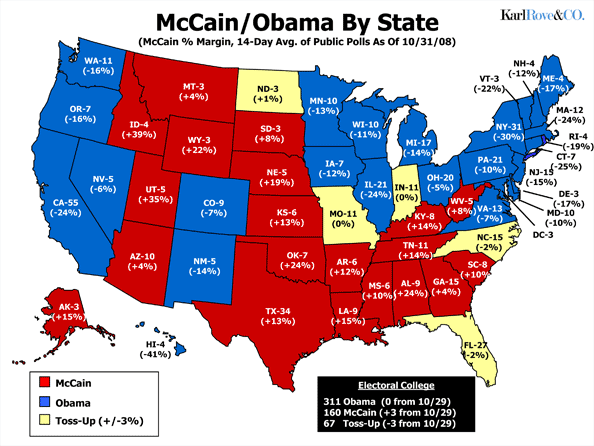
As per Karl Rove’s electoral map, even with McCain getting all the toss-up and close states in which Obama has not broken 50%, the only path to victory for McCain has to include Pennsylvania. On the never say die part of the argument, we’ll soon find out if Ed Rendell was just hamming it up or if the state really is close.

McCain’s Path to 270

160 – McCain solid
67 – Toss-ups – FL / IN / MI / NC / ND
38 – Obama in lead, but not over 50% – OH / NV / VA
—-
265
21 – Gets Pennsylvania
—-
286
– Can then afford to lose Virginia
—-
273
====

Posted in Current Affairs & History | Tagged , | Leave a comment

Elections and All Souls Day

Believe it or not, there is a connection.

The reason we vote on a Tuesday instead of a Monday was that prior to the 20th century, trips to vote could take up an entire day and people would begin those trips on a Sunday. The reason we vote on the first Tuesday, instead of the first Monday, is that ‘All Souls Day’ is a Holy Day of Obligation for us Catholics.

The reason elections don’t define us as Catholics is best summarized by our favorite ethernet priest–God’s sense of humor gives me wisdom through a priest who embraces the kind of cultural icons [Springsteen] I loathe–Fr Vallee:

It may be hard to get to sainthood. But I don’t believe it I quite so hard to get into heaven, thank God. My Meme was not terribly devout. She could be a very difficult sometimes. As far as I know, there are no miracles attributed to her or extraordinary acts of Christian heroism. She smoked and drank and swore a little too much – clearly I am her biological grandson. Yet for all that, she departed faithfully and, I hope and believe, rests now in the arms of Our Lord – not because she was so good but because God is so good. At the end, she recognized Our Lord, surely Our Lord recognized her. God is not looking for ways to keep us out of heaven; God is looking for ways, in spite of ourselves, to get us into heaven. For most of us, today is our feast. As Bruce Springsteen sang, “It’s hard to be a saint in the city.” Fortunately, it is not quite so difficult to be a child of God. “Grant them eternal rest. O Lord, and may perpetual light shine upon them. May their souls and the souls of all the faithful departed, through the mercy of God, rest in peace.”

The entire Homily referenced at end of post.

——————————————————–
Fr Vallee’s Homily – 11/2/08

I. “It’s hard to be a saint in the city.”
Today we celebrate the feast of All Souls, the day when we remember all of the faithful departed. I suppose that, like myself, most of you will have to settle for this day when you die. Yesterday was the feast of All Saints which, I guess, is sort of like the first string. Ah well, never mind! I am happy just to be on the team with “faithful departed.” In any event, today is the day when we remember the dead. For my part, I would like to recall my Meme, my Dad’s mom. Not a saint, I suppose. But, as you will see, faithfully departed

II. Meme story
Several years ago, my paternal Grandmother died. She died of Alzheimer’s disease. As you know, it is very terrible disease. We slowly watched her forget everything, until there was nothing left but primal desire to live. The disease, as you know, first erases short term memory and then long term memory. Pretty early on, my Meme forgot my brother and I, her grandchildren. But, for a long time she would still remember my father, her son. After a few years, she would still recognize my Dad but would call him “Joe.” Joe was my grandfather’s name. Eventually, she did not even recognize her own son. It was sad and terrible, like watching someone be erased from the inside out.

Anyhow, when the end came, Meme, was in a nursing home. She would just lie in bad all day and stare at the ceiling. She had not spoken a coherent word in over 6 months. My dad called me and said that I should go and give her last rites. When I got there, Meme was lying down flat on the bed, staring into space. I had brought communion and oils but figured that I would not need communion because she wouldn’t be able to receive. Bear in mind that my Meme had not spoken for 6 months and had not recognized me, her grandson, for years. When I walked in, something kind of scary and extraordinary happened. Meme shot up in bed, reached out, grabbed my Roman collar and started muttering in a panic. As my Dad and I listened, she was saying: “hurry up, hurry up, do it.” I did not understand what she meant. But she kept muttering, like she didn’t want to forget what she wanted. She kept saying, “Hurry up, do it.” The pyx, holding the Eucharist, was around my neck. She was staring at it and saying, “Hurry Up, Do it.” Realizing what she wanted, I went to get the Eucharist but it wasn’t easy because she wouldn’t let go of my collar. She had me by the neck, muttering intensely. I gave her communion. Instead, of saying “Amen,” she said, “you done?” I said, “yes Meme, I am done.” She then let go of my collar, lay down flat on the bed and never spoke another word to another living soul. About a week later, she died.

III. Conclusion
It may be hard to get to sainthood. But I don’t believe it I quite so hard to get into heaven, thank God. My Meme was not terribly devout. She could be a very difficult sometimes. As far as I know, there are no miracles attributed to her or extraordinary acts of Christian heroism. She smoked and drank and swore a little too much – clearly I am her biological grandson. Yet for all that, she departed faithfully and, I hope and believe, rests now in the arms of Our Lord – not because she was so good but because God is so good. At the end, she recognized Our Lord, surely Our Lord recognized her. God is not looking for ways to keep us out of heaven; God is looking for ways, in spite of ourselves, to get us into heaven. For most of us, today is our feast. As Bruce Springsteen sang, “It’s hard to be a saint in the city.” Fortunately, it is not quite so difficult to be a child of God. “Grant them eternal rest. O Lord, and may perpetual light shine upon them. May their souls and the souls of all the faithful departed, through the mercy of God, rest in peace.”
————————————————-

Posted in Catholic Faith & Inspiration | Tagged | Leave a comment

Obama: The Missing Data

OK, let the non-violent and loyal opposition begin. Here’s a list of what we don’t know, courtesy of Gateway Pundit:

  1. Occidental College records — Not released
  2. Columbia College records — Not released
  3. Columbia Thesis paper — not available, locked down by faculty
  4. Harvard College records — Not released, locked down by faculty
  5. Selective Service Registration — Not released
  6. Medical records — Not released
  7. Illinois State Senate schedule — “not available”
  8. Law practice client list — Not released
  9. Certified Copy of original Birth certificate – – Not released
  10. Embossed, signed paper Certification of Live Birth — Not released
  11. Harvard Law Review articles published — None
  12. University of Chicago scholarly articles — None
  13. Record of baptism– Not released or “not available”
  14. Illinois State Senate records–“not available”.
Posted in Current Affairs & History | Tagged , | Leave a comment

Early voting pays off for Miami

Miami goes a month without murder

All articles referenced are copied in full at end of post.
——————————————————–
Miami goes a month without murder

Posted on Sat, Nov. 01, 2008

BY DAVID OVALLE
Midnight Friday marked the end of October and the news from Miami’s homicide office was what didn’t happen.

No one was murdered.

October passed without a homicide — meaning for the first time since May 1966, an entire month went by in the city of Miami without someone succumbing violently.

”That’s an amazing thing,” said Miami Lt. John Buhrmaster, a longtime homicide investigator. “It’s a great record when people are not killing each other.”

The total actually stood at 35 days and counting. The last homicide: Sept. 26, the Overtown shooting death of Demetrius Sherman, 26.

THE STATS

Overall, Miami has notched 55 homicides in 2008. Last year, the overall number was 87.

As of late Friday, all county police agencies had logged 217 homicides.

Miami’s milestone isn’t to say detectives haven’t been working.

Homicide detectives investigate suicides, accidents and natural deaths where no doctor is available to sign a death certificate.

Just Friday, Miami’s homicide unit was tasked to investigate the deaths of three migrants who apparently drowned after jumping from a suspected smuggling ship off Virginia Key.

In Miami, they also investigate near homicides, like the Oct. 22 case of Coconut Grove bouncer Bobby Lee Porter, shot twice by his girlfriend’s brother, police say.

Two bullets pierced femoral arteries in both his legs. He lost massive amounts of blood — but Ryder Trauma Center doctors saved him.

SAVING PEOPLE

Homicide detectives credit ever-improving emergency care with saving people who, perhaps 20 years ago, might have met their demise.

”It helps us tremendously,” said Miami Cmdr. Delrish Moss, a spokesman and former homicide investigator.

“They don’t become murder victim, they become witnesses and help us get the offenders off the streets.”
————————————————-

Posted in Current Affairs & History | Tagged , , | Leave a comment

Barack Obama to personally deport Aunt

[AP-BHO Newswire] Sensing that his illegal alien aunt [Zeituni Onyango]–who has been living in public housing in Boston for at least 5 years–might be the only obstacle between him and the presidency, today Obama offered to ‘personally deport the scoundrel.’ The usually placid Obama had not been this perturbed since he disavowed the Rev Wright, about 6 weeks after he had indicated that he ‘could no more disavow the Rev Wright than he could disavow his own grandmother.’

Speaking of which, it was also revealed that the visit to his grandmother last week came perilously close to having been canceled when the campaign became aware that she had yet to pay her property taxes. However, the campaign granted the grandmother a ‘temporary waiver’ when it was discovered that the taxes were not technically late, but rather had just missed the first payment option with no interest surcharge. The terminally ill grandmother expressed appreciation for the empathy shown her by the campaign and promised that ‘it will never happen again, even if I have to sell the house or pull a Kevorkian.’ The campaign was quick to respond that Obama was only 12 years old when Kevorkian ended his first life and that his grandmother had completed a notarized DNR which the campaign filed with the FEC.

The news went from bad to worse for his ‘supposed aunt,’ Ms Zeituni Onyango. Late this afternoon an Obama legal team was dispatched to Kenya to challenge the supposed blood lineage between the two. In addition, the Obama campaign hired noted OJ Simpson attorney, Barry Scheck, to challenge any DNA connection and strongly implied that they had entire villages ready to testify as to ‘a shocking lack of probity during her fertile years, just like many of her supposed kin.’

Scheck went on the record to note, ‘the Kenyan records are just a mess, it may be 2 election cycles before we have the facts straight.’ In the meantime, all potential Obama relatives were ordered quarantined in the lovely tiny island of Cape Verde. When asked how long they would have to remain there, Scheck responded, ‘Why do you assume they would want to leave. Please don’t let your colonial mentality blind your objectivity in this issue.’ The New York Times reporter immediately apologized and performed 20 push-ups as penance. Unfortunately, it proved to be too little too late. When editors in New York learned of his insubordination, he was fired immediately and forced to pay his own way back into the US.

Posted in Random Observations | Tagged , , | Leave a comment

60 Minutes catches up to 2 Think Good

Sorry couldn’t help myself. But I did have a post on Oct 13th which identified the the Commodity Futures Modernization Act of 2000 as a prime example of both political parties being part of the problem in the financial meltdown. The idea for that post was a previous segment on 60 Minutes which focused on credit default swaps and how those instruments were at the root of the problem. So I tune to the latest 60 Minutes [on DVR of course, haven’t watched live TV since 24 was on the air] to find CBS did another segment which took a close look at the Commodity Futures Modernization Act of 2000.

The segment was fair, it didn’t try to shift political blame to any one side. Turns out what that law protected were practices which had been outlawed after the stock market crash of 1907. The Knickerbocker Trust Company was at the heart of that problem–no doubt Isiah Thomas had a hand in screwing that up as well.

All articles referenced are copied in full at end of post.
——————————————————–
60 Muntes – CBS News
The Bet That Blew Up Wall Street
Oct. 26, 2008(CBS) The world’s financial system teetered on the edge again last week, and anyone with more than a passing interest in their shrinking 401(k) knows it’s because of a global credit crisis. It began with the collapse of the U.S. housing market and has been magnified worldwide by what Warren Buffet once called “financial weapons of mass destruction.”

They are called credit derivatives or credit default swaps, and 60 Minutes did a story on the multi-trillion dollar market three weeks ago. But there’s a lot more to tell.

As Steve Kroft reports, essentially they are side bets on the performance of the U.S. mortgage markets and the solvency on some of the biggest financial institutions in the world. It’s a form of legalized gambling that allows you to wager on financial outcomes without ever having to actually buy the stocks and bonds and mortgages.

It would have been illegal during most of the 20th century, but eight years ago Congress gave Wall Street an exemption and it has turned out to be a very bad idea.

While Congress and the rest of the country scratched their heads trying to figure out how we got into this mess, 60 Minutes decided to go to Frank Partnoy, a law professor at the University of San Diego, who has written a couple of books on the subject.

Ask to explain what a derivative is, Partnoy says, “A derivative is a financial instrument whose value is based on something else. It’s basically a side bet.”

Think of it for a moment as a football game. Every week, the New York Giants take the field with hopes of getting back to the Super Bowl. If they do, they will get more money and glory for the team and its owners. They have a direct investment in the game. But the people in the stands may also have a financial stake in the ouctome, in the form of a bet with a friend or a bookie.

“We could call that a derivative. It’s a side bet. We don’t own the teams. But we have a bet based on the outcome. And a lot of derivatives are bets based on the outcome of games of a sort. Not football games, but games in the markets,” Partnoy explains.

Partnoy says the bet was whether interest rates were going to go up or down. “And the new bet that arose over the last several years is a bet based on whether people will default on their mortgages.”

And that was the bet that blew up Wall Street. The TNT was the collapse of the housing market and the failure of complicated mortgage securities that the big investment houses created and sold around the world.

But the rocket fuel was the trillions of dollars in side bets on those mortgage securities, called “credit default swaps.” They were essentially private insurance contracts that paid off if the investment went bad, but you didn’t have to actually own the investment to collect on the insurance.

“If I thought certain mortgage securities were gonna fail, I could go out and buy insurance on them without actually owning them?” Kroft asks Eric Dinallo, the insurance superintendent for the state of New York.

“Yeah,” Dinallo says. “The irony is, though, you’re not really buying insurance at that point. You’re just placing the bet.”

Dinallo says credit default swaps were totally unregulated and that the big banks and investment houses that sold them didn’t have to set aside any money to cover their potential losses and pay off their bets.

“As the market began to seize up and as the market for the underlying obligations began to perform poorly, everybody wanted to get paid, had a right to get paid on those credit default swaps. And there was no ‘there’ there. There was no money behind the commitments. And people came up short. And so that’s to a large extent what happened to Bear Sterns, Lehman Brothers, and the holding company of AIG,” he explains.

In other words, three of the nation’s largest financial institutions had made more bad bets than they could afford to pay off. Bear Stearns was sold to J.P. Morgan for pennies on the dollar, Lehman Brothers was allowed to go belly up, and AIG, considered too big to let fail, is on life support to thanks to a $123 billion investment by U.S. taxpayers.

“It’s legalized gambling. It was illegal gambling. And we made it legal gambling…with absolutely no regulatory controls. Zero, as far as I can tell,” Dinallo says.

“I mean it sounds a little like a bookie operation,” Kroft comments.

“Yes, and it used to be illegal. It was very illegal 100 years ago,” Dinallo says.

In the early part of the 20th century, the streets of New York and other large cities were lined with gaming establishments called “bucket shops,” where people could place wagers on whether the price of stocks would go up or down without actually buying them. This unfettered speculation contributed to the panic and stock market crash of 1907, and state laws all over the country were enacted to ban them.

“Big headlines, huge type. This is the front page of the New York Times,” Dinallo explains, holding up a headline that reads “No bucket shops for new law to hit.”

“So they’d already closed up ’cause the law was coming. Here’s a picture of one of them. And they were like parlors. See,” Dinallo says. “Betting parlors. It was a felony. Well, it was a felony when a law came into effect because it had brought down the market in 1907. And they said, ‘We’re not gonna let this happen again.’ And then 100 years later in 2000, we rolled them all back.”

The vehicle for doing this was an obscure but critical piece of federal legislation called the Commodity Futures Modernization Act of 2000. And the bill was a big favorite of the financial industry it would eventually help destroy.

It not only removed derivatives and credit default swaps from the purview of federal oversight, on page 262 of the legislation, Congress pre-empted the states from enforcing existing gambling and bucket shop laws against Wall Street.

“It makes it sound like they knew it was illegal,” Kroft remarks.

“I would agree,” Dinallo says. “They did know it was illegal. Or at least prosecutable.”

In retrospect, giving Wall Street immunity from state gambling laws and legalizing activity that had been banned for most of the 20th century should have given lawmakers pause, but on the last day and the last vote of the lame duck 106th Congress, Wall Street got what it wanted when the Senate passed the bill unanimously.

“There was an awful lot of, ‘Trust us. Leave it alone. We can do it better than government,’ without any realistic understanding of the dangers involved,” says Harvey Goldschmid, a Columbia University law professor and a former commissioner and general counsel of the Securities and Exchange Commission.

He says the bill was passed at the height of Wall Street and Washington’s love affair with deregulation, an infatuation that was endorsed by President Clinton at the White House and encouraged by Federal Reserve Chairman Alan Greenspan.

“That was the wildest and silliest period in many ways. Now, again, that’s with hindsight because the argument at the time was these are grownups. They’re institutions with a great deal of money. Government will only get in the way. Fears it will be taken overseas. Leave it alone. But it was a wrong-headed argument. And turned out to be, of course, extraordinarily unwise,” Goldschmid says.

Asked what role Greenspan played in all of this, Professor Goldschmid says, “Well, he made clear in his public speeches and book that a Libertarian drive was part of the way he looked at the world. He’s a very talented man. But that didn’t take us where we had to be.”

“Alan was the most powerful man in Washington in a real sense. Certainly a rival to the president and had enormous influence on Capitol Hill,” Goldschmid says,

“And he was at the height of his power,” Kroft adds.

Within eight years, unregulated derivatives and swaps helped produce the largest financial services economy the United States has ever had. Estimates of the market for credit default swaps grew from $100 billion to more than $50 trillion, and you could bet on anything from the solvency of communities to the fate of General Motors.

It also produced a huge transfer of private wealth to Wall Street traders and investment bankers, who collected billions of dollars in bonuses. A lot of the money was made financing what seemed to be a never-ending housing boom, selling mortgage securities they thought were safe and credit default swaps that would never have to be paid off.

“The credit default swaps was the key of what went wrong and what’s created these enormous losses,” Goldschmid says.

“Is it your impression that people at the big Wall Street investment houses knew what was going on and knew the kind of risks that they were exposed to?” Kroft asks.

“No. My impression is to the contrary, that even at senior levels they only vaguely understood the risks. They only vaguely followed what was going on,” Goldschmid says. “And when it tumbled, there was some genuine surprise not only at the board level where there wasn’t enough oversight but at senior management level.”

They didn’t know what was going on in part because credit default swaps were totally unregulated. No one knew how many there were or who owned them. There was no central exchange or clearing house to keep track of all the bets and to hold the money to make sure they got paid off. Eventually, savvy investors figured out that the cheapest, most effective way to bet against the entire housing market was to buy credit defaults swaps, in effect taking out inexpensive insurance policies that would pay off big when other people’s mortgage investments went south.

“I know people personally who have taken away more than $1 billion from having been on the right side of these transactions,” says Jim Grant, publisher of Grant’s Interest Rate Observer and one of the country’s foremost experts on credit markets.

“If you can and you could lay down cents on the dollar to place a bet on the solvency of Wall Street, for example, as some did, when Wall Street became evidently insolvent, that cents on the dollar bet went up 30, 40, and 50 fold. Not everyone who did that wants to get his name in the paper. But there are some spectacularly rich people who came out of this,” Grant says.

“Who got richer,” Kroft remarks.

“Who got richer, who became, you know, fantastically richer,” Grant says.

A lot of them were hedge fund managers. John Paulson’s Credit Opportunities Fund returned almost 600 percent last year, with Paulson pocketing a reported $3.7 billion.

Bill Ackman, of Pershing Square Capital Management, said he plans to make hundreds of millions. Both declined 60 Minutes’ request for an interview.

Congress now seems shocked and outraged by the consequences of its decision eight years ago to effectively deregulate swaps and derivatives. Various members of the House and Senate have hauled in the usual suspects to accept or share the blame.

“Were you wrong?” Rep. Henry Waxman asked former Federal Reserve Chairman Greenspan.

“Credit default swaps, I think, have some serious problems with them,” Greenspan replied.

It appears to be the first step in a long process of restoring at least some of the regulations and safeguards that might have prevented, or at least mitigated this disaster after the damage has already been done.

Where do we go from here?

“We need the most dramatic rethinking of the regulatory scheme for financial markets since the New Deal. If anything has demonstrated that imperative, it’s the economy right now and the tragic circumstances we’re in,” Goldschmid says.

Asked how much danger he thinks is still out there, Goldschmid says, “We don’t know. Part of the problem of the lack of transparency in these – in these markets has been we don’t really know.”

Produced by L. Franklin Devine and Jennifer MacDonald
© MMVIII, CBS Interactive Inc. All Rights Reserved.
————————————————-

Posted in Current Affairs & History, Entertainment | Tagged , , | Leave a comment

Obama Aunt in Section 8 Housing

U.S. Senator Barack Obama–whose Senate salary was bolstered by an almost 2 million dollar book deal advance in 2005–has raised over $600 million dollars in his bid for the presidency. Part of his desire to be president is rooted in his goal to ‘spread the wealth around.’

U.S. Senator Barack Obama has an Aunt who has been living in Public Housing in Boston for at least the past 5 years. ‘Aunti Zeituni’ is not some faceless charity he never got around to writing a check for, she might be his only remaining blood connection to his father.

How did this information appear? Don’t get your hopes up MSM-denizens, it was due to a London newspaper which had the gall to do some reporting.

Does anyone see a problem with those two set of facts? If his positions and ‘desires’ are to be taken at face value, why shouldn’t the above facts raise doubts about the candidate’s sincerity?

One thing it does do, it takes the isolated fact that before his presidential run, the Obama’s donated less than 1% of their earnings to charity and makes it a pattern of a lack of generosity. Which is not a big deal in it of itself, but it does make the ‘caring leader’ facade that much less believable.

It also gives his idea of ‘spreading the wealth around’ a more exact meaning, it clearly does not apply to his wealth. Otherwise, he would have done so outside of the presidential spotlight with charities and within his own family.

All articles referenced are copied in full at end of post.
——————————————————–
Boston Housing Authority ‘flabbergastered’ Barack Obama’s aunt living in Southie

Jessica Fargen By Jessica Fargen
Friday, October 31, 2008 – Updated 16h ago

General Assignment Reporter

A Boston Housing Authority director says Barack Obama’s aunt, a Kenyan woman who has lived in public housing for five years, is an “exemplary resident” and only recently did anyone know of her connection to the presidential contender.

Obama’s campaign spokesman Reid Cherlin confirmed to the Herald yesterday that Zeituni Onyango, 56, who lives on Flaherty Way in South Boston, is Obama’s aunt on his father’s side.

Onyango, a Kenyan native, is believed to be the “Aunti Zeituni” in Obama’s memoir, “Dreams From My Father.”

It wasn’t until recently, when a London newspaper started making inquiries about Onyango, that Deputy Director Bill McGonagle learned of the link.

McGonagle said BHA employees were caught off guard.

“We were as surprised as anyone,” he said. “We were a little bit flabbergasted.”

Onyango has lived in Boston public housing for five years, McGonagle said.

“She has been an exemplary resident,” he said.

She received a small stipend over the past year for working six hours a week as a volunteer resident health advocate in her complex, he said.

Little else is known about her.

Onyango had conversations with several BHA employees in recent days about her blood ties to the senator, McGonagle said. She proudly displays photos of Obama, including some that appear as old as 25 years, inside her first-floor apartment, McGonagle said.

A message left at Onyango’s apartment was not returned.

McGonagle asked that the media respect Onyango’s privacy.

“She is feeling very put upon,” he said.
jfargen@bostonherald.com
——————————————————
Donation-heavy Obama on track to outspend McCain as campaign winds down
Obama raised $36 million in the first half of October, more evidence that he made the correct decision when he opted out of taking federal funds for the general election campaign.
By Dan Morain

October 24, 2008

Barack Obama disclosed Thursday that he raised $35.9 million in the first 15 days of October, after a jaw-dropping $150 million in September.

Although his fundraising pace slowed, Obama’s September-October surge all but guarantees that he will outspend John McCain and the Republican National Committee in the closing days of the 2008 presidential campaign.

The latest fundraising numbers provide further evidence that Obama made the correct decision when he opted not to take federal funds for the general election campaign, instead relying on his ever-growing donor base of more than 3 million — whose average donation size is $86.

McCain, by contrast, accepted a federal grant of $84.1 million. That money must last from the beginning of September through Nov. 4, although the RNC also can raise money and spend it on his behalf.

Obama and the Democratic National Committee are poised to outspend McCain by as much as a 3-2 margin, the nonpartisan Campaign Finance Institute concluded.

Obama and the DNC spent $134.1 million in September, far more than the $108.6 million spent by McCain and the RNC.

In the first 15 days of October, Obama and the DNC spent a combined $117.6 million. That compares with $67 million by McCain and the RNC.

Obama had $65.7million in the bank for the final three weeks of the campaign, plus a combined $30 million held by the DNC and a separate committee that Obama and the DNC control.

McCain and the RNC entered the campaign’s final three weeks with a combined $84.4 million in the bank. The RNC raised what was, for it, a record $66 million in September, but failed to maintain that pace in the first half of October, when it raised $27 million.

McCain and Obama continued to use a legal loophole that allowed them to raise money for party committees far in excess of the $4,600 maximum that individual donors can give to their presidential accounts.

The RNC drew $2.6 million in donations of $10,000 or more, including $28,500 from Facundo and Elizabeth Bacardi, the rum producers.

Obama, using a so-called joint fundraising committee, raised more than $9.9 million in donations of $10,000 or more, including $30,800 each from Sam and Tillie Walton of the Wal-Mart fortune. Jerry Yang, head of Yahoo, also donated $30,800.

Producer Jeffrey Katzenberg, wife Marilyn and their daughter, Laura, each donated $28,500. Producer Steven Spielberg and his wife, Kate Capshaw, also donated $28,500 each.

Obama raised $18,500 from professional poker player Howard Lederer and the same amount from Lederer’s wife, Susan, who listed her occupation as casino pit manager at the Bellagio in Las Vegas.

Morain is a Times staff writer.

dan.morain@latimes.com
————————————————-

Posted in Current Affairs & History | Tagged | Leave a comment

Alphonso Rachel

The best lines, and they’re a lot of them, from Alphonso Rachel:

  • [4:30] Democrats farming votes.
  • [5:30] Why buckets of crabs don’t have lids.
  • [5:55] ‘The price that John McCain paid for his country, Democrats can’t even pay the taxes on that service.’
  • [7:30] Hollywood liberals.

Video link Alphonso Rachel.

Posted in Random Observations | Tagged | Leave a comment