A Few Observations #1

From Bernard Golberg’s blog:

Did you hear the one about how President Obama, upon taking office, learned that the economy was in even worse shape than he thought – so in order to save money, he had to fire 17 journalists.

From Jorge Costales:

If someone had done in the Tour de France what Cliff Lee is doing in the MLB playoffs, they would have required a blood transfusion to compensate for all the blood and urine tests he would have been subjected to.

About Catholic Squirrels:

There were four country churches in a small Texas town: Presbyterian, Baptist, Methodist and Catholic. Each church was overrun with pesky squirrels.
One day, the Presbyterian Church called a meeting to decide what to do about the squirrels. After much prayer and consideration they determined that the squirrels were predestined to be there and they shouldn’t interfere with God’s divine will.

In the Baptist Church the squirrels had taken up habitation in the baptistry. The deacons met and decided to put a cover on the baptistry and drown the squirrels in it. The squirrels escaped somehow and next week there were twice as many there.

The Methodist Church got together and decided that they were not in a position to harm any of God’s creation. So, they humanely trapped the squirrels and set them free a few miles outside of town. Three days later, the squirrels were back.

But the Catholic Church came up with the best and most effective solution. They baptized the squirrels and registered them as members of the church. Now they only see them on Christmas and Easter.

From a 10/29/09 WSJ Editorial regarding the federal first-time home-buyer tax credit:

It’s hard not to laugh when viewing the results of the federal first-time home-buyer tax credit. The credit, worth up to $8,000 for the purchase of a home, has only been available since April of last year. Yet news of the latest taxpayer-funded mortgage scam has traveled fast. The Treasury’s inspector general for tax administration, J. Russell George, recently told Congress that at least 19,000 filers hadn’t purchased a home when they claimed the credit. For another 74,000 filers, claiming a total of $500 million in credits, evidence suggests that they weren’t first-time buyers.

As a “refundable” tax credit, it guarantees the claimants will get cash back even if they paid no taxes. A lack of documentation requirements also makes this program a slow pitch in the middle of the strike zone for scammers. The Internal Revenue Service and the Justice Department are pursuing more than 100 criminal investigations related to the credit, and the IRS is reportedly trying to audit almost everyone who claims it this year.

The program is set to expire at the end of November, so naturally given its record of abuse, Congress is preparing to extend it.

Posted in Random Observations | Tagged , , , | Leave a comment

Government Promise [Un]Keepers

Below is a post practically unchanged from Greg Mankiw’s blog. The shock about what the government has done with GM is not that it failed to do what it promised. It’s that they failed — in staying out of business decisions — immediately.

President Obama’s remarks on General Motors restructuring, given on June 1, 2009:

What we are not doing — what I have no interest in doing — is running GM. GM will be run by a private board of directors and management team with a track record in American manufacturing that reflects a commitment to innovation and quality. They — and not the government — will call the shots and make the decisions about how to turn this company around.

WSJ article dated 10/30/09 on how one dealership avoided shutdown. Hint: it had nothing to do with business decisions.

In May, even before the government’s ownership became official, lawmakers erupted when GM disclosed it planned to produce a new subcompact car at its factories in China. Under congressional pressure, GM dropped those plans and promised instead to retool an existing U.S. facility in Michigan, Wisconsin or Tennessee for the new model.

Lawmakers from those states demanded and received high-level meetings in Washington to quiz GM on the criteria for site selection and to tout their states. GM in the end picked a site in Michigan.

That same month, GM dealer Pete Lopez in Spencer, W.Va., received notice that GM was giving him just over a year to shut down his Chevy, Pontiac and Buick dealership, which he’d acquired two years earlier. GM’s move to shutter more than 1,300 dealerships — about one-quarter of its network — was central to its restructuring because it cleared out underperforming showrooms and brought the network more in line with its shrunken sales.

With an assist from his mayor, Mr. Lopez took his complaint straight to one of his state’s senators, Jay Rockefeller, the Democratic chairman of the powerful Commerce Committee.

Sen. Rockefeller sent a letter to GM headquarters on Mr. Lopez’s behalf, according to a staff aide. He arranged for Mr. Lopez to come testify before a Senate panel in early June, alongside GM Chief Executive Frederick “Fritz” Henderson. The senator introduced the two men, giving Mr. Lopez a chance to make a personal pitch.

“He couldn’t have been nicer,” Mr. Lopez said of the GM CEO. “He said to me, ‘We’ve made some quick decisions and now we’re going to look it all over again.’ “

The GM chief executive put Mr. Lopez in touch with Mark LaNeve, then the company’s top official for North American sales. The dealer received a response on the last Saturday in June while fishing on a lake near his house.

“Mr. LaNeve called and said, ‘I’ve got some good news for you. We’re going to save your dealership,’ ” Mr. Lopez recalls. He says he owes it all to Sen. Rockefeller.

Where is the fig leaf of pretense? ‘I don’t need no stinking fig leaf,’ the man-child is rumored to have said.

Tagged | Leave a comment

Bob Griese: Worthy Role Model

It is unfortunate to watch someone who has had such a distinguished career — as an athlete, broadcaster and leader in his community — be subjected to the type of hypocritical — in that no one really believes he is guilty of the type of beliefs that would justify a suspension — news cycle reporting Bob Griese’s name will be exposed to over the next few weeks. Griese is only guilty of a bad joke in my opinion. One can only hope that if Dante ever issues a revised edition of Inferno, a special ring will be reserved for practitioners of political correctness.

Bob Griese was my sports hero growing up and that makes me pretty lucky. Given that my hero selection process was not exactly a rigorous one, whoever was the Miami Dolphins quarterback was the likely front runner. That he would lead ‘our’ Dolphins to 2 NFL championships during his HOF career turns out to have just been an appetizer. As a young and maturing adult, I had the additional good fortune that my childhood hero continued to be someone I could look up to. He was a solid and involved citizen who carried himself with class and integrated himself into our Miami community in all sorts of ways, most prominently as part of the Orange Bowl Committee, but also when his son Brian attended the local Catholic high school championed by the working class in Miami, Columbus, as opposed to the more elite, not to insinuate effete, Belen.

This one may be hard to explain to outsiders, but as a Cuban-American, I believe that having people like Bob Griese and Don Shula — Evansville and Cleveland, Purdue and Baltimore — so closely associated and obviously admired in our community, helped to legitimize what the rest of the country, especially those who followed sports, thought of our city. As I got older, their involvement and identification as Catholics further added to my appreciation of them. To put it in financial terms, the role models I ‘selected’ in my teens, continued to appreciate in value and paid dividends throughout. How are yours doing?

But as a sports fan, what I came to most enjoy about Bob Griese’s career did not even occur while watching him play in our beloved Orange Bowl — although the victory over the Colts in the 1971 AFC championship game came close. It actually occurred at a no longer in existence public library in Bayfront Park. The revelation came as I was leafing through old Sports Illustrated magazines during my lunch break from being a teller at Southeast Bank in downtown Miami. The revelation was that Bob Griese had a performance against Notre Dame on September 25, 1965 that can only have been had by … a great athlete!

Why was this a revelation? A little context. When the Dolphins were at their best, the passing game was secondary. Griese, who early in his career scrambled out of necessity, began to be more careful and was criticized at times for running out of bounds and avoiding unnecessary hits [See Ted Ginn, some things never change about sports fans]. Griese came to be seen as more of a caretaker than a great athlete. I remained faithful of course, but what I learned that day [we’re talking 1979] was great ammunition which I used mercilessly on the uninformed infidels who would pull the ‘Griese was soft’ line on me going forward.

This from the Sports Illustrated article by Dan Jenkins — please, please appreciate the writing which I think is comparable to the Updike article on Ted Williams:

Purdue University is the Big Ten’s contribution to ethnic jokes. It is a pile of engineering textbooks, asphalt, and dull-red buildings on the plain of West Lafayette, Ind., and through the years its football players have been referred to as Rail Splitters, Pumpkin Shuckers, Cedar Choppers, Blacksmiths, Hayseeds, Cornfield Sailors and—curtain, please—Boilermakers. For a moment, consider the term Boilermakers, a derisive name Purdue liked and adopted officially. Does a Boilermaker sound like the kind of a guy you would want your sister to date? Does he sound like fun? He’s got to drive a beat-up ’57 Buick, come from a family of 14 in Gary and spend most of his time breathing rivet dust. Yeah, yeah, he’ll study for you and maybe he’ll become an astronaut—big deal—but he couldn’t do the jerk if he loaded up on Dexies, he couldn’t find Chez Paul in Chicago with a compass and he’d stumble on a carpet. Naw, man. To have any class you’ve got to come from a cooled-out school like Michigan or Wisconsin or Northwestern. Purdue? Man, Purdue is like Iowa. After all, how many Boilermakers do you know who can chew gum and walk at the same time?

Well, as of last Saturday, there was at least one. His name is Bob Griese and he may be a farm-type boy from Evansville, and he might have made the terrible social mistake of going to Purdue, but in playing No. 1-ranked Notre Dame he was outlined against the pale-blue September sky so dramatically that 61,921 people suffered hysterical seizures, and there was one in a group of frantic, shocked sportswriters who became so deadline-destitute that he labeled Griese the Lone Horseman “riding into the Valley of Death.” Griese had that kind of day. He brought out the Apocalypse in you.

Passing, running, kicking and thinking, Griese whooshed out the candlelight that Grantland Rice promised (in the second and unremembered paragraph of his famous Four Horseman story) would “always gleam through the Indiana sycamores” in South Bend. And it would have taken all of the literary fame of the Four Horsemen, Knute Rockne’s intensity, Frank Leahy’s shrewdness, The Gipper’s devotion, Johnny Lujack’s cunning and a whole Golden Dome full of Nick Eddys and Bill Wolskis to have kept Bob Griese (pronounced greasy) from upsetting the Irish 25-21. It is awfully difficult even now, after digesting all of the statistical goodies and recovering from the monotonous heroism of the afternoon, to remember a more brilliant performance by a quarterback against such superb collegiate opposition.

Unless you were present in Purdue’s Ross-Ade Stadium, you cannot really know what Griese did, for surely the radio broadcast was an excusable exercise in outrageous babble. It takes a summing-up to capture the true potency of the performance. For example, Griese did complete a noteworthy 19 of 22 passes for 283 yards and three touchdowns and set up the fourth (and winning) score with his passes. But he also ran nine times for an average of five yards per carry, exclusive of a couple of losses on passing tries. These were clutch-keepers—sharp, darting runs necessary to sustain drives. Griese punted three times—high, accurately and deliberately short—to the Notre Dame six-, seven- and 26-yard lines. He kicked off three times, always deep enough, and on one of the returns, in an unexpected moment of agonizing excitement, he made a touchdown-saving tackle on Wolski.

The Notre Dame halfback, who had sprinted 54 untouched yards for one touchdown, blazed through a cluster of black-shirted Purdue tacklers, burst clear after 40 yards and appeared gone. But Griese, scrambling up from a block, lunged and caught Wolski’s ankle, spilling him from a desperate angle.

Griese did all of these things in a game so full of thrills it would have wrecked an IBM computer. It was a game that produced 726 yards of combined total offense between old, old, disrespectful rivals that were rated after last week’s opening games first and sixth in the national polls. It was a game that saw a total of 37 different running, passing and returning plays gain more than 10 yards each, often more. And this figure does not include two touchdown runs of short yardage that were more important than the 37 plays and a late, apparent game-winning Notre Dame field goal that bounced—bounced, mind you—over the crossbar, causing Coach Ara Parseghian to jump around like a man with a scorpion in his pants. It was a game in which the lead changed hands five times, with Notre Dame taking it first 3-0, Purdue going ahead 6-3, Notre Dame coming back 10-6, Purdue rallying 12-10 then building to 18-10, Notre Dame tying it up 18-18 then assuming the lead again 21-18 and with Purdue, just four minutes short of the end, coming back once more with a stunning drive to win.

If the type of people I’ve heard through the years criticize Griese ever had a day like that, even in a pickup game, they would never have shut up about it. It gets even more impressive. Aside from being a 2-time All-American [in 1965 with Howard Twilley and 1966 with Larry Csonka] in football, he pitched on the baseball team [one year going 12-1] and was a guard on the basketball team. Folks this is not high school, a 3-sport star at a Big Ten college! Now that you know that, you do what you like with the rest of the story.

So you’ll forgive me if you see me walking around with only one shoe during the next few weeks, I may have just been exposed to some ESPN news flash.

The Dan Jenkins SI article referenced is copied in full at end of post.


—————————————————————————-
Oh, That Griese Kid Stuff! by Dan Jenkins – October 04, 1965

Purdue’s Bob Griese—running, passing, punting and tackling—was too slick for Notre Dame last week, as he led the Boilermakers to a last-minute win in a game that saw the lead change hands five times

Purdue University is the Big Ten’s contribution to ethnic jokes. It is a pile of engineering textbooks, asphalt, and dull-red buildings on the plain of West Lafayette, Ind., and through the years its football players have been referred to as Rail Splitters, Pumpkin Shuckers, Cedar Choppers, Blacksmiths, Hayseeds, Cornfield Sailors and—curtain, please—Boilermakers. For a moment, consider the term Boilermakers, a derisive name Purdueliked and adopted officially. Does a Boilermaker sound like the kind of a guy you would want your sister to date? Does he sound like fun? He’s got to drive a beat-up ’57 Buick, come from a family of 14 in Gary and spend most of his time breathing rivet dust. Yeah, yeah, he’ll study for you and maybe he’ll become an astronaut—big deal—but he couldn’t do the jerk if he loaded up on Dexies, he couldn’t find Chez Paul in Chicago with a compass and he’d stumble on a carpet. Naw, man. To have any class you’ve got to come from a cooled-out school like Michigan or Wisconsin or Northwestern. Purdue? Man, Purdue is like Iowa. After all, how many Boilermakers do you know who can chew gum and walk at the same time?

Well, as of last Saturday, there was at least one. His name is Bob Griese and he may be a farm-type boy from Evansville, and he might have made the terrible social mistake of going to Purdue, but in playing No. 1-ranked Notre Dame he was outlined against the pale-blue September sky so dramatically that 61,921 people suffered hysterical seizures, and there was one in a group of frantic, shocked sportswriters who became so deadline-destitute that he labeled Griese the Lone Horseman “riding into the Valley of Death.” Griese had that kind of day. He brought out the Apocalypse in you.

Passing, running, kicking and thinking, Griese whooshed out the candlelight that Grantland Rice promised (in the second and unremembered paragraph of his famous Four Horseman story) would “always gleam through the Indiana sycamores” in South Bend. And it would have taken all of the literary fame of the Four Horsemen, Knute Rockne’s intensity, Frank Leahy’s shrewdness, The Gipper’s devotion, Johnny Lujack’s cunning and a whole Golden Dome full of Nick Eddys and Bill Wolskis to have kept Bob Griese (pronounced greasy) from upsetting the Irish 25-21. It is awfully difficult even now, after digesting all of the statistical goodies and recovering from the monotonous heroism of the afternoon, to remember a more brilliant performance by a quarterback against such superb collegiate opposition.

Unless you were present in Purdue’s Ross-Ade Stadium, you cannot really know what Griese did, for surely the radio broadcast was an excusable exercise in outrageous babble. It takes a summing-up to capture the true potency of the performance. For example, Griese did complete a noteworthy 19 of 22 passes for 283 yards and three touchdowns and set up the fourth (and winning) score with his passes. But he also ran nine times for an average of five yards per carry, exclusive of a couple of losses on passing tries. These were clutch-keepers—sharp, darting runs necessary to sustain drives. Griese punted three times—high, accurately and deliberately short—to the Notre Dame six-, seven- and 26-yard lines. He kicked off three times, always deep enough, and on one of the returns, in an unexpected moment of agonizing excitement, he made a touchdown-saving tackle on Wolski.

The Notre Dame halfback, who had sprinted 54 untouched yards for one touchdown, blazed through a cluster of black-shirted Purdue tacklers, burst clear after 40 yards and appeared gone. But Griese, scrambling up from a block, lunged and caught Wolski’s ankle, spilling him from a desperate angle.

Griese did all of these things in a game so full of thrills it would have wrecked an IBM computer. It was a game that produced 726 yards of combined total offense between old, old, disrespectful rivals that were rated after last week’s opening games first and sixth in the national polls. It was a game that saw a total of 37 different running, passing and returning plays gain more than 10 yards each, often more. And this figure does not include two touchdown runs of short yardage that were more important than the 37 plays and a late, apparent game-winning Notre Dame field goal that bounced—bounced, mind you—over the crossbar, causing Coach Ara Parseghian to jump around like a man with a scorpion in his pants. It was a game in which the lead changed hands five times, with Notre Dame taking it first 3-0, Purdue going ahead 6-3, Notre Dame coming back 10-6, Purdue rallying 12-10 then building to 18-10, Notre Dame tying it up 18-18 then assuming the lead again 21-18 and with Purdue, just four minutes short of the end, coming back once more with a stunning drive to win.

Purdue plays this kind of game a lot, although it is not always as flamboyant in winning. Back in 1945, when Assistant Coach Bob DeMoss, who put in Griese’s pass patterns, was the quarterback, he shot down an Ohio State team that was ranked No. 1. In 1950 it was a Purdue passer named Dale Samuels who broke Notre Dame’s 39-game winning streak on a day South Bend Publicist Charlie Callahan likes to call “the day Notre Dame lost.” And then in 1953 the Boilermakers snapped No. 1 Michigan State’s 28-game streak. And if no one else does, Terry Brennan will remember that Len Dawson and Purdue cost him a perfect season in 1954, his first year as Notre Dame coach.

But there are two big differences between those Purdue teams and this one. This one has Griese, and Griese has a splendid team with him. If Purdue can just avoid the upset itself (which it never has) the Boilermakers will finally get to see for themselves whether the Rose Bowl looks like it does on the postcards. Purdue, in fact, probably is stronger than even Coach Jack Mollenkopf knows.

“It’s true that we have more variety than we’ve ever had because Griese can do so many things well, and he’s smart enough to call 95% of the plays,” said Mollenkopf after the game. “And we began this season thinking about winning the Big Ten championship instead of beating Notre Dame. But we’ve got a lot of tough ones ahead [Iowa, Michigan, Michigan State] and we’re sure not going to surprise anybody now.”

Mollenkopf is being his usual cautious self. Purdue will go to the Rose Bowl if it plays up to its capabilities. The team is so talented that every break had to go against it to keep the Notre Dame game even. Were it not for the luxuries of a couple of defensive naps, the score against the Irish would have been something preposterous—say, 32-7. At least four times, perhaps more, Purdue Halfback Gordon Teter, who twisted over for the winning touchdown, came within a half step of breaking for a big gain, and few teams have anyone capable of catching the 183-pound senior. He is a tough, smart runner with quick moves and the bounce-up spirit of a sophomore.

Two other times Griese’s favorite passing target, Split End Bob Hadrick (8 for 113 yards), slipped down, after subtle, dazzling moves that thrust him into the open. Hadrick is 6 feet 2, weighs 195, catches anything near him and reminds you of a Raymond Berry who has speed. Three nights a week, all summer long, Griese and Hadrick played catch, while Purdue’s engineers grew beards and read books. Consequently, the two know one another pretty well. But while Hadrick’s moves confused Notre Dame’s experienced secondary, led by a usually competent Nick Rassas at safety, a Purdue sophomore named Jim Beirne popped up from tight end to make Parseghian’s defense, talk of the college community last year, look downright foolish.

On Purdue’s first touchdown, a 28-yard pass from Griese to Beirne, all three Notre Dame defenders had their backs turned—and Beirne was 12 yards behind them. “I had Rassas beat so good I thought he was gonna grab my arm, but he didn’t. Then I saw that empty grass, and the ball came, and I thought, ‘don’t drop it in front of all these people.’ ”

Later Beirne beat Rassas by a good step at the goal line to catch a 14-yard pass from Griese that put Purdue ahead again. This was one of only two passes that a Purdue player had to struggle to grab. Beirne stretched forward as he was cutting across to his right and fell with the ball. Griese, who is extremely accurate with a fast delivery—and says playing guard on the varsity basketball team helped him get that way—threw only one ball that was more than a stride off target. It was intercepted, but just before Griese got rid of the ball a Notre Dame lineman slapped his arm.

Griese threw his third scoring pass to Halfback Randy Minnear. Again the secondary was beaten by 10 yards, as Griese sent two men wide and put a halfback in motion. The Irish were scurrying around in some strange 4-4 alignment (Teter had blasted them out of their customary Split Six), and no one saw the halfback until it was too late.

“We knew we could do anything we wanted to do,” explained Griese after the game. “Rassas likes to play you tight, so we took advantage of it. Everything was open. Even after they went ahead at the last, we weren’t worried.”

Truly, Griese was not. He simply hit Halfback Jim Finley for 32 yards, Beirne for 13 and then 19, and Teter scored from the 3:67 yards in four plays and in one minute and nine seconds. Parseghian didn’t have time to think, pray, face the dome or quote Rockne.

The final irony of it all was that Griese would have preferred to have gone to Notre Dame when he finished Rex Mundi High School in Evansville. “I was eager,” he said, “but just when I was getting ready to visit the campus, one of their alumni [who had best remain anonymous forever] said they didn’t want me because I was too small. So I picked Purdue. You ought to stay in your own state, because that’s where you’ll wind up earning your living.”

Griese has reddish-blond hair in a short cut that sweeps down over his forehead as Brutus’ did, high cheek bones and a quick, easy smile. He has a typically flat Midwest accent, and the swingingest Kappa Kappa Gamma at Northwestern would have to confess that he is outdoorsy nice-looking and personable, especially for a Boilermaker.

“It was just a question of mechanics,” Griese said, as confidently as he had performed. “We’ve got a tough defense that’ll make you know we’re there [particularly against inside running, as Eddy and Wolski learned, good as they were], and the protection and the receivers are great. Hadrick is always going to be half open. And that’s comforting to know.”

Since there is not another Griese on Notre Dame’s schedule, it seems likely that its defense can be repaired and blended with the powerful rushing game to carry Ara Parseghian through to perhaps a 9-1 season and no worse than 7-3. But the upset underlined the fact that this is not Ara’s kind of team. As he said, ” Purdue has Huarte and Snow this time,” meaning Griese and Hadrick.

Parseghian’s life has changed since a year ago, even if he does not seem to sense it. He writes a syndicated column, has a TV show and is bombarded with triple the number of banquet and clinic invitations he had a year ago. He was truly worried before the Purdue game, because he knew he did not have the quick strike. He was so concerned about Purdue, in fact, that he did not appear at a Friday night smoker in the Van Orman-Fowler Hotel. Easygoing Jack Mollenkopf took advantage of his absence to plant a gentle needle. “Oh, well,” said Mollenkopf, “we didn’t really expect the Pope either.”

Purdue also knew that it did not have its usual Golden Girl to wear that brief costume and run up in the stands with her baton and make all the newspapers in a wire-service photograph. No coed qualified for the first time in 11 years under the restrictions that she must be pretty, a good twirler and, perish the thought, academic.

Last week, however, it did not matter much. The Boilermakers had a Golden Arm instead.

Find this article at:
http://sportsillustrated.cnn.com/vault/article/magazine/MAG1077732/index.htm
———————————————————————

Posted in 2TG Favorites | Tagged , , | 2 Comments

Pirate Finances – Gladwell’s Law

Malcolm Gladwell’s Law – Journalists need to have a better grasp of financial figures in order to truly understand some of their subjects.

A good place to analyze how a better understanding of finances could impact a journalist’s work is an article by Rob Biertempfel of the Pittsburgh Tribune-Review back in April 2008. As someone who was been scouring the web for clues about MLB finances for the past two years, I can tell you that this article represented a real opening in the secretive world of MLB finances. I wrote this post shortly afterwards. Mr. Biertempfel got the Pittsburgh Pirates President Frank Coonnelly to disclose the following items which few teams ever publicly admit or even discuss:

  • Amount expected to be received in Revenue Sharing for 2008 – $35 million.
  • Team had debts which exceeded $100 million and the interest payments were between $5 and $7 million yearly.
  • That the CBA language as to the use of revenue sharing monies — “to be used to improve on field performance” — would not preclude the Pirates from using those monies to pay down team debt.
  • Although Coonnelly states that the “Forbes numbers are never right,” Coonnelly does not take issue with Forbes estimate of the Pirates operating profits for 2006 [$25 million], given that he agrees that it was the “highest [operating] profit recent season” for the Pirates and that he “didn’t expect to be seeing $25 million in operating profits [in the future].”

How a financial background could have affected the questions or focus of this article.

  1. Coonelly states: “Team is paying down debt and reinvesting in the club, not spinning off money to ownership.” It matters greatly the source of the debt being paid down. If the debt being paid down was incurred as part of the purchase of the franchise, then paying down debt is an indirect way of enriching ownership.
  2. What does Mr. Coonnelly mean by ‘spinning off?’ Selling off interest in the franchise or the owners salary? What is the owners salary? Is it tied to performance [a little sarcastic in the case of the Pirates, but still a legitimate question]?
  3. Coonelly states: “When interest, taxes, depreciation and amortization are thrown into the mix, said the Pirates rank 27th in revenue.” Those non-operating expense items [interest, depreciation and amortization] would affect net income, but not revenues or even the operating profits. Forbes does not disclose net income.
  4. Given that Forbes employs the same methodology yearly, how likely is it for Forbes to have materially erred on determining operating profits in 2007, given that 2006 was accurate?
  5. The article glossed over the fact that the team purchased for $92 million in 1996 was now estimated to be worth $292 in 2008. The fact that their investment in the team had tripled in value — largely due to the fact that a new stadium was built for them with a minimal investment by the franchise [net of $14 million] — means that the team literally has been handed house [or PNC] money to play with.
  6. How reliable are Forbes estimates? The less complicated the finances of a franchise, the more accurate Forbes can be. Franchises who don’t own their RSN’s [like the Pirates and Marlins] are easier to calculate. Forbes estimate of the Marlins worth was 97% accurate when compared to the value ascribed to the franchise in the Marlins stadium agreement deal with local governments in early 2009.

OK, this is the fun part. $100 million in debt? From where?

Keep the following in mind:

  • Team purchased in 1996 for $92 million.
  • Team assumed debt from the URA totaling $29 million initially and an additional debt of $11.5 million in 2000. However, that is a debt which does not have to be repaid unless the team moves. The URA writes off roughly $2 million of that debt yearly.
  • Technically, the Pirates still have to disclose that debt on financial statements until it is actually written off, however it is clearly misleading to include that amount when disclosing debt, while ignoring the fact that the debt does not have to be repaid.
  • $100 million in debt and interest payments between $5 and $7 million would indicate that the team pays between 5 & 7% in interest rates, which is reasonable.
  • But if they are including the URA debt in the $100 million figure, then the reported $5 to $7 million in interest payments makes no sense, since the URA debt does not require interest payments. The interest is added to the principal and will be written off as well.
  • The Pirates operating profits since 1998 total $98 million. Only one year in that period showed an operating loss.
  • The Pirates net contribution towards the stadium was a net of $14 million, since naming rights were used to offset scheduled team contributions.

Bottom Line: The Pittsburgh Pirates use of revenue sharing monies to pay down team debt is very likely an indirect method of enriching ownership, when a part [or a majority] of the $100 million in debt could only have originated from the team’s purchase.

Pretend that a generous neighbor on your block gave you $10,000 yearly to “improve the look” of your home. Imagine further that you turned around and paid down the principal on your mortgage instead of fixing up your property. Could you convince that neighbor that his monies didn’t go into your pocket? If you could, you are ready to be a MLB executive.

Click on the spreadsheet to enlarge or print

The Biertempfel article referenced is copied in full at end of post.

—————————————————————————-
Profitable Pirates to pay down huge debt
By Rob Biertempfel
TRIBUNE-REVIEW
Friday, April 18, 2008

The Pittsburgh Pirates turned a profit in 2007 — the franchise’s fourth consecutive year in the black — and will do so again this year, regardless of how many games they win or lose.

Team President Frank Coonelly said the profit will be used to pay down the franchise’s debt, which will help field a better team in the future. The Pirates have endured 15 consecutive losing seasons.

According to Forbes Magazine’s annual team valuations, the Pirates’ 2007 operating income was $17.6 million. That ranks 18th among the 30 major league clubs. Forbes estimated the team’s value at $292 million, putting it at No. 28 among the 30 major league clubs.

“Their numbers are never right,” Coonelly said Thursday. “But, we are profitable.”

Coonelly said the Pirates’ actual profit is much lower, taking into account annual interest payments of “over $5 million, maybe approaching $7 million” on the franchise’s $100 million-plus in debts.

When interest, taxes, depreciation and amortization are thrown into the mix, Coonelly said the Pirates rank 27th in revenue.

The Pirates expect to receive about $35 million this year through Major League Baseball’s revenue-sharing system, Coonelly said, adding that it’s incorrect to believe that money must be used only to increase player payroll.

“The revenue-sharing plan says you have to use those proceeds to improve your performance on the field,” Coonelly said. “That’s written extraordinarily broadly, and we did that on purpose. Paying down debt can help you improve on the field. You can’t get any better while you’re taking a (huge) interest hit on all the debt you have. You can’t be building an academy in the Dominican Republic. You can’t be improving Pirate City. You can’t be spending on major league payroll.”

This year, the Pirates broke ground on a $5 million baseball academy in the Dominican. The club contributed $2 million of the $30 million necessary to renovate its spring training complex in Bradenton, Fla.

Coonelly denied that principal owner Bob Nutting is pocketing the Pirates’ profits.

“We’re paying down debt and reinvesting in the club, not spinning off money to ownership,” Coonelly said. “If the Nutting family wanted to get into a business that would just spin off money, baseball would not be that business.”

The sport is not necessarily a loser for owners, though. According to Forbes, Major League Baseball’s profits increased 7.7 percent last year to $5.5 billion. The magazine estimates the average team is worth $472 million, a one-year hike of 9.5 percent.

The Forbes estimate means former owner Kevin McClatchy’s purchase price of $92 million in 1996 was $200 million below its current value.

Where is all that money going? Not necessarily to the players. According to Forbes, player costs in Major League Baseball (salaries, bonuses and benefits) have fallen over the past five years from 66 percent of revenue to 56 percent.

In 2003, 16 teams lost money. Last year, only Toronto, Boston and the New York Yankees posted operating losses. But, Boston and New York recouped their losses with the dividends from their cable television deals.

Last year, Forbes reported the Pirates made $25.3 million profit in 2006, the year PNC Park hosted the All-Star Game.

“It was the highest-profit season in the recent past for the Pirates,” Coonelly said. “I don’t expect us to be seeing $25 million operating profits. I expect (growth), although I don’t want to promise it.”

Rob Biertempfel can be reached at rbiertempfel@tribweb.com
———————————————————————

Posted in Marlins Ballpark & Finances | Tagged , , , , , | Leave a comment

Introduction To Malcolm Gladwell’s Law

Malcolm Gladwell’s Law – Journalists need to have a better grasp of financial figures in order to truly understand some of their subjects.

In an obvious desperate attempt to push my Google Analytics Direct Traffic into the triple digit stratosphere [the 2nd generation Kardashian Zone], best-selling writer Malcolm Gladwell has recommended that young journalists be more like your humble 2 Think Good blogger. I exaggerate, but not as much as you would think. Here is the portion of the interview which addresses young journalists:

Time magazine / Alex Altman: If you had a single piece of advice to offer young journalists, what would it be?

Malcolm Gladwell: The issue is not writing. It’s what you write about. One of my favorite columnists is Jonathan Weil, who writes for Bloomberg. He broke the Enron story, and he broke it because he’s one of the very few mainstream journalists in America who really knows how to read a balance sheet. That means Jonathan Weil will always have a job, and will always be read, and will always have something interesting to say. He’s unique. Most accountants don’t write articles, and most journalists don’t know anything about accounting. Aspiring journalists should stop going to journalism programs and go to some other kind of grad school. If I was studying today, I would go get a master’s in statistics, and maybe do a bunch of accounting courses and then write from that perspective. I think that’s the way to survive. The role of the generalist is diminishing. Journalism has to get smarter.

I intend to illustrate Mr Gladwell’s point whenever possible. The complete Gladwell interview is copied in full at end of post.

—————————————————————————-
Author Interview: Malcolm Gladwell By Alex Altman
Tuesday, Oct. 20, 2009

With three best sellers to his credit, Malcolm Gladwell is one of the brightest stars in the media firmament. A British-born, Ontario-raised New Yorker staff writer and 2005 TIME 100 honoree, Gladwell’s clear prose and knack for upending conventional wisdom across the social sciences have made The Tipping Point, Blink and Outliers, as well as his lengthy magazine features on topics ranging from cool-hunting to ketchup, into must reads. His new collection of New Yorker stories, titled What the Dog Saw, hit stores Oct. 20. Gladwell talked to TIME about experimenting with public education, the flaws in corporate hiring processes and the future of journalism.

Once you pick a story topic, what’s your reporting process like?
It differs. I’m interested in placing things in a larger context and in making lateral connections. A lot of my process is informed by the notion that two mildly good stories put together sometimes equal one really good story. (Read Malcolm Gladwell’s TIME 100 bio.)

Have you ever raised an idea in one of your pieces and then later — say, when a new nugget of information emerges — realized it was off the mark?
Yeah. Or, more often, additional evidence starts to pile up and you realize you just positioned the article the wrong way. In The Tipping Point, I would write the chapter about the decline of crime in New York differently, just because we know so much more about crime than we used to.

In your last book, Outliers, you talked about how success comes not just through genetics or hard work but through context — the situations we stumble into fortuitously. Can you talk a little bit about your own lucky breaks?
I’ve had millions. I was in one of the last generations to sign on with newspapers when newspapers were still hiring lots of young people. To go to the New Yorker and get the editor I got were lucky breaks. I’m also lucky to be an outsider in America. A lot of what Americans take for granted I think of as strange and weird. I still don’t feel like I fully understand this country. (See the 100 best novels of all time.)

You’ve talked before about the deficiencies of the U.S. public-education system. If you were U.S. Secretary of Education Arne Duncan — who has about $5 billion in discretionary funding and a mandate to fix our schools — what would you do?
There’s precious little experimentation in education. Instead there seems to be a desire for greater regimentation, which I think is nonsense. I think we need to try 100 different things. If I were Arne Duncan, I’d think of myself as a venture capitalist, fund as many wacky and inventive ideas as I could, and closely monitor them to see how they worked.

I’ve always been fascinated by the idea that in inner-city schools, the thing they do best is sports. They do really, really well in sports. It’s not correct to say these schools are dysfunctional; they’re highly functional in certain areas. So I’ve always wondered about using the principles of sports in the classroom. Go same sex; do everything in teams; have teams compete with each other. I’d like to try that. I don’t know whether it will work, but it’s certainly worth a shot, and we could learn something really useful.

I’m curious about your take on the statistics revolution in baseball and, increasingly, basketball. You’ve cautioned against assessing players through measurements like height or arm strength. Some of the ideas in Blink would also seem to support old scouting models, in which you just take the guy who looks like he plays the best.
My take on it is that what you’re looking for is a balance between these two things. I remember once having a conversation with a top executive with the Toronto Raptors. I asked her about the stats revolution in basketball and she just kind of shrugged and said, “It’s interesting, and we look at those things, but you have to understand that for our purposes, it’s all [about] character.” The thing that separates players is that some have a work ethic, some don’t; some are coachable, some aren’t; some party all night, some go to bed early. From her standpoint, it’s all those intangibles. (See the top 10 non-fiction books of 2008.)

But as a society, as you’ve pointed out, we’re not very good at making these predictions. We use measurements like IQ or the SAT or the Wonderlic test, and we’re unable to determine if a budding lawyer or a budding quarterback is going to be any good. How can we get better at making predictions?
Certain kinds of predictions are impossible. If you want to find out if someone can do the job, you have to let them do the job. We should be experimenting with people too. I feel very strongly about the notion that if you want to find the best teachers, you let everybody into the profession, monitor them for two years, and then pick the 10% that are the best. That’s how you do it, and that’s completely the opposite of the way we do it now. Right now we’re acting out a fiction, which is that we can tell whether someone’s good at this enormously complex thing called teaching before they’ve ever taught.

If you had a single piece of advice to offer young journalists, what would it be?
The issue is not writing. It’s what you write about. One of my favorite columnists is Jonathan Weil, who writes for Bloomberg. He broke the Enron story, and he broke it because he’s one of the very few mainstream journalists in America who really knows how to read a balance sheet. That means Jonathan Weil will always have a job, and will always be read, and will always have something interesting to say. He’s unique. Most accountants don’t write articles, and most journalists don’t know anything about accounting. Aspiring journalists should stop going to journalism programs and go to some other kind of grad school. If I was studying today, I would go get a master’s in statistics, and maybe do a bunch of accounting courses and then write from that perspective. I think that’s the way to survive. The role of the generalist is diminishing. Journalism has to get smarter.
———————————————————————

Posted in Current Affairs & History | Tagged | Leave a comment

Yankee Pride?

When I hear ‘Yankee Pride,’ I know that I’m dealing with people having a automatic stimulus–response. A nice and round happy memory from their childhood being revived, which they now attempt to fit into the square peg which is the 2009 Yankees. While I have nothing against nostalgia, pride is not something which the 2009 Yankees are worthy of.

In fact, to quote Jack Woltz, ‘just to show you that I’m not a hard-hearted man,’ I share the following: The first book I remember loving — I was probably a 5th grader at Citrus Grove Elementary at the time — was one that covered the history of the World Series. If I try real hard, I can remember the great smell of that [it turns out] small oval library just off 22nd Avenue and NW 3rd Street. I can still remember the excitement of going back to that book again and again. Grover Cleveland Alexander, Babe Ruth, The Gas House Gang, Yogi Berra all came alive, seemingly just for me, because certainly no one around me seemed to realize the great stories that were unfolding before me. What if all those other books had stories like these? I remember desperately wanting to read faster as I kept glancing up at the clock, until finally realizing that I just would would not make it to the next World Series that day. I couldn’t believe that those Yankees kept winning year after year. I thought they were great. Then when I got home, my father was a huge Yankee fan who revered Babe Ruth and Mickey Mantle and would never forget watching Don Larsen’s perfect game in 1956. I loved the Yankees too. That was then.

Here is my best analogy to being a fan of the 2009 Yankees. An adult who has hacked his way into a fantasy baseball league intended for first graders. His dealings with the kids are best exemplified by the one transaction in which he got a kid to trade him Alex Rodriguez for Coco Crisp, since he knew the kid loved his dog named Coco. The adult wins the fantasy league and at the Chucky Cheese award ceremony, guarantees another championship the following year, taunting one of the kids who had broken down and cried.

An organization whose yearly off-season strategy is to sign the best available pitchers and hitters from the preceding year is many things, but not one worthy of the type of sentimental attachment denoted by the phrase ‘Yankee Pride.’ To equate a sentiment born of a Lou Gehrig to the current bunch of 1099 contractors occupying the jerseys is to miss the mark more egregiously than your typical MLB umpire.

To be clear — MLB needs the New York Yankees and the New York Yankees need the rest of MLB — especially those of us at the other end of the revenue spectrum – heck how many times do you really want them to play the Boston Red Sox. But MLB is much better off when their fantasy league-type strategy fails to succeed.

Ladies and Gentlemen
Meet your new 2010 Yankees
Albert Pujols and Zack Greinke!

Posted in Miami Marlins & MLB | Tagged , , , | Leave a comment

Poem From An Alzheimers Patient

I was moved by the poem copied below, from a local paper in North Carlina, on Kathy Hatfield’s blog. Ms Hatfield offers all sorts of information for caregivers dealing with patient’s with dementia. The poem:

DO NOT ASK ME TO REMEMBER.
DON’T TRY TO MAKE ME UNDERSTAND.
LET ME REST AND KNOW YOU’RE WITH ME.
KISS MY CHEEK AND HOLD MY HAND.

I’M SO CONFUSED BEYOND YOUR CONCEPT.
I AM SAD AND SICK AND LOST.
ALL I KNOW IS THAT I NEED YOU.
TO BE WITH ME AT ALL COST.

SO DO NOT LOSE YOUR PATIENCE WITH ME.
DO NOT SCOLD OR CURSE OR CRY.
I CAN’T HELP THE WAY I’M ACTING.
CAN’T BE DIFFERENT THOUGH I TRY.

JUST REMEMBER THAT I NEED YOU,
THAT THE BEST OF ME IS GONE.
PLEASE DON’T FAIL TO STAND BESIDE ME,
LOVE ME ‘TIL MY LIFE IS GONE

Posted in Catholic Faith & Inspiration | Tagged | 1 Comment

Goodwill To Die For

Former US attorney general, Michael Mukasey, makes an argument in the WSJ of why civilian courts are not the place to try terrorists:

It was anticipated that if those detainees were to be tried at all, it would be before a military commission where the touchstone for admissibility of evidence was simply relevance and apparent reliability. Thus, the circumstances of their capture on the battlefield could be described by affidavit if necessary, without bringing to court the particular soldier or unit that effected the capture, so long as the affidavit and surrounding circumstances appeared reliable. No such procedure would be permitted in an ordinary civilian court.Moreover, it appears likely that certain charges could not be presented in a civilian court because the proof that would have to be offered could, if publicly disclosed, compromise sources and methods of intelligence gathering. The military commissions regimen established for use at Guantanamo was designed with such considerations in mind. It provided a way of handling classified information so as to make it available to a defendant’s counsel while preserving confidentiality. The courtroom facility at Guantanamo was constructed, at a cost of millions of dollars, specifically to accommodate the handling of classified information and the heightened security needs of a trial of such defendants.

Nevertheless, critics of Guantanamo seem to believe that if we put our vaunted civilian justice system on display in these cases, then we will reap benefits in the coin of world opinion, and perhaps even in that part of the world that wishes us ill. Of course, we did just that after the first World Trade Center bombing, after the plot to blow up airliners over the Pacific, and after the embassy bombings in Kenya and Tanzania.

In return, we got the 9/11 attacks and the murder of nearly 3,000 innocents. True, this won us a great deal of goodwill abroad—people around the globe lined up for blocks outside our embassies to sign the condolence books. That is the kind of goodwill we can do without.

When does the Obama administration’s default option of pursuing goodwill, at the expense of security [what else?], become irresponsible, not just naive?

Mukasey’s WSJ article referenced is copied in full at end of post.

—————————————————————————-
Civilian Courts Are No Place to Try Terrorists
We tried the first World Trade Center bombers in civilian courts. In return we got 9/11 and the murder of nearly 3,000 innocents.

By MICHAEL B. MUKASEY – OCTOBER 19, 2009

The Obama administration has said it intends to try several of the prisoners now detained at Guantanamo Bay in civilian courts in this country. This would include Khalid Sheikh Mohammed, the mastermind of the Sept. 11, 2001 terrorist attacks, and other detainees allegedly involved. The Justice Department claims that our courts are well suited to the task.

Based on my experience trying such cases, and what I saw as attorney general, they aren’t. That is not to say that civilian courts cannot ever handle terrorist prosecutions, but rather that their role in a war on terror—to use an unfashionably harsh phrase—should be, as the term “war” would suggest, a supporting and not a principal role.

The challenges of a terrorism trial are overwhelming. To maintain the security of the courthouse and the jail facilities where defendants are housed, deputy U.S. marshals must be recruited from other jurisdictions; jurors must be selected anonymously and escorted to and from the courthouse under armed guard; and judges who preside over such cases often need protection as well. All such measures burden an already overloaded justice system and interfere with the handling of other cases, both criminal and civil.

Moreover, there is every reason to believe that the places of both trial and confinement for such defendants would become attractive targets for others intent on creating mayhem, whether it be terrorists intent on inflicting casualties on the local population, or lawyers intent on filing waves of lawsuits over issues as diverse as whether those captured in combat must be charged with crimes or released, or the conditions of confinement for all prisoners, whether convicted or not.

Even after conviction, the issue is not whether a maximum-security prison can hold these defendants; of course it can. But their presence even inside the walls, as proselytizers if nothing else, is itself a danger. The recent arrest of U.S. citizen Michael Finton, a convert to Islam proselytized in prison and charged with planning to blow up a building in Springfield, Ill., is only the latest example of that problem.

Moreover, the rules for conducting criminal trials in federal courts have been fashioned to prosecute conventional crimes by conventional criminals. Defendants are granted access to information relating to their case that might be useful in meeting the charges and shaping a defense, without regard to the wider impact such information might have. That can provide a cornucopia of valuable information to terrorists, both those in custody and those at large.

Thus, in the multidefendant terrorism prosecution of Sheik Omar Abdel Rahman and others that I presided over in 1995 in federal district court in Manhattan, the government was required to disclose, as it is routinely in conspiracy cases, the identity of all known co-conspirators, regardless of whether they are charged as defendants. One of those co-conspirators, relatively obscure in 1995, was Osama bin Laden. It was later learned that soon after the government’s disclosure the list of unindicted co-conspirators had made its way to bin Laden in Khartoum, Sudan, where he then resided. He was able to learn not only that the government was aware of him, but also who else the government was aware of.

It is not simply the disclosure of information under discovery rules that can be useful to terrorists. The testimony in a public trial, particularly under the probing of appropriately diligent defense counsel, can elicit evidence about means and methods of evidence collection that have nothing to do with the underlying issues in the case, but which can be used to press government witnesses to either disclose information they would prefer to keep confidential or make it appear that they are concealing facts. The alternative is to lengthen criminal trials beyond what is tolerable by vetting topics in closed sessions before they can be presented in open ones.

In June, Attorney General Eric Holder announced the transfer of Ahmed Ghailani to this country from Guantanamo. Mr. Ghailani was indicted in connection with the 1998 bombing of U.S. Embassies in Kenya and Tanzania. He was captured in 2004, after others had already been tried here for that bombing.

Mr. Ghailani was to be tried before a military commission for that and other war crimes committed afterward, but when the Obama administration elected to close Guantanamo, the existing indictment against Mr. Ghailani in New York apparently seemed to offer an attractive alternative. It may be as well that prosecuting Mr. Ghailani in an already pending case in New York was seen as an opportunity to illustrate how readily those at Guantanamo might be prosecuted in civilian courts. After all, as Mr. Holder said in his June announcement, four defendants were “successfully prosecuted” in that case.

It is certainly true that four defendants already were tried and sentenced in that case. But the proceedings were far from exemplary. The jury declined to impose the death penalty, which requires unanimity, when one juror disclosed at the end of the trial that he could not impose the death penalty—even though he had sworn previously that he could. Despite his disclosure, the juror was permitted to serve and render a verdict.

Mr. Holder failed to mention it, but there was also a fifth defendant in the case, Mamdouh Mahmud Salim. He never participated in the trial. Why? Because, before it began, in a foiled attempt to escape a maximum security prison, he sharpened a plastic comb into a weapon and drove it through the eye and into the brain of Louis Pepe, a 42-year-old Bureau of Prisons guard. Mr. Pepe was blinded in one eye and rendered nearly unable to speak.

Salim was prosecuted separately for that crime and found guilty of attempted murder. There are many words one might use to describe how these events unfolded; “successfully” is not among them.

The very length of Mr. Ghailani’s detention prior to being brought here for prosecution presents difficult issues. The Speedy Trial Act requires that those charged be tried within a relatively short time after they are charged or captured, whichever comes last. Even if the pending charge against Mr. Ghailani is not dismissed for violation of that statute, he may well seek access to what the government knows of his activities after the embassy bombings, even if those activities are not charged in the pending indictment. Such disclosures could seriously compromise sources and methods of intelligence gathering.

Finally, the government (for undisclosed reasons) has chosen not to seek the death penalty against Mr. Ghailani, even though that penalty was sought, albeit unsuccessfully, against those who stood trial earlier. The embassy bombings killed more than 200 people.

Although the jury in the earlier case declined to sentence the defendants to death, that determination does not bind a future jury. However, when the government determines not to seek the death penalty against a defendant charged with complicity in the murder of hundreds, that potentially distorts every future capital case the government prosecutes. Put simply, once the government decides not to seek the death penalty against a defendant charged with mass murder, how can it justify seeking the death penalty against anyone charged with murder—however atrocious—on a smaller scale?

Even a successful prosecution of Mr. Ghailani, with none of the possible obstacles described earlier, would offer no example of how the cases against other Guantanamo detainees can be handled. The embassy bombing case was investigated for prosecution in a court, with all of the safeguards in handling evidence and securing witnesses that attend such a prosecution. By contrast, the charges against other detainees have not been so investigated.

It was anticipated that if those detainees were to be tried at all, it would be before a military commission where the touchstone for admissibility of evidence was simply relevance and apparent reliability. Thus, the circumstances of their capture on the battlefield could be described by affidavit if necessary, without bringing to court the particular soldier or unit that effected the capture, so long as the affidavit and surrounding circumstances appeared reliable. No such procedure would be permitted in an ordinary civilian court.

Moreover, it appears likely that certain charges could not be presented in a civilian court because the proof that would have to be offered could, if publicly disclosed, compromise sources and methods of intelligence gathering. The military commissions regimen established for use at Guantanamo was designed with such considerations in mind. It provided a way of handling classified information so as to make it available to a defendant’s counsel while preserving confidentiality. The courtroom facility at Guantanamo was constructed, at a cost of millions of dollars, specifically to accommodate the handling of classified information and the heightened security needs of a trial of such defendants.

Nevertheless, critics of Guantanamo seem to believe that if we put our vaunted civilian justice system on display in these cases, then we will reap benefits in the coin of world opinion, and perhaps even in that part of the world that wishes us ill. Of course, we did just that after the first World Trade Center bombing, after the plot to blow up airliners over the Pacific, and after the embassy bombings in Kenya and Tanzania.

In return, we got the 9/11 attacks and the murder of nearly 3,000 innocents. True, this won us a great deal of goodwill abroad—people around the globe lined up for blocks outside our embassies to sign the condolence books. That is the kind of goodwill we can do without.

Mr. Mukasey was attorney general of the United States from 2007 to 2009.
———————————————————————

Posted in Current Affairs & History | Tagged | Leave a comment

Who Was Friedrich Wilhelm Heinrich Alexander Freiherr von Humboldt?

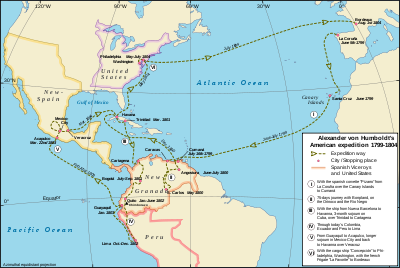
David McCullough’s inspiring book — Brave Companions – Portraits in History— shines a light on an amazing scientist and explorer, Friedrich Wilhelm Heinrich Alexander Freiherr von Humboldt [Baron von Humboldt to his friends]. When McCullough writes, ” … like Halley’s comet or the white whale or other such natural phenomena dear to the nineteenth century, he would be remembered by all who saw him for the rest of their days,” this is what he meant; a recap of FWHAFvH’s life mixed with McCullough descriptions in quotes:

  • 1769 – Born in Berlin – “… he was a baron in about the way some Southerners are colonels”
  • During his youth, developed a penchant for collecting and labeling plants, shells, and insects.
  • With the purpose of preparing himself for a distinctive calling as a scientific explorer, he studied commerce, foreign languages, geology, anatomy, astrology and the use of scientific instruments.
  • 1790 – Published treatise on scientific excursion taken up the Rhine.
  • 1792 – Appointed government inspector of mines in Prussia [Berlin].
  • 1793 – Published research on the vegetation of the mines of Freiberg.
  • 1795 – Made a geological and botanical tour through Switzerland and Italy.
  • 1796 – Upon the death of his mother [father had died in 1779], his inheritance gave him “the means to do whatever he wished.”
  • 1797 – Published research on experiments on the phenomena of muscular irritability.
  • 1798 – Set to be part of Captain Nicolas Baudin’s proposed voyage of circumnavigation leaving from Paris, however the expedition was canceled.
  • 1799 – Humboldt left Paris for Marseille with Aimé Bonpland, the designated botanist of the frustrated expedition, hoping to join Napoleon Bonaparte in Egypt. However, they could not find transportation.
  • 1799 – Arrived in Madrid, where the unexpected patronage of the minister Don Mariano Luis de Urquijo convinced them to make Spanish America the scene of their explorations.
  • 1799 – During an audience with King Charles IV, an expedition, to be paid for by Humboldt, was immediately and unexpectedly sanctioned.

You can just feel McCullough’s excitement [and your own I would hope] as he describes the amazing chain of events:

… Humboldt and Bonpland departed from La Coruña, Spain, in June 1799, on a Spanish frigate, slipping past a British blockade in the dark of night, in the midst of a storm, and carrying with him a unique document from the Spanish government. He and Bonpland had been granted complete freedom to explore — for scientific purposes — any or all of Spain’s largely unexplored American colonies; to make astronomical observations, maps; to collect; to go wherever they wished, speak to whomever they wished. The whole arrangement was quite unprecedented (prior to this Spain had rigorously denied any such travels by foreigners), and it had come about quite by chance.

Fast forward five years. The 34 year old German arrives at the White House to meet a fan, Thomas Jefferson. Jefferson had just purchased a large part of the North American continent from Napoleon the previous year, and had just sent Meriwether Lewis and William Clark to investigate — whose journey McCullough notes, “could not compare to Humboldt’s in scientific consequence” — Jefferson was not alone in his admiration, the list would come to include John James Audubon, Simón Bolívar, Charles Darwin etc.

What happened next? What did Humboldt and Bonpland see? McCullough again on how it began, it would end in Havana in 1804:

They landed [in New Granada or Venezuela], bag and baggage, on July 16, 1799. Their gear included forty-odd scientific instruments, the most versatile and finest available at the time and just the sort of thing Thomas Jefferson would have found fascinating. Included were a tiny, two-inch sextant, compasses, a microscope , barometers and thermometers that had been standardized with those of the Paris observatory before departure, three different kinds of electrometers, a device for measuring the specific gravity of seawater, telescopes, a theodolite, a Leyden jar, an instrument by which the blueness of the sky could be determined, a large and cumbersome magnetometer, and a rain gauge. Their excitement was enormous. No botanist, no naturalist or scientist of any kind, had ever been there before them. Everything was new, even the stars in the sky. “We are here in a divine country,” Humboldt wrote to his brother. “What trees! Coconut trees, fifty to sixty feet high, Poinciana pulcherrima, with a foot-high bouquet of magnificent, bright-red flowers; pisang and a host of trees with enormous leaves and scented flowers, as big as the palm of a hand, of which we knew nothing … And what colors in birds, fish, even crayfish (sky blue and yellow)! we rush around like the demented; in the first three days we were quite unable to classify anything; we pick up one object to throw it away for the next. Bonpland keeps telling me that he will go mad if the wonders do not cease soon.”

What happened in Havana? This from the Wikipedia page:

Humboldt is considered to be the “second discoverer of Cuba” due to all the scientific and social research he conducted on this Spanish colony. During an initial three-month stay at Havana, his first tasks were to properly survey that city and the nearby towns of Guanabacoa, Regla and Bejucal. He befriended Cuban landowner and thinker Francisco Arrango y Parreño; together they visited the Guines area in south Havana, the valleys of Matanzas Province, and the Valley of the Sugar Mills in Trinidad. Those three areas were, at the time, the first frontier of sugar production in the island. During those trips, Humboldt collected statistical information on Cuba’s population, production, technology and trade, and with Arrango, made suggestions for enhancing them. He predicted that the agricultural and commercial potential of Cuba was huge and could be vastly improved with proper leadership in the future. After traveling to America, Humboldt returned to Cuba for a second, shorter stay in April 1804. During this time he socialized with his scientific and landowner friends, conducted mineralogical surveys and finished his vast collection of the island’s flora and fauna.

Geez, I’m happy when I get to bike ride in the mornings.

Posted in Books & Reading | Tagged , , | Leave a comment

Al Gore: Snakeoil Salesman Extraordinaire

Al Gore speech from September 2005 speech:

Now, the scientific community is warning us that the average hurricane will continue to get stronger because of global warming. A scientist at MIT has published a study well before this tragedy showing that since the 1970s, hurricanes in both the Atlantic and the Pacific have increased in duration, and in intensity, by about 50%. … The waters in the gulf have been unusually warm. The oceans generally have been getting warmer. And the pattern is exactly consistent with what scientists have predicted for twenty years. Two thousand scientists, in a hundred countries, engaged in the most elaborate, well organized scientific collaboration in the history of humankind, have produced long-since a consensus that we will face a string of terrible catastrophes unless we act to prepare ourselves and deal with the underlying causes of global warming. [applause] It is important to learn the lessons of what happens when scientific evidence and clear authoritative warnings are ignored in order to induce our leaders not to do it again and not to ignore the scientists again and not to leave us unprotected in the face of those threats that are facing us right now. [applause]

The President says that he is not sure that global warming is a real threat. … He tells us that he believes the science of global warming is in dispute. … It’s important to establish accountability in order to make our democracy work.

This from a recent Reuters article about the ‘Quiet Hurricane Season:’

“There was for all intents and purposes no hurricane damage in the United States this year,” Robert Hartwig, president of the Insurance Information Institute, told Reuters.

Forecasters saw nothing on the horizon on Wednesday.

“El Nino produced an increase in wind shear,” said meteorologist Todd Crawford of private forecaster WSI Corp.

“If you have an increase in the speed of the winds aloft over the Atlantic it acts to basically chop the heads off any kinds of storms,” he said. Wind shear is a technical term for different wind speeds at different altitudes.

Crawford also said sea temperatures in the tropical Atlantic are cooler, by about 2 degrees Fahrenheit (1.12 degrees Celsius) on average, than the blistering seasons of 2004, when four hurricanes hit Florida, and 2005, which produced 28 storms, the highest single-season total in recorded history.

Hurricanes draw energy from warm water, so cooler sea temperatures can mean fewer and less intense storms.

Real accountability should mean that people like Gore — who struck when the moment was ripe [just after Katrina], just like snakeoil salesmen no doubt proliferated after diseases affected a region — owe his audience an explanation. One that apologizes for the hyperbole. One that acknowledges that predictions — even the ‘most elaborate, well organized scientific collaboration in the history of humankind’ — are still just that, predictions. Which are the result of a particular set of data and a particular type of analysis applied by people trying to advance a particular point of view.

Then again, there is probably a good reason snakeoil salesman keep moving from town to town. Heck, Al’s got himself new stuff in his wagon nowadays. Caveat emptor dude.

Posted in Science & Technology | Leave a comment