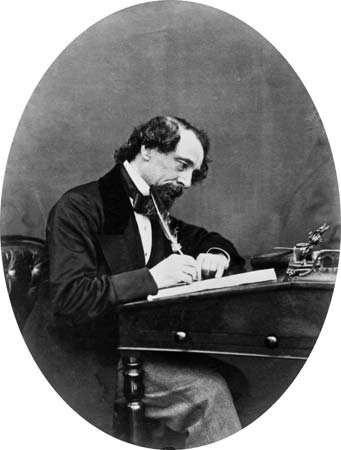
Charles Dickens was in better shape than me

Nothing says middle age like, ‘Charles Dickens was in better shape than me.’ Don’t laugh, if you’re even glancing at obscure blogs like mine you are likely a sad sedentary jumble of man boobs and a mid-section that resembles a sack of rice which has mostly settled at one end.

This summer, as part of a shameless plan to focus on reading shorter books to drive up my total books read for the year, I was working my way through the Penguin Lives series and got to Charles Dickens by Jane Smiley. Smiley wrote:

… Dickens more signal quality, the one most often commented upon by his acquaintances and the one he relied upon at all times, was his energy. It was in this period [age 26] that he took up the habit of long, vigorous daily walks that seem almost unimaginable today for an otherwise very busy man with many obligations. At a pace of 12 to 15 minutes per mile, he regularly covered 20 and sometimes 30 miles. Returning, as his brother-in-law said, “he looked the personification of energy which seem to ooze from every pore as from some hidden reservoir….”

Continue reading

Posted in Books & Reading | Tagged , , | Leave a comment

Why the SEC probe is not a replay of the Braman trial

To show why I don’t think the SEC probe represents a replay of the Braman trial, it is necessary to revisit what Judge Jeri Beth Cohen’s ruling stated in 2008.

While there were various claims to Braman’s initial lawsuit, the Judge’s ruling focused only on one [Count 4]. Another claim [Count 5] was invalidated due to a Florida Supreme Court ruling.  They ruled that municipalities do not have get voter approval before committing ad valorem money toward bonds.

So the Braman trial boiled down to one issue. Did the baseball stadium serve a “paramount public purpose?”  Judge Cohen ruled that it did and it doesn’t read as though it was a tough call.  She wrote “… similar to the trend in Florida, courts across the country have consistently held that sports stadiums serve a paramount public purpose.”  Cohen relied particularly on one case she described as “strikingly similar” to the Marlins situation, the building of a stadium for the Tampa Bay Buccaneers. I’ll leave it to others to wonder if the Poe case makes a po’ precedent [sorry].

Here is how Sports Illustrated has summarized the SEC’s request:

The parking garage tax issue is specifically mentioned by the SEC. Investigators also want records about the Marlins’ ability to contribute to the stadium complex’s financing, the team’s revenues and profitability, and whether any Marlins employees gave “any payments, loans, campaign contributions or any offers of anything of value” to city, county or state government officials.

The SEC also wants detailed information about the bonds used to finance the stadium and whether investors might have been misled.

Not all SEC investigations end in enforcement actions, but enforcement actions typically end in settlements that can include fines and other penalties. Investigators can refer individuals or companies to the Justice Department for potential criminal prosecution.

Now here are some of the issues documented in Judge Cohen’s order which were not part of the narrow “public purpose” issue she eventually ruled on:

  • “The financial condition of the Marlins is unknown to anyone except the Marlins and MLB.”
  • “… It is undisputed that the County has no idea whether or not the Marlins can satisfy any of their obligations under the BSA.”
  • “… the terms of the negotiated deal are not a subject for this Court’s scrutiny”
  • “While the Court agrees with Plaintiff that the Marlins are getting what amounts to a ‘sweet deal,’ this is, put bluntly, not the business of this Court.”

The reason I believe that the SEC probe is not a replay of the Braman trial, is that the SEC’s concerns differ greatly from that a civil court judge. I believe the SEC very much considers it its business if the Marlins obtained a ‘sweet deal’ through misleading representations to local governments. Especially if those representations were then relied upon to determine which government bonds to be issued.

Meet real Miamian’s favorite new fathead poster:

Posted in Marlins Ballpark & Finances | Tagged , , , , | Leave a comment

On The Wire: Pigs get fat, hogs get the SEC’s attention

On Saturday, the Miami Herald reported the following:

Federal authorities have opened a wide-ranging investigation into the Miami Marlins’ controversial ballpark deal with Miami-Dade County and the city of Miami, demanding financial information underpinning nearly $500 million in bond sales as well as records of campaign contributions from the Marlins to local and state elected leaders.

In a pair of lengthy letters delivered to government attorneys Thursday, the U.S. Securities & Exchange Commission gave the city and county until Jan. 6 to deliver everything from minutes of meetings between government leaders and Marlins owner Jeffrey Loria and Major League Baseball Commissioner Bud Selig, to records of Marlins finances dating back to 2007.

I thought it right that the SEC extended their focus beyond Miami to Bud Selig and MLB. After all, in Miami’s version of The Wire, the Marlins just have one of the Towers. Bud Selig is the Avon Barksdale character pulling on the strings. Speaking of which, the Stringer Bell role in this play is a combination of Rod Manfred and Bob DuPuy.

In the hopes of obtaining public financing for the new stadium, the Marlins lied to reporters and fans about their finances.   Who knows, for now, what they actually told or shared with government officials.  They did it all with the blessings of Major League Baseball.  Given that David Samson would often make silly [here], misleading [here and here] or false [here and here] statements about the Marlins finances, especially on his radio show, it must have all seemed like a very clever game to them. They acted, as Mr. Omar Little once commented, as though it was “all in the Game, y’all, all in the Game.”

The Braman trial has now become like a grand jury report for the SEC. Every government official who testified at the Braman trial is going to be spending a lot of money on attorney fees. The Marlins and MLB must be hoping that those attorney’s are very good because those officials are not the endgame in this investigation. Hard to imagine how this ends without some admission of guilt or complicity on the part of the Marlins and a fine which significantly increases their share of the stadium costs. Pigs get fat, hogs finally got someone’s attention that didn’t think it was a game and is in a position to do something about it.

The repercussions are just beginning. At the SunSentinel, Juan C. Rodriguez considers the initial effects:

With the new stadium, the possibility of another “market correction” as the club termed its pre-2006 purge would seem unfathomable. Yet the investigation conceivably might unnerve free agents looking for deals of five-plus years. Ultimately, players in most cases follow the money, but whether warranted or not, some might shy away from not having no-trade protection in light of this new specter.

The Marlins earlier this week with their 3-year, $27 million commitment to Bell silenced skeptics who believed their dalliances with upper echelon free agents were some kind of ruse. Though the SEC investigation barely is off the ground, the Marlins already may have lost whatever small earnings they made in public trust.

Update 12/04: My blog is mentioned in Juan C. Rodriguez’s article about the Marlins reaction to the SEC filing.

Articles referenced are copied in full at the end of this blog post.

Continue reading

Posted in Marlins Ballpark & Finances | Tagged , , | Leave a comment

Pride in my place, Miami

Pride (In the name of The Miami Foundation)

My Hometown View

Javier A. Soto, president of The Miami Foundation, poses an interesting question in the Opinion section of the Miami Herald and then provides an answer I found persuasive.

… how many Miamians see this [cultural side of] Miami — and why does this matter?

Part of Soto’s answer.

As the Knight Foundation’s Soul of the Community report has demonstrated, the social offerings of a place — its arts scene, sports events and entertainment options — help attach residents to that place. A central factor in this community attachment is pride. Pride in your place — your city — is an important factor in driving feelings of attachment and commitment on the part of the residents.

Once a commitment to a place has been formed, it is much more likely to be followed by an involvement in its civic life. In fact, a recent study by Americans for the Arts found that individuals who develop a pride in their place by participating in the cultural life of a community are three times more likely to be active in other civic activities such as volunteering, registering to vote, giving to charity and helping their neighbor. So by engaging in the arts and other social offerings available in our community — by seeing what our visitors see — levels of civic pride are likely to increase and bring with them an increased level of attachment, commitment and civic engagement.

Soto’s entire column is copied in full at the end of this post.

Continue reading

Tagged , , | 2 Comments

Miami Marlins Stadium Agreement: What Went Right

David Samson has lied so often with his public comments about the Marlins finances, he is understandably ignored even when making a good point. David meet Aesop, he no Hee-seop [Choi].

Here are Samson’s comments as reported in Juan C. Rodriguez’s post in the SunSentinel about the issue of property taxes on parking garages:

“That really has nothing to do with the team. It’s really between the city and the county. It’s a city-owned garage. I don’t know if the city pays property taxes on all its other garages or not. These are the same. It’s being run by the Miami Parking Authority. The only thing we are is tenants who are agreeing to buy a lot of spots. It’s like when you pull into a garage in any downtown office building and buy a spot for a day. You don’t pay property tax.”

This is what the actual agreement entails, again from the Rodriguez post:

The Marlins are buying all 5,700 spaces for the 81 home games at $10 each [for next 15 years]. The City of Miami annually will receive $4,617,000 from the Marlins for those spots, whether they are sold or not. What the Marlins in turn charge fans for those spots is up to them.

In a recent Miami Herald article [copied in its entirety below], it was reported that Miami-Dade County is attempting to charge the City of Miami property taxes on the 4 parking garage structures built around the new stadium. The County’s reasoning is that since the Marlins have discretion in pricing the parking spaces [all of them] leased from the City, the garage is “controlled by a for-profit enterprise,” and as such should be subject to property taxes. Having to pay property taxes on the garages was not something the City anticipated and would cost City taxpayers up to $2 million annually.

The initial public reaction is probably best captured by Carl Hiaasen’s opinion column [copied below] in Sunday Herald. While Hiaasen made good use of the red meat he was tossed–the 800 word column used the following adjectives; outlandish, foul, breathtaking, boondoggle, dysfunction, incompetence, fiasco, bombed [as in drunk], outfoxed, harpooned, Sucker Ball and an allusion to “law degrees purchased online from Nigeria”–the column made the following specific points.

  1. “In the two years since financing was approved, the numbers are looking more dismal than what was feared.”
  2. “There is nothing public about those garages. They might be owned [and operated] by the city, but they’ll be controlled by the Marlins, purely for profit. The county is absolutely right to treat them as commercial property.”
  3. “On the bright side, the City did get the Marlins to cough up $10 whether or not the parking space is used…. If the Marlins start [I’m sure he meant continue] losing, there will be a drearily familiar abundance of empty seats and empty parking spaces.”

Point #1 – My reply to Hiaasen’s “numbers looking dismal” claim

  • Leaving the parking garage property taxes aside, given that it may not be an issue, it’s hard to figure out what exactly Hiaasen is referring to. There were two big contingencies associated with the new stadium: potential construction costs overruns with a franchise whose finances were uncertain and whether Miami-Dade County’s Hotel [or Bed] tax receipts would bounce back after the financial crisis.
  • The stadium itself apparently did not have cost overruns. [My links are to my own blog posts where I always copy the article being referenced at the end of the post.] There were structural issues with at least one of the garages which raised construction costs from $94 to $101 million for the garages.
  • County Hotel taxes were the biggest concern at the time of the Stadium Agreement was approved. In effect, the anti-stadium advocates stated that tourism could not be counted on to recover. Miami-Dade argued that they would.
  • The results are in, or about 3 years worth of data. Tax receipts fell by 15% for the fiscal year ended [FYE] 2009, rose 9% for FYE 2010 and rose 15% for FYE  2011. For the first time since the financial crisis, the tax receipts for the fiscal year which ended this past June 30th [FYE 2011], exceeded those in the year [FYE 2008] before the financial crisis. Miami-Dade’s bond payments were structured to account for a growing tax receipts following the recovery from the financial crisis.
  • Here are the comments of George Burgess, Miami-Dade’s county manager at the time: “Our belief is the slowdown will last two or three years and then rebound,” he said. “Is it reasonable that we’ll be flat-lining for six or seven years? It is not.”  So far so good on that prognosis.
  • In April of 2010 there was concern that the City of Miami would not be able to issue bonds due to an SEC audit, but that was resolved.
  • Another development was the Deadspin release of the Marlins financials, but that revelation is positive news from the point of view of the stadium deal, since it meant that the Marlins would be able to meet their construction costs obligations.
  • Also, the terrible economic environment since the financial crisis has translated into good news for local governments ability to obtain financing with lower interest rates.
  • If Hiaasen was a Monty Python character, he’d be calling for a draw at this point.

Points # 2 & 3 – My reply to “garage is commercial property”

  • Here I would repeat Samson’s point. What is done at the other comparable venues? While it’s interesting that a columnist would take such a definitive position on an intra-governmental legal issue — by stating that the garages should be treated as commercial property — actual reporting about the why would have been useful.
  • Hiaasen is relying on reputation to get away with writing that ‘…there is nothing public about parking garages that happen to be owned [and operated] by a city government…’ Ownership and responsibility for running the four garages ain’t nothing.
  • I think Hiaasen’s 3rd point [Marlins unlikely to sell out parking spaces, especially in the long run] counters his 2nd point [garages are commercial property because the Marlins might profit from the deal]. If profitability is the key to who is controlling the garages, what happens to that analysis if the Marlins start losing money on the garages after year 2?
  • Bottom line, the City of Miami has outsourced the responsibility for selling parking spaces at the new stadium for the next 15 years.  Hard to imagine that would cost them their tax-exempt status.
  • Mr Hiaasen, Malcom Gladwell on line 2 for you.

All articles referenced are copied in full at the end of the post.

Continue reading

Posted in Marlins Ballpark & Finances | Tagged , , | Leave a comment

Stan Musial: Great Catholic American

Book: Stan Musial: An American Life by George Vecsey

Method: Read library copy

What I got from the book:

  • The word nice is essential to understanding who Stan Musial was.
  • The book cloth color is Cardinal Red, naturally. The dust jacket is bathed in red, white and blue with a picture of a young Musial at the end of his swing. Perfect. A tip of the cap to book designer Jo Anne Metsch.  Book typeface is Caledonia, designed in 1939 by William Addison Dwiggins for the Merganthaler Linotype Company. Hey, my Dad was a printer, this stuff matters.
  • The style of the book is anecdotal. It has 47 chapters and 337 written pages, 397 in total. Some of the chapters are only a few pages long. Given that, I fully expected the chapters and pages numbers to have some connection to Musial’s stats. They don’t, or I couldn’t decipher it. Look, his lifetime average was 331. Jus saying …. Am I alone on this one?
  • This was the 1st sentence, which recounted when Vescey first saw Musial in St. Petersburg in 1960: “We drove straight through the night, married only a few months, on spring break, our first vacation together. Like Bonnie and Clyde, we had the feeling of putting something over on every body, Every mile we traveled south of Baltimore was the farthest I had ever been from New York. We were twenty-one.”
  • Reminded of one of the the greatest stats in MLB history. Musial struck out only 696 times while hitting 475 home runs, “an astounding ratio.” DiMaggio actually excelled him in that one area, hitting 361 home runs with only 369 strikeouts.
  • Stan is really Stanislaus. In 1910 Musial’s Polish father, Lukasz, sailed out of the Elbe River and arrived at Ellis Island six days later and then immediately settled in Donora PA, 20 miles south of Pittsburgh, because of work at a mill. It was a close-knit, 6 kids, but poor family. The men from the mill all drank. Vescey treads lightly on how that might have affected the young Musical.

Continue reading

Posted in 2TG Favorites, Books & Reading | Tagged , , , , , , | Leave a comment

Thanksgiving and Christmas

Joe Christmas that is.  After reading how the Faulkner character came to be adopted, I was reminded, yet again, that many of my blessings, like my sins, are things of omission.

Continue reading

Posted in Books & Reading | Tagged , , , , , , , , | Leave a comment

How Do I Lift Thee, Let Me Count The Ways

To say that getting the United States to lift their economic sanctions against Cuba is an article of faith to some on the left, is a comical understatement.  Perhaps fueled by guilt, given their complicity in giving Fidel Castro a platform, The New York Times leads the apologist pack. Here’s a quick overview of just a few of their headlines re Cuba through the years:

Continue reading

Posted in Cuba | Tagged , | Leave a comment

The OB2 — Miami Marlins Arrive Alive

The Miami Marlins were born on 11/11/11. Despite the elephantine gestation period, I watched the birth online with nothing but feelings of pride. Both for my city of Miami and the neighborhood of my youth and preferred locale for cultural identification, Little Havana.  For perhaps only a few brief moments, it will be home to one of the most modern sports facilities in the world. The unlikeliness of the previous sentence is comparable to a sentence involving Joe Paterno and violent pedophiles would have been back in the old days.

Continue reading

Posted in Miami Marlins & MLB, Random Observations | Tagged , , , | Leave a comment

Berlin 1961: Little Boy Blue Meets Al Capone

Book: Berlin 1961 by Frederick Kempe

Method: Read library copy

What I got from the book:

  • Beautiful book.  Two-toned cover in green and mahogany and a font, which although still readable, reminded me that I might be on the verge of exploring large print editions.  One complaint.  The page inside both the front and back covers of the book, have the exact same map of Berlin from 1961. Hey it was a nice map, but ….
  • I checked the book out based on George Will’s column — copied in full at end of post — about the book.  The title of this blog post is a quote from a diplomat describing the meeting between Kennedy and Khrushchev in Vienna.  The most surprising thing about the book is that the quote was not much of an exaggeration.
  • Eisenhower’s classy handling of transition meetings.  In one, he details why Kennedy’s “missile gap” attack on his Administration during the campaign was so much nonsense due to Polaris missiles.
  • In attempting to avoid a conflict over Berlin, Kennedy is the first to refer to “West Berlin” as a signal to Khrushchev that the U.S. would not interfere with its partition.  If the people who gathered for Kennedy’s “I am a Berliner” speech in 1963 were somehow able to know the things revealed in this book, Little Boy Blue would have been met with boos, if not violence.
  • It’s striking that so much of what is associated with Kennedy, in a Gladwell-Blink way, is so wrong.  To Catholic, married, author, war hero [“dark-of-night fog-of-war”], add committed anti-communist.

Continue reading

Posted in Books & Reading | Tagged , , , , | Leave a comment