The Miami Herald’s political correctness

On Tuesday, The Miami Herald endorsed Alcee Hastings for U.S. House District 23. The endorsement was interesting to me for what it did not state.

No mention–as in zero–of any of the following facts about Mr Hastings:

  • 1979 – Appointed federal judge by President Carter – the first African American to be named in Florida.
  • 1981 – Charged with accepting a $150,000 bribe in exchange for a lenient sentence and a return of seized assets for 21 counts of racketeering
  • 1982 – As part of his defense, Hastings argued that a federal judge could not be tried without first having been impeached, but the courts rejected this and he was brought to trial.
  • 1982 – Hastings co-conspirator, attorney William Borders, Jr., found guilty and sent to jail.
  • 1983 – Hastings acquitted by a jury after Borders refused to testify in court.
  • 1988 – Impeached for bribery and perjury by a vote of 413-3 by a Democratically controlled U.S. House of Representatives.
  • 1989 – Convicted in 1989 by the U.S. Senate, becoming the sixth federal judge in the history of the United States to be removed from office.

But let’s be reasonable, perhaps an endorsement is not the place to note problems in the candidate’s past? Unfortunately, the lead editorial the same day was an endorsement of Raul Martinez, which devoted two sentences to his conviction and acquittal.

Clearly, a sense of shame is not one of the qualities the Herald thinks is needed to serve in Congress. Looking around public life, I find little that will not be excused in the name of diversity. Is it any wonder that Rev Wright, Tony Rezko and Bill Ayers are off limits to the MSM?

I think that Alcee Hastings is a corrupt public official, who happens to be an African-American. In organizations like the Miami Herald, the fear of not being clear enough in that type of distinction simply can not be risked.

Too bad, our country deserves better from its Congress and editorial pages.

All articles referenced are copied in full at end of post.

——————————————————–
Miami Herald Editorial
Posted on Tue, Oct. 14, 2008
For U.S. House District 23
This inland district meanders through Broward, Palm Beach, Martin, St. Lucie and Hendry counties. It encompasses some of the poorest communities in South Florida along with diverse, middle-class cities like Lauderhill and the west sides of coastal cities such as Delray Beach. Incumbent Democrat Alcee Hastings, 72, is opposed by Republican Marion Thorpe Jr., 44, a physician.

Mr. Thorpe says a major goal is to develop and implement ”quality healthcare systems that are both affordable and accessible.” He is short on specifics of how to accomplish this other than to expand multiple-payer programs. Mr. Thorpe supports using more alternative energy while stepping up oil and gas drilling in the United States to reduce foreign-oil consumption. According to his website, Mr. Thorpe opposed the $700 billion financial-market bailout.

We recommend that voters return Rep. Hastings to Congress, where he has served ably since 1992. Mr. Hastings thinks and acts both globally and locally. He chairs the U.S. Commission on Security and Cooperation in Europe, an offshoot of the Organization for Security and Cooperation in Europe — an international security accord. Conversely, Mr. Hastings has long pushed for single-member district city commissions in communities such as Hallandale Beach, where black residents are underrepresented.

Mr. Hastings supported the bailout plan. He opposes expanding drilling off Florida’s coast, calling for more research into alternative fuels. When gas prices soared this summer Mr. Hastings introduced a bill to create a gas-tax credit for working families. Before the Iraq invasion Mr. Hastings sought, without success, to make the administration create a long-term plan for the stabilization of Iraq.

For U.S. House District 23, The Miami Herald recommends ALCEE L. HASTINGS.
———————————————————————————
Miami Herald editorial
Posted on Tue, Oct. 14, 2008
For U.S. House District 21
The race for Congress in District 21 pits two of the most prominent Cuban-American political figures in South Florida against each other. Rep. Lincoln Diaz-Balart, the eight-term Republican incumbent, faces a serious challenge by Democrat Raul Martinez, who served on and off as Hialeah’s mayor for more than 20 years, beginning in 1981.

Both are strong advocates of a free Cuba, but otherwise differ emphatically on major issues. Mr. Martinez believes the occupation of Iraq must be brought to an end ”as soon as possible,” while Rep. Diaz-Balart says premature withdrawal would be ”catastrophic.” The congressman has generally favored the Bush administration tax cuts, while Mr. Martinez would vote to end tax breaks for higher earners.

Mr. Martinez is firmly grounded in reality. He has a broad agenda and a robust, hands-on style of leadership. His penchant for devising practical solutions to political problems would be an asset to the district.

These are some of the reasons that our recommendation is for Mr. Martinez. Under his leadership, Hialeah was transformed into a modern, more-livable community thanks in no small part to his energy and effectiveness. He has a popular touch and a record of delivering services to constituents.

Mr. Martinez won reelection in 1993 even though he was appealing a conviction on charges involving allegations of extorting money from developers in return for zoning favors. The conviction was reversed and two later trials ended in hung juries.

Mr. Martinez’s candidacy represents an opportunity for voters to reflect the changing nature of South Florida, where the Hispanic community no longer is identified as a solid bloc always favoring the same political party.

For U.S. House District 21, The Miami Herald recommends RAUL MARTINEZ.
————————————————-

Posted in Current Affairs & History | Tagged , , , , | Leave a comment

In defense of a loyal opposition

We have now come to the logical conclusion of the political correctness movement. Criticism of an inexperienced presidential candidate with past [we hope] radical alliances is racist. The implicit threat to critics is, ‘back off or you will be labeled as extremists.’ The problem is that a significant segment of our society [conservatives] have come to despise those doing the labeling–MSM and academia–and so the threat is not much of a deterrent.

Count me out with ‘reasonableness’ which is based on overlooking facts because [always] hopeful supporters don’t think it means what it appears to mean. Far from being deterred, many like me embrace our loyal opposition role against the Obama-Chicago political machine, like a ‘non-stinkin bage’. As Nick Carraway might have phrased it, I think ‘they’re a rotten crowd, the whole damn bunch put together.’

Columnist Thomas Sowell does not seem too worried about earning disapproval from the non-right crowd:

Does anyone in real life put more faith in what people say than in what they do? A few gullible people do– and they often get deceived and defrauded big time.

Barack Obama has carried election-year makeovers to a new high, presenting himself a uniter of people, someone reaching across the partisan divide and the racial divide– after decades of promoting polarization in each of his successive roles and each of his choices of political allies.

Yet the media treat exposing a fraudulent election-year image as far worse than letting someone acquire the powers of the highest office in the land through sheer deception.

All articles referenced are copied in full at end of post.

—————————————————————————————-
October 14, 2008
Negative Advertising
By Thomas Sowell

One of the oldest phenomena of American elections– criticism of one’s opponent– has in recent times been stigmatized by much of the media as “negative advertising.”

Is this because the criticism has gotten more vicious or more personal? You might think so, if you were totally ignorant of history, as so many of the graduates of even our elite universities are.

Although Grover Cleveland was elected President twice, he had to overcome a major scandal that he had fathered a child out of wedlock, which was considered more of a disgrace then than today. Even giants like Lincoln and Jefferson were called names that neither McCain nor Obama has been called.

Why then is “negative advertising” such a big deal these days? The dirty little secret is this: Liberal candidates have needed to escape their past and pretend that they are not liberals, because so many voters have had it with liberals.

In 1988, Governor Michael Dukakis of Massachusetts called himself a “technocrat,” a pragmatic solver of problems, despite a classic liberal track record of big spending, big taxes, and policies that were anti-business and pro-criminal.

When the truth about what he actually did as governor was brought out during the Presidential election campaign, the media were duly shocked– not by Dukakis’ record, but by the Republicans’ exposing his record.

John Kerry, with a very similar ultra-liberal record, topped off by inflammatory and unsubstantiated attacks on American military men in Vietnam, disdained the whole process of labeling as something unworthy. And the mainstream media closed ranks around him as well, deploring those who labeled Kerry a liberal.

Barack Obama is much smoother. Instead of issuing explicit denials, he gives speeches that sound so moderate, so nuanced and so lofty that even some conservative Republicans go for them. How could anyone believe that such a man is the very opposite of what he claims to be– unless they check out the record of what he has actually done?

In words, Obama is a uniter instead of a divider. In deeds, he has spent years promoting polarization. That is what a “community organizer” does, creating a sense of grievance, envy and resentment, in order to mobilize political action to get more of the taxpayers’ money or to force banks to lend to people they don’t consider good risks, as the community organizing group ACORN did.

After Barack Obama moved beyond the role of a community organizer, he promoted the same polarization in his other roles.

That is what he did when he spent the money of the Woods Fund bankrolling programs to spread the politics of grievance and resentment into the schools. That is what he did when he spent the taxpayers’ money bankrolling the grievance and resentment ideology of Michael Pfleger.

When Barack Obama donated $20,000 to Jeremiah Wright, does anyone imagine that he was unaware that Wright was the epitome of grievance, envy and resentment hype? Or were Wright’s sermons too subtle for Obama to pick up that message?

How subtle is “Goddamn America!”?

Yet those in the media who deplore “negative advertising” regard it as unseemly to dig up ugly facts instead of sticking to the beautiful rhetoric of an election year. The oft-repeated mantra is that we should trick to the “real issues.”

What are called “the real issues” are election-year talking points, while the actual track record of the candidates is treated as a distraction– and somehow an unworthy distraction.

Does anyone in real life put more faith in what people say than in what they do? A few gullible people do– and they often get deceived and defrauded big time.

Barack Obama has carried election-year makeovers to a new high, presenting himself a uniter of people, someone reaching across the partisan divide and the racial divide– after decades of promoting polarization in each of his successive roles and each of his choices of political allies.

Yet the media treat exposing a fraudulent election-year image as far worse than letting someone acquire the powers of the highest office in the land through sheer deception.

Copyright 2008, Creators Syndicate Inc.
Page Printed from: http://www.realclearpolitics.com/articles/2008/10/negative_advertising.html at October 14, 2008 – 08:28:24 AM EDT
————————————————————————————–
What Right Wingers Mean When They Call Obama A “Socialist”

Right-wing attempts to paint Barack Obama as a socialist aren’t just disingenuous. They’re rooted in a history of conservative smears against black leaders.

Adam Serwer | October 13, 2008 | web only

On Saturday, Georgia Congressman John Lewis went nuclear on John McCain, releasing a statement that seemed to compare McCain to segregationist George Wallace. “George Wallace never threw a bomb,” Lewis wrote. “He never fired a gun, but he created the climate and the conditions that encouraged vicious attacks against innocent Americans who only desired to exercise their constitutional rights.” The civil rights icon continued, “Because of this atmosphere of hate, four little girls were killed one Sunday morning when a church was bombed in Birmingham, Alabama.”

Lewis accused McCain and his running mate Sarah Palin of “sowing the seeds of hatred and division.” He was referring to the angry tone of recent McCain rallies, where cries of “kill him” and “off with his head” have made many people anxious about the potential for violence against the Democratic nominee.

It’s no wonder that the tone at McCain rallies remind Lewis of the bad old days. In recent months, conservatives have sounded increasingly retro with their attempts to paint Obama as a socialist or communist. In some ways, this accusation is typical far-right boilerplate. Obama certainly isn’t the first Democrat running for president to be accused of communist sympathies. And as usual, the accusations are rarely linked to policy specifics. But the difference with Obama is that, in the eyes of the right, it’s not just his political affiliation that implicates him as a socialist. It’s his ethnic background.

The hysterical accusations of socialism from conservatives echo similar accusations leveled at black leaders in the past, as though the quest for racial parity were simply a left-wing plot. Obama may not actually be a socialist or communist, but his election would strike another powerful blow to the informal racial hierarchy that has existed in America since the 1960s, when it ceased being enforced by law. This hierarchy, which holds that whiteness is synonymous with American-ness, is one conservatives are now instinctively trying to preserve. Like black civil-rights activists of the 1960s, Obama symbolizes the destruction of a social order they see as fundamentally American, which is why terms like “socialism” are used to describe the threat.

This phenomenon extends beyond Obama’s candidacy. The conservative explanation for the mortgage crisis falls neatly into this narrative, too; the country is at risk because Democrats allowed minorities to disrupt the natural social order by becoming homeowners. Never mind that this defies all data, logic, and history, the narrative resonates because it allows Obama, a living symbol of black folks rising above “their station,” to become a focus for conservative economic anxieties.

Conservatives, now and in the past, have turned to “socialism” and “communism” as shorthand to criticize black activists and political figures since the civil-rights era. In The Autobiography of Malcolm X as written by Alex Haley, Malcolm recalls being confronting by a government agent tailing him in Africa, not long after his pilgrimage to Mecca. The agent was convinced that Malcolm was a communist. Malcolm spent years under surveillance because of such bizarre suspicions. Likewise, J. Edgar Hoover spent years attempting to link Martin Luther King Jr. to the communist cause. King, for his part, welcomed everyone who embraced the cause of black civil rights, regardless of their ideological ties. This included communists and socialists, but the idea that a devout man of God like King saw black rights as a mere step in a worldwide communist revolution was absurd. Malcolm was a conservative. King was a liberal. To their enemies, they were simply communists.

The feeling that black-rights activists were part of a front for communism and socialism was widespread. Jerry Falwell famously criticized “the sincerity and intentions of some civil rights leaders such as Dr. Martin Luther King Jr., James Farmer, and others, who are known to have left-wing associations.” Falwell charged, “It is very obvious that the Communists, as they do in all parts of the world, are taking advantage of a tense situation in our land, and are exploiting every incident to bring about violence and bloodshed.” For the agents of intolerance, things haven’t changed much. On October 9, a McCain supporter told the candidate that he was angry about “socialists taking over our country.” McCain told him he was right to be angry.

The right wing continues to link the fight for black equality with socialism and communism. At the website of conservatism’s flagship publication, National Review, conservatives like Andy McCarthy argue whether Obama is “more Maoist than Stalinist,” and National Review writer Lisa Schiffren explicitly argued this summer that Obama must have communist links based on his interracial background. Schiffren mused, “for a white woman to marry a black man in 1958, or 60, there was almost inevitably a connection to explicit Communist politics.”

This conclusion is one she shares with Robert Shelton, Imperial Wizard of the Ku Klux Klan in the 1950s, who declared that “amalgamation is ultimately the goal of the Communist element.” (To be fair, these conclusions make a bit of sense: could there be a more perfect vessel for a secret communist takeover of the United States than a biracial one-term senator from Chicago with an Arabic-sounding name? At a Starbucks somewhere, Chairman Mao is leeching WiFi for a quick instant message to William Ayers: “It’s happening exactly how we planned it.”)

McCain, a child of privilege who spent the late 1960s in a Vietnamese prison camp, may simply be unaware of the feelings and historical context he has evoked through his campaign’s rhetoric. When Sarah Palin accuses Obama of “palling around with terrorists” and suggests that Obama hates his own country enough to wish it violence, the McCain campaign fuels age-old paranoia built around the conflation of black rights and the radical left. As for McCain himself, his attempts to tamp down the vitriol of his crowds suggest that he is somewhat confused by their response. He wants voters to dislike Obama, but he seems unaware of just what he has unleashed. However, by implicitly invoking the idea that Obama represents a socialist takeover of the United States, McCain is inviting what can only be a rational response from those who would die for their country: violence. What else is a patriot to do when freedom is threatened? Especially when their fears have been validated by no less authoritative a source than the Republican nominee for president of the United States?

John McCain is no George Wallace, and a direct comparison may not be what Lewis intended. Rather, Lewis was expressing concern that the McCain campaign’s rhetoric could lead some of their supporters to conclude that violence is the only rational response to an Obama victory. (This is essentially the position staked out by the Obama campaign, which both rejected the Wallace comparison and remained critical of the “hateful rhetoric” at McCain rallies.) A veteran of the 1968 civil-rights march with Dr. King across the Edmund Pettis Bridge, John Lewis has the kind of credibility on mob violence that John McCain has on torture.

We should listen to him very carefully.
—————————————————————————–

Posted in Current Affairs & History | Tagged , , , | Leave a comment

Afrocentrists anyone?

See Stanley Kurtz article.

October 14, 2008

Wright 101
Obama funded extremist Afrocentrists who shared Rev. Wright’s anti-Americanism

By Stanley Kurtz

It looks like Jeremiah Wright was just the tip of the iceberg. Not only did Barack Obama savor Wright’s sermons, Obama gave legitimacy — and a whole lot of money — to education programs built around the same extremist anti-American ideology preached by Reverend Wright. And guess what? Bill Ayers is still palling around with the same bitterly anti-American Afrocentric ideologues that he and Obama were promoting a decade ago. All this is revealed by a bit of digging, combined with a careful study of documents from the Chicago Annenberg Challenge, the education foundation Obama and Ayers jointly led in the late 1990s.

John McCain, take note. Obama’s tie to Wright is no longer a purely personal question (if it ever was one) about one man’s choice of his pastor. The fact that Obama funded extremist Afrocentrists who shared Wright’s anti-Americanism means that this is now a matter of public policy, and therefore an entirely legitimate issue in this campaign.

African Village
In the winter of 1996, the Coalition for Improved Education in [Chicago’s] South Shore (CIESS) announced that it had received a $200,000 grant from the Chicago Annenberg Challenge. That made CIESS an “external partner,” i.e. a community organization linked to a network of schools within the Chicago public system. This network, named the “South Shore African Village Collaborative” was thoroughly “Afrocentric” in orientation. CIESS’s job was to use a combination of teacher-training, curriculum advice, and community involvement to improve academic performance in the schools it worked with. CIESS would continue to receive large Annenberg grants throughout the 1990s.

The South Shore African Village Collaborative (SSAVC) was very much a part of the Afrocentric “rites of passage movement,” a fringe education crusade of the 1990s. SSAVC schools featured “African-Centered” curricula built around “rites of passage” ceremonies inspired by the puberty rites found in many African societies. In and of themselves, these ceremonies were harmless. Yet the philosophy that accompanied them was not. On the contrary, it was a carbon-copy of Jeremiah Wright’s worldview.

Rites of Passage
To learn what the rites of passage movement was all about, we can turn to a sympathetic 1992 study published in the Journal of Negro Education by Nsenga Warfield-Coppock. In that article, Warfield-Coppock bemoans the fact that public education in the United States is shaped by “capitalism, competitiveness, racism, sexism and oppression.” According to Warfield-Coppock, these American values “have confused African American people and oriented them toward American definitions of achievement and success and away from traditional African values.” American socialization has “proven to be dysfuntional and genocidal to the African American community,” Warfield-Coppock tells us. The answer is the adolescent rites of passage movement, designed “to provide African American youth with the cultural information and values they would need to counter the potentially detrimental effects of a Eurocentrically oriented society.”

The adolescent rites of passage movement that flowered in the 1990s grew out of the “cultural nationalist” or “Pan-African” thinking popular in radical black circles of the 1960s and 1970s. The attempt to create a virtually separate and intensely anti-American black social world began to take hold in the mid-1980s in small private schools, which carefully guarded the contents of their controversial curricula. Gradually, through external partners like CIESS, the movement spread to a few public schools. Supporters view these programs as “a social and cultural ‘inoculation’ process that facilitates healthy, African-centered development among African American youth and protects them against the ravages of a racist, sexist, capitalist, and oppressive society.”

We know that SSAVC was part of this movement, not only because their Annenberg proposals were filled with Afrocentric themes and references to “rites of passage,” but also because SSAVC’s faculty set up its African-centered curriculum in consultation with some of the most prominent leaders of the “rites of passage movement.” For example, a CIESS teacher conference sponsored a presentation on African-centered curricula by Jacob Carruthers, a particularly controversial Afrocentrist.

Jacob Carruthers
Like other leaders of the rites of passage movement, Carruthers teaches that the true birthplace of world civilization was ancient “Kemet” (Egypt), from which Kemetic philosophy supposedly spread to Africa as a whole. Carruthers and his colleagues believe that the values of Kemetic civilization are far superior to the isolating and oppressive, ancient Greek-based values of European and American civilization. Although academic Egyptologists and anthropologists strongly reject these historical claims, Carruthers dismisses critics as part of a white supremacist conspiracy to hide the truth of African superiority.

Carruthers’s key writings are collected in his book, Intellectual Warfare. Reading it is a wild, anti-American ride. In his book, we learn that Carruthers and his like-minded colleagues have formed an organization called the Association for the Study of Classical African Civilizations (ASCAC), which takes as its mission the need to “dismantle the European intellectual campaign to commit historicide against African peoples.” Carruthers includes “African-Americans” within a group he would define as simply “African.” When forced to describe a black person as “American,” Carruthers uses quotation marks, thus indicating that no black person can be American in any authentic sense. According to Carruthers, “The submission to Western civilization and its most outstanding offspring, American civilization, is, in reality, surrender to white supremacy.”

Carruthers’s goal is to use African-centered education to recreate a separatist universe within America, a kind of state-within-a-state. The rites of passage movement is central to the plan. Carruthers sees enemies on every part of the political spectrum, from conservatives, to liberals, to academic leftists, all of whom reject advocates of Kemetic civilization, like himself, as dangerous and academically irresponsible extremists. Carruthers sees all these groups as deluded captives of white supremacist Eurocentric culture. Therefore the only safe place for Africans living in the United States (i.e. American blacks) is outside the mental boundaries of our ineradicably racist Eurocentric civilization. As Carruthers puts it: “…some of us have chosen to reject the culture of our oppressors and recover our disrupted ancestral culture.” The rites of passage movement is a way to teach young Africans in the United States how to reject America and recover their authentic African heritage.

America as Rape
Carruthers admits that Africans living in America have already been shaped by Western culture, yet compares this Americanization process to rape: “We may not be able to get our virginity back after the rape, but we do not have to marry the rapist….” In other words, American blacks (i.e. Africans) may have been forcibly exposed to American culture, but that doesn’t mean they need to accept it. The better option, says Carruthers, is to separate out and relearn the wisdom of Africa’s original Kemetic culture, embodied in the teachings of the ancient wise man, Ptahhotep (an historical figure traditionally identified as the author of a Fifth Dynasty wisdom book). Anything less than re-Africanization threatens the mental, and even physical, genocide of Africans living in an ineradicably white supremacist United States.

Carruthers is a defender of Leonard Jeffries, professor in the department of black studies at City College in Harlem, infamous for his black supremacist and anti-Semitic views. Jeffries sees whites as oppressive and violent “ice people,” in contrast to peaceful and mutually supportive black “sun people.” The divergence says Jeffries, is attributable to differing levels of melanin in the skin. Jeffries also blames Jews for financing the slave trade. Carruthers defends Jeffries and excoriates the prestigious black academics Carruthers views as traitorous for denouncing their African brother, Jeffries. Carruthers’s vision of the superior and peaceful Kemetic philosophy of Ptahhotep triumphing over Greco-Euro-American-white culture obviously parallels Jeffries’ opposition between ice people and sun people.

More of Carruthers’s education philosophy can be found in his newsletter, The Kemetic Voice. In 1997, for example, at the same time Carruthers was advising SSAVC on how to set up an African-centered curriculum, he praised the decision of New Orleans’ School Board to remove the name of George Washington from an elementary school. Apparently, some officials in New Orleans had decided that nobody who held slaves should have a school named after him. Carruthers touted the name-change as proof that his African-centered perspective was finally having an effect on public policy. At the demise of George Washington School, Carruthers crowed: “These events remind us of how vast the gulf is that separates the Defenders of Western Civilization from the Champions of African Civilization.”

According to Chicago Annenberg Challenge records, Carruthers’s training session on African-centered curricula for SSAVC teachers was a huge hit: “As a consciousness raising session, it received rave reviews, and has prepared the way for the curriculum readiness survey….” These teacher-training workshops were directly funded by the Chicago Annenberg Challenge. Another sure sign of the ideological cast of SSAVC’s curriculum can be found in Annenberg documents noting that SSAVC students are taught the wisdom of Ptahhotep. Carruthers’s concerns about “menticide” and “genocide” at the hand of America’s white supremacist system seem to be echoed in an SSAVC document that says: “Our children need to understand the historical context of our struggles for liberation from those forces that seek to destroy us.”

When Jeremiah Wright turned toward African-centered thinking in the late 1980s and early 1990s (the period when, attracted by Wright’s African themes, Barack Obama first became a church member), many prominent thinkers from Carruthers’s Association for the Study of Classical African Civilizations were invited to speak at Trinity United Church of Christ, Carruthers himself included. We hear echoes of Carruthers’s work in Wright’s distinction between “right brained” Africans and “left brained” Europeans, in Wright’s fears of U.S. government-sponsored genocide against American blacks, and in Wright’s embittered attacks on America’s indelibly white-supremacist history. In Wright’s Trumpet Newsmagazine, as in Carruthers’s own writings, blacks are often referred to as “Africans living in the diaspora” rather than as Americans.

Asa Hilliard
Chicago Annenberg Challenge records also indicate that SSAVC educators invited Asa Hilliard, a pioneer of African-centered curricula and a close colleague of Carruthers, to offer a keynote address at yet another Annenberg-funded teacher training session. Hilliard’s ties to Wright run still deeper than Carruthers’s. A close Wright mentor and friend, Hilliard died in 2007 while on a trip to Kemet (Egypt) with Wright and members of Wright’s congregation. Hillard was scheduled to deliver several lectures to the congregants, and to speak at a meeting of the Association for the Study of Classical African Civilization, which he co-founded with Carruthers and other “African-centered” scholars. On that last trip, Hilliard accepted an appointment to the board of Wright’s new elementary school, Kwame Nkrumah Academy. Speaking of the need for such a school, Wright had earlier said, “We need to educate our children to the reality of white supremacy.” (For more on Wright’s Afrocentric school, see “Jeremiah Wright’s ‘Trumpet.’”)

Wright delivered the eulogy at Hilliard’s memorial service, with prominent members of ASCAC in the audience. To commemorate Hilliard, a special, two-cover double issue of Wright’s Trumpet Newsmagazine was published, with a picture of Hilliard on one side, and a picture of Louis Farrakhan on the other (in celebration of a 2007 award Farrakhan received from Wright). In short, the ties between Wright and Hilliard could hardly have been closer. Clearly, then, Wright’s own educational philosophy was mirrored at the Annenberg-funded SSAVC, which sought out Hilliard’s and Carruthers’s counsel to construct its curriculum.

Perhaps inadvertently, Wright’s eulogy for Hilliard actually established the fringe nature of his favorite African-centered scholars. In his tribute, Wright stressed how intensely “white Egyptologists recoiled at the very notion of everything Asa taught.” As Wright himself made plain, it seems virtually impossible to find respectable scholars of any political stripe who approve of the extremist anti-American version of Afrocentrism promoted by Hilliard and Carruthers.

Ayers’s Pals
An important exception to the rule is Bill Ayers himself, who not only worked with Obama to fund groups like this at the Chicago Annenberg Challenge, but who is still “palling around” with the same folks. Discretely waiting until after the election, Bill Ayers and his wife, and fellow former terrorist, Bernardine Dohrn plan to release a book in 2009 entitled Race Course Against White Supremacy. The book will be published by Third World Press, a press set up by Carruthers and other members of the ASCAC. Representatives of that press were prominently present for Wright’s eulogy at Asa Hilliard’s memorial service. Less than a decade ago, therefore, when it came to education issues, Barack Obama, Bill Ayers, and Jeremiah Wright were pretty much on the same page.

Obama’s Knowledge
Given the precedent of his earlier responses on Ayers and Wright, Obama might be inclined to deny personal knowledge of the educational philosophy he was so generously funding. Such a denial would not be convincing. For one thing, we have evidence that in 1995, the same year Obama assumed control of the Chicago Annenberg Challenge, he publicly rejected “the unrealistic politics of integrationist assimilation,” a stance that clearly resonates with both Wright and Carruthers. (See “No Liberation.”)

And as noted, Wright had invited Carruthers, Hilliard, and like-minded thinkers to address his Trinity congregants. Wright likes to tick off his connections to these prominent Afrocentrists in sermons, and Obama would surely have heard of them. Reading over SSAVC’s Annenberg proposals, Obama could hardly be ignorant of what they were about. And if by some chance Obama overlooked Hilliard’s or Carruthers’s names, SSAVC’s proposals are filled with references to “rites of passage” and “Ptahhotep,” dead giveaways for the anti-American and separatist ideological concoction favored by SSAVC.

We know that Obama did read the proposals. Annenberg documents show him commenting on proposal quality. And especially after 1995, when concerns over self-dealing and conflicts of interest forced the Ayers-headed “Collaborative” to distance itself from monetary issues, all funding decisions fell to Obama and the board. Significantly, there was dissent within the board. One business leader and experienced grant-smith characterized the quality of most Annenberg proposals as “awful.” (See “The Chicago Annenberg Challenge: The First Three Years,” p. 19.) Yet Obama and his very small and divided board kept the money flowing to ideologically extremist groups like the South Shore African Village Collaborative, instead of organizations focused on traditional educational achievement.

As if the content of SSAVC documents wasn’t warning enough, their proposals consistently misspelled “rites of passage” as “rights of passage,” hardly an encouraging sign from a group meant to improve children’s reading skills. The Chicago Annenberg Challenge’s own evaluators acknowledged that Annenberg-aided schools showed no improvement in achievement scores. Evaluators attributed that failure, in part, to the fact that many of Annenberg’s “external partners” had little educational expertise. A group that puts its efforts into Kwanzaa celebrations and half-baked history certainly fits that bill, and goes a long way toward explaining how Ayers and Obama managed to waste upwards of $150 million without improving student achievement.

However he may seek to deny it, all evidence points to the fact that, from his position as board chair of the Chicago Annenberg Challenge, Barack Obama knowingly and persistently funded an educational project that shared the extremist and anti-American philosophy of Jeremiah Wright. The Wright affair was no fluke. It’s time for McCain to say so.

— Stanley Kurtz is a senior fellow at the Ethics and Public Policy Center

Posted in Current Affairs & History | Tagged , , | Leave a comment

Bernard Hopkins in South Florida

Miami Herald boxing article by Santos Perez on Bernard Hopkins .
————————————————————————————–
Bernard Hopkins ready for Saturday’s fight against Pavlik

Posted on Mon, Oct. 13, 2008

BY SANTOS A. PEREZ

Bernard Hopkins closed the South Florida segment of his training camp last week and now is on a short wait leading to Saturday night’s bout against Kelly Pavlik in Atlantic City.

Six weeks ago, Hopkins returned to South Florida to train for fights after a three-year absence. Hopkins, who trained for the Pavlik fight at the Normandy Gym in Miami Beach, worked out in local gyms during the late stages of his 10-year middleweight championship run.

Now fighting in the light-heavyweight division, Hopkins, 43, prides himself on conditioning as a pivotal reason why he continues fighting. Hopkins stressed dedication to fellow Philadelphia fighters he brought to his recently concluded camp.

”They’ve been here with me training and running with me because I want them to see how an athlete is supposed to train,” Hopkins said during a conference call last week. “We’re in Miami. We’re in the bed at 9 [p.m.]. We’re up at 5:30 [a.m.] — in Miami.

“So, you know, when people listen to this interview they’ve got to understand, can’t too many athletes at any sport train in South Beach, Miami and stay this focused.”

Hopkins (48-5, 32 KOs) has reason to remain focused against Pavlik.

Considered one of the top fighters in the sport, Pavlik knocked out Jermain Taylor, who ended Hopkins’ middleweight reign three years ago. Pavlik (34-0, 30 KOs) also defeated Taylor in a direct rematch.

”Kelly Pavlik is the perfect opponent for me [Saturday] because he comes forward, he comes to fight and look, he wants to knock Bernard Hopkins out,” Hopkins said. “But he’s going to find it difficult and that’s going to change the fight.

“If Kelly Pavlik thinks he’s going to beat Bernard Hopkins because he has a right hand, he’s a damn fool.”

DAWSON WINS EASILY

On Saturday night, Chad Dawson won a convincing unanimous decision over Antonio Tarver and captured a light-heavyweight title in Las Vegas.

Dawson (27-0) was the busier fighter throughout the bout and solidified the victory with a knockdown in the 12th round. Two judges scored the fight for Dawson, 117-110 and the third also had him winning 118-109.

Unsuccessful in his first defense as International Boxing Federation titleholder, Tarver is now 27-5.

MIAMI FIGHTER DIES

Bobby Marie, whose professional career in the Miami fight circuit spanned from the late 1950s to mid 1960s, died Oct. 1. He was 71.

A longtime Hollywood resident, Marie fought in 51 bouts and compiled a 33-16-5 record according to boxrec.com.

Marie fought in local and defunct venues such as the Pan American Club and the Little River Auditorium.

”He was proud to be a boxer but he also knew when to get out,” said former boxer and Weston resident Dwaine Simpson, who fought Marie twice.

THIS AND THAT

In an effort to promote National Breast Cancer Awareness Month, fighters will wear pink gloves and perform on a pink canvas during Friday night’s card at Miccosukee Resort and Gaming.

Mexico’s Jorge Lacierva and Colombia’s Feider Viloria will fight for a regional super-bantamweight title in the eight-bout card’s main event.

• Miami’s Jorge Valdez (23-5-2) lost a unanimous decision against Van Goodman on Saturday night in Hinckley, Minn.

————————————————————————————-

Posted in Sports | Tagged , | Leave a comment

Deregulation vs. a lack of regulation

I dislike the ‘both parties are at fault’ argument. Strikes me as lazy, a way to avoid really thinking about an issue. Unfortunately, I found a good example of the ‘both sides’ argument in the debate over what went wrong in the financial crisis.

The issue is deregulation. Actually that’s the problem. What’s thought of as ‘deregulation’ really has two components. Deregulation occurs when existing regulations are removed. If there are financial instruments which have never been covered by regulatory laws, that properly understood, is not ‘deregulation.’ That is a lack of regulation or no regulation. The reasons for no regulation may be philosophical, insufficient political will or just a lack of understanding about how to regulate effectively.

In the current crisis, when ‘deregulation’ is blamed, defenders–like Peter Wallison from Bloomberg.com–point out the following:

  • There has been a great deal of deregulation in our economy over the last 30 years, but none of it has been in the financial sector or has had anything to do with the current crisis.
  • The repeal of portions of the Glass-Steagall Act in 1999 — often cited by people who know nothing about that law — has no relevance whatsoever to the financial crisis, with one major exception: it permitted banks to be affiliated with firms that underwrite securities.

A 60 Minutes segment on Oct 5th did a very good job of highlighting the difference. The lack of regulation which existed at the highest end of the financial sector, specifically with credit default swaps [CDS], is shocking to hear described. Michael Greenberger, former director of trading and markets at the Commodity Futures Trading Commission [CFTC], defines the financial instrument:

A credit default swap is a contract between two people, one of whom is giving insurance to the other that he will be paid in the event that a financial institution, or a financial instrument, fails.

It is an insurance contract, but they’ve been very careful not to call it that because if it were insurance, it would be regulated. So they use a magic substitute word called a ‘swap,’ which by virtue of federal law is deregulated.

That federal law referred to is the Commodity Futures Modernization Act of 2000. Who was behind that law? A CNN/Money.com article explains:

The federal government has long shied away from any oversight of CDS. The CFTC floated the idea of taking an oversight role in the late ’90s, only to find itself opposed by Federal Reserve chairman Alan Greenspan and others. Then, in 2000, Congress, with the support of Greenspan and [Clinton] Treasury Secretary Lawrence Summers, passed a bill prohibiting all federal and most state regulation of CDS and other derivatives. Republican Senator Phil Gramm crowed that the new law “protects financial institutions from over-regulation and it guarantees that the US will maintain its global dominance of financial markets.” Not everyone was as sanguine as Gramm. In 2003 Warren Buffett famously called derivatives “financial weapons of mass destruction.”

Another perspective from a Dow Jones newswire:

Putting regulation of credit-default swaps on the table a decade ago led to the idea being shot down. In May 1998, the CFTC issued a so-called concept release asking what kind of regulation might be appropriate. The release didn’t suggest that such swaps be traded on exchanges, but outlined alternatives that would provide authority to combat fraud and manipulation, and set standards for capital adequacy of those backing the swaps.

A backlash to the proposal quickly came from Alan Greenspan, then the Fed chairman, [Clinton] Treasury Secretary Robert Rubin and SEC Chairman Arthur Levitt, and from Congress. After, it was never formally taken up by the CFTC.

Finally, in reading up on this stuff I came across 2 incredible items:

  1. The Daily Kos – a popular left-wing blog – comes to the same conclusion that “not regulating, as opposed to deregulating” is the real problem.
  2. The amount of outstanding credit derivatives is $16.4 trillion at the end of March 2008. For reference and perspective, the US GDP for 2007 was $13.8 trillion, while the world’s GDP for 2007 was estimated at $54.3 trillion. [Insert incredulous noises here].

All articles referenced are copied in full at end of post.

——————————————————————————————–
A Look At Wall Street’s Shadow Market

Oct. 5, 2008(CBS) On Friday Congress finally passed – and President Bush signed into law – a financial rescue package in which the taxpayers will buy up Wall Street’s bad investments.

The numbers are staggering, but they don’t begin to explain the greed and incompetence that created this mess.

It began with a terrible bet that was magnified by reckless borrowing, complex securities, and a vast, unregulated shadow market worth nearly $60 trillion that hid the risks until it was too late to do anything about them.

And as correspondent Steve Kroft reports, it’s far from being over.

It started out 16 months ago as a mortgage crisis, and then slowly evolved into a credit crisis. Now it’s something entirely different and much more serious.

What kind of crisis it is today?

“This is a full-blown financial storm and one that comes around perhaps once every 50 or 100 years. This is the real thing,” says Jim Grant, the editor of “Grant’s Interest Rate Observer.”

Grant is one of the country’s foremost experts on credit markets. He says it didn’t have to happen, that this disaster was created entirely by Wall Street itself, during a time of relative prosperity. And they did it by placing a trillion dollar bet, with mostly borrowed money, that the riskiest mortgages in the country could be turned into gold-plated investments.

“If you look at how this started with the subprime crisis, it doesn’t seem to be a good bet to put your money behind the idea that people with the lowest income and the poorest credit ratings are gonna be able to pay off their mortgages,” Kroft points out.

“The idea that you could lend money to someone who couldn’t pay it back is not an inherently attractive idea to the layman, right. However, it seemed to fly with people who were making $10 million a year,” Grant says.

With its clients clamoring for safe investments with above average return, the big Wall Street investment houses bought up millions of the least dependable mortgages, chopped them up into tiny bits and pieces, and repackaged them as exotic investment securities that hardly anyone could understand.

60 Minutes looked at one of the selling documents of such a security with Frank Partnoy, a former derivatives broker and corporate securities attorney, who now teaches law at the University of San Diego.

“It’s hundreds and hundreds of pages of very small print, a lot of detail here,” Partnoy explains.

Asked if he thinks anyone ever reads all this fine-print, Partnoy says, “I doubt many people read it.”

These complex financial instruments were actually designed by mathematicians and physicists, who used algorithms and computer models to reconstitute the unreliable loans in a way that was supposed to eliminate most of the risk.

“Obviously they turned out to be wrong,” Partnoy says.

Asked why, he says, “Because you can’t model human behavior with math.”

“How much of this catastrophe had to do with the instruments that Wall Street created and chose to buy…and sell?” Kroft asks Jim Grant.

“The instruments themselves are at the heart of this mess,” Grant says. “They are complex, in effect, mortgage science projects devised by these Nobel-tracked physicists who came to work on Wall Street for the very purpose of creating complex instruments with all manner of detailed protocols, and who gets paid when and how much. And the complexity of the structures is at the very center of the crisis of credit today.”

“People don’t know what they’re made up of, how they’re gonna behave,” Kroft remarks.

“Right,” Grant replies.

But it didn’t stop ratings agencies, like Standard & Poor’s and Moody’s, from certifying the dodgy securities investment grade, and it didn’t stop Wall Street from making billions of dollars selling them to banks, pension funds, and other institutional investors all over the world. But that was just the beginning of the crisis.

What most people outside of Wall Street and Washington don’t know is that a lot of people who bought these risky mortgage securities also went out and bought even more arcane investments that Wall Street was peddling called “credit default swaps.” And they have turned out to be a much bigger problem.

They are private and largely undisclosed contracts that mortgage investors entered into to protect themselves against losses if the investments went bad. And they are part of a huge unregulated market that has already helped bring down three of the largest firms on Wall Street, and still threaten the ones that are left.

Before your eyes glaze over, Michael Greenberger, a law professor at the University of Maryland and a former director of trading and markets for the Commodities Futures Trading Commission, says they are much simpler than they sound. “A credit default swap is a contract between two people, one of whom is giving insurance to the other that he will be paid in the event that a financial institution, or a financial instrument, fails,” he explains.

“It is an insurance contract, but they’ve been very careful not to call it that because if it were insurance, it would be regulated. So they use a magic substitute word called a ‘swap,’ which by virtue of federal law is deregulated,” Greenberger adds.

“So anybody who was nervous about buying these mortgage-backed securities, these CDOs, they would be sold a credit default swap as sort of an insurance policy?” Kroft asks.

“A credit default swap was available to them, marketed to them as a risk-saving device for buying a risky financial instrument,” Greenberger says.

But he says there was a big problem. “The problem was that if it were insurance, or called what it really is, the person who sold the policy would have to have capital reserves to be able to pay in the case the insurance was called upon or triggered. But because it was a swap, and not insurance, there was no requirement that adequate capital reserves be put to the side.”

“Now, who was selling these credit default swaps?” Kroft asks.

“Bear Sterns was selling them, Lehman Brothers was selling them, AIG was selling them. You know, the names we hear that are in trouble, Citigroup was selling them,” Greenberger says.

“These investment banks were not only selling the securities that turned out to be terrible investments, they were selling insurance on them?” Kroft asks.

“Well, it made it easier to sell the terrible investments if you could convince the buyer that not only were they gonna get the investment, but insurance,” Greenberger explains.

But when homeowners began defaulting on their mortgages, and Wall Street’s high-risk mortgage backed securities also began to fail, the big investment houses and insurance companies who sold the credit default swaps hadn’t set aside the money they needed to pay off their obligations.

Bear Stearns was the first to go under, selling itself to J.P. Morgan for pennies on the dollar. Then, Lehman Brothers declared bankruptcy. And when AIG, the nation’s largest insurer, couldn’t cover its bad debts, the government stepped in with an $85 billion rescue.

Asked what role the credit default swaps play in this financial disaster, Frank Partnoy tells Kroft, “They were the centerpiece, really. That’s why the banks lost all the money. They lost all the money based on those side bets, based on the mortgages.”

How big is the market for credit default swaps?

Says Partnoy, “Well, we really don’t know. There’s this voluntary survey that claims that the market is in the range of 50 to 60 or so trillion dollars. It’s sort of alarming that, in a market that big, we don’t even know how big it is to within, say, $10 trillion.”

“Sixty trillion dollars. I know it seems incredible. It’s four times the size of the U.S. debt. But that’s the size of the market according to these voluntary reports,” says Partnoy.

He says this market is almost entirely unregulated.

The result is a huge shadow market that may control our financial destiny, and yet the details of these private insurance contracts are hidden from the public, from stockholders and federal regulators. No one knows what they cover, who owns them, and whether or not they have the money to pay them off.

One of the few sources of information is the International Swaps and Derivatives Association (ISDA), a trade organization made up the largest financial institutions in the world. Many of them are the very same companies that created the vast shadow market, lobbied to keep it unregulated, and are now drowning because of unanticipated risks.

ISDA’s CEO, Robert Pickel, says there is nothing wrong with credit default swaps, and that the problem was with underlying mortgage securities.

“Well, there’s clearly something wrong with the system if all of these leveraged bets, hidden leveraged bets, caused a collapse in the financial system,” Kroft remarks.

“It is something that we all need to look at and learn lessons from. And we all need to work together to understand that and design a structure in the future that works more effectively,” Pickel says.

“My point is, the people that made these mistakes are the people you represent in your organization. And many of them sit on the board. I mean, if they didn’t get it right, who would?” Kroft asks.

“These people understand the nature of these products. They understand the risks,” Pickel replies.

“Well…they didn’t or they wouldn’t have bought them. They wouldn’t have used them,” Kroft says.

“These are very useful transactions. And the people do understand the nature of the risk that they’re entering into…but I’m not sure that…,” Pickel says.

“Useful?” Kroft interrupts. “How come they brought down the financial system?”

“Because, perhaps they didn’t understand the underlying risk, and nobody really saw the effects that were going to flow through from the subprime lending situation,” Pickel says.

That chapter is not over, and there is much suspense and fear on Wall Street that there are other big losses out there that have yet to be disclosed

They already dwarf what has been lost on those original risky mortgages. As bad as the mortgage crisis has been, 94 percent of all Americans are still paying off their loans. The problem is Wall Street placed its huge bets and side bets with all of those fancy securities on the 6 percent who are not.

“We wouldn’t be in any of this trouble right now if we had just had underlying investments in mortgages. We wouldn’t be in any trouble right now,” says Partnoy.

He says it’s the side bets.

“You got Wall Street firms, Bear Stearns, Lehman Brothers. You got insurance companies like AIG. Merrill lost a ton of money on this,” Kroft says. “Everybody’s lost a ton of money. They’re supposed to be the smartest investors in the world. And they did it themselves.”

“They did it all on their own,” Partnoy agrees. “That’s the most incredible thing about this crisis is that they pushed the button themselves. They blew themselves up.”

Asked how much of this was incompetence on the part of Wall Street and the people who ran it, Jim Grant tells Kroft, “The truth is that on Wall Street, a lot of people just weren’t very good at their jobs. It’s as simple as that.”

“These people were being paid $50 to $100 million a year. Some of them, the guys that were running the places,” Kroft remarks.

“There is no defending,” Grant replies. “A trainee making 45,000 a year would have had the common sense not to bet the firm on mortgage contraptions that no one in the firm actually understood. That is not a deep point to comprehend. Somehow, through, I will call it a criminal neglect and incompetence, the people at the top of these firms chose to look away, to take more risk, to enrich themselves and to put the shareholders and, indeed, the country, itself, ultimately, the country’s economy at risk. And it is truly not only a shame, it’s a crime.”

60 Minutes requested interviews with top executives at Bear Stearns, Lehman Brothers, Merrill Lynch , Morgan Stanley, Goldman Sachs, and AIG. They all declined.
——————————————————————
Unregulated swaps seen as big factor in Wall Street collapse

By John Dunbar
The Associated Press
Sunday, October 12, 2008
related linksSTORY TOOLS

* E-mail story
* Comments
* iPod friendly
* Printer friendly
* Digg!

related linksMore from Business

* An idea for helping daughter to break the ice at school has become a viable business for artist-entrepreneur
* The time is near to end 2007 tax extension procrastination
* Who’s New in Business: Brad Hudson, independent Shaklee distributor

WASHINGTON — It can be a fine line between investing and gambling, but in Las Vegas, you know the odds.

On Wall Street that’s not always the case, especially when it comes to the $62 trillion market in arcane financial contracts known as “credit default swaps.”

“Moreover,” added Michael Greenberger, former director of trading and markets for the Commodity Futures Trading Commission, “Las Vegas is regulated.”

These swaps are increasingly being blamed for the near-collapse of insurance giant American International Group Inc., the bankruptcy of investment bank Lehman Brothers, and the downfall of other investment houses and financial institutions.

Members of the House Oversight and Government Reform Committee on Tuesday accused AIG of opening “a casino in London” when it began dealing in these complex derivative contracts. The Federal Reserve came to AIG’s rescue three weeks ago with an $85 billion line of credit; so far, the company has tapped it for $61 billion.

The swaps are a form of insurance, but they aren’t regulated that way.

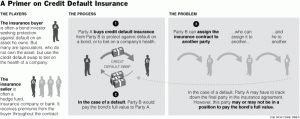
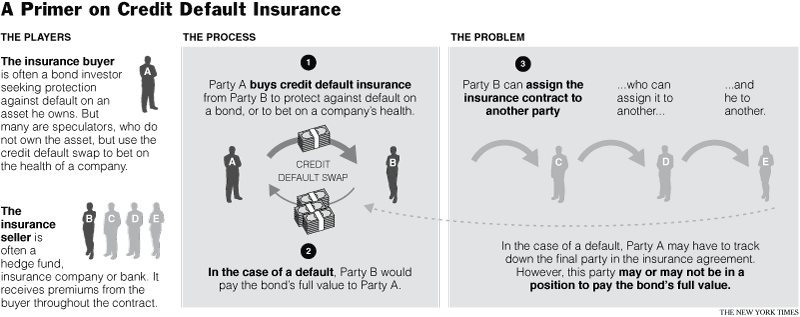
Say a big investor buys a bond from a company, but is worried about the company’s ability to pay off that bond. The investor turns to a third party like AIG, for example, and buys protection in the form of a credit default swap contract. AIG agrees to pay the investor the value of the bond in the event the company defaults on it.

The issuer doesn’t write this insurance for free. It gets a fee, usually a percentage of the value of the bond.

False sense of security

The transactions are made “over the counter,” not regulated by any public exchange, and since the contracts are not considered “insurance,” Greenberger said, the companies that guarantee the bonds are not required to keep enough capital on hand to pay them off in the event of a default.

The swaps have given those invested in all manner of debt, including mortgage-backed securities, a false sense of security.

“Everyone walked around saying, We’re insured,'” said Greenberger, a law professor at the University of Maryland.

As housing prices rose and more people could get mortgages despite questionable credit records, mortgage-backed securities were an attractive place for pension funds and other investors to park money.

“Were it not for that insurance, it certainly wouldn’t have reached this manic state of growth,” Greenberger said.

Mortgage-backed securities have turned sour with plummeting home prices and increasing default rates. The securities have clogged the credit market, prompting the Bush administration and Congress to put taxpayers on the hook buying them up.

As the government buys mortgage-backed securities from teetering financial institutions at less than face value prices, issuers of the credit default swaps could be liable for the difference.

That’s troublesome enough, but it actually gets worse.

Phantom contracts

Buyers of credit default swap insurance are not required to own the underlying securities they are insuring.

In other words, the investor can buy insurance on a mortgage-backed security without having to buy the security itself. When that security turns sour, whoever is holding the credit default contract — whether they actually own the security or not — can demand payment for the face value of the security.

This has created a market in which speculators actually are betting that mortgage-backed securities will lose their value.

Because the market is unregulated, the size of the credit default market is difficult to estimate.

The International Swaps and Derivatives Association, a trade group, estimates that its “notional value” for year-end 2007 at $62.2 trillion — roughly five times the entire U.S. production of goods and services last year. The total represents how much sellers of the protection would have to pay if every one of the securities were to default, an unlikely scenario to be sure.

But even this is a rough estimate. Participation in the survey was voluntary. What is helping drive the panic in these contracts is that little is known about who owes what to whom.
http://www.venturacountystar.com/news/2008/oct/12/unregulated-swaps-seen-as-big-factor-in-wall/?printer=1/
———————————————————
The $55 trillion question
The financial crisis has put a spotlight on the obscure world of credit default swaps – which trade in a vast, unregulated market that most people haven’t heard of and even fewer understand. Will this be the next disaster?
By Nicholas Varchaver, senior editor and Katie Benner, writer-reporter
Last Updated: September 30, 2008: 12:28 PM ET

(Fortune Magazine) — As Congress wrestles with another bailout bill to try to contain the financial contagion, there’s a potential killer bug out there whose next movement can’t be predicted: the Credit Default Swap.

In just over a decade these privately traded derivatives contracts have ballooned from nothing into a $54.6 trillion market. CDS are the fastest-growing major type of financial derivatives. More important, they’ve played a critical role in the unfolding financial crisis. First, by ostensibly providing “insurance” on risky mortgage bonds, they encouraged and enabled reckless behavior during the housing bubble.

“If CDS had been taken out of play, companies would’ve said, ‘I can’t get this [risk] off my books,'” says Michael Greenberger, a University of Maryland law professor and former director of trading and markets at the Commodity Futures Trading Commission. “If they couldn’t keep passing the risk down the line, those guys would’ve been stopped in their tracks. The ultimate assurance for issuing all this stuff was, ‘It’s insured.'”

Second, terror at the potential for a financial Ebola virus radiating out from a failing institution and infecting dozens or hundreds of other companies – all linked to one another by CDS and other instruments – was a major reason that regulators stepped in to bail out Bear Stearns and buy out AIG (AIG, Fortune 500), whose calamitous descent itself was triggered by losses on its CDS contracts (see “Hank’s Last Stand”).

And the fear of a CDS catastrophe still haunts the markets. For starters, nobody knows how federal intervention might ripple through this chain of contracts. And meanwhile, as we’ll see, two fundamental aspects of the CDS market – that it is unregulated, and that almost nothing is disclosed publicly – may be about to change. That adds even more uncertainty to the equation.

“The big problem is that here are all these public companies – banks and corporations – and no one really knows what exposure they’ve got from the CDS contracts,” says Frank Partnoy, a law professor at the University of San Diego and former Morgan Stanley derivatives salesman who has been writing about the dangers of CDS and their ilk for a decade. “The really scary part is that we don’t have a clue.” Chris Wolf, a co-manager of Cogo Wolf, a hedge fund of funds, compares them to one of the great mysteries of astrophysics: “This has become essentially the dark matter of the financial universe.”

***

AT FIRST GLANCE, credit default swaps don’t look all that scary. A CDS is just a contract: The “buyer” plunks down something that resembles a premium, and the “seller” agrees to make a specific payment if a particular event, such as a bond default, occurs. Used soberly, CDS offer concrete benefits: If you’re holding bonds and you’re worried that the issuer won’t be able to pay, buying CDS should cover your loss. “CDS serve a very useful function of allowing financial markets to efficiently transfer credit risk,” argues Sunil Hirani, the CEO of Creditex, one of a handful of marketplaces that trade the contracts.

Because they’re contracts rather than securities or insurance, CDS are easy to create: Often deals are done in a one-minute phone conversation or an instant message. Many technical aspects of CDS, such as the typical five-year term, have been standardized by the International Swaps and Derivatives Association (ISDA). That only accelerates the process. You strike your deal, fill out some forms, and you’ve got yourself a $5 million – or a $100 million – contract.

And as long as someone is willing to take the other side of the proposition, a CDS can cover just about anything, making it the Wall Street equivalent of those notorious Lloyds of London policies covering Liberace’s hands and other esoterica. It has even become possible to purchase a CDS that would pay out if the U.S. government defaults. (Trust us when we say that if the government goes under, trying to collect will be the least of your worries.)

You can guess how Wall Street cowboys responded to the opportunity to make deals that (1) can be struck in a minute, (2) require little or no cash upfront, and (3) can cover anything. Yee-haw! You can almost picture Slim Pickens in Dr. Strangelove climbing onto the H-bomb before it’s released from the B-52. And indeed, the volume of CDS has exploded with nuclear force, nearly doubling every year since 2001 to reach a recent peak of $62 trillion at the end of 2007, before receding to $54.6 trillion as of June 30, according to ISDA.

Take that gargantuan number with a grain of salt. It refers to the face value of all outstanding contracts. But many players in the market hold offsetting positions. So if, in theory, every entity that owns CDS had to settle its contracts tomorrow and “netted” all its positions against each other, a much smaller amount of money would change hands. But even a tiny fraction of that $54.6 trillion would still be a daunting sum.

The credit freeze and then the Bear disaster explain the drop in outstanding CDS contracts during the first half of the year – and the market has only worsened since. CDS contracts on widely held debt, such as General Motors’ (GM, Fortune 500), continue to be actively bought and sold. But traders say almost no new contracts are being written on any but the most liquid debt issues right now, in part because nobody wants to put money at risk and because nobody knows what Washington will do and how that will affect the market. (“There’s nothing to do but watch Bernanke on TV,” one trader told Fortune during the week when the Fed chairman was going before Congress to push the mortgage bailout.) So, after nearly a decade of exponential growth, the CDS market is poised for its first sustained contraction.

***

ONE REASON THE MARKET TOOK OFF is that you don’t have to own a bond to buy a CDS on it – anyone can place a bet on whether a bond will fail. Indeed the majority of CDS now consists of bets on other people’s debt. That’s why it’s possible for the market to be so big: The $54.6 trillion in CDS contracts completely dwarfs total corporate debt, which the Securities Industry and Financial Markets Association puts at $6.2 trillion, and the $10 trillion it counts in all forms of asset-backed debt.

“It’s sort of like I think you’re a bad driver and you’re going to crash your car,” says Greenberger, formerly of the CFTC. “So I go to an insurance company and get collision insurance on your car because I think it’ll crash and I’ll collect on it.” That’s precisely what the biggest winners in the subprime debacle did. Hedge fund star John Paulson of Paulson & Co., for example, made $15 billion in 2007, largely by using CDS to bet that other investors’ subprime mortgage bonds would default.

So what started out as a vehicle for hedging ended up giving investors a cheap, easy way to wager on almost any event in the credit markets. In effect, credit default swaps became the world’s largest casino. As Christopher Whalen, a managing director of Institutional Risk Analytics, observes, “To be generous, you could call it an unregulated, uncapitalized insurance market. But really, you would call it a gaming contract.”

There is at least one key difference between casino gambling and CDS trading: Gambling has strict government regulation. The federal government has long shied away from any oversight of CDS. The CFTC floated the idea of taking an oversight role in the late ’90s, only to find itself opposed by Federal Reserve chairman Alan Greenspan and others. Then, in 2000, Congress, with the support of Greenspan and Treasury Secretary Lawrence Summers, passed a bill prohibiting all federal and most state regulation of CDS and other derivatives. In a press release at the time, co-sponsor Senator Phil Gramm – most recently in the news when he stepped down as John McCain’s campaign co-chair this summer after calling people who talk about a recession “whiners” – crowed that the new law “protects financial institutions from over-regulation … and it guarantees that the United States will maintain its global dominance of financial markets.” (The authors of the legislation were so bent on warding off regulation that they had the bill specify that it would “supersede and preempt the application of any state or local law that prohibits gaming …”) Not everyone was as sanguine as Gramm. In 2003 Warren Buffett famously called derivatives “financial weapons of mass destruction.”

***

THERE’S ANOTHER BIG difference between trading CDS and casino gambling. When you put $10 on black 22, you’re pretty sure the casino will pay off if you win. The CDS market offers no such assurance. One reason the market grew so quickly was that hedge funds poured in, sensing easy money. And not just big, well-established hedge funds but a lot of upstarts. So in some cases, giant financial institutions were counting on collecting money from institutions only slightly more solvent than your average minimart. The danger, of course, is that if a hedge fund suddenly has to pay off on a lot of CDS, it will simply go out of business. “People have been insuring risks that they can’t insure,” says Peter Schiff, the president of Euro Pacific Capital and author of Crash Proof, which predicted doom for Fannie and Freddie, among other things. “Let’s say you’re writing fire insurance policies, and every time you get the [premium], you spend it. You just assume that no houses are going to burn down. And all of a sudden there’s a huge fire and they all burn down. What do you do? You just close up shop.”
———————————————
Posted in Business & Economics | Tagged , , , , | Leave a comment

Like the 2008 Marlins, McCain kept it close late

There are actually a few parallels between McCain and the Florida Marlins. A decided underdog, a home base with limited support and opponents with seemingly unlimited budgets.

At least we won’t have to wait until a book about the campaign is written to figure out when McCain knew he would lose conclusively. He was told either last night or this morning and like the pro and patriot he is, he dramatically softened his criticism of Obama, which effectively ended his campaign. Jay Cost from Real Clear Politics sums it up:

The average voter doesn’t understand the intricacies of economic policy. Heck, when you think about it, nobody really understands the economy. So, voters often rely on simple yet sensible metrics to make political decisions about the economy. One of them has been more or less operative since the election of 1840: if the economy tanks during a Republican administration, vote Democrat. If it tanks during a Democratic administration, vote Republican. Applying this rule to 2008, we get the following. McCain, because he is of the incumbent party, gets the political harm. Obama, because he is of the out party, gets the political benefit. That’s all there is to it.

This rule might not be just, but remember justice is a matter of law. This is a matter of politics, a space where the law does not exist. This rule might not make for the best choice every time, but in the long run it does have some beneficial effects. Above all, it makes the party in charge work hard for growth, which is what the country really wants.

Turning the focus to the inevitable Obama administration and the new president’s circumstances. At its outset it will likely feature the following:

  • The most inexperienced executive to earn the US presidency
  • A Democratic House and Senate
  • 2 ongoing wars
  • Political base which prefers immediate withdrawal from those wars
  • No terrorist attacks on US soil in 8 years
  • A certain economic recession, perhaps even a severe one – despite the exploding sales of black bow-ties
  • Record and structural budget deficits
  • A tax policy which is considered a mistake during economic contractions
  • 2 young daughters
  • A healthy Minister Farrakhan, Rev Wright and Bill Ayers
  • A wife nicknamed, Michelle O’Drama, who has been under wraps since April
  • Circumstantial evidence which might surface and contradict statements made during the campaign
  • Alienated from his Church, some friends and mentors during his Chicago days
  • An office view which does not even face Mecca

Looks like smooth sailing from here.

All articles referenced are copied in full at end of post.

———————————————
October 10, 2008
Why No Traction for McCain?

One week ago, the House of Representatives passed the financial bailout bill. At the end of that day, the RCP average stood at: Obama 49.2%, to McCain 43.4%. As of this writing today, the RCP average is essentially unchanged: Obama 49.2%, to McCain 42.9%.

Why has the Republican gotten no traction in the last week? After all, the congressional spectacle was supposed to be damaging his prospects because (as the story went) Obama looked so cool and McCain too hot. Now that it’s over, shouldn’t his numbers be on the rise?

No. That was never McCain’s problem. McCain’s problem a week ago is the same as his problem today, enhanced anxiety about the economy. The deal failed to sooth any nerves, so McCain is still in a weakened position.

We can see this with crystal clarity by looking at what average voters are looking at. Here are the above-the-fold portions of my hometown newspaper for the last five days.

Jennifer Rubin had a very thoughtful take on what McCain should do to get himself out of his current polling slump. I’d suggest, however, that so long as headlines like these persist, there is nothing he can do. This race will become close again only if these headlines disappear.

For such a big and diverse country, the essence of America can be summarized fairly simply: it’s all about development. Bigger and better, that might as well be our motto. Most of us are probably not just worried about the economy, we’re also a little pissed off about it. This contraction seems vaguely un-American, doesn’t it? We don’t contract, we grow!

That is what is harming McCain right now.

So long as the newspapers and the televisions are full of stories about contraction, which as you can see dominated every day this week here in Pittsburgh, John McCain’s poll position will be weak. That’s all there is to it. Conservatives can criticize McCain for not doing this, that or the other; liberals can praise Obama for doing this, that, or the other. But the fact remains that, as of today, the state of the race is pretty simple: this was an even-steven contest until the markets started to sputter and people started really worrying about the economy. Now Obama’s up 6 points.

This is infuriating conservatives. If you peruse the conservative blogs or listen to talk radio – you can almost feel their anger. There’s plenty of blame to go around, they argue. And of course they’re right – both parties are to blame – but it doesn’t matter.

The average voter doesn’t understand the intricacies of economic policy. Heck, when you think about it, nobody really understands the economy. So, voters often rely on simple yet sensible metrics to make political decisions about the economy. One of them has been more or less operative since the election of 1840: if the economy tanks during a Republican administration, vote Democrat. If it tanks during a Democratic administration, vote Republican. Applying this rule to 2008, we get the following. McCain, because he is of the incumbent party, gets the political harm. Obama, because he is of the out party, gets the political benefit. That’s all there is to it.

This rule might not be just, but remember justice is a matter of law. This is a matter of politics, a space where the law does not exist. This rule might not make for the best choice every time, but in the long run it does have some beneficial effects. Above all, it makes the party in charge work hard for growth, which is what the country really wants.

Does that mean this race is over? No. If the bad news dissipates and some good news manages to creep back into the papers and onto the television, McCain’s position should improve at least a bit. But that means that his fortunes are out of his control (the same goes for Obama). A retooled message might help him at the margin, but to change things he’s first going to need some better headlines.
———————————————

Posted in Current Affairs & History | Tagged , , | Leave a comment

America’s most respected economic leader weighs In

One of my biggest fears about this financial crisis, is that our form of a capitalist system will be seen as having failed and thereby opening the door for an even more socialized economic framework. One of America’s real economic leaders is Paul Volcker. He writes in an article titled, ‘We Have the Tools to Manage the Crisis,’ the following in today’s WSJ:

There is, and must be, recognition of the essential role that free and competitive financial markets play in a vigorous, innovative economic system. There needs to be understanding, in that context, that financial ups and downs — and financial crises — will be inevitable, even with responsible economic policies and sensible regulation. But never again should so much economic damage be risked by a financial structure so fragile, so overextended, so opaque as that of recent years.

All articles referenced are copied in full at end of post.

———————————————
OCTOBER 10, 2008

We Have the Tools to Manage the Crisis Now we need the leadership to use them.
By PAUL VOLCKER

Today, the financial crisis has reached a critical point. The sharp decline in the stock market and its volatility dramatically make the point. More important if less visible, the flow of credit through the banking system and the financial markets is seriously impaired — even in part frozen.

For months, the real economy, apart from housing, had not been much affected by the developing crisis. Now, a full-scale recession appears unavoidable. Important state and local governments face deficits they may be unable to finance. Recessionary forces are apparent in other important countries and exchange rates are unstable.

Those are facts.

They are the culmination of economic imbalances, a succession of financial bubbles and financial crises that have been building for years. It’s no wonder that confidence in markets, banks, and financial management has been badly eroded. Without effective action, fear might take hold, threatening orderly recovery.

Fortunately, there is also good reason to believe that the means are now available to turn the tide. Financial authorities, in the United States and elsewhere, are now in a position to take needed and convincing action to stabilize markets and to restore trust.

First of all, there is now clear recognition that the problem is international, and international coordination and cooperation is both necessary and underway. The days of finger pointing and schadenfreude are over. The concerted reduction in central bank interest rates is one concrete manifestation of that fact.

More important in existing circumstances is the clear determination of our Treasury, of European finance ministries, and of central banks to support and defend the stability of major international banks. That approach extends to providing fresh capital to supplement private funds if necessary.

In the U.S., with higher limits of deposit insurance in place, the FDIC has demonstrated its ability to protect depositors, to arrange mergers, and to provide capital for troubled banks. Most other countries now have a comparable capacity.

Recent U.S. legislation has provided authority for large-scale direct intervention by the Treasury in the mortgage and other troubled markets. Along with increased purchases by Fannie Mae and Freddie Mac, now under government control, means of restoring needed liquidity are at hand.

Other key sectors of financial markets are now protected or supported by either the Treasury or Federal Reserve, specifically by temporary insurance of money-market funds and by direct purchase of commercial paper.

Active efforts are underway to develop stronger netting, clearing and settlement arrangements for certain derivatives, in particular the notional trillions of credit default swaps, the absence of which has contributed to uncertainty and large demands for scarce collateral.

None of that is easy. Some of it poses risks for the taxpayer. All of it is decidedly unattractive in the sense of large official intervention in what should be private markets able to stand on their own feet. Unattractive or not in normal circumstances, the point is the needed tools to restore and maintain functioning markets are there. Now is the time to use them. To that end, the immediate and critical need is determined, forceful and persistent leadership — extending across administrations and Congresses. Both the public and private sectors must be involved.

The inevitable recession can be moderated. The groundwork can be laid for reconstructing the financial system and the regulatory and supervisory arrangements from the bottom up. The extraordinary interventions by the government (and taxpayer) should be ended as soon as reasonably feasible.

That rebuilding will be the job of another day — of a new administration here in the U.S., of finance ministries and central banks working together. It must draw upon the strength of the now chastened private sector. It will require more understanding of the risks embedded in so-called financial engineering and of the perverse compensation incentives that have exalted risk over prudence.

There is, and must be, recognition of the essential role that free and competitive financial markets play in a vigorous, innovative economic system. There needs to be understanding, in that context, that financial ups and downs — and financial crises — will be inevitable, even with responsible economic policies and sensible regulation. But never again should so much economic damage be risked by a financial structure so fragile, so overextended, so opaque as that of recent years.

Mr. Volcker was chairman of the Federal Reserve from 1979-1987.
———————————————

Posted in Business & Economics | Tagged , | Leave a comment

The Weather Underground and Barack Obama

The more I learn about these people who Obama called his friends and with whom he made professional alliances, the angrier I get. I have no idea what the best way will be to channel those feelings in a constructive manner after the election. A wait and see honeymoon period is out. All I know for now is that I see Barack Obama as a dangerous person.

Dangerous in the following way, I assume that his past radical alliances were the by-product of an intelligent and opportunistic young black man using the tools which were available to him. Ayers knocked at his door [or vice-versa], not the Chamber of Commerce. The people whom he was trying to reach related to Rev Wright. Acorn, not the Bank One corporation, needed legal help.

But how much do we wish to ‘gamble’ on our assumptions that those relationships were based more on opportunism than conviction? Do you believe that we really get to know candidates during campaigns? I think most of my fellow citizens, think they have a sense of Obama and that he is no radical, while some may hope he is. That’s fine, but given Obama’s record, no one can claim that that belief is grounded in his actions. It’s an assumption based on a political campaign. Since all political campaigns are designed to achieve a result, rather than to allow voters a greater insight to the candidates true thoughts, that’s not enough for me.

I didn’t think this way a few days ago. A few days ago, while I was always going to vote for McCain, I saw a type of political justice in Republicans losing the White House. But not to a candidate who is, at best, comfortable with anti-Americanism.

[Post-post – Oct 12] – No surprise that Charles Krauthammer makes the case better than me. But I was pleased to read that it was a similar argument:

Obama is not the first politician to rise through a corrupt political machine. But he is one of the rare few to then have the audacity to present himself as a transcendent healer, hovering above and bringing redemption to the “old politics” — of the kind he had enthusiastically embraced in Chicago in the service of his own ambition.Second, and even more disturbing than the cynicism, is the window these associations give on Obama’s core beliefs. He doesn’t share Rev. Wright’s poisonous views of race nor Ayers’ views, past and present, about the evil that is American society. But Obama clearly did not consider these views beyond the pale. For many years he swam easily and without protest in that fetid pond.

Until now. Today, on the threshold of the presidency, Obama concedes the odiousness of these associations, which is why he has severed them. But for the years in which he sat in Wright’s pews and shared common purpose on boards with Ayers, Obama considered them a legitimate, indeed unremarkable, part of social discourse.

Do you? Obama is a man of first-class intellect and first-class temperament. But his character remains highly suspect. There is a difference between temperament and character. Equanimity is a virtue. Tolerance of the obscene is not.

All articles referenced are copied in full at end of post.

———————————————————————————
October 10, 2008
A Question of Barack Obama’s Character
By Charles Krauthammer

WASHINGTON — Convicted felon Tony Rezko. Unrepentant terrorist Bill Ayers. And the race-baiting Rev. Jeremiah Wright. It is hard to think of any presidential candidate before Barack Obama sporting associations with three more execrable characters. Yet let the McCain campaign raise the issue, and the mainstream media begin fulminating about dirty campaigning tinged with racism and McCarthyite guilt by association.

But associations are important. They provide a significant insight into character. They are particularly relevant in relation to a potential president as new, unknown, opaque and self-contained as Obama. With the economy overshadowing everything, it may be too late politically to be raising this issue. But that does not make it, as conventional wisdom holds, in any way illegitimate.

McCain has only himself to blame for the bad timing. He should months ago have begun challenging Obama’s associations, before the economic meltdown allowed the Obama campaign (and the mainstream media, which is to say the same thing) to dismiss the charges as an act of desperation by the trailing candidate.

McCain had his chance back in April when the North Carolina Republican Party ran a gubernatorial campaign ad that included the linking of Obama with Jeremiah Wright. The ad was duly denounced by The New York Times and other deep thinkers as racist.

This was patently absurd. Racism is treating people differently and invidiously on the basis of race. Had any white presidential candidate had a close 20-year association with a white preacher overtly spreading race hatred from the pulpit, that candidate would have been not just universally denounced and deemed unfit for office but written out of polite society entirely.

Nonetheless, John McCain in his infinite wisdom, and with his overflowing sense of personal rectitude, joined the braying mob in denouncing that perfectly legitimate ad, saying it had no place in any campaign. In doing so, McCain unilaterally disarmed himself, rendering off-limits Obama’s associations, an issue that even Hillary Clinton addressed more than once.

Obama’s political career was launched with Ayers giving him a fundraiser in his living room. If a Republican candidate had launched his political career at the home of an abortion-clinic bomber — even a repentant one — he would not have been able to run for dogcatcher in Podunk. And Ayers shows no remorse. His only regret is that he “didn’t do enough.”

Why are these associations important? Do I think Obama is as corrupt as Rezko? Or shares Wright’s angry racism or Ayers’ unreconstructed 1960s radicalism?

No. But that does not make these associations irrelevant. They tell us two important things about Obama.

First, his cynicism and ruthlessness. He found these men useful, and use them he did. Would you attend a church whose pastor was spreading racial animosity from the pulpit? Would you even shake hands with — let alone serve on two boards with — an unrepentant terrorist, whether he bombed U.S. military installations or abortion clinics?

Most Americans would not, on the grounds of sheer indecency. Yet Obama did, if not out of conviction then out of expediency. He was a young man on the make, an unknown outsider working his way into Chicago politics. He played the game with everyone, without qualms and with obvious success.

Obama is not the first politician to rise through a corrupt political machine. But he is one of the rare few to then have the audacity to present himself as a transcendent healer, hovering above and bringing redemption to the “old politics” — of the kind he had enthusiastically embraced in Chicago in the service of his own ambition.

Second, and even more disturbing than the cynicism, is the window these associations give on Obama’s core beliefs. He doesn’t share Rev. Wright’s poisonous views of race nor Ayers’ views, past and present, about the evil that is American society. But Obama clearly did not consider these views beyond the pale. For many years he swam easily and without protest in that fetid pond.

Until now. Today, on the threshold of the presidency, Obama concedes the odiousness of these associations, which is why he has severed them. But for the years in which he sat in Wright’s pews and shared common purpose on boards with Ayers, Obama considered them a legitimate, indeed unremarkable, part of social discourse.

Do you? Obama is a man of first-class intellect and first-class temperament. But his character remains highly suspect. There is a difference between temperament and character. Equanimity is a virtue. Tolerance of the obscene is not.
———————————————

Posted in Current Affairs & History | Tagged , , , , , | Leave a comment

The Obama / Ayers Lie, Nowhere To Go But Down

I had a mild mannered friend once almost get into a fight at a disco with another guy who claimed he was a model. When he told our group what had happened, we were bewildered. ‘What!, who cares what he said,’ we informed him in graphic language. ‘He’s got acne scars,’ our friend pleaded in defense of his behavior.

Some lies we can ignore, some are offensive. Some lies which we initially ignore, become harder to do so and eventually become offensive. This is what I think is developing with Obama in regards to Ayers. Whether it ends up offensive or just an example of a tolerated lie is still to be decided.

The common sense interpretation of how the Obama / Ayers relationship developed is that Obama knew who Ayers was–former domestic terrorist, current activist–but was not so personally offended by those acts that he would have passed up a good professional opportunity. Politically, he knew that Ayers operated with Mayor Daley’s blessings in Chicago. In effect, if he was good enough for Hyde Park and Daley, he was good enough for Obama. So no big deal, just another good connection for the rising political star. Fast forward to presidential campaign.

The unknown candidate, having survived one radical association in his past, Rev Wright, decides that he cannot afford two. So he lies about what he knew and when he knew it. No one actually believes that Obama didn’t know who Ayers was or that he was just ‘a guy in the neighborhood.’ That’s important because there is no plausible middle ground here for partisans to hide behind.

Bill Clinton told that a lie about smoking pot and ‘not inhaling.’ That was a lie which people felt they could ignore, and eventually even ridicule. The Ayers lie was settling into the tolerated lie category. But the Obama campaign made a bad strategic mistake by going down the road of ‘he didn’t know Ayers was a terrorist.’ Obama would have had to be an idiot not to have know. Then today, it got personal. The son of one of Ayers’ intended victims issued a statement.

When I was 9 years-old the Weather Underground, the terrorist group founded by Barack Obama’s friend William Ayers, firebombed my house. Barack Obama has dismissed concerns about his relationship with Ayers by noting that he was only a child when Ayers was planting bombs at the Pentagon and the U.S. Capitol. But Ayers has never apologized for his crimes, he has reveled in them, expressing regret only for the fact that he didn’t do more.

While Barack Obama once downplayed his relationship with Ayers, today his campaign took that deceit one step further. Barack Obama now denies he was even aware of his friend’s violent past when, in 1995, Ayers hosted a party launching Obama’s political career. Given Ayers’ celebrity status among the left, it’s difficult to believe. The question remains: what did Obama know, and when did he know it? When did Obama learn the truth about his friend? Barack Obama helped Ayers promote his book in 1997, served on charitable boards with him through 2002, and regularly exchanged emails and phone calls with him through 2005. At what point did Barack Obama discover that his friend was an unrepentant terrorist? And if he is so repulsed by the acts of terror committed by William Ayers, why did the relationship continue? Any honest accounting by Barack Obama will necessarily cast further doubt on his judgment and his fitness to serve as commander in chief.

To prove my point about how indefensible his position is, watch an Obama spokesman, Robert Gibbs, squirm when asked the same question for 5 minutes; Is it OK to have a professional association with an unrepentant terrorist? He actually makes a mistake in stating that Obama is ‘not a judge.’ There is no need for Obama to have sullied his non-judgmental Hyde Park sensibilities, Ayers has freely confessed his terrorist activities.

On Hannity & Colmes, Gibbs had to resort to calling Hannity anti-Semitic, rather than answer the same question. Obama must either eventually answer that question, or appear so fearful of it, that he looks weak and guilty. If he chooses that option, the bunker approach, it means that if he tried to deny knowledge about Ayers, it is likely that evidence would surface to contradict him. This is going to be fun to watch.

Check out the Babaulu blog which has a number of useful links on this topic.

[Post-post 10/9] Peter Wehner from Commentary magazine, saw the same interview and draws the same conclusion, asking:

Team Obama’s evasive and clumsy response simply raises additional doubts about its candidate and his past. If there’s a simple explanation to Obama’s past associations, it would be helpful to hear what it is.

All articles referenced are copied in full at end of post.

———————————————
McCain Release on Ayers

ARLINGTON, VA — Today, John M. Murtagh made the following statement on Barack Obama’s relationship with William Ayers:

“When I was 9 years-old the Weather Underground, the terrorist group founded by Barack Obama’s friend William Ayers, firebombed my house. Barack Obama has dismissed concerns about his relationship with Ayers by noting that he was only a child when Ayers was planting bombs at the Pentagon and the U.S. Capitol. But Ayers has never apologized for his crimes, he has reveled in them, expressing regret only for the fact that he didn’t do more.

“While Barack Obama once downplayed his relationship with Ayers, today his campaign took that deceit one step further. Barack Obama now denies he was even aware of his friend’s violent past when, in 1995, Ayers hosted a party launching Obama’s political career. Given Ayers’ celebrity status among the left, it’s difficult to believe. The question remains: what did Obama know, and when did he know it? When did Obama learn the truth about his friend? Barack Obama helped Ayers promote his book in 1997, served on charitable boards with him through 2002, and regularly exchanged emails and phone calls with him through 2005. At what point did Barack Obama discover that his friend was an unrepentant terrorist? And if he is so repulsed by the acts of terror committed by William Ayers, why did the relationship continue? Any honest accounting by Barack Obama will necessarily cast further doubt on his judgment and his fitness to serve as commander in chief.

“Barack Obama may have been a child when William Ayers was plotting attacks against U.S. targets — but I was one of those targets. Barack Obama’s friend tried to kill my family.”

In February 1970 John Murtagh’s father was a New York State Supreme Court justice presiding over the trial of the so-called “Panther 21,” members of the Black Panther Party indicted in a plot to bomb New York landmarks and department stores. Early on the morning of February 21, three gasoline-filled firebombs exploded at their home on the northern tip of Manhattan, two at the front door and the third tucked neatly under the gas tank of the family car. The same night, bombs were thrown at a police car in Manhattan and two military recruiting stations in Brooklyn. A few weeks after the attack, the New York contingent of the Weathermen blew themselves up making more bombs in a Greenwich Village townhouse. In late November that year, a letter to the Associated Press signed by Bernardine Dohrn, Ayers’s wife, promised more bombings.

John Murtagh’s Account Of The Weather Underground’s Attack
————————————————————————————–
This is a rush transcript from “Hannity & Colmes,” October 7, 2008. This copy may not be in its final form and may be updated.

SEAN HANNITY, CO-HOST: So with us now is Senator Obama’s communication director and senior spokesman, Robert Gibbs. I don’t even want — I know you think he won. So there’s not — not reason in asking you that.

All right. A lot of what came up tonight seem to be a rehash of what we discussed in the first debate. But going into the debate, the feeling was that, in light of recent comments by Governor Palin that we will be talking about William Ayers tonight.

Now let me ask you a question. How can you fight terrorism when you give speeches with, you sit on a board with, Axelrod says you’re friendly with, and you never speak out against William Ayers?

ROBERT GIBBS, OBAMA COMMUNICATIONS DIRECTOR: You see — you had it (INAUDIBLE) until…

• Video: Watch Sean and Alan’s interview with Robert Gibbs
Related

*
Column Archive
o Obama Campaign Defends William Ayers Relationship
o Former Tennessee Sen. Fred Thompson on Second Presidential Debate
o Jack Kemp: McCain Warned of Fannie-Freddie Fallout
o Ann Coulter and Pat Caddell on Vice Presidential Debate
o Rep. Debbie Wasserman Schultz on VP Debate

Full-page Interview Archive
Video
o Watch Sean and Alan’s Interview
Show Info
Airs Weekdays at 9 p.m. ET
o E-mail Sean: hannity@foxnews.com
o E-mail Alan: colmes@foxnews.com
o Sean Hannity’s Bio
o Alan Colmes’ Bio
o Interview Archive

HANNITY: Wait a minute. Wait, he did blurbed his book, you know?

GIBBS: No.

HANNITY: No, no. Barack Obama did blurb Ayers’s book.

GIBBS: Listen to this, do you think — so you think he’s guilty by association, right?

HANNITY: No, I would — I’m Sean Hannity, here’s my answer. Would never sit on a board with a guy that bombed our Pentagon or our capital. And I want to know…

GIBBS: Can I ask you…

HANNITY: No, wait, wait.

Why does Barack Obama sit on a board with — why did he stay — knowing his past, why would did he be friends with him?

GIBBS: What William Ayers did was deplorable. And when he did it, Barack Obama was 8. And Barack Obama said it was a deplorable act.

HANNITY: Then why would he sit on a…

GIBBS: That’s what he said…

HANNITY: Why would you sit on a board with — would you sit on a board that a guy that bombed the Pentagon and wasn’t sorry about it?

GIBBS: He sat on a charitable board and a board funded by a conservative Republican and a friend of Ronald Reagan.

HANNITY: Was that poor judgment?

GIBBS: That was Walter Annenberg, I say that was.

HANNITY: Was that poor judgment on Obama’s part?

GIBBS: I don’t think that’s poor judgment at all. I think what Barack Obama has done throughout his career is talk about the big issues that are important.

HANNITY: All right. You’re giving me a spin now. I’m asking you…

GIBBS: No, no. Let me ask you one question.

HANNITY: All right, you ask me a question.

GIBBS: OK. Are you anti-Semitic?

HANNITY: Not at all.

GIBBS: OK. On your show on Sunday, you — the show that’s named after you, right? The show or the centerpiece of that show was a guy named Andy Martin, right?

HANNITY: I know you’re reading it your talking points…

GIBBS: No, no, no, no. I don’t have a talking point.

(CROSSTALK)

HANNITY: When I interviewed — hang on a second. I’ll answer your question.

GIBBS: Let me do this. Let me do this.

HANNITY: When I interviewed Malik Shabbazz, when I interviewed Al Sharpton…

GIBBS: Right.

HANNITY: When I interviewed all these controversial figures — you see on FOX we actually interviewed people of all points of view whether we agree or disagree.

GIBBS: So…

HANNITY: I — the statement you’re about to read…

GIBBS: Yes. Andy Martin called a judge a crooked clammy dude who has…

HANNITY: I totally, completely…

GIBBS: … a history of lying and thieving coming…

HANNITY: His (INAUDIBLE) a few.

GIBBS: Martin went on to write that he understood better why the holocaust took place, given that Jew survivors are operating as a wolf pack of…

HANNITY: Here’s my answer to you, I find those comments despicable. But wait a minute.

GIBBS: But you put him on your show.

HANNITY: We put Malik Shabbazz on the show?

GIBBS: It’s the Hannity…

HANNITY: I put Khalid Mohammad on my show?

GIBBS: Why am I not to believe that you are anti-Semitic?

HANNITY: I put — let me…

GIBBS: Why am I not to believe that everybody who works for the network is anti-Semitic?

HANNITY: Here’s the answer. Here’s…

GIBBS: Because Sean Hannity…

HANNITY: Mr. Gibbs. Mr. Gibbs…

GIBBS: … gave a platform to somebody who thinks that Jews are…

HANNITY: Mr. Gibbs, I’m a journalist who interviews people that I disagree with all the time that give their opinion. FOX has all points of view. We are allowing you on the program and I don’t agree with hardly anything Obama says.

GIBBS: Well…

HANNITY: So here’s my — no, I don’t need an answer. No, no, I’m going to answer.

GIBBS: I won’t — I really wish you wouldn’t give a platform to virulent anti-Semites…

HANNITY: Here’s – I will tell you this.

GIBBS: … who said…

(CROSSTALK)

HANNITY: I’ll make a deal with you. If Barack Obama admits that what he did by sitting on a board with, giving speeches with, having Ayers, going over to Ayers’s house…

GIBBS: You’ll admit you’re anti-Semitic?

HANNITY: No, no. I will admit to you that — I will tell you that Barack Obama wants to be president. It’s poor judgment, it is irresponsible…

GIBBS: Well…

HANNITY: … and it’s reckless to be — let me finish.

GIBBS: No, OK.

HANNITY: … to be friends with a guy that bombed our Pentagon, was at war with our country, whose motto was to kill our children and kill your parents.

GIBBS: I think it’s deplorable that you have put somebody on TV that’s anti-Semitic…

HANNITY: And it’s deplorable that your candidate for president has not been honest with the American people.

GIBBS: … and he calls the Jews slimy and understands the holocaust better…

HANNITY: I’m explain — let me finish first.

(CROSSTALK)

ALAN COLMES, CO-HOST: We’re on a short time here.

(CROSSTALK)

HANNITY: I’m explaining to you…

GIBBS: I can’t believe you would give a platform…

HANNITY: So you don’t want me to interview anyone I — only I can interview only people I agree with?

GIBBS: You put your whole show around him, Sean?

HANNITY: Barack Obama…

GIBBS: How am I to believe only that you agree with each and everything that Andy Martin said.

HANNITY: Barack Obama, the president sat in the pew of Jeremiah Wright for 20 years.

(CROSSTALK)

HANNITY: I have one last question. Did Barack Obama ever sit and meet with Louis Farrakhan? Has he ever met with Louis Farrakhan?

GIBBS: I don’t know the answer to that.

HANNITY: Will you give us an answer by tomorrow?

GIBBS: Will you get back to me on whether you’re anti -Semitic? Or whether you agree…

HANNITY: I’m not anti-Semitic?

(CROSSTALK)

COLMES: Now hold on.

HANNITY: The biggest supporter of Israel, Benjamin Netanyahu blurred my thoughts.

GIBBS: Let me tell you…

COLMES: Hold on.

GIBBS: I don’t your Jewish viewers are going to take it very well…

HANNITY: Excuse me. Excuse me.

GIBBS: … if you put somebody like that on your show.

HANNITY: I am the biggest supporter of Israel.

GIBBS: I think it’s bad that you gave him a platform.

HANNITY: And I’ve got a 30-year history of — on the record of it.

COLMES: Well…

GIBBS: Ask him (INAUDIBLE) friends about what Andy Martin said.

HANNITY: And listen, I’m not friend with a guy that bomb to the Pentagon. I’m not friends with the guy that bombed the capitol and New York…

(CROSSTALK)

COLMES: Let me jump in here for a second, Robert.

(CROSSTALK)

COLMES: Hold on, guys. Hold on.

(CROSSTALK)

HANNITY: Your candidate is friends with a terrorist.

COLMES: Hey, guys.

GIBBS: That’s not true.

HANNITY: He sits on a board with a terrorist.

COLMES: Guys, guys, stop it. First of all, he is not anti-Semitic. He’s not.

HANNITY: Thank you very much.

GIBBS: Well…

COLMES: He’s not anti-Semitic. This game of guilt by association, I disagree with on all fronts. I will defend Sean against anti-Semitism. He’s not anti-Semitic. But I also deplore this game of guilt by association.

GIBBS: Sure.

COLMES: The people that sat on this board were also Republicans.

GIBBS: Right.

COLMES: On one of the boards it was a former president of Northwestern University. Walter Annenberg was a Reagan ambassador…

GIBBS: Friend of Ronald Reagan.

COLMES: … who gave his money.

GIBBS: Right.

COLMES: Who spent — you know so, I mean, this game of guilt by association is ridiculous. And by the way, the Republicans who want to keep putting this fourth — I’ll you a chance to respond in a second.

GIBBS: Yes.

COLMES: It’s not working, because Barack Obama, the trend is towards Obama. It hasn’t worked. The stuff they flung at him, which is now the kitchen sink, is a desperation, desperate act by a desperate campaign.

GIBBS: Here’s what I think, Alan — here’s what — exactly. This campaign — the John McCain campaign has run out of ideas and they’re running out of time.

COLMES: Yes.

GIBBS: I think they realized — the reason they didn’t talk about that tonight is because they understand that after two or three days, that attack didn’t work.

COLMES: Right.

GIBBS: People are concerned about the economy. They’re worried about keeping their job and keeping their home. They’d rather talk about these big issues.

COLMES: Yes. So what I don’t understand is, as a tactician, and you work as a tactician, to some regard in the Obama campaign, if you’re not winning and things aren’t going your way and the narrative you’re doing isn’t helping your wind, change the narrative.

This isn’t helping. Palin — and McCain is allowing Palin to do this. She started doing this.

GIBBS: Well, look, I read in the newspaper, on Monday, the McCain campaign said, every time we talked about the economy, we lose. They don’t want to talk about the economy.

COLMES: Right.

GIBBS: But everyday Americans are losing their jobs and their homes and their health care. The American people deserve a debate that focuses on the big issues.

COLMES: Rick Davis of the — of the McCain campaign said this isn’t about the issue.

GIBBS: It’s not even about issues.

COLMES: The campaign is not about issues. They don’t want it to be about issues.

GIBBS: They never have and they never will.

COLMES: Thank you very much, Robert.

GIBBS: Thanks for having me.

COLMES: Appreciate your being here tonight.

GIBBS: Thank you.

HANNITY: Good to see you, Mr. Gibbs.

GIBBS: Thank you, Sean.
———————————————

Posted in Current Affairs & History | Tagged , , , | 2 Comments

Economist Nouriel Roubini Predicted Meltdown

You know things are bad when an economist whose nickname is ‘Dr Doom’ has been the most accurate about the housing bust and the potential systemic financial meltdown. In a recent interview, Nouriel Roubini explains why the problems in the money and credit markets are not areas which the $700 billion rescue plan are designed to effect. Here is a summary of what he believes is occurring:

  • A silent run on the uninsured [not FDIC covered] deposits of the banking system and even a run on some insured deposits are small depositors are scared
  • A run on most of the shadow banking system: over 300 non bank mortgage lenders are now bust; the SIVs and conduits are now all bust; the five major brokers dealers are now bust (Bear and Lehman) or still under severe stress even after they have been converted into banks (Merrill, Morgan, Goldman); a run on money market funds restrained only by a blanket government guarantee; a serious run on hedge funds; a looming refinancing crisis for private equity firms and LBOs)
  • A run on the short term liabilities of the corporate sector as the commercial paper market has totally frozen (and experiencing a roll-off) while access to medium terms and long term financing’s for corporations is frozen at a time when hundreds of billions of dollars of maturing debts need to be rolled over;
  • A total seizure of the interbank and money markets

His emergency recommendations:

  1. A temporary six-month blanket guarantee on all US deposits (not just those below $250k) combined with a rapid triage between insolvent banks that should be quickly closed and distressed but solvent – conditional on liquidity and capital injections – banks that should be rescued. To stop the silent run on the banking system you do need now such blanket guarantee on all (insured and uninsured) deposit regardless of their size.
  2. Direct lending to the business sector from the Fed via extension of the PDCF and TSLF to the non financial corporate sector. This could include Fed purchases of commercial paper from corporations and other forms of financing of the short term liabilities of the Administration to small businesses secured in appropriate ways.
  3. Have a coordinated 100bps reduction in policy rates by all major advanced economies central bank and, possibly, even some emerging market economies central banks.
  4. Radically redesign the Treasury TARP rescue plan – possibly after its necessary approval today – to make it effective, efficient and fair.

His recommendations in English:

  1. Insure all depositors and determine which banks are salvageable.
  2. Have the government lend directly to corporations. This step was taken by the Fed yesterday.
  3. Have all central banks coordinate a rate cut. This was done on Wednesday.
  4. Change Rescue plan. Government should buy stock in the banks themselves, not just their bad assets. This was done on Friday.

It’s good to see that Cuban-Americans have not joined the masses on these bank runs, which is why they remain ‘silent runs.’

All articles referenced are copied in full at end of post.
————————————————————————————-
Radical Policy Steps Necessary to Avoid a Systemic Meltdown: Interview with the Council on Foreign Relations
Nouriel Roubini | Oct 7, 2008

Here is below the text of an interview with the Council on Foreign Relations; the interview took place on Sunday October 5th but the message and policy recommendations that I proposed to prevent a systemic financial and corporate sector meltdown are still very relevant as the Fed and other central banks are still fiddling while Rome is burning. As discussed in this Global EconoMonitor forum Friday and yesterday Monday radical policy action is urgently necessary to avoid a systemic meltdown and a severe economic depression. The global economy is now already in a recession (as GDP is now contracting in all advanced economies and sharply slowing down in emerging market economies). We need now to take steps avoid a global depression.

9.30am Update: The Fed just announced a plan to start buying commercial paper (both asset backed and unsecured) from financial institutions and corporations. This action follows closely one of the radical policy options that I recommended last week: “Direct lending to the business sector from the Fed via extension of the PDCF and TSLF to the non financial corporate sector. This could include Fed purchases of commercial paper from corporations and other forms of financing of the short term liabilities of the Administration to small businesses secured in appropriate ways. Given the collapse of the corporate CP market and the banking system reluctance to provide loans to the corporate sector (credits lines are being shut down) the only alternative to the Fed becoming directly the biggest emergency bank for the corporate sector would be to force the banking system to maintain its exposure to the corporate sector, possibly in exchange for further Fed provision of liquidity to the banking system. The former option may be better than the latter to deal with the looming illiquidity of the corporate sector. ” The action also allows the Fed to provide liquidity to non-bank financial instiutions that issues commercial paper; thus the PDCF has now been also extended well beyond non- bank primary dealers to other non-bank financial institutions that qualify for the new facility. This step also goes in the direction that I recommended last week: “Extension of the emergency liquidity support of the Fed (both TSLF and PDCF) to a broader range of institutions in the shadow banking system, especially those directly providing credit to the corporate sector. The TSLF and PDCF are already available to some non banks (the broker dealers that are primary dealers of the Fed). But two of such broker dealers are gone (Bear and Lehman) and the other three are under stress. Goldman Sachs, Morgan Stanley, the other primary dealers and the banks that have access to the TSLF and PDCF (and discount window) have massively used these facilities in the last few weeks; but they are hoarding such liquidity and not relending it to other banks, to the thousands of the other members of the shadow banking system and to the corporate sector as they need such liquidity and don’t trust any counterparty. Thus the transmission mechanism of credit policy (the non-traditional Fed liquidity lines) is completely shut down now. Thus, on an emergency basis the TSLF and PDCF need to be extended to other non-bank financial institutions, especially those directly providing credit to the corporate sector such as non-bank finance companies and leasing companies.”

What still remains to be done – as i suggested last week – is a temporary blanket guarantee of all (insured and uninsured deposits) followed by a radical triage between insolvent banks that need to be shut down rapidly and solvent banks that need to be rescued. While Congress may resist legislation to pass such massive extension of deposit insurance the FDIC can rely on its “systemic risk exception” to provide guarantees to uninsured deposits. This “systemic risk exception” was already used – for the very first time in its historyy – by the FDIC to do the Citi-Wachovia. And yesterday the President’s Working Group on Financial Markets made a statement that leaves open the option that “the FDIC will will use its authority and its resources, on an open or closed-bank basis, to protect depositors, guarantee liabilities, facilitate orderly wind downs, mergers, or adopt other stabilizing measures.” I.e. both closed banks and still open banks may receive a guarantee of uninsured deposits. It is thus important that the FDIC uses such authority to stop a run on the uninsured deposits of the banking system. Whether the FDIC can use its “systemic risk exception” authority to provide a blanket guarantee of all uninsured deposits or whether the authority allows only to guarantee uninsured deposits on a case-by-case bank-by-bank basis is not clear. But certainly the authority could be used for large and systemically important banks that are at a risk of a run.

Steps to Halt the Slide

Interviewee:

Nouriel Roubini, Chairman, RGE Monitor, Professor of Economics, New York University

Interviewer:

Lee Hudson Teslik, Associate Editor, CFR.org

October 6, 2008

Nouriel Roubini, a professor of economics at New York University and the founder of the financial analysis firm RGE Monitor, has made his name by correctly predicting financial problems. Dubbed”Dr. Doom” by the New York Times Magazine, Roubini correctly warned of the impending housing market bust back in 2006, and, last February, of a rising probability of “catastrophic” financial system failure. At the time, he says, people called him a “lunatic,” but his predictions have proven prescient.

In an interview with CFR.org, Roubini says the $700 billion financial bailout package passed by the U.S. Congress last week is unlikely to end the present crisis of confidence in financial markets. The plan, he says, does not get at the “much more urgent problem” of a “generalized run on the short-term liabilities both of the banks, of the non-bank shadow system, and now of the corporate sector.” Roubini encourages a multi-pronged policy approach to the crisis, including: 1) coordinated interest rate cuts by all major world economies; 2) a move by the U.S. Federal Reserve to guarantee that it will provide liquidity in the event of any major bank run; 3) increased Fed action to provide short-term liquidity to non-bank actors that lend to corporations; and, if that doesn’t work, 4) a willingness to make short-term loans directly to corporations. Roubini adds that despite having predicted much of the present crisis, he has been surprised at the speed at which it has unfolded.

Despite the so-called bailout plan passing the House of Representatives on Friday, there are obviously still some major strains to global financial markets, and it now appears as if commercial paper markets could be seizing up as well. How much of a help was the bailout plan, and where do you think things stand now?

The bill, first of all, in many dimensions is flawed. But leaving aside the flaws of the bill, there is a much more urgent problem that we’re facing right now. It is one of a generalized run on the short-term liabilities both of the banks, of the non-bank shadow system, and now of the corporate sector. In the case of the banks, there is the beginning of a silent run on the uninsured debts of the banking systems, which are still over $2 trillion despite the increased deposit insurance. Many institutions in the non-bank shadow financial system are also finding that they cannot roll over their debts. There is a situation of generalized panic and lack of trust in counterparties. And worst of all, at this point, the commercial paper [short-term debt issued by large banks and corporations] to the corporate sector, and other types of funding to the corporate sector, is frozen right now. That can tip a corporation into a situation of defaults. They might not be able to pay interest on maturing debts, they might not be able to roll over maturing debts, and they might not be able to finance their working capital. So we’re seeing a generalized liquidity run, and it’s something that this bill cannot directly address. It’s something that needs to be addressed with different sorts of tools.

What sorts of tools do you recommend? I see you’ve called for major coordinated interest-rate cuts, on the order of one hundred points across the board, in all major world economies.

That’s only part of the solution. It has to do with coordinated rate cuts, but it’s not obvious [even after the cuts] that liquidity is going to flow to those who need it. We need to do something slightly more radical than just an interest rate cut. Most likely the Fed will have either to guarantee all deposits on a temporary basis, since that’s the only way you can essentially stop a run. But since that requires legislation and it’s not obvious that Congress will pass a temporary blanket guarantee, the Fed has to stand ready to provide the liquidity to any bank that needs liquidity. So if there is a run on any bank, the Fed has to increase the money supply by as much as is needed to essentially prevent that particular institution from collapsing. That’s the first thing.

The second thing is that the Fed is already, through its own emergency authority, allowed to provide liquidity to non-bank primary dealers that are systemically important. But the money the Fed is giving to the banks and to the primary dealers is not being re-lent to the other financial institutions in the shadow banking system. So the transmission of monetary policy is locked. Fixing that might require the Fed to start extending the PDCF [Primary Dealer Credit Facility], that is the facility that provides liquidity to non-banks, also to other financial institutions like finance companies, leasing companies, and you name it, in a way to provide liquidity to those financial institutions that directly lend to the corporate sector.

And if all that doesn’t work, the Fed might be forced to directly liquefy the corporate sector by using its emergency powers to directly lend to the corporate sector, essentially buying commercial paper, providing cash.

Those are all three radical actions, but some combination of all three at this point is necessary. The problem is that once the bill was passed, the stock market reacted negatively both to the passage of the bill in the Senate–on Thursday, equities fell by 4 percent–then on Friday, after the House voted, the Dow fell almost 400 points. So the stock market is not reacting positively, and for the last couple weeks, interbank markets and commercial paper and other kinds of short-term lending in the financial system and the corporate system have come to a freeze. And this particular legislation doesn’t have any role in essentially restoring the confidence and the liquidity in interbank and short-term credit markets. And in the short run, in the next few weeks, that’s what you need to do. Because that legislation, even if implemented properly, is going to take a few months–if you don’t reliquefy the banking system, the shadow banks, and the corporate sector, you’ll have a financial meltdown in a matter of two or three weeks. That’s much more urgent than anything else.

If we do start to see spillover into the corporate sector, where would you see that starting? Are there specific firms or specific industries that you think are most susceptible?

Now the situation is that even triple-A corporations [corporations with AAA credit ratings, the highest level] cannot roll over [defer payment on] commercial paper at any maturity past overnight. So we’re already seeing a situation in which essentially commercial paper is frozen, and even corporations that are going to the banks now to try to draw down on their credit lines are finding that they are being refinanced at much higher rates. So it’s becoming very expensive, and it’s really squeezing the corporate sector. Unless the government steps in and directly provides liquidity to the corporate sector, I think we’ll be in big trouble.

You have said that Goldman Sachs and Morgan Stanley converting themselves to bank holding companies was a “cosmetic” move and that they should be looking to merge at this point to avoid a run on their overnight liabilities. How big of a risk do you see at this point of a run?

They wanted to convert themselves as banks to have a stable base of insured deposits in the same way that brokerages in JP Morgan and Citi[group] have it, and the same way that Merrill [Lynch], being a part of Bank of America, will have it. You’re not going to see Goldman Sachs or Morgan Stanley branches on the corner anytime soon. And even acquiring other banks over time, as a way to acquire deposits, is going to take a lot of time. Ninety percent of their borrowing is still overnight; they’re leveraged thirty times, and they lend in ways that are illiquid and longer term. So there is a serious risk. Morgan Stanley, over the last ten days, has lost a good third of their hedge-fund clients. So the foundations of what they do are being undermined. Of course the Fed is providing both institutions with mass amounts of liquidity to try to compensate for whatever lack of finances they have, but how much? $100 billion? $200 billion? At some point there has to be a limit. So I think both institutions would be well-advised to do what Merrill did, as a way to avoid ending up like Lehman [Brothers, which collapsed]. Just do whatever to avoid ending up like Lehman is the basic thing, and just converting yourself to bank holding companies is not enough at this point. You really have to merge.

Obviously in many ways this is metastasized into a global crisis, but how evenly spread is the crisis across the globe? We’ve been seeing some pretty ugly news out of Europe. Which parts of the world are most vulnerable, and which are best buffered?

Certainly European banks are very vulnerable, for a variety of reasons. They bought a lot of the securitized debt, there is a bursting of housing bubbles in the UK, Ireland, Spain, even in Italy, Portugal, and France. There is the beginning of a recession in the Eurozone. The liquidity credit crunch in the United States is negatively affecting liquidity conditions in Europe. Plus European banks are exposed to Eastern Europe, Scandinavian banks are exposed to Iceland, Lithuania, Latvia, and Estonia-which are on their way to a hard landing. German and Austrian banks are exposed to countries in southern Europe like Hungary, the Czech Republic, Romania, Bulgaria, and Turkey-and they all look shaky. On top of all that the Fed at least has been cutting the Fed funds rate aggressively, while the ECB [European Central Bank] was first on hold and then they hiked from 4 [percent] to 4.25. They’re going to cut them soon enough, but it’s too little, too late. So the Eurozone and the rest of Europe is already in a recession, and it’s getting worse, and now it’s hit by a liquidity and credit crunch. And there is a crisis of confidence in European banks since several of them now from Germany, to the UK, to Iceland, to other parts of Europe, are now in trouble and need to be rescued. So the European banking crisis is getting severe.

Asia is less affected in terms of banks, even if you’ve had a couple of problems with banks in Hong Kong and there has been some nervousness there. The impact has been more on the stock market. The real economy is about to start to slow down, and hit Asian financial institutions.

Back in February, you predicted, or at least predicted the possibility, of much of what has happened. What about the way it has actually unfolded has surprised you the most?

I predicted most of these things happening, but what has surprised me the most is the speed at which things have happened. In February, back before Bear Stearns, I wrote this piece in which I said there are a couple major broker-dealers that could go belly-up and that in a couple years there won’t be any major independent broker-dealers left, because I knew that their business model at this point was fundamentally flawed. But I said two years. Instead it took literally seven months, for first Bear Stearns to go, then Lehman, then Merrill merged with Bank of America, and now Morgan Stanley and Goldman Sachs have been forced to convert to bank holding companies. At that point people thought I was a lunatic to say two years, but it took seven months. In the last months we’ve had an acceleration of the collapse of the financial system. We had to go to a $700 billion package, but even that has not restored calm in the stock market, and it has not restored any calm in money markets or credit markets. The last few weeks since the proposal passed, interbank spreads have widened, TED spreads [the spread between interest rates on interbank loans and those on U.S. Treasury bills] have widened, credit spreads have widened, CDS [credit default swaps, essentially a kind of insurance on credit products] spreads have widened, and now there is even a run on commercial paper for corporations. So everything has gotten much worse. There is a generalized loss of confidence like we’ve never seen before. That was something that even somebody as bearish as myself wouldn’t have thought would happen so quickly.
———————————————

Tagged , | Leave a comment